
Data is no longer just an operational asset pooled inside isolated databases; it flows through interconnected cloud environments, localized servers, third-party APIs, and remote endpoints. As organizations increasingly adopt compliance automation to manage complex regulatory and security requirements, maintaining visibility over these data pipelines becomes both a compliance and operational necessity. As enterprise architectures expand, maintaining visibility over these data pipelines becomes overwhelmingly complex. Security teams find themselves fighting an asymmetric war against increasingly sophisticated threat actors.
In this landscape, defensive strategies cannot rely on point-in-time assessments or annual audits. Security configurations drift within hours of a patch deployment, and a single misaligned permission baseline can expose sensitive infrastructure to the public internet. This reality has shifted the conversation from manual checklist monitoring to a continuous, software-driven model. Implementing compliance automation is no longer just a method for checking boxes to appease regulators; it has become one of the most effective, scalable strategies for hardening an enterprise infrastructure against data breaches and unauthorized intrusions.
The Architecture of Vulnerability: Why Modern Infrastructures Fail
Traditional security architectures frequently break under the weight of scale. When systems rely on manual oversight, a dangerous gap opens up between the moment a technical control fails and the moment human operators discover the error. This delay is precisely what threat actors exploit. By leveraging compliance automation, organizations can continuously monitor controls and reduce the risks associated with delayed detection.
A data breach rarely occurs because an organization lacks advanced security software. Instead, it occurs because existing security controls were improperly configured, accounts were left unmonitored, or a vendor pipeline lacked appropriate access restrictions. This is where compliance automation plays a critical role by continuously validating security configurations and access controls. Consider the typical vectors behind major enterprise breaches:
- Cloud Configuration Drift Cloud resources change constantly. A developer troubleshooting an application might temporarily open a security group port or relax an S3 bucket policy, intending to revert it later. Without automated tracking, that temporary loophole easily becomes a permanent back door.
- Privileged Creep Over time, employees accumulate access permissions across various platforms as their roles evolve. When these permissions aren’t systematically pruned through continuous access governance, identity-based attacks become significantly more lethal.
- The Vendor Blind Spot Enterprises frequently share sensitive data with external processors, SaaS applications, and logistics partners. If a partner’s security standards slip, that compromise rapidly travels upstream into the primary corporate network.
Manual oversight cannot scale alongside these shifting dynamics. Relying on spreadsheets, calendar reminders, and quarterly reviews leaves infrastructure exposed for weeks or months at a time.
What Is Compliance Automation in a Practical Security Context?
To understand how software-driven validation blocks threat vectors, it is important to define what compliance automation actually does under the hood. It is not an administrative tool that merely fills out paperwork. Rather, it is an active orchestration engine that directly interfaces with your cloud infrastructure, identity providers, local networks, and application code.
By integrating deeply with systemic configuration frameworks, these platforms continually cross-reference your live operational environment against a rigorous, hardened security baseline. It evaluates user behavior, asset deployment states, encryption certificates, and data processing workflows against strict regulatory and operational parameters. Through compliance automation, the system treats security frameworks not as static laws, but as continuous technical benchmarks that must be satisfied every single second of the day.
Five Ways Automated Compliance Mitigates Core Breach Risks
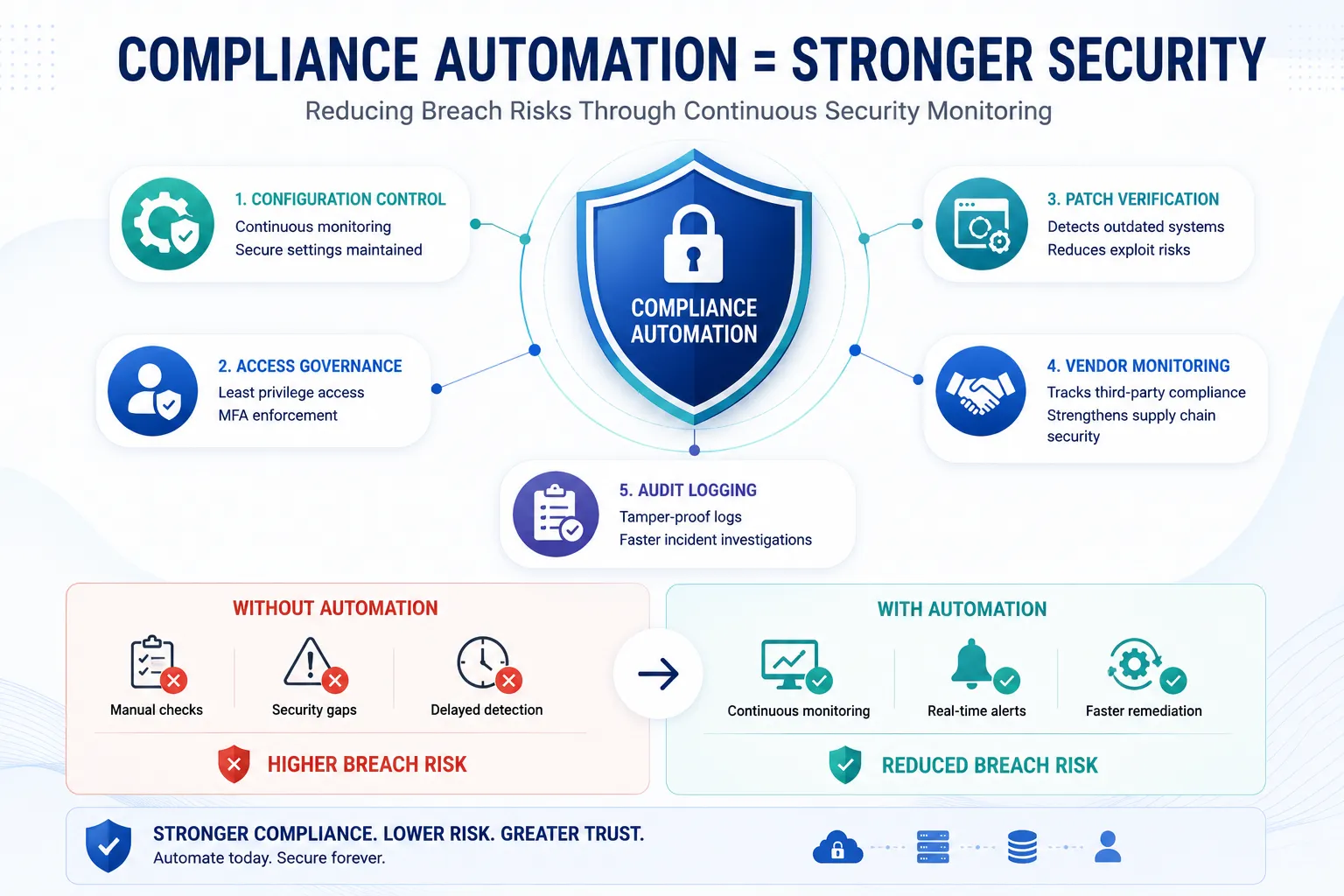
1. Instantaneous Eradication of Configuration Drift
In enterprise IT, configuration drift is a silent killer. An automated platform systematically scans cloud infrastructure, virtual environments, and database clusters against predefined secure configurations.
If an engineer accidentally modifies an access control list or disables encryption on a storage volume, the automation engine notices the discrepancy within minutes. Instead of waiting for the next quarterly audit cycle, the system triggers an immediate alert to the security operations center (SOC) or executes an automated remediation script to restore the secure state instantly. This proactive approach to compliance automation drastically reduces the window of vulnerability that an attacker can exploit.
2. Enforcing Strict Identity and Access Governance
Compromised credentials remain one of the most common root causes of enterprise data breaches. Regulatory standards like ISO 27001 and SOC 2 require organizations to enforce the principle of least privilege, ensuring employees only have access to data required for their current tasks.
Compliance automation platforms continually audit your identity providers. They automatically flag inactive user accounts, detect accounts lacking multi-factor authentication (MFA), and highlight instances of privilege escalation. By enforcing automated lifecycle management for user accounts, businesses remove the human oversight errors that frequently leave old administrator accounts open to brute-force attacks.
3. Continuous Vulnerability Patch Verification
Maintaining a strict patch management schedule across thousands of endpoints and servers is notoriously difficult. Vulnerability exploitation often happens because a critical security update was missed on an obscure legacy server. Effective compliance automation helps ensure that patching processes remain consistent and continuously monitored across the entire infrastructure.
Automated compliance tools run persistent, non-intrusive scans across the entire network fabric. They identify operating systems, firmware, and dependencies that fall behind established security baselines. Because the verification is continuous, leadership receives real-time visibility into the organization’s true patch status, allowing teams to prioritize and remediate vulnerable assets before threat actors find them. This level of visibility is one of the key advantages of modern compliance automation solutions.
4. Hardening the Third-Party Vendor Ecosystem
An organization’s security posture is only as strong as its weakest vendor link. Securing the supply chain requires validating that external processors maintain equivalent security controls.
Compliance automation extends an organization’s defensive perimeter by standardizing vendor risk assessments. Instead of relying on static self-reporting questionnaires, automated platforms pull verifiable data regarding vendor compliance postures, tracking their alignment with international security frameworks. When a vendor’s security standing drops below your specified threshold, the system flags the risk automatically, allowing your procurement and IT teams to isolate the vendor connection before a cross-network compromise occurs.
5. Creating Tamper-Proof Audit Trails for Incident Forensics
When an anomalous event occurs, speed is everything. Understanding exactly what happened requires reliable, untampered log data. Manual tracking systems are often prone to human gaps, or worse, can be altered by a skilled insider threat.
Compliance software records system configurations, user activities, and policy changes into secure, immutable audit trails. These logs provide a clear chronological map of network activity. If an alert is tripped, incident response teams can quickly look at the automated records to isolate the origin of the event, determine what files were accessed, and execute containment strategies before a minor incident turns into a catastrophic data breach.
Bridging the Gap: Regulatory Alignment Meets Technical Defense
Many organizations make the mistake of viewing cybersecurity and regulatory compliance as two separate tasks. In reality, they are completely interdependent. Official data protection standards—such as India’s Digital Personal Data Protection (DPDP) Act 2023, Europe’s GDPR, or global standards like SOC 2—are designed around proven security best practices. They mandate strong encryption, strict user control, detailed access tracking, and rapid incident notification.
When you deploy an automated compliance strategy, you are simultaneously achieving two goals: satisfying legal data protection requirements and implementing deep tactical defenses. For instance, creating an automated consent and data tracking map satisfies the legal requirements of the DPDP Act 2023, while inherently giving your security teams complete visibility into exactly where sensitive personal data resides within your network. You cannot protect data if you do not know where it lives.
How RuleExpert Streamlines Continuous Infrastructure Protection
Navigating the complexities of overlapping compliance frameworks while maintaining an aggressive defense posture can strain internal IT teams. This is why modern enterprises rely on specialized platforms like RuleExpert to automate their compliance workflows.
RuleExpert integrates natively with your active business tools, cloud infrastructure, and databases to provide centralized, real-time control over your security environment.
- Real-Time Dashboard Monitoring View your current compliance scores and security posture across multiple international frameworks from a single, unified interface.
- Automated Verification Workflows Replace manual spreadsheet verification with continuous, software-driven tracking that identifies infrastructure flaws the moment they appear.
- Pre-Built Framework Checklists Instantly align your infrastructure with the specific, verified demands of international data protection laws and industry standards.
- Tamper-Proof Logging Maintain clear, audit-ready documentation that satisfies regulatory inspectors while providing forensic clarity for internal security teams.
By automating repetitive, highly complex monitoring tasks, RuleExpert frees your engineering talent to focus on core product development while maintaining a continuously verified, resilient security perimeter.
Securing the Digital Foundation
The speed at which modern business operates requires security frameworks that keep pace with code deployment. Shifting away from slow, manual verification towards automated oversight ensures that your defensive baselines are continuously verified and actively enforced.
Understanding the intimate relationship between regulatory alignment and technical infrastructure defense is critical for modern leadership. By adopting the right automation systems, organizations turn compliance from an administrative burden into a proactive, resilient shield against modern digital threats.
Take Strategic Action: Secure your infrastructure, protect your user data, and eliminate regulatory friction. Start your compliance automation journey with RuleExpert today to build a resilient, future-ready enterprise.
Frequently Asked Questions (FAQs)
Q1: What is the primary difference between manual compliance and compliance automation?
Manual compliance relies on periodic, point-in-time checks, spreadsheets, and human observation, leaving large windows of vulnerability between audits. Compliance automation continuously monitors systems in real time, detecting security misconfigurations, unauthorized access, and software vulnerabilities the moment they occur.
Q2: Can compliance automation completely eliminate the risk of a data breach?
No security solution can guarantee absolute protection against zero-day exploits or advanced human engineering. However, compliance automation significantly shrinks an organization’s attack surface by eliminating configuration drift, securing access controls, and ensuring security patches are uniformly applied, which thwarts the vast majority of opportunistic cyberattacks.
Q3: How does automated compliance help reduce insider threats?
It continuously monitors and logs all internal user activities and permissions. By enforcing strict access governance and the principle of least privilege, the system automatically flags anomalous behavior—such as an employee attempting to access sensitive records outside their typical scope of work—allowing security teams to intervene immediately.
Q4: Will automating compliance slow down our software development lifecycles?
On the contrary, it accelerates development. By integrating compliance checks directly into development pipelines (often referred to as DevSecOps), code is automatically scanned for security vulnerabilities and compliance alignment before deployment, preventing costly security rewrites later in the production cycle.
Q5: How do automated audit trails assist our organization during a security incident?
During an incident, automated audit trails provide incident response teams with immediate access to unalterable, chronological system logs. This allows teams to quickly isolate the point of entry, pinpoint compromised accounts, identify affected data silos, and execute containment strategies much faster than manual log collection allowed.
Q6: Is compliance automation only suitable for large, global enterprises?
No. While large enterprises benefit from managing massive infrastructure scale, small and medium-sized businesses face significant resource constraints. Automation allows smaller teams to maintain enterprise-grade security tracking and satisfy strict data protection laws without hiring an army of dedicated compliance officers.
Q7: How does compliance automation handle updates to international data protection laws?
Dedicated platforms like RuleExpert receive centralized updates when official regulatory bodies change or update documentation requirements. The software automatically updates its built-in checklists and scanning rules, ensuring your organization’s technical controls evolve alongside new legal mandates without requiring manual system overhauls.
Q8: Can we use compliance automation across multi-cloud environments?
Yes. Modern compliance automation platforms are designed to connect seamlessly across fragmented infrastructures, including AWS, Microsoft Azure, Google Cloud, and on-premise servers, consolidating security telemetry into a single pane of glass.