

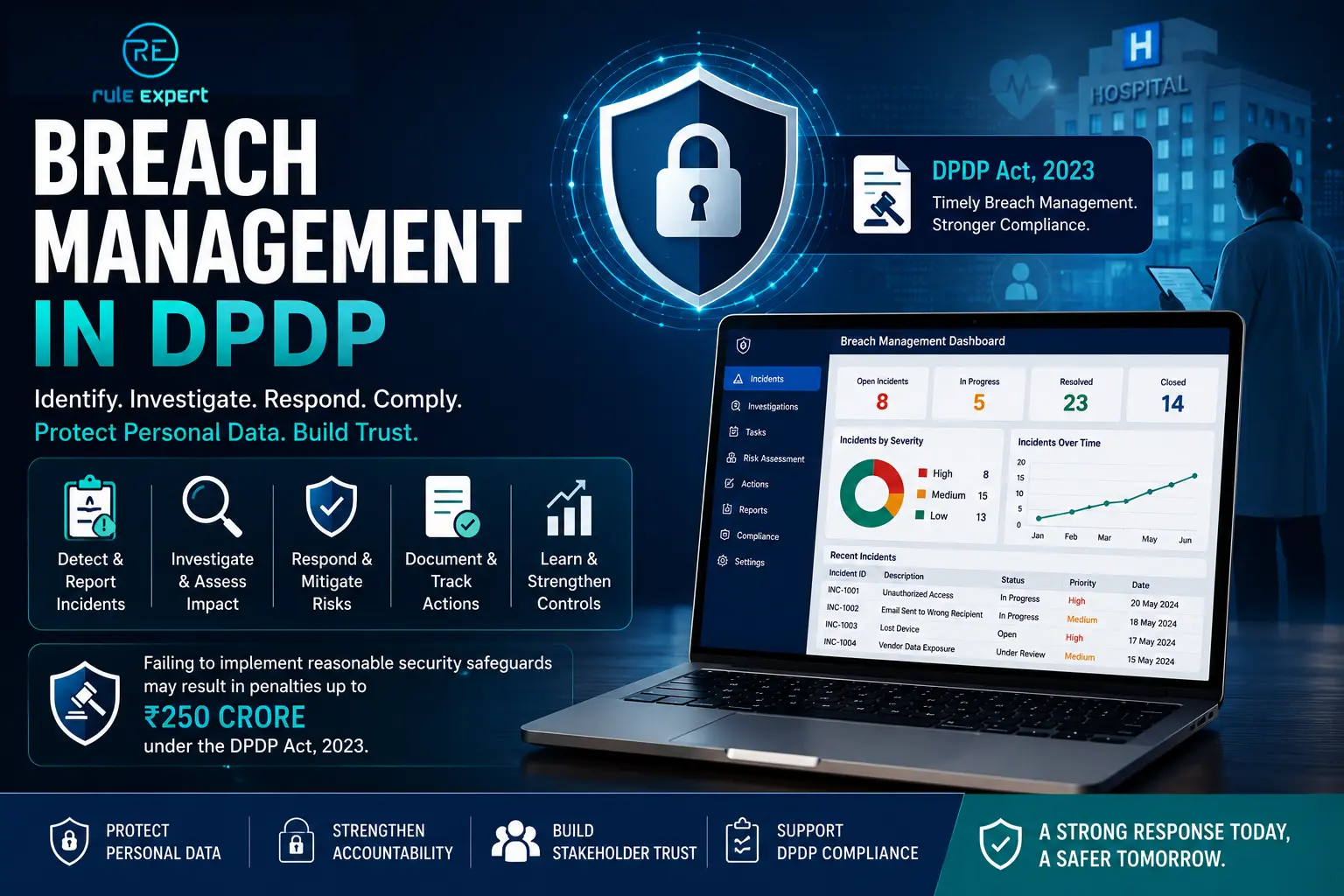
Breach Management in DPDP is a critical component of protecting personal data and strengthening organizational compliance under the Digital Personal Data Protection (DPDP) Act, 2023. This blog explains what a personal data breach is, why every organization needs a structured breach management process, and the operational, financial, reputational, and regulatory risks of failing to respond effectively. It also covers common breach management challenges, DPDP notification requirements, best practices for incident response, and potential penalties of up to ₹250 crore for failing to implement reasonable security safeguards. Finally, discover how RuleExpert’s Breach Management solution helps organizations centralize incident reporting, investigations, documentation, and compliance monitoring to improve accountability, support audit readiness, and build stronger privacy governance.
Every organization that processes personal data faces one common risk—a personal data breach.
Whether it’s a hospital, bank, IT company, educational institution, retailer, or manufacturing business, a breach can expose sensitive personal information and disrupt business operations.
The Digital Personal Data Protection (DPDP) Act, 2023 recognizes the importance of protecting personal data and places responsibilities on organizations (Data Fiduciaries) to implement appropriate safeguards. When a personal data breach occurs, organizations are expected to respond promptly, assess the impact, and comply with applicable notification requirements.
Breach management is the structured process of identifying, investigating, documenting, responding to, and learning from personal data breach incidents.
What is a Personal Data Breach?
A personal data breach is any incident that results in the accidental or unauthorized:
- Access to personal data
- Disclosure of personal data
- Loss of personal data
- Alteration of personal data
- Destruction of personal data
A breach is not always caused by hackers.
Common examples include:
- Email sent to the wrong recipient
- Employee accessing records without authorization
- Lost laptop containing customer information
- Cloud storage configured incorrectly
- Third-party vendor exposing personal data
- Ransomware attacks
- Stolen backup devices
- Accidental publication of confidential information
Why is Breach Management Important?
A personal data breach can have serious consequences for an organization.
Without a structured response process, organizations often struggle to answer critical questions such as:
- What personal data was affected?
- How many individuals were impacted?
- When did the breach occur?
- How did the incident happen?
- Who is responsible for coordinating the response?
- What corrective actions have been taken?
- Has every step been documented?
Delayed or poorly coordinated responses can increase operational disruption and regulatory risk.
Common Challenges Organizations Face
Many organizations discover that they are unprepared when a breach occurs.
Common challenges include:
No Central Incident Reporting Process
Employees report incidents through emails, phone calls, or messaging apps, making it difficult to track investigations.
Unclear Ownership
Different departments may assume someone else is handling the incident.
Without clearly assigned responsibilities, valuable time is lost.
Poor Documentation
Organizations often fail to maintain evidence of:
- Investigation timelines
- Risk assessments
- Internal approvals
- Corrective actions
- Communication records
Proper documentation supports accountability and future learning.
Limited Visibility
Personal data may be stored across:
- ERP systems
- CRM platforms
- HR software
- Hospital Information Systems
- Cloud storage
- Shared drives
- Employee devices
Without visibility, assessing the impact becomes difficult.
Third-Party Risks
Many incidents involve vendors processing personal data.
Organizations need structured processes for coordinating investigations with external service providers.
DPDP Act and Personal Data Breaches
The DPDP Act requires Data Fiduciaries to implement reasonable security safeguards to prevent personal data breaches.
If a breach occurs, organizations are required to notify the Data Protection Board of India and each affected Data Principal in the manner that may be prescribed under the Act and applicable Rules.
Organizations should establish documented breach response procedures to support timely assessment, communication, and remediation.
What Happens If a Personal Data Breach Occurs?
A breach can result in several consequences, including:
Operational Impact
- Business disruption
- Incident investigations
- System downtime
- Recovery costs
Reputational Impact
Loss of customer confidence may affect long-term business relationships and brand reputation.
Financial Impact
Organizations may incur costs related to:
- Incident response
- Forensic investigations
- Legal advice
- Customer communication
- System recovery
Regulatory Action
Where organizations fail to comply with obligations under the DPDP Act, the Data Protection Board of India may impose monetary penalties after considering the facts of each case, as provided under the Act.
What Are the Penalties Under the DPDP Act?
The DPDP Act empowers the Data Protection Board of India to impose financial penalties for non-compliance.
For example, failure to implement reasonable security safeguards to prevent personal data breaches may attract penalties of up to ₹250 crore, depending on the nature and circumstances of the violation, as specified in the Act’s Schedule.
The actual penalty is not automatic. It depends on factors considered by the Board, including:
- Nature and gravity of the breach
- Duration of the violation
- Type of personal data involved
- Measures taken to mitigate harm
- Previous compliance history
Organizations should therefore focus on prevention, preparedness, and documented response processes rather than viewing penalties as inevitable.
Best Practices for Effective Breach Management in DPDP
Organizations can improve their readiness by:
Establishing a Breach Response Plan
Define clear procedures for identifying, escalating, investigating, and resolving incidents.
Assigning Roles and Responsibilities
Identify who is responsible for:
- Incident reporting
- Investigation
- Risk assessment
- Legal review
- Communication
- Remediation
Maintaining Incident Records
Document:
- Timeline
- Evidence
- Decisions
- Corrective actions
- Lessons learned
Monitoring Third-Party Risks
Ensure vendors have appropriate security controls and incident reporting mechanisms.
Conducting Regular Reviews
Review incidents periodically to identify recurring risks and improve internal processes.
How RuleExpert Helps Organizations Manage Personal Data Breaches
Responding to a breach using spreadsheets, emails, and disconnected systems can delay investigations and create documentation gaps.
RuleExpert’s Breach Management solution helps organizations streamline incident response by providing a centralized platform for managing the entire breach lifecycle.
Key capabilities include:
- Centralized incident reporting
- Structured investigation workflows
- Risk assessment tracking
- Responsibility assignment
- Evidence and documentation management
- Corrective action tracking
- Compliance monitoring
- Audit-ready records
By centralizing breach management activities, RuleExpert helps organizations improve visibility, strengthen accountability, and support more consistent privacy governance.
Conclusion
No organization can eliminate every risk of a personal data breach.
However, every organization can improve how it prepares for, responds to, and learns from incidents.
Effective breach management is not just about responding quickly—it is about building structured processes, maintaining accountability, and protecting the trust of customers, employees, patients, and stakeholders.
Organizations that invest in strong privacy governance today are better positioned to manage future risks and demonstrate responsible data protection practices.
Nitin Ray is a thought leader in DPDP compliance, data privacy, breach management, and governance technology. He regularly publishes insights on the Digital Personal Data Protection (DPDP) Act, 2023, helping organizations understand data protection obligations, manage privacy risks, and strengthen compliance programs. His articles focus on practical strategies for Breach Management in DPDP, incident response, privacy governance, vendor risk management, and compliance automation, enabling organizations to protect personal data, improve audit readiness, and build lasting stakeholder trust.
Frequently Asked Questions
What is breach management in DPDP Act?
Breach management is the process of identifying, investigating, documenting, responding to, and improving after a personal data breach while supporting compliance with the DPDP Act.
Is every data incident considered a breach?
Not necessarily. Organizations should assess each incident to determine whether it involves unauthorized access, disclosure, loss, alteration, or destruction of personal data.
Does the DPDP Act require organizations to report breaches?
Yes. The Act requires notification of personal data breaches to the Data Protection Board of India and affected Data Principals in accordance with the Act and applicable Rules.
What is the maximum penalty for failing to implement reasonable security safeguards?
The DPDP Act provides for penalties of up to ₹250 crore for failure to implement reasonable security safeguards to prevent personal data breaches. The actual penalty depends on the facts and circumstances of each case.
How does RuleExpert support breach management?
RuleExpert helps organizations centralize incident reporting, investigation, risk assessment, documentation, responsibility tracking, and compliance monitoring to support a structured and audit-ready breach response process.