 RuleExpert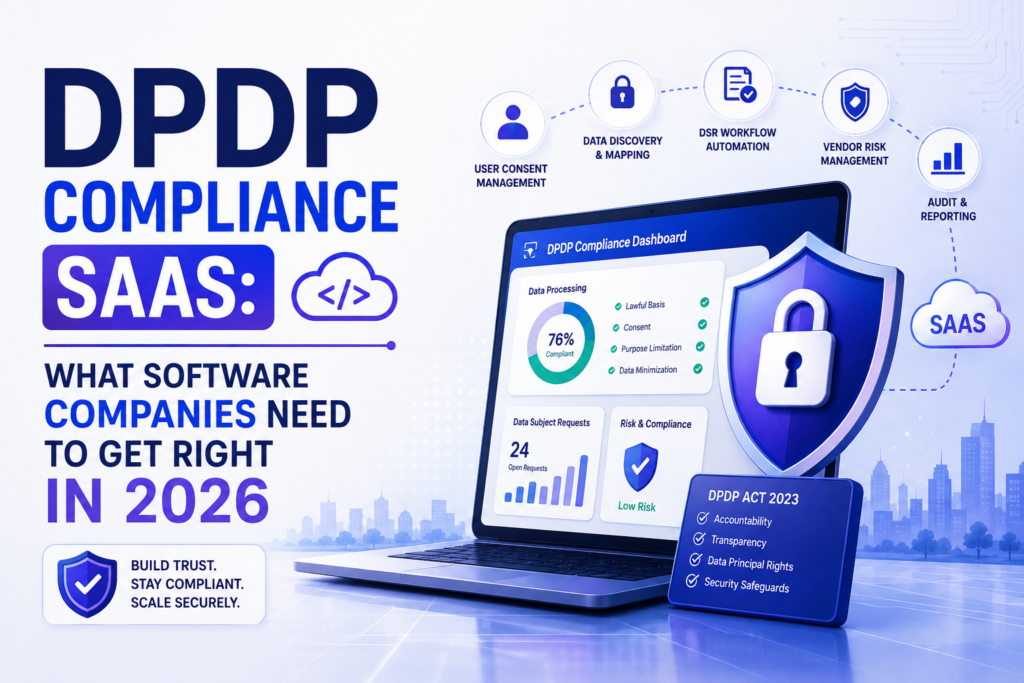
SaaS companies carry a specific kind of DPDP exposure a generic compliance article doesn’t capture: one multi-tenant breach touches every customer at once, a single signup flow generates thousands of consent records a day, and most SaaS platforms are simultaneously a Data Fiduciary for their own users and a Data Processor for their enterprise customers’ data — two roles with different obligations, running through the same codebase. With the DPDP Rules, 2025 notified on November 13, 2025, Consent Manager registration opening around November 2026, and full enforcement landing on May 13, 2027, DPDP compliance SaaS planning isn’t a future roadmap item — it’s an active build.
This guide is written specifically for software companies, not adapted from a general template. It covers where SaaS-specific risk sits, the Fiduciary-versus-Processor distinction most SaaS teams get wrong, how obligations shift depending on your business model, what SOC 2 and ISO 27001 do and don’t already cover, what your engineering team actually needs to build, and what to have ready before your next enterprise security review or investor data room request.
Table of Contents
- What Is DPDP Compliance for SaaS Companies?
- Why SaaS Companies Carry Distinct DPDP Risk
- Data Fiduciary or Data Processor: The Distinction Most SaaS Teams Get Wrong
- DPDP Compliance by SaaS Business Model
- Core DPDP Obligations for SaaS Companies
- SaaS-Specific Compliance Scenarios
- Cross-Border Hosting and Subprocessor Risk
- Breach Management in a Multi-Tenant Environment
- DPDP Compliance vs. SOC 2 and ISO 27001
- The Real Cost of DPDP Non-Compliance for SaaS Companies
- Build vs. Buy: Should a SaaS Company Build Its Own Compliance Tooling?
- Engineering Implementation Roadmap for SaaS DPDP Compliance
- Evaluation Checklist for DPDP Compliance Software Built for SaaS
- What to Include in Your DPA and Customer-Facing Trust Documentation
- Answering Enterprise Security Questionnaires
- DPDP Compliance and Fundraising or M&A Due Diligence
- Common Mistakes SaaS Companies Make with DPDP Compliance
- Glossary: DPDP Terms Every SaaS Team Should Know
- How RuleExpert Supports SaaS Companies
- Frequently Asked Questions
What Is DPDP Compliance for SaaS Companies?
DPDP compliance for SaaS companies means operationalising the Digital Personal Data Protection Act, 2023 across two overlapping surfaces at once: the personal data a SaaS company collects directly from its own users (signups, billing contacts, support tickets, product telemetry), and the personal data its enterprise customers store inside the product on their own end-users’ behalf. A CRM platform, an HRMS tool, or a customer-support SaaS doesn’t just need its own privacy policy in order — it’s also processing personal data that belongs, legally, to its customers’ Data Principals, under obligations that flow through the customer contract as much as through the Act itself.
This is different from, say, a hospital’s DPDP compliance, where the organisation is almost always the Data Fiduciary for a single, well-defined patient population. A SaaS company’s compliance posture depends on which product surface you’re looking at, and getting that classification wrong is where most SaaS compliance programmes start on the wrong foot. It also means a SaaS company’s compliance evidence has two very different audiences: the Data Protection Board, which cares about statutory obligations, and the enterprise procurement team on the other side of a sales cycle, which cares whether that evidence can be produced fast enough to keep a deal moving. Building a programme that only satisfies one of those audiences is a common, and avoidable, gap.
Why SaaS Companies Carry Distinct DPDP Risk
- Multi-tenant data commingling. A shared database schema, analytics pipeline, or support-ticket system often holds personal data from dozens or hundreds of customer organisations at once — a consent or access-control gap doesn’t stay contained to one customer, it’s structural across the tenant base.
- High-volume, low-touch consent events. A PLG or consumer SaaS can generate thousands of signup and trial-start events a day, each one a consent capture moment that needs to be purpose-specific and auditable, not a single “I agree to terms” checkbox.
- Deep subprocessor chains. Cloud hosting, email delivery, analytics, support tooling, payment processing, and increasingly third-party AI APIs — each is a Data Processor relationship needing its own Section 8(2) agreement and authorisation trail.
- Freemium and trial data that outlives the trial. Free-tier and trial accounts routinely keep processing data long after a user stops actively using the product, without a clear purpose or retention boundary.
- Product telemetry treated as exempt. Usage analytics and session recordings often get built without a compliance review, on the assumption it’s “just product data” — but if it’s tied to an identifiable user, it’s personal data under the Act regardless of the internal label.
- AI features processing customer data without a matching consent scope. A support-ticket summarisation feature or AI copilot that reads customer data is a new processing purpose, and in many SaaS products it ships without anyone checking whether existing consent actually covers it.
Data Fiduciary or Data Processor: The Distinction Most SaaS Teams Get Wrong
The DPDP Act defines a Data Fiduciary as the entity that determines the purpose and means of processing, and a Data Processor as the entity processing data on a Fiduciary’s behalf and instructions. Most B2B SaaS companies are both, on different parts of the same product, and conflating the two is a recurring compliance gap.
Where a SaaS Company Is the Data Fiduciary
For its own operational data — user accounts, billing contacts, marketing lists, support interactions, its own employees’ HR data — a SaaS company sets the purpose and means of processing itself, and carries full Fiduciary obligations: notice, consent, DSR fulfilment, breach notification, and Significant Data Fiduciary duties if it crosses the relevant thresholds.
Where a SaaS Company Is the Data Processor
For personal data an enterprise customer stores inside the product — say, an HRMS platform holding a customer’s own employees’ records — the SaaS company is processing that data on the customer’s instructions. The customer, not the SaaS vendor, is the Data Fiduciary responsible for consent and notice to those end-users. The SaaS company’s obligation here runs primarily through the Data Processing Agreement under Section 8(2): processing only as instructed, implementing reasonable security safeguards, supporting the customer’s own DSR and breach obligations, and not retaining or using that data for its own separate purposes without authorisation.
Why This Distinction Matters Operationally
A consent management workflow built only for the Fiduciary role — capturing and tracking consent from your own signups — misses the Processor obligations entirely, and vice versa. Enterprise customers evaluating a SaaS vendor during procurement increasingly ask for evidence of both: a DPA that meets Section 8(2) standards, and proof that the vendor’s own internal data handling (its own signup and account data) is compliant in its own right. A platform that can only produce one half of that evidence loses deals during security review, independent of any DPB enforcement risk.
DPDP Compliance for SaaS Business Model
“DPDP compliance for SaaS companies” isn’t one checklist — the risk profile shifts meaningfully depending on how the product is sold and who it’s sold to. Treating a PLG consumer app and an enterprise HR platform as facing identical obligations is where a lot of generic advice breaks down.
B2B Enterprise SaaS
Sold through a sales-led motion to named enterprise accounts, usually with a signed MSA and DPA. The primary compliance surface is the Data Processor relationship — the product mostly holds the customer’s own employee or end-customer data, and the SaaS vendor’s job is proving it processes strictly within instructions, with security safeguards documented well enough to survive an enterprise procurement review. DSR volume is usually moderate but concentrated, since requests typically route through the customer’s own DPO rather than directly to the SaaS vendor.
B2C / Consumer SaaS
The SaaS company is almost entirely the Data Fiduciary here — it’s collecting consent, sending notices, and fulfilling DSRs directly from individual end-users, often at high volume. Consent granularity (marketing vs. product vs. AI-feature use) and DSR automation matter more here than DPA negotiation, since there’s no intermediary enterprise customer absorbing that operational load.
PLG and Freemium SaaS
A hybrid of the two, with an added wrinkle: self-serve signup flows generate consent events at a volume and velocity that make manual tracking impossible almost immediately, and free-tier accounts that never convert create the retention and stale-data problem covered earlier in this guide. Growth mechanics — referral invites, team-invite flows, viral loops — routinely process the personal data of people who never directly signed up, which needs its own lawful-basis review rather than being waved through as an extension of the inviting user’s consent.
Vertical and Regulated SaaS
HR tech, healthtech, fintech, and legaltech SaaS products inherit sector-specific obligations on top of the standard DPDP baseline — guardian consent considerations for a healthtech product touching minors’ data, RBI-adjacent expectations for a fintech SaaS handling financial personal data, or biometric attendance data for an HR tech product serving manufacturing clients. A vertical SaaS company needs its DPDP programme to interoperate with the sector-specific rules its customers are themselves subject to, not just the generic Act text.
API and Infrastructure SaaS
Developer-facing and infrastructure products (APIs, data pipelines, headless platforms) often process personal data indirectly, passed through by the customer’s own application, with limited visibility into what that data actually is. This makes the Processor role dominant, but also makes documentation harder — an infrastructure SaaS company needs to be able to describe, in its DPA and subprocessor list, what categories of data typically flow through its systems even when it doesn’t control what a given customer sends.
Core DPDP Obligations for SaaS Companies
Purpose-Specific Consent Across the Signup and Onboarding Flow
Account creation, marketing opt-in, product analytics, and any AI-feature data use each need their own consent record — not one blanket checkbox at signup. This is the same purpose-level granularity requirement covered in our detailed guide to DPDP consent management software, applied to a product signup flow instead of a marketing site.
DSR Fulfilment at SaaS Scale
A consumer or PLG SaaS product can generate a meaningful volume of access, correction, and erasure requests every month once the user base crosses a few hundred thousand accounts. Manually triaging each request against multiple internal systems — the primary database, the analytics warehouse, the support tool, backup snapshots — doesn’t scale past a handful of requests a month. DSR automation that can query across connected data sources and produce an audit-ready response is the difference between a 30-day SLA that’s met comfortably and one that’s missed on a recurring basis.
A Live Data Registry Across Product Systems
SaaS companies typically have personal data scattered across a primary application database, a data warehouse, a CRM, a support tool, and log/telemetry pipelines. A data registry that maps personal data across all of these — not just the primary database — is what makes an erasure request or a breach-scope assessment answerable in hours instead of days.
Vendor and Subprocessor Governance
Every cloud provider, email service, analytics tool, payment processor, and AI API in the stack is a Data Processor relationship requiring a Section 8(2) agreement, a documented authorisation, and periodic review. Vendor governance tooling that tracks DPA status and renewal dates against the live subprocessor list — the same list that typically appears on a company’s public subprocessor page — closes a gap that’s otherwise tracked, if at all, in a spreadsheet nobody updates after the initial vendor onboarding.
Breach Detection and Notification Readiness
Section 8(6) requires notification to the Data Protection Board without undue delay, with the Rules specifying a 72-hour outer limit. For a SaaS company, “without undue delay” starts with knowing which tenants and which data categories a given incident actually touched — a question that’s unanswerable quickly without a live data registry connected to breach management workflows.
SaaS-Specific Compliance Scenarios
Free Trials and Freemium Accounts
A trial that ends without a conversion often leaves personal data sitting in the product indefinitely, with no active purpose being served. Define a retention window for inactive trial and freemium accounts, and automate deletion or anonymisation once that window closes, rather than letting stale accounts accumulate as undocumented risk.
Churned Customer Data
When an enterprise customer offboards, the SaaS company is usually contractually and legally obligated to delete that customer’s data within a defined window — but “delete” needs to reach backups, data warehouse copies, and any analytics exports, not just the primary database record. A churn-triggered deletion workflow that only clears the production database while the data lingers in a nightly backup or a BI tool is a documentation gap waiting to surface during a customer’s own audit of you as their processor.
AI and LLM Features Reading Customer Data
An AI copilot, auto-summarisation feature, or support-ticket triage model that reads personal data to generate output is a new processing purpose, and if that processing routes data to a third-party model API, it’s also a new subprocessor relationship. Both need to be reflected in the consent scope and the subprocessor list before the feature ships — retrofitting this after launch, once the feature already has active users, is significantly harder than building the compliance check into the feature’s launch checklist.
Referral Programs and Growth Loops
A “invite your team” or referral feature that imports a user’s contact list processes the personal data of people who never signed up for the product and never consented to anything. This is a common, under-scrutinised DPDP gap in PLG-style growth mechanics, and it needs its own lawful basis analysis rather than being treated as an extension of the referring user’s own consent.
Product Telemetry and Session Recording
Session-replay and analytics tools that capture user behaviour in detail — sometimes including form inputs — need to be reviewed for what personal data they’re incidentally capturing, not just what the product team intended to capture. A telemetry pipeline built for product-analytics purposes without a compliance review is a common source of over-collection that nobody flags until a DSR forces someone to actually inventory what’s being stored.
Third-Party Integrations and Marketplace Apps
SaaS products with an app marketplace or integration ecosystem — Slack-style app directories, Zapier-type connectors, partner-built plugins — routinely grant third-party developers access to customer data through APIs and OAuth scopes. Each integration a customer installs is effectively a new subprocessor relationship the platform introduced, but marketplace apps are frequently built and published without the same DPA and authorisation review applied to the company’s own core-product vendors. A consent and vendor-governance programme that only tracks the SaaS company’s own direct vendors, and ignores what its marketplace ecosystem can access, has a structural blind spot exactly where a security researcher or a customer’s own audit is most likely to look first.
Multi-Region Deployment and Data Residency
SaaS companies serving both Indian and international customers from a shared infrastructure often replicate data across regions for latency or redundancy, without a clear map of which Indian users’ data ends up replicated to a non-India region as a side effect of infrastructure design rather than a deliberate transfer decision. Since the DPDP Act’s cross-border rules apply based on where the Data Principal is, not where the company is headquartered, a multi-region SaaS architecture needs its replication topology reviewed specifically for what it does to Indian users’ data, independent of whatever the primary hosting decision was.
Cross-Border Hosting and Subprocessor Risk
Most Indian SaaS companies run on global cloud infrastructure — AWS, GCP, or Azure regions that may sit outside India — and many rely on foreign-headquartered analytics, email, and AI vendors. The DPDP Act doesn’t impose blanket data localisation the way some other regimes do, but the government retains the power to restrict transfers to specific countries by notification, which means a SaaS company’s cross-border posture needs to be treated as a live, monitored fact rather than a one-time legal opinion filed away after incorporation.
A subprocessor list that isn’t cross-referenced against the current notified restrictions — and re-checked whenever a new vendor is added — is the kind of gap that surfaces during enterprise procurement review long before it surfaces during a DPB audit.
Breach Management in a Multi-Tenant Environment
A breach in a multi-tenant SaaS environment is rarely a single-customer event — a misconfigured access control, a compromised admin credential, or a vulnerable shared service can expose data across many tenants simultaneously. This changes the shape of breach response in two ways. First, scoping the breach — which tenants, which data categories, how many Data Principals — has to happen fast enough to meet the 72-hour DPB notification clock, which is only realistic if the underlying data registry already maps which tenant’s data lives where.
Second, most enterprise SaaS contracts carry their own breach-notification obligations to the customer, often on a tighter clock than the statutory one, which means breach response needs to serve two notification tracks — the DPB and the affected enterprise customers — from the same incident record rather than two disconnected processes built after the fact.
DPDP Compliance vs. SOC 2 and ISO 27001: What Each Actually Covers
Nearly every SaaS company selling to enterprise customers already carries SOC 2 or ISO/IEC 27001 certification, or has one in progress, and a common assumption follows from that: “we’re already SOC 2 certified, so we must be covered on DPDP too.” That assumption is only partly right, and the gap matters.
Where the Overlap Genuinely Helps
Section 8(5) of the DPDP Act requires Data Fiduciaries to implement “reasonable security safeguards” to prevent personal data breaches — a deliberately open standard, not a prescriptive control list. SOC 2’s security Trust Services Criteria and ISO 27001’s Information Security Management System both document exactly the kind of access controls, encryption practices, logging, and incident-response processes that go a long way toward satisfying that “reasonable safeguards” bar.
If a SaaS company already has SOC 2 Type II or ISO 27001 in place, most of the underlying security infrastructure — not the compliance programme, the actual controls — is likely to already meet or exceed what DPDP expects on the security side.
Where SOC 2 and ISO 27001 Don’t Reach
Both frameworks are about the security and availability of systems, not about the specific, India-context privacy rights the DPDP Act creates. Neither SOC 2 nor ISO 27001 requires purpose-level consent capture, a Section 6(4)-standard “as easy to withdraw as to give” mechanism, a 30-day DSR fulfilment SLA, interoperability with a registered Consent Manager, or DPB-specific breach notification within 72 hours. A SaaS company can hold a clean SOC 2 Type II report and still have no functioning consent record, no DSR workflow, and no idea which of its subprocessors are missing a Section 8(2) agreement.
The two compliance programmes solve genuinely different problems: SOC 2 and ISO 27001 answer “is our system secure,” while DPDP compliance answers “are we honouring the specific rights an Indian Data Principal has over their data.”
The Practical Approach
Treat SOC 2 or ISO 27001 evidence as a strong head start on the security-safeguards half of DPDP compliance, and build the consent, DSR, and India-specific breach-notification layer as a distinct, additional programme rather than assuming it’s already covered. The two efforts share infrastructure — the same audit-logging system that supports a SOC 2 control can back a DPDP-compliant consent trail — which is exactly why data registry and audit-log architecture decisions are worth making once, for both frameworks at the same time, rather than building parallel systems later.
The Real Cost of DPDP Non-Compliance for SaaS Companies
Section 33 penalties apply to SaaS companies the same way they apply to any Data Fiduciary — up to ₹250 crore for security-safeguard failures, ₹200 crore each for breach-notification and children’s-data violations, ₹150 crore for Significant Data Fiduciary failures, and ₹50 crore for general non-compliance including consent and notice failures, all assessed per violation and capable of stacking. But for a SaaS company specifically, the more immediate exposure is usually commercial rather than regulatory, and it shows up faster.
- Stalled or lost enterprise deals. A security questionnaire that surfaces a missing DPA clause, an undocumented subprocessor, or no clear DSR process can pause a procurement cycle for weeks, or lose the deal outright to a competitor who had the paperwork ready.
- Contract termination exposure. Most enterprise MSAs now include a data-protection breach as grounds for termination for cause, sometimes without the usual cure period that applies to other contract breaches — a compliance gap that surfaces during a customer’s own audit can trigger this clause even without a DPB finding.
- Renewal and expansion risk. An enterprise customer that discovers a compliance gap after signing rarely churns immediately, but it routinely shows up at renewal as reduced trust, a smaller expansion deal, or a demand for contractual concessions the SaaS company wouldn’t otherwise have agreed to.
- Fundraising and M&A friction. Covered in more detail below — a compliance gap discovered during investor or acquirer due diligence rarely kills a deal outright, but it routinely affects valuation, escrow terms, or the closing timeline.
- Cyber insurance and premium impact. Insurers underwriting cyber and tech E&O policies increasingly ask about DPDP readiness as part of the underwriting questionnaire, and a weak answer can affect premiums or coverage terms independent of whether any incident has occurred.
The pattern across all five is the same: the commercial cost of a DPDP gap for a SaaS company usually arrives through a business process — procurement, renewal, diligence, underwriting — well before it arrives through a regulator. That’s precisely why SaaS compliance planning benefits from being framed as a revenue-protection exercise as much as a legal one — the audience deciding whether a deal closes or a round gets signed rarely waits for a DPB finding before forming an opinion.
Build vs. Buy: Should a SaaS Company Build Its Own Compliance Tooling?
SaaS companies are unusually likely to consider building consent tracking and DSR workflows in-house — the team already has engineering capacity, and “we build software for a living” makes buying a compliance platform feel unnecessary. In practice, three things make in-house builds heavier than they first appear:
- The audit trail has to be evidentiary-grade from day one. A consent log built as an afterthought inside an existing user table rarely has the signed, tamper-evident, append-only structure a DPB inspection or enterprise security review expects.
- Cross-system DSR fulfilment is the hard part, not consent capture. Reliably finding and acting on every copy of a person’s data across the primary database, warehouse, backups, and third-party tools — inside a 30-day SLA, repeatedly — is the part that turns into ongoing overhead most product teams didn’t budget for.
- Regulatory text changes; internal tools don’t get re-prioritised to keep up. A compliance tool competes for roadmap space with every other feature request, and updates tend to lose that competition until an audit or a lost enterprise deal forces the issue.
An in-house build isn’t always wrong — a very early-stage company with a small, well-understood data footprint may reasonably start there. But the calculus shifts once DSR volume, subprocessor count, or enterprise security reviews start recurring monthly, which is roughly the point at which a connected platform like RuleExpert’s DPDP compliance software starts paying for itself in engineering time alone, independent of the compliance benefit.
Engineering Implementation Roadmap for SaaS DPDP Compliance
Whether a SaaS company buys a platform or builds internally, the underlying engineering work follows a similar sequence. This is the version aimed at the team actually shipping it, not the compliance function alone.
1. Data Schema Audit and PII Tagging
Run a field-level audit across the primary database, data warehouse, and any BI or analytics store to identify which columns hold personal data, and tag them consistently — a data classification layer that every later step depends on. This is usually the most underestimated step; teams that skip it end up unable to answer a DSR completely because nobody flagged a personal-data field in a secondary table.
2. Consent Capture Integrated into the Signup and Feature-Flag Pipeline
Wire consent capture into the actual signup flow and any new feature launch that introduces a new processing purpose, ideally via an SDK or API call rather than a standalone form disconnected from the product. New feature flags — particularly AI features — should have a compliance check as a launch gate, not a retrofit.
3. DSR API Endpoints and Internal Query Tooling
Build (or integrate) an internal tool that can query every tagged personal-data field across every connected system for a given user ID, and expose a structured way to execute deletion or export on that same query. This is the piece that turns a 30-day DSR SLA from a manual, error-prone scramble into a repeatable, largely automated process.
4. Automated Subprocessor Discovery
Where possible, scan infrastructure-as-code, API integrations, and billing records for new third-party services being added to the stack, and route any new vendor that touches personal data through a DPA and authorisation check before it goes into production — rather than discovering six months later that a new analytics tool was added without one.
Build a single, signed, append-only audit-log system that captures consent events, DSR actions, and data-access events, and reuse it for both DPDP evidence and SOC 2 / ISO 27001 control evidence rather than maintaining separate logging pipelines for each.
6. Breach Runbook and Tabletop Exercise
Document a specific incident-response runbook that names who scopes an incident, who drafts the DPB notification, and who handles customer-facing communication, and run at least one tabletop exercise before an actual incident tests it live. A runbook that exists only as a policy document, never rehearsed, tends to fail on exactly the details — who has authority to notify, how fast the data registry can actually be queried — that matter most under real time pressure.
7. Security Questionnaire and Trust-Page Readiness
Package the outputs of the previous six steps — DPA template, subprocessor list, security certifications, breach process summary — into a standing “trust” packet that can go out to a prospective enterprise customer within a day of being asked, rather than being assembled from scratch each time procurement asks for it.
Evaluation Checklist for DPDP Compliance Software Built for SaaS
- Does it distinguish Fiduciary and Processor obligations, or does it assume every customer is a single-role Fiduciary the way a hospital or retailer would be?
- Can it map personal data across a modern SaaS stack — primary database, data warehouse, support tool, analytics pipeline — not just a single application database?
- Does DSR fulfilment work at volume, with a bulk queue and cross-system search, rather than a one-request-at-a-time manual workflow?
- Does vendor governance track subprocessors the way your own subprocessor page already lists them, so the compliance record and the public disclosure stay in sync?
- Does it integrate via API, so consent and deletion events can be triggered from your own product code rather than requiring a parallel manual process outside the app?
- Can breach management scope an incident by tenant, answering “which customers were affected” quickly enough to meet both the DPB clock and customer contractual notification windows?
- Is pricing structured around a metric that scales with your growth — DSR volume, data records, or tenants — rather than a flat enterprise licence that penalises early adoption?
What to Include in Your DPA and Customer-Facing Trust Documentation
Two documents do most of the work in a SaaS company’s DPDP posture when it comes to enterprise trust: the Data Processing Agreement signed with each customer, and a public or on-request trust page that answers the same questions before procurement even has to ask.
DPA Essentials for a Section 8(2)-Aligned Agreement
- A clear statement of processing scope and purpose limitation — the SaaS company processes only for the purposes the customer instructs, nothing broader.
- A current subprocessor list, with a defined notice period before any new subprocessor is added, and a right for the customer to object.
- Security measures described concretely, ideally cross-referencing existing SOC 2 or ISO 27001 certifications rather than restating controls from scratch.
- A breach-notification timeline to the customer that’s at least as fast as what the customer itself needs to meet its own DPB obligations.
- Audit rights, or a reasonable substitute such as a standing right to review the SaaS company’s own compliance documentation on request.
- A data return-or-deletion clause on contract termination, specific enough to cover backups and analytics exports, not just the primary database.
- A cross-border transfer clause identifying where data is hosted and processed, and confirming that any transfer to a country later restricted by government notification will be addressed.
- Support for the customer’s own DSR obligations — a defined process and turnaround time for the SaaS company to locate and act on a Data Principal’s data when the request comes from the customer, not directly from the individual.
What a Trust Page Should Cover
A public or gated trust page — increasingly standard for enterprise SaaS — should list current subprocessors, link to security certifications, offer the DPA as a downloadable template, describe data retention and deletion practices in plain language, and name a compliance or DPO contact. This is the single artefact most likely to shortcut a procurement cycle, because it answers the standard questionnaire before the first call even happens.
Answering Enterprise Security Questionnaires: DPDP Questions to Expect
Indian enterprise buyers, and increasingly global ones evaluating Indian vendors, have started adding DPDP-specific questions to standard security questionnaires alongside the usual SOC 2 and ISO 27001 items. The recurring ones:
- “Is your company DPDP Act compliant, and what’s your target date for full compliance?” — have a specific, honest answer tied to your actual implementation roadmap, not a blanket “yes.”
- “Who is your Data Protection Officer or compliance contact?” — a named person or role, not a generic support inbox.
- “Where is our data hosted, and does any of it leave India?” — a specific answer naming cloud regions and any subprocessor location outside India.
- “What is your process for handling consent and Data Subject Requests for our end-users?” — this is where the Fiduciary/Processor distinction matters: clarify that the customer remains the Fiduciary for their end-users, and describe how you support their DSR obligations as a Processor.
- “What is your breach notification SLA to us as a customer?” — a specific number of hours, ideally faster than the statutory 72-hour DPB clock, since the customer needs time to act on your notification before their own clock runs out.
- “Do you plan to integrate with a registered Consent Manager?” — increasingly asked by larger enterprises anticipating the November 2026 registration window; a considered answer, even if “not yet, here’s our timeline,” lands better than silence.
DPDP Compliance and Fundraising or M&A Due Diligence
Data protection has become a standing line item in both venture due diligence and M&A technical diligence for Indian SaaS companies, not just a security-team concern. Investors and acquirers reviewing a target increasingly ask for the same core evidence an enterprise customer would: a data registry or data map, DPA templates used with customers, a documented consent process, and any history of breaches or unresolved DSRs.
A gap here rarely kills a deal outright at the term-sheet stage, but it routinely surfaces during confirmatory diligence and turns into one of three things — a valuation discount, a longer escrow period tied to compliance remediation, or a specific representation-and-warranty carve-out that shifts risk back onto the founders post-close. For a Founder or CFO preparing for a raise or an exit, having the data registry, DPA templates, and a documented consent and breach process ready before diligence starts — rather than assembled reactively once a data room request lands — is the difference between a clean process and a renegotiated one.
Common Mistakes SaaS Companies Make with DPDP Compliance
- Treating the Terms of Service checkbox as full consent coverage. A single acceptance at signup doesn’t cover marketing, analytics, and AI-feature processing as separate, specific purposes.
- Assuming Processor status removes all obligations. Acting as a Data Processor for a customer’s end-user data still carries Section 8(2) duties — reasonable security safeguards, breach support, and processing strictly within instructions.
- Leaving trial and freemium accounts to accumulate indefinitely. Undefined retention on inactive accounts is exactly the kind of gap a DPIA or security review flags first.
- Shipping AI features without a consent-scope check. A new processing purpose introduced by an AI feature needs to be checked against existing consent before launch, not after a customer asks how their data is being used by the new copilot.
- Losing enterprise deals to security review, not DPB enforcement. For B2B SaaS, the more immediate commercial risk is often a stalled procurement cycle because the compliance evidence — DPA templates, subprocessor list, breach process — isn’t ready to produce on request.
- Ignoring marketplace and integration apps in vendor governance. A third-party app installed from an integration marketplace is a subprocessor relationship the platform enabled, but it rarely gets the same DPA and authorisation scrutiny as a core infrastructure vendor.
- Building compliance and security programmes in separate silos. Treating DPDP work as entirely distinct from an existing SOC 2 or ISO 27001 programme duplicates audit-logging and control-documentation work that could largely be built once and reused for both.
Glossary: DPDP Terms Every SaaS Team Should Know
A quick-reference for the terms used throughout this guide, since DPDP Act terminology doesn’t map cleanly onto GDPR vocabulary many SaaS teams already know.
- Data Principal — the individual whose personal data is being processed; roughly equivalent to a GDPR “data subject.”
- Data Fiduciary — the entity that determines the purpose and means of processing; carries the primary compliance obligations under the Act.
- Data Processor — the entity processing data on a Fiduciary’s behalf and instructions; a SaaS vendor is usually a Processor for data its enterprise customers store in the product.
- Significant Data Fiduciary — a Fiduciary designated by the government based on volume or sensitivity of data processed, carrying extra duties including a DPIA, an independent data auditor, and an India-based Data Protection Officer.
- Consent Manager — a registered intermediary through which a Data Principal can manage consent across multiple Fiduciaries from one interface; registration opens around November 2026.
- Data Protection Board (DPB) — the regulatory body that receives breach notifications, investigates complaints, and levies Section 33 penalties.
- DPA (Data Processing Agreement) — the contract governing how a Processor handles a Fiduciary’s data; distinct from a DPA in the fundraising sense (define both if using the acronym in a customer-facing document).
- Processing — any operation performed on personal data, including collection, storage, use, sharing, and deletion.
- Personal data breach — any unauthorised processing, or accidental disclosure, acquisition, sharing, use, alteration, destruction, or loss of access to personal data that compromises its confidentiality, integrity, or availability.
How RuleExpert Supports SaaS Companies
RuleExpert’s platform is built as connected modules rather than a single point tool, which maps directly onto how a SaaS company’s compliance surface actually works:
- The Consent Manager module captures purpose-level consent across signup, marketing, and product-feature flows, with a signed audit trail ready for both a DPB inspection and an enterprise security review.
- DSR Automation handles access, correction, and erasure requests at SaaS scale, with workflow routing and SLA monitoring so volume growth doesn’t turn into a backlog.
- The Data Registry maps personal data across your primary database, warehouse, and connected tools, so a DSR or a breach-scope question has an answer in minutes, not a multi-day internal investigation.
- Vendor Governance tracks every subprocessor’s DPA status and renewal date against your live vendor list, closing the gap between your public subprocessor page and your actual compliance record.
- Breach Management workflows scope an incident by tenant and data category, supporting both the statutory DPB notification clock and contractual customer notification obligations from a single incident record.
- Compliance Copilot answers operational questions — which subprocessors touch a given data category, which DSRs are approaching their deadline — against your live registry, cutting the manual research load on a compliance or DPO function that’s often a single person at a SaaS company this size.
Run a free, five-minute DPDP compliance score to see where your SaaS product’s compliance gaps actually sit, or book a demo to see the platform against your own data flows, whether you’re preparing for an enterprise security review, a fundraise, or simply getting ahead of the May 2027 enforcement date.
Frequently Asked Questions
What does DPDP compliance mean for a SaaS company specifically?
It means meeting DPDP Act obligations across two roles at once — Data Fiduciary for the SaaS company’s own user and account data, and Data Processor for personal data its enterprise customers store inside the product on their own end-users’ behalf — each carrying different notice, consent, and documentation requirements.
Is a SaaS company a Data Fiduciary or a Data Processor under the DPDP Act?
Usually both, depending on which data is in question. The SaaS company is the Fiduciary for its own operational data (accounts, billing, marketing lists) and typically the Processor for personal data an enterprise customer stores inside the product on the customer’s instructions.
Do B2B SaaS companies need consent management if they don’t collect data directly from consumers?
Yes. Even a purely B2B SaaS company collects personal data directly — account holder details, billing contacts, support-ticket senders — that requires its own Fiduciary-level consent and notice, separate from whatever data its customers store inside the product.
What is the DPDP compliance deadline for SaaS companies in India?
The same as for any organisation under the Act: the DPDP Rules, 2025 were notified on November 13, 2025, Consent Manager registration opens around November 2026, and full substantive compliance is due by May 13, 2027. There’s no separate, extended timeline for SaaS or technology companies.
Does the DPDP Act apply to SaaS companies hosted outside India?
Yes, if the company processes the personal data of individuals in India in connection with offering goods or services to them, regardless of where the company itself is incorporated or hosted.
How should a SaaS company handle DPDP compliance for its subprocessors?
Every subprocessor — cloud hosting, analytics, email, payment, and AI API vendors — needs a Section 8(2) Data Processing Agreement, a documented authorisation for the specific processing it performs, and periodic review, ideally tracked against the same list published on the company’s public subprocessor page.
What happens to customer data when a SaaS contract ends?
Data should be deleted or returned within the window specified in the customer contract, and that deletion needs to reach backups, data warehouse copies, and analytics exports, not just the primary production database, to be defensible under both the DPDP Act and the underlying commercial agreement.
Do AI features inside a SaaS product need separate DPDP consent?
If an AI feature processes personal data for a purpose not covered by existing consent — such as an AI copilot reading support tickets to generate suggestions — that’s a new processing purpose requiring its own consent scope, and potentially a new subprocessor relationship if the feature routes data to a third-party model API.
How does DPDP compliance affect enterprise SaaS sales and procurement?
Enterprise buyers increasingly ask for DPDP-specific evidence during security review — a compliant DPA, a current subprocessor list, and a documented breach process — alongside existing SOC 2 or ISO 27001 requirements. Missing this evidence can stall or lose a deal independent of any regulatory enforcement action.
Can a small or early-stage SaaS startup handle DPDP compliance manually?
For a very early stage, with a small user base and few subprocessors, manual tracking may hold up briefly — but DSR volume, subprocessor count, and enterprise security reviews typically scale faster than a founder expects, and the gap between manual tracking and what’s needed tends to appear suddenly, usually during a large customer’s procurement review rather than gradually.
What’s the difference between DPDP compliance and SOC 2 or ISO 27001 for a SaaS company?
SOC 2 and ISO 27001 certify that a company’s systems are secure — access controls, encryption, incident response. DPDP compliance is about specific privacy rights: purpose-level consent, DSR fulfilment within statutory timelines, and India-specific breach notification. A SaaS company can hold a clean SOC 2 report and still have no functioning consent or DSR process; the two need to be built as complementary, not substitute, programmes.
Do investors check DPDP compliance during due diligence?
Increasingly yes. Venture and M&A diligence for Indian SaaS companies routinely asks for a data registry or data map, DPA templates, and any history of breaches or unresolved DSRs, and gaps here can affect valuation, escrow terms, or deal timelines even without any regulatory action having occurred.
What should a SaaS company’s DPA with enterprise customers include?
At minimum: processing scope and purpose limitation, a current subprocessor list with notice rights, documented security measures, a customer-facing breach notification timeline, audit rights, a data return-or-deletion clause on termination, a cross-border transfer clause, and support for the customer’s own DSR obligations.
How does DPDP compliance differ across B2B, B2C, and PLG SaaS models?
B2B enterprise SaaS is primarily a Data Processor relationship, centred on the DPA and security documentation. B2C SaaS is primarily a Data Fiduciary relationship, centred on direct consent and DSR handling at volume. PLG and freemium SaaS combines both, with the added complexity of high-velocity, self-serve consent events and growth mechanics like referrals that process non-user personal data.
See Your SaaS Product’s DPDP Gaps in Five Minutes
Run the free DPDP compliance score, or book a demo to see how RuleExpert’s Consent Manager, DSR Automation, and Vendor Governance modules map onto your specific SaaS architecture. Book your demo with RuleExpert →
Sources: Ministry of Electronics and Information Technology — Digital Personal Data Protection Act, 2023 (official text); Press Information Bureau, Government of India — DPDP Rules, 2025 notification (November 14, 2025); Shardul Amarchand Mangaldas & Co. — Enforcement of the DPDP Act and notification of the DPDP Rules; ISO/IEC 27001:2022 — Information security management systems.