 RuleExpert
A common assumption among businesses already working toward GDPR compliance is that meeting GDPR requirements should make DPDP compliance relatively straightforward. It's an understandable assumption, given the significant overlap between the two frameworks.
However, the differences between them are substantial enough that GDPR compliance alone does not automatically translate into DPDP compliance. Understanding where the two laws align - and where they diverge - is essential for building a compliance programme that addresses both effectively.
The DPDP Act and GDPR share a lot of DNA. Both exist to protect people's personal data, both reach beyond their own borders, and both carry penalties large enough to get a board's attention. But they were built on different legal philosophies, for different regulatory cultures, and they diverge in ways that matter operationally, not just academically. This guide goes through those differences precisely, with the actual statutory sections and articles behind each claim, so you can see exactly where your GDPR programme helps and exactly where it doesn't.
If you're new to the DPDP Act itself, start with our complete guide to DPDP compliance in India before this one. This piece assumes that foundation and focuses specifically on the comparison.
1. What Are the DPDP Act and GDPR, and Why Compare Them?
The Digital Personal Data Protection Act, 2023 is India's first comprehensive data protection law, built around a small number of sections written in deliberately plain language. The General Data Protection Regulation is the European Union's data protection law, in force since 25 May 2018, running to nearly a hundred articles of considerably more granular detail.
The comparison matters for three practical reasons. First, a large share of Indian businesses in scope for DPDP, especially SaaS companies, BPOs, and outsourcing providers, already handle EU personal data and are GDPR-obligated today. Second, DPDP's drafters were visibly aware of GDPR while writing a shorter, India-specific law, so the overlap is real but incomplete. Third, and most importantly for planning: assuming the two laws are interchangeable leads directly to gaps that only surface during an actual regulatory inquiry or client audit.
2. Who Do These Laws Actually Apply To?
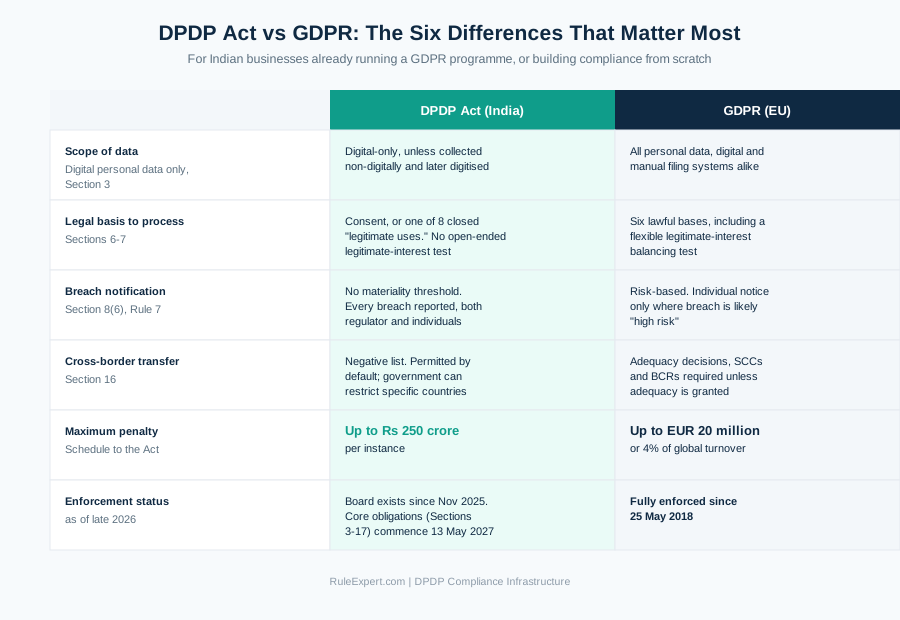
Both laws reach outside their home territory, but the trigger differs.
Under Section 3 of the DPDP Act, the law applies to processing digital personal data within India, and to processing outside India if it's connected to offering goods or services to Data Principals located in India. The trigger is the offering, not where your servers sit.
GDPR's Article 3 casts a similar net but adds a second limb: it also applies to monitoring the behaviour of individuals in the EU, even without any commercial offering involved. A company doing pure analytics or profiling on EU visitors, with nothing for sale, can fall under GDPR through that monitoring limb. DPDP has no direct equivalent; its extraterritorial reach is tied more narrowly to offering goods or services.
3. What Counts as Personal Data Under Each?
This is one of the most consequential, least discussed differences. DPDP is explicitly a digital-only law. Section 3(a) applies it to personal data collected in digital form, or collected non-digitally and later digitised. A paper form that's never scanned into a system simply isn't in scope.
GDPR draws no such line. It covers personal data processed by automated means and personal data forming part of, or intended to form part of, a manual filing system, meaning structured paper records are squarely covered too.
For an Indian business with any physical paperwork, HR files, physical KYC forms, printed contracts, that never gets digitised, DPDP genuinely doesn't reach it. GDPR would, if EU data subjects were involved. That's not a loophole to build a strategy around, since most paper eventually gets digitised anyway, but it's a real, statutory divergence worth knowing rather than assuming away.
4. What's the Legal Basis for Processing Data?
This is where the two laws genuinely part ways in philosophy.
GDPR offers six lawful bases under Article 6: consent, contract necessity, legal obligation, vital interests, public task, and legitimate interests. That sixth basis does a lot of work in practice. It's a flexible, judgment-based test that lets an organisation process data without consent if it has a genuine interest that isn't outweighed by the individual's rights.
DPDP doesn't offer an equivalent. Section 6 sets a strict consent standard: free, specific, informed, unconditional, and unambiguous, with clear affirmative action required and withdrawal as easy as giving consent in the first place. Alongside consent, Section 7 provides a closed list of specific "legitimate uses", covering situations like voluntarily provided data for a specified purpose, state functions like subsidies and benefits, medical emergencies, and compliance with a court order or judgment. There are roughly eight enumerated categories, not an open-ended balancing test. If your processing doesn't fit consent or one of those specific categories, there's no general "legitimate interest" fallback to lean on.
Practically: a GDPR compliance memo built around "we're relying on legitimate interests" for a given processing activity does not automatically translate into DPDP compliance. That activity needs to be re-examined against Section 7's specific list, and if it doesn't fit, consent becomes mandatory.
5. How Do Breach Notification Rules Differ?
We've written a full breakdown of this elsewhere, so we'll keep this section focused on the comparison itself. Under GDPR's Articles 33 and 34, notification to the supervisory authority is required within 72 hours unless the breach is unlikely to result in a risk to individuals, and notification to affected individuals is required only where the breach is likely to result in a high risk. Materiality genuinely matters; a low-risk, well-contained breach can, in some cases, avoid individual notification entirely.
The DPDP Act, through Section 8(6) and Rule 7, takes a stricter, simpler position: there's no materiality threshold at all. Any personal data breach meeting the statutory definition triggers notification to both the Data Protection Board and every affected Data Principal, regardless of scale or actual harm. The full mechanics, including the exact timelines and what each notice must contain, are covered in our guide to DPDP breach notification requirements.
The operational implication is significant. A breach response programme built around GDPR's risk-based judgment calls will, if imported unchanged into a DPDP context, likely under-notify. The DPDP default should be to notify, not to assess whether notification is warranted.
6. Where Can Data Actually Go? Cross-Border Transfer Rules
GDPR's transfer regime is mature and restrictive by default. Moving personal data outside the EU requires an adequacy decision for the destination country, Standard Contractual Clauses, Binding Corporate Rules, or a narrow derogation. The default assumption is restriction unless a mechanism applies.
Section 16 of the DPDP Act flips that default. It adopts a negative list model: transfers are permitted to any country or territory, except ones the Central Government specifically notifies as restricted. As of the most recent available information, no countries have actually been placed on that restricted list, meaning cross-border transfer under DPDP is, in practice, considerably more permissive than under GDPR today. Significant Data Fiduciaries face an added layer here too; specified categories of personal data may face government-directed localisation requirements, which we cover in our guide to Significant Data Fiduciary obligations under the DPDP Rules.
One nuance worth knowing if your business does outsourcing or BPO work: Section 17(1)(d) exempts processing of personal data belonging to individuals located outside India, where an Indian entity carries out that processing under a contract with a person outside India. This is a meaningful carve-out for India's outsourcing sector, though it doesn't remove the foreign client's own obligations, including GDPR, over that same data.
7. What Rights Do Individuals Actually Get?
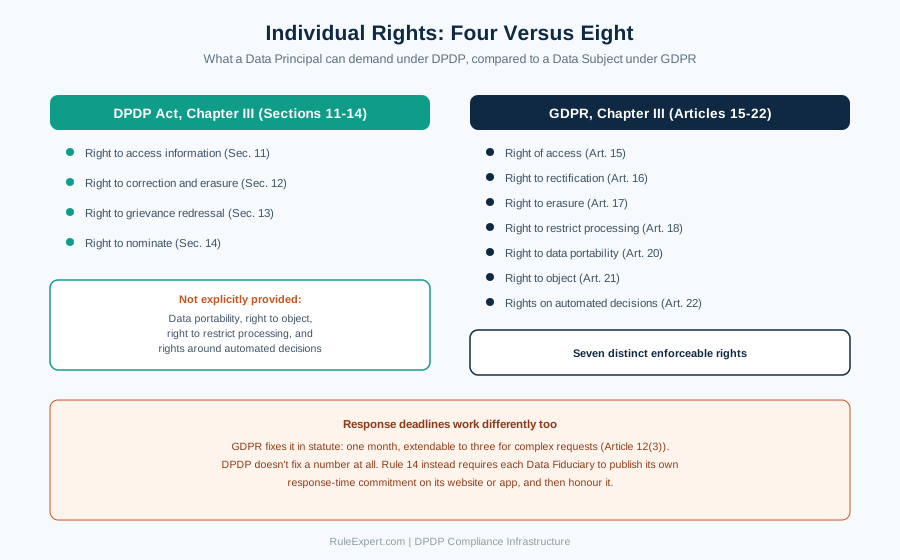
DPDP's Chapter III gives Data Principals four enforceable rights: access to information (Section 11), correction and erasure (Section 12), grievance redressal (Section 13), and nomination, meaning designating someone to exercise these rights after death or incapacity (Section 14).
GDPR's Chapter III is broader: access, rectification, erasure, restriction of processing, data portability, the right to object, and rights related to automated decision-making and profiling, seven distinct rights in total. Data portability and the right to object to processing, both genuinely significant for individuals, simply have no direct DPDP equivalent today.
Response timing differs in an interesting way too. GDPR fixes the deadline in statute: one month, extendable by two further months for complex requests, under Article 12(3). DPDP doesn't fix a number at all. Rule 14 instead requires each Data Fiduciary to publish its own response-time commitment on its website or app, and then actually meet it. That's more flexible for business, but it also means "we haven't set a timeline yet" isn't a defensible position once Rule 14 is enforceable; publishing a clear, honest SLA becomes part of the compliance obligation itself.
8. When Does Each Law Actually Bite?
This is the comparison point most competitor content glosses over, and it matters enormously for how urgently you should treat each law.
GDPR has been fully enforced since 25 May 2018. There's no phasing left to consider; every article has been operative for years, and enforcement precedent is extensive.
DPDP is genuinely still arriving. The Digital Personal Data Protection Rules, 2025 were notified on 13 November 2025, and both the Act's substantive provisions and the Rules commence in phases. The Data Protection Board exists procedurally since that notification, but the core obligations Indian businesses actually need to operationalise, consent mechanics, breach notification, Data Principal rights, cross-border rules, fall within an eighteen-month phased compliance window that lands on 13 May 2027.
That gap, GDPR live for years, DPDP's core obligations not yet legally operative, is the single biggest reason "we're GDPR compliant, so we're fine" is premature. It's not that DPDP doesn't matter yet; it's that the runway between now and May 2027 is exactly when the underlying capability needs to get built, tested, and embedded, not assembled in a rush once enforcement starts.
9. How Much Does Non-Compliance Cost?
GDPR's penalty structure is tiered: up to €10 million or 2% of global annual turnover for lower-tier infringements, and up to €20 million or 4% of global annual turnover, whichever is higher, for the most serious ones.
The DPDP Act's Schedule sets penalties by specific provision rather than a flat tier, up to ₹250 crore for failing to implement reasonable security safeguards, up to ₹200 crore for breach notification failures, up to ₹150 crore for Significant Data Fiduciary obligation failures, and up to ₹50 crore for other contraventions, all per instance, imposed by the Data Protection Board after an inquiry.
Numerically, GDPR's ceiling can run higher in absolute terms for very large global companies given the turnover-based calculation. But comparing headline numbers misses the more useful point: DPDP's per-provision structure means a single incident, weak security safeguards leading to an unreported breach, say, can trigger penalties under multiple sections simultaneously. Our guide to the DPDP Act's penalty and enforcement structure and how the Data Protection Board's process actually works cover this in full.
10. Why "GDPR Ready" Doesn't Mean "DPDP Ready"
None of this means GDPR maturity is wasted effort. It genuinely isn't.
Show Image
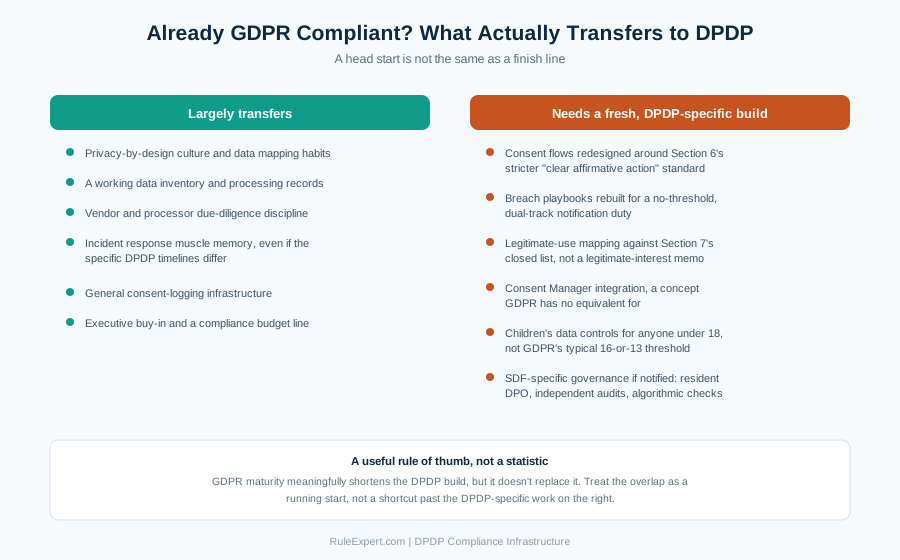
A privacy-by-design culture, an existing data inventory, vendor due-diligence habits, and general incident-response muscle memory all carry over meaningfully. What doesn't transfer cleanly is anything built around GDPR's specific mechanics: legitimate-interest reasoning that needs re-mapping against Section 7's closed list, risk-based breach judgment calls that need to become no-threshold defaults, consent flows that need DPDP's stricter affirmative-action standard, and entirely new concepts like Consent Managers that GDPR has no equivalent for at all.
If your organisation is a Significant Data Fiduciary once notified, the gap widens further: a resident Data Protection Officer answerable to the board, an independent auditor, and algorithmic due diligence are obligations GDPR's DPO trigger doesn't map onto directly, since GDPR's DPO requirement runs off different criteria (public authorities, large-scale monitoring, large-scale special-category processing) rather than a government notification.
This is precisely the gap RuleExpert's platform is built to close for organisations already running a GDPR programme: mapping existing consent, data registry, and breach management infrastructure onto DPDP's specific requirements rather than rebuilding from zero. If you want to see exactly where your GDPR programme already covers DPDP ground and where it doesn't, book a demo with RuleExpert and we'll map it against your actual processing activities. You can also see how our full platform fits together on our DPDP compliance solution page.
11. Mistakes Businesses Make Comparing the Two
- Assuming GDPR consent language satisfies DPDP's stricter standard. GDPR permits some implied consent in narrow circumstances. DPDP requires clear affirmative action every time.
- Relying on "legitimate interest" reasoning without checking Section 7. If a processing activity doesn't fit one of DPDP's specific enumerated categories, the GDPR justification doesn't carry over.
- Applying GDPR's risk-based breach judgment to DPDP incidents. A breach assessed as "low risk, no individual notice needed" under GDPR still needs full notification under DPDP's no-threshold rule.
- Assuming DPDP's cross-border rules are stricter than GDPR's. They're currently more permissive, a negative list with no countries yet restricted, versus GDPR's adequacy-and-safeguards model. Don't over-engineer transfer mechanisms DPDP doesn't yet require.
- Treating DPDP as already fully enforced because GDPR has been for years. DPDP's core obligations commence 13 May 2027. That's a preparation runway, not a reason to delay preparation.
- Ignoring DPDP-only concepts entirely. Consent Managers and the SDF governance tier have no GDPR equivalent, so a GDPR gap analysis alone will miss them completely.
12. Frequently Asked Questions
Is the DPDP Act the same as GDPR? No. They share broad goals but differ substantially in legal basis for processing, breach notification thresholds, individual rights, cross-border transfer rules, and enforcement timelines. DPDP is shorter, consent-centric, and still in its phased commencement period, while GDPR has been fully enforced since 2018.
If we're GDPR compliant, are we automatically DPDP compliant? No. GDPR maturity provides a meaningful head start, particularly around data mapping, vendor governance, and privacy culture, but DPDP-specific work is still required: consent flow redesign, Section 7 legitimate-use mapping, no-threshold breach processes, and Consent Manager integration among them.
Does DPDP cover the same personal data as GDPR? Not exactly. DPDP applies only to digital personal data, covering data collected digitally or collected non-digitally and later digitised. GDPR covers both digital data and structured manual filing systems.
How does DPDP's legal basis for processing differ from GDPR's? GDPR offers six lawful bases, including a flexible legitimate-interest test. DPDP offers only consent and a closed list of specific legitimate uses under Section 7, with no open-ended legitimate-interest fallback.
Is breach notification stricter under DPDP or GDPR? DPDP is stricter in one specific sense: it has no materiality threshold, so every breach triggers notification to both the regulator and affected individuals. GDPR applies a risk-based test that can, in genuinely low-risk cases, avoid individual notification.
Can personal data be transferred out of India more easily than out of the EU? Currently, yes. DPDP's Section 16 uses a negative list model with no countries currently restricted, making cross-border transfer more permissive today than GDPR's adequacy-and-safeguards regime, though this could change if the government notifies restricted countries.
When does DPDP become fully enforceable? The Data Protection Board has existed procedurally since November 2025, but the core operational obligations, consent, breach notification, individual rights, cross-border rules, commence 13 May 2027, eighteen months after the DPDP Rules were notified.
Which law has higher penalties, DPDP or GDPR? GDPR's ceiling, up to €20 million or 4% of global annual turnover, can be numerically higher for very large multinational companies. DPDP's Schedule sets penalties per provision, up to ₹250 crore per instance for the most serious contraventions, and multiple provisions can be breached by a single incident.
Does GDPR's Data Protection Officer requirement match DPDP's? No. GDPR requires a DPO for public authorities and organisations engaged in large-scale monitoring or large-scale special-category data processing. DPDP requires a resident DPO only for Significant Data Fiduciaries formally notified by the Central Government, a narrower, notification-based trigger.
Do Indian BPOs processing EU data need to comply with both laws? Often yes, though DPDP itself carves out some of this activity. Section 17(1)(d) exempts an Indian entity's processing of personal data of individuals located outside India, done under contract with a foreign client, from DPDP's core obligations. The foreign client's own obligations, including GDPR where EU data subjects are involved, still apply independently.