 RuleExpert
Ask five compliance leads what "consent management" means under India's DPDP Act, and you'll usually get five different answers: a cookie banner, a checkbox, a privacy policy link, a third-party Consent Manager platform, or "whatever the legal team drafted last year." None of those answers is wrong exactly. None of them is complete either.
Consent management under the DPDP Act is a full operational lifecycle with seven distinct moving parts, each tied to a specific statutory requirement, each capable of failing independently, and each carrying its own exposure if it does. This guide is the complete, ground-up version: what counts as valid consent, what has to happen before you even ask for it, how withdrawal actually works end to end, what changes for children's data, where the registered Consent Manager institution fits in, and how to actually build this as a working system rather than a policy document nobody follows.
This is written as a pillar resource. Where a topic has its own deeper treatment on our site, breach notification, the Data Protection Board, penalties, the Consent Manager institution specifically, we link out to it rather than repeating it here.
1. What Does "Consent Management" Actually Mean Under DPDP?
Strip away the tooling and the vendor pitches, and consent management under the DPDP Act is really the operational answer to one legal requirement: Section 4(1) of the Act says a Data Fiduciary may process personal data only if the Data Principal has given consent, or if the processing falls under one of the specific "certain legitimate uses" listed in Section 7. For the large majority of everyday commercial processing, marketing, personalisation, most customer data collection, consent is the operative basis, not the legitimate-use exceptions.
That means consent isn't a one-time checkbox event. It's a lifecycle: you notify someone about what you want to do with their data, they consent in a way the law recognises as valid, you record that consent in a way you can later prove, you use the data strictly within what was consented to, and you handle it correctly the moment they change their mind. Every one of those steps is independently regulated. Getting four out of five right doesn't make you compliant; it makes you exposed at exactly the point you got wrong.
For businesses that already run a GDPR consent programme, it's worth knowing upfront that DPDP's consent mechanics are stricter in several specific ways, not simply a shorter version of the same idea. We cover that comparison in full in our guide to DPDP Act vs GDPR for Indian businesses, but the short version relevant here: DPDP has no general "legitimate interest" basis to fall back on the way GDPR does, which makes getting consent itself right considerably more load-bearing for Indian operations.
2. Who Is Responsible for Getting This Right?
The Data Fiduciary, meaning whichever entity decides why and how personal data is processed, carries the compliance obligation. This holds true regardless of whether you built your own consent collection flow, bought a third-party consent management platform, or route consent through a registered Consent Manager. The tooling changes how the obligation gets fulfilled. It doesn't change who's accountable if it isn't.
This matters practically in vendor conversations. A consent management platform vendor can help you operationalise Section 6's requirements. No vendor contract transfers the statutory burden of proof away from you, and Section 6(10), which we'll come back to, puts that burden squarely on the Data Fiduciary's shoulders.
Two other parties sit inside this picture. The Data Principal is the individual whose consent is being sought and who holds the rights this whole framework protects. The Data Protection Board of India is the body that adjudicates disputes and can penalise failures; we cover its full role and process in a separate guide if you want the complete picture of how a complaint actually reaches it.
3. What Makes Consent Legally Valid? The Six Pillars
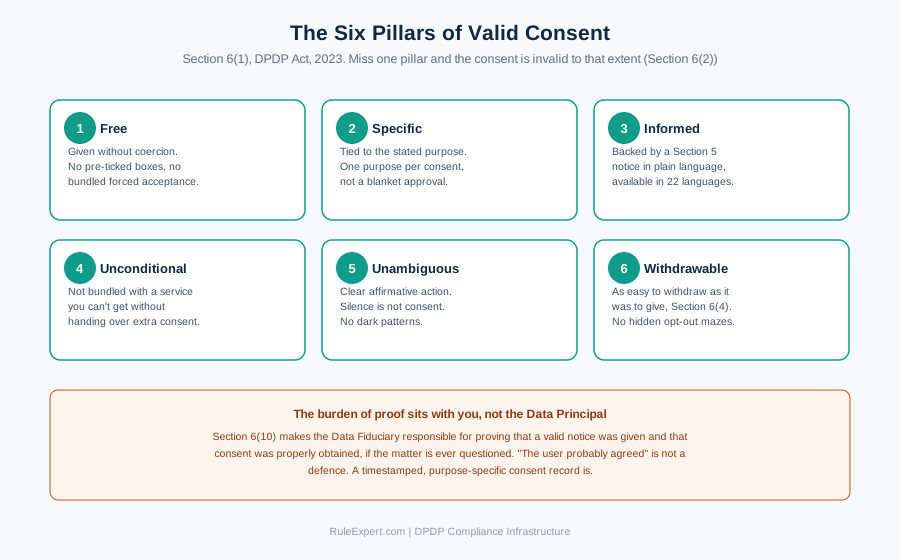
Section 6(1) of the DPDP Act sets a cumulative six-part standard. Every part has to be satisfied, and under Section 6(2), any part of a consent that violates the Act or Rules is invalid to that specific extent, not the whole consent necessarily, but the defective piece.
Free. Consent given without coercion, and critically, not bundled into accepting a service you can't otherwise access. A pre-ticked checkbox someone has to actively un-tick doesn't meet this standard; the affirmative action has to come from the individual, not from a default the business set in its own favour.
Specific. Tied to a stated purpose, not a blanket approval covering whatever the business might want to do with the data later. If you're collecting an email address for order updates and also want to use it for marketing, that's two purposes, and DPDP expects two specific consents, not one broad one that happens to cover both if you squint at the wording.
Informed. This is where notice and consent connect directly; you can't have informed consent without the notice we cover in the next section actually being shown, in language the person can genuinely understand.
Unconditional. Similar to "free," but specifically about not making an unrelated service conditional on consent to something else. A weather app requiring contacts-list access to function is the canonical example of what this pillar exists to prevent.
Unambiguous. Clear affirmative action is required. Silence, inactivity, or a pre-selected option someone didn't actively choose does not constitute consent. This is also where DPDP's stance against dark patterns, manipulative interface designs that trick people into agreeing to more than they intended, lives operationally.
Withdrawable. Under Section 6(4), withdrawal has to be at least as easy as giving consent was. If sign-up took one click, an eight-step account-settings maze to withdraw doesn't meet the standard. We'll cover the mechanics of what happens after withdrawal in its own section below.
One more piece belongs here even though it isn't a "pillar" in the same sense: Section 6(10) makes the Data Fiduciary responsible for proving, if the matter is ever questioned in a proceeding, that a valid notice was given and that consent was properly obtained. That single clause is the entire justification for building a real consent record system rather than trusting that "people probably agreed."
4. What Must the Notice Say Before You Even Ask?
Consent can't stand alone. Section 5 requires every consent request to be accompanied or preceded by a notice, and that notice has its own specific content requirements under Section 5(1) and Rule 3 of the DPDP Rules, 2025.
Section 5(1) requires the notice to inform the Data Principal of three things: the personal data being processed and the purpose for processing it, how to exercise withdrawal rights under Section 6(4) and grievance redressal rights under Section 13, and how to lodge a complaint with the Data Protection Board.
Rule 3 adds operational teeth to that requirement. The notice must be independently understandable, meaning a person shouldn't need to have read your privacy policy from six months ago or click through to some other page to make sense of it; it has to stand on its own. It must use clear, plain language rather than legal boilerplate. It must give an itemised description of the personal data being collected and an itemised description of the purposes or goods and services involved, not a bundled, vague description covering everything at once. And it must be available in English or any of the 22 languages listed in the Eighth Schedule to the Constitution of India, a meaningfully higher accessibility bar than most global privacy notices are built to.
There's a separate rule for data collected before the Act's provisions commence. Under Section 5(2), where consent was already obtained before the relevant commencement date, the Data Fiduciary must, as soon as reasonably practicable, give a notice covering the same ground retroactively, though processing can continue in the meantime until the individual actually withdraws consent. The Act's own illustration imagines an e-commerce company sending this by email or in-app notification. If your business has been collecting data for years before DPDP's core provisions take effect, this retroactive notice obligation applies to you specifically, and it's worth planning for well before the deadline rather than treating it as a footnote.
5. How Does Consent Withdrawal Actually Work?
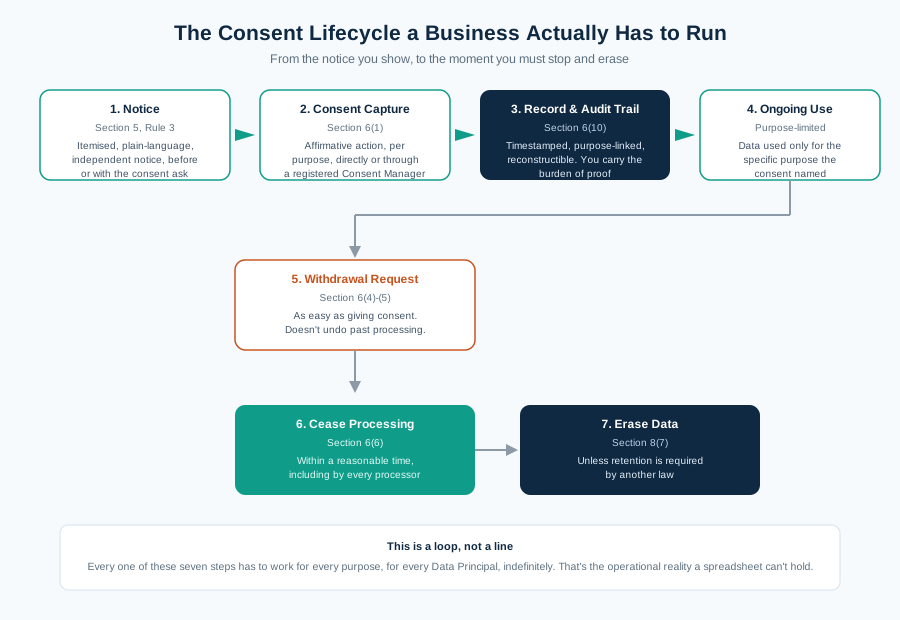
This is the part of the consent lifecycle most businesses build the shallowest version of, usually a button that changes a database flag without touching anything downstream. The statute expects considerably more.
Section 6(4) establishes the right itself: withdrawal has to be at least as easy as giving consent. Section 6(5) clarifies that withdrawal doesn't retroactively invalidate processing that already happened before the withdrawal, and that the consequences of withdrawing are borne by the Data Principal, meaning if withdrawing consent means a service can no longer be provided, that's a legitimate consequence, not a violation.
The obligation that actually requires operational work sits in Section 6(6): once consent is withdrawn, the Data Fiduciary must, within a reasonable time, cease processing the relevant personal data, and critically, must cause every Data Processor working on its behalf to cease processing too, unless continued processing is separately required or authorised by law. That second part is the piece that trips up businesses with any meaningful vendor stack. If your customer data flows through an email marketing platform, an analytics tool, and a CRM, all three need to actually stop processing that individual's data for the withdrawn purpose, not just your primary system.
Then there's the connection to data retention itself: Section 8(7) requires the Data Fiduciary to erase personal data, and cause its processors to erase it, once the purpose is no longer being served and retention isn't required by some other law. Withdrawal is usually the clearest trigger for that erasure obligation to kick in for a given purpose.
Put together, a compliant withdrawal flow needs to answer five questions correctly, not one: Can the person actually find and use the withdrawal mechanism easily? Does withdrawing stop processing in your own systems? Does it cascade to every processor and vendor touching that data for that purpose? Does it trigger the erasure clock where no other law requires retention? And can you document that all of this happened, for the same burden-of-proof reason covered above?
6. What Changes for Children and Persons with Disabilities?
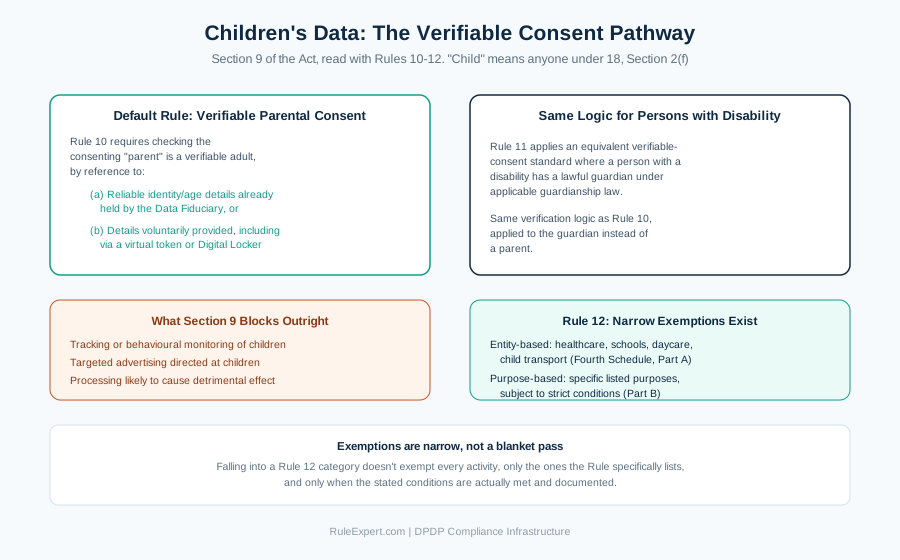
Section 9 of the Act defines a child as anyone who hasn't turned 18, a notably higher threshold than GDPR's typical 16-or-13 range, and requires verifiable consent from a parent or lawful guardian before processing a child's personal data at all.
Rule 10 of the DPDP Rules, 2025 sets out what "verifiable" actually requires. The Data Fiduciary has to adopt technical and organisational measures to confirm the person identifying themselves as the parent is genuinely a verifiable adult, checked by reference to either reliable identity and age details the Data Fiduciary already holds, or details voluntarily provided by the individual, including through a virtual token issued by an authorised entity or a Digital Locker service. Rule 11 applies an equivalent standard for persons with disabilities who have a lawful guardian under applicable guardianship law, same verification logic, applied to the guardian relationship instead.
Beyond consent itself, Section 9 imposes outright prohibitions that don't bend based on consent at all: no tracking or behavioural monitoring of children, and no targeted advertising directed at children, full stop. A parent consenting to data collection doesn't unlock the ability to behaviourally profile that child for ad targeting; the Act blocks that regardless.
Rule 12 does carve out narrow exemptions, entity-based ones for healthcare providers, educational institutions, daycare services, and child transport services under specific listed conditions, and purpose-based ones for other specific listed activities. These exemptions are genuinely narrow. Falling into a listed entity category doesn't exempt every activity that entity performs, only the specific ones the Rule names, and only when the stated conditions are actually met and documented, not assumed.
If your business processes any data from users who could plausibly be under 18, an ed-tech platform, a gaming app, any consumer service without strict age-gating, this section isn't a hypothetical edge case. It's a core design requirement for your consent flow from day one.
7. Where Do Consent Managers Fit In?
It's worth being precise here because the terminology causes genuine confusion, including, we'll be upfront, in some of our own past coverage. Section 2(g) of the DPDP Act defines a "Consent Manager" as a specific, registered institution: a person registered with the Data Protection Board who acts as a single point of contact enabling a Data Principal to give, manage, review, or withdraw consent across multiple Data Fiduciaries through one interoperable platform. Under Section 6(7) to (9), a Data Principal may choose to route consent through such a registered Consent Manager, and the Consent Manager itself must meet registration conditions under Rule 4 of the DPDP Rules, including incorporation in India and a minimum net worth threshold.
This is an optional channel, not a mandatory one. A Data Principal can give consent directly to your business without ever touching a Consent Manager, and most consent today, and for the foreseeable future, will likely work that way. If you want the full detail on this specific institution, its registration requirements, its obligations, and its role in the broader ecosystem, we've covered it in depth in our dedicated guide to Consent Managers under the DPDP Act.
One clarification worth making explicitly: when we, or other DPDP compliance vendors, refer to a "Consent Manager" product or module, that's almost always describing internal software that helps your business run its own consent lifecycle, the six pillars, the notice, the withdrawal cascade, not a claim that the vendor is itself a registered Section 2(g) Consent Manager intermediary. Those are two different things sharing a name, and worth keeping distinct when you're evaluating tools.
8. When Does All of This Actually Become Enforceable?
Here's a detail that changes how urgently to treat all of the above: none of Sections 4 through 17 of the DPDP Act, which is where consent, notice, withdrawal, and children's data obligations all live, are legally enforceable yet. The DPDP Rules, 2025 were notified on 13 November 2025, and both the Act's substantive provisions and the Rules commence in phases rather than all at once. The Data Protection Board exists procedurally since that notification date. The core operational obligations this guide has walked through fall within an eighteen-month phased compliance window that lands on 13 May 2027.
That's not a reason to treat any of this as theoretical. It's a build window. Consent architecture, notice content, withdrawal cascades through vendor systems, and children's verification flows are not things that get assembled well in the weeks before a deadline. The organisations that use this runway deliberately will be operating a tested system by May 2027. The ones that wait will be building all of it, including the parts that only reveal their complexity in practice, at the exact moment enforcement begins.
9. How Much Does Getting Consent Wrong Cost?
The Schedule to the DPDP Act sets penalties by specific provision, and consent-related failures aren't a single line item; they connect to several. A breach traceable to inadequate security safeguards around consent records can trigger penalties up to ₹250 crore per instance under Section 8(5). Broader contraventions not separately specified, which would capture many pure consent-mechanics failures, carry penalties up to ₹50 crore per instance. Where a consent failure results in a personal data breach and that breach isn't properly notified, Section 8(6) penalties, up to ₹200 crore, can apply as well.
The practical point is that consent failures rarely stay contained to a single provision. Weak consent records tend to surface during a breach investigation or a Data Principal complaint, at which point the Data Protection Board is looking at the whole picture, not just the original consent defect in isolation. Our guide to the DPDP Act's penalty and enforcement structure covers the full Schedule and how the Board actually runs an inquiry.
10. Why Consent Tracking Breaks at Scale
A spreadsheet, or a single "consent given: yes/no" database flag, works for a business with a few hundred users and one processing purpose. It stops working almost immediately once real complexity shows up, and DPDP's structure guarantees that complexity arrives fast.
Consider what a single customer relationship actually requires under the framework covered above: separate, specific consent for each distinct purpose, an itemised notice matched to each of those purposes, a timestamped record defensible enough to satisfy Section 6(10)'s burden of proof, a withdrawal mechanism that cascades correctly to every processor touching that data, and, if the customer is a minor, an entirely separate verified-parental-consent layer sitting on top of all of it. Multiply that by every purpose your business actually has, marketing, analytics, third-party sharing, product personalisation, and by every customer, and a binary flag or a static spreadsheet row simply has nowhere to hold the necessary granularity.
This is precisely the operational gap RuleExpert's platform is built to close. Our Consent Manager module (again, internal software for your business, not a registered Section 2(g) intermediary) handles the full lifecycle: itemised consent collection tied to specific purposes, an audit trail built to satisfy Section 6(10)'s burden of proof, and withdrawal workflows that actually propagate to connected systems rather than quietly stopping at your primary database. If you want to see what that looks like against your actual purpose list and vendor stack rather than in the abstract, book a demo with RuleExpert and we'll walk through it.
11. How to Build a Consent Management Programme That Works
A few concrete steps, in a sensible build order, rather than a generic checklist:
- Inventory every distinct processing purpose first. Before touching consent UI or notice copy, list out every genuinely separate purpose your business processes personal data for. This list is almost always longer than people expect, and it's the foundation everything else sits on.
- Draft itemised notices per purpose, not one master notice. Each notice needs to independently satisfy Rule 3: standalone clarity, plain language, itemised data and purpose description, and a path to withdrawal and grievance redressal.
- Build the consent record with the burden of proof in mind. Timestamp, purpose, the exact notice version shown, and the specific affirmative action taken. If you can't reconstruct this for any given consent event, Section 6(10)'s burden isn't met.
- Map the withdrawal cascade before you need it. List every processor and vendor that touches personal data for each purpose, and confirm, concretely, how a withdrawal signal reaches each one, not just your own primary system.
- Design the children's data pathway separately, even if you think it doesn't apply to you. Age-gating isn't a substitute for a verified-consent flow if your service is genuinely accessible to minors. Decide deliberately, don't assume.
- Plan the retroactive notice for existing data. If you're processing personal data collected before the Act's core provisions commence, Section 5(2)'s retroactive notice obligation applies, and it's a real project, not a minor addendum.
- Test the whole loop, not just collection. Run an actual end-to-end test: give consent, then withdraw it, then verify processing actually stopped everywhere it should have, including with vendors. Most gaps surface here, not at the collection stage.
12. Mistakes Businesses Make With Consent
- Treating consent as a one-time UI project rather than an ongoing system. A well-designed consent banner that isn't backed by a real record and withdrawal cascade solves the visible part of the problem, not the enforceable part.
- Bundling multiple purposes into one broad consent. This fails the "specific" pillar directly and is one of the most common defects the Board is likely to encounter first, since it's also one of the easiest to detect from the outside.
- Building withdrawal as a database flag, not a cascade. If withdrawal doesn't propagate to processors and vendors, Section 6(6) isn't actually satisfied, regardless of how clean the user-facing withdrawal button looks.
- Assuming a privacy policy satisfies the Section 5 notice requirement. A general privacy policy, written once and rarely itemised per purpose, typically fails Rule 3's itemisation and independent-clarity requirements.
- Skipping the multilingual requirement. An English-only notice for a user base that includes non-English speakers doesn't meet the "informed" pillar for those individuals, regardless of intent.
- Assuming age-gating equals compliance for children's data. A self-reported birthdate field isn't verifiable consent under Rule 10's standard, and platforms genuinely accessible to minors need a real verification pathway, not an honesty-based checkbox.
- Confusing internal consent software with the regulatory Consent Manager institution. As covered above, these are different things, and assuming your consent platform vendor is itself a registered Section 2(g) intermediary is a factual error worth correcting internally before it appears in a compliance filing.
13. Frequently Asked Questions
What is consent management under the DPDP Act? It's the full operational process of notifying a Data Principal about data processing, obtaining consent that meets Section 6(1)'s six-part standard, recording that consent defensibly, using data only within the consented purpose, and correctly handling withdrawal, including cessation and erasure, when it happens.
What are the six requirements for valid consent under DPDP? Under Section 6(1), consent must be free, specific, informed, unconditional, unambiguous, and withdrawable. All six are cumulative requirements, not alternatives, and Section 6(2) invalidates any part of a consent that fails to meet them.
What must a consent notice include under the DPDP Act? Under Section 5 and Rule 3, the notice must be independently understandable, in clear and plain language, available in English or any of the 22 languages in the Eighth Schedule, and must give an itemised description of the personal data and purpose, alongside how to withdraw consent, raise a grievance, or complain to the Data Protection Board.
How easy does withdrawing consent have to be? At least as easy as giving it, under Section 6(4). If consent took one click, an equally simple mechanism must exist to withdraw it.
What happens after someone withdraws consent? Under Section 6(5) and (6), withdrawal doesn't undo the legality of past processing, but the Data Fiduciary must, within a reasonable time, stop processing the data and ensure every Data Processor working on its behalf does too, unless the law separately requires continued processing. Section 8(7) then generally requires erasure once the purpose is no longer served.
Who has to prove that valid consent was obtained? The Data Fiduciary. Section 6(10) places the burden of proof on the business to demonstrate, if questioned, that a valid notice was given and consent was properly obtained in line with the Act and Rules.
How is children's consent different under DPDP? Section 9 defines a child as anyone under 18 and requires verifiable parental consent under Rule 10 before processing their data, alongside outright prohibitions on tracking, behavioural monitoring, and targeted advertising directed at children, regardless of consent. Narrow exemptions exist under Rule 12 for specific entities and purposes.
Is a registered Consent Manager mandatory for businesses to use? No. A Consent Manager under Section 2(g) is an optional, registered intermediary a Data Principal may choose to route consent through. Businesses can, and mostly do, collect consent directly without one. See our dedicated guide to Consent Managers for the full detail on that specific institution.
When does DPDP's consent framework actually become legally enforceable? Sections 4 through 17 of the Act, covering consent, notice, and children's data, fall within the DPDP Rules' third commencement phase, effective 13 May 2027, eighteen months after the Rules were notified in November 2025.
What's the difference between a "Consent Manager" institution and consent management software? A Consent Manager under Section 2(g) is a specific, Board-registered intermediary meeting statutory eligibility conditions under Rule 4. Consent management software, including RuleExpert's Consent Manager module, is internal tooling that helps a Data Fiduciary run its own consent lifecycle; it is not itself a registered Section 2(g) intermediary unless separately registered as one.