
Organizations across India are preparing for a new era of privacy governance under the Digital Personal Data Protection (DPDP) Act, 2023. As businesses process increasing volumes of digital personal data across cloud applications, enterprise systems, customer portals, and third-party platforms, managing compliance through spreadsheets, emails, and disconnected processes is becoming increasingly difficult.
Compliance today is no longer limited to creating policies or maintaining documentation. Organizations must operationalize privacy by establishing structured processes for consent management, personal data governance, Data Principal request handling, breach response, vendor oversight, and compliance reporting. Achieving this consistently requires more than manual effort—it requires automation.
This is where a DPDP compliance automation platform becomes valuable.
Rather than managing privacy activities across multiple tools, a centralized platform enables organizations to automate workflows, maintain audit-ready documentation, improve collaboration between departments, and gain better visibility into their compliance posture.
However, choosing the right platform can be challenging. Numerous vendors offer compliance software, privacy tools, consent managers, and governance solutions, each with different capabilities. Decision-makers need a practical framework for evaluating which solution best supports their organization’s operational requirements—not simply the longest feature list.
This buyer’s guide explains:
- What a DPDP compliance automation platform is
- Why organizations are moving from manual compliance to automation
- The essential features every platform should provide
- How AI supports privacy operations
- What to evaluate before selecting a platform
- How an integrated solution can help operationalize DPDP compliance across the organization
Whether you are a CEO, founder, compliance leader, legal professional, HR head, or technology executive, this guide will help you make an informed decision when evaluating a DPDP compliance automation platform for your organization. The content is designed to support commercial evaluation while helping you understand the practical capabilities required to build scalable and audit-ready privacy operations.
What Is a DPDP Compliance Automation Platform?
A DPDP compliance automation platform is a centralized software solution that helps organizations manage and operationalize privacy compliance activities associated with the Digital Personal Data Protection (DPDP) Act, 2023 through structured workflows, automation, centralized documentation, and governance.
Unlike traditional compliance methods that rely on spreadsheets, email chains, and manual approvals, a compliance automation platform brings privacy operations into a single system where teams can collaborate efficiently and maintain consistent records.
Depending on the organization’s requirements, a modern platform can support activities such as:
- DPDP readiness assessments
- Consent lifecycle management
- Data Principal request (DSR) workflows
- Personal data inventory and data registry
- Personal data breach management
- Vendor governance and third-party oversight
- Risk assessment and mitigation
- Compliance documentation
- Audit-ready reporting
- Executive dashboards and compliance monitoring
Instead of treating compliance as a one-time implementation project, organizations can establish repeatable operational processes that support ongoing governance and continuous improvement.
Why Organizations Are Moving Beyond Manual Compliance
Many organizations begin their DPDP compliance journey using existing business tools such as spreadsheets, shared drives, emails, and manual checklists.
While these methods may work during the initial stages, they often become difficult to manage as privacy operations expand across departments, business units, and third-party vendors.
Some of the most common operational challenges include:
- Compliance activities tracked across multiple systems
- Difficulty locating supporting documentation during audits
- Manual follow-up for approvals and investigations
- Limited visibility into consent records and privacy requests
- Inconsistent breach response processes
- Fragmented communication between Legal, Compliance, IT, HR, and business teams
- Challenges maintaining evidence of compliance activities
As organizations process larger volumes of personal data and privacy responsibilities become more distributed, manual processes increase operational effort and reduce visibility.
A DPDP compliance automation platform helps address these challenges by centralizing workflows, improving accountability, and creating a structured environment for managing privacy operations across the organization.
What Makes a DPDP Compliance Automation Platform Different from Traditional Compliance Software?
Many compliance solutions focus on document storage, policy management, or regulatory checklists.
A DPDP compliance automation platform goes a step further by enabling organizations to operationalize compliance through workflow-driven automation.
Instead of simply storing documents, the platform helps organizations:
- Coordinate compliance activities across departments
- Assign responsibilities and monitor progress
- Maintain centralized evidence and audit trails
- Automate recurring privacy workflows
- Improve visibility into ongoing compliance activities
- Support governance through dashboards and reporting
This shift from document management to operational compliance is becoming increasingly important for organizations seeking scalable and sustainable privacy governance.
Key Takeaways
By the end of this guide, you’ll understand:
How organizations can move from manual compliance management to structured, scalable privacy operations
How a DPDP compliance automation platform supports operational privacy governance
The essential capabilities to evaluate before selecting a solution
How AI-powered automation can improve compliance efficiency
What differentiates a comprehensive platform from standalone privacy tools
Why Organizations Need a DPDP Compliance Automation Platform
For many organizations, DPDP compliance begins with good intentions—creating privacy policies, updating consent forms, maintaining spreadsheets, and assigning compliance responsibilities across departments.
However, as the volume of personal data grows and privacy obligations become part of everyday business operations, these manual approaches quickly become difficult to manage.
A modern organization may process personal data across customer portals, HR systems, CRM platforms, ERP applications, cloud environments, websites, mobile applications, and third-party vendors. Managing privacy obligations across these disconnected systems requires structured workflows, centralized visibility, and continuous monitoring.
This is why organizations are increasingly adopting a DPDP compliance automation platform—not simply to document compliance, but to operationalize it.
The Growing Complexity of DPDP Compliance
Complying with the Digital Personal Data Protection (DPDP) Act, 2023 is not a one-time project. It requires organizations to establish ongoing operational processes that support responsible personal data management throughout the data lifecycle.
As organizations expand, they often face challenges such as:
- Personal data spread across multiple business systems
- Manual tracking of consent records
- Increasing volumes of Data Principal requests
- Limited visibility into data processing activities
- Multiple departments handling privacy responsibilities independently
- Growing dependence on third-party vendors
- Difficulty maintaining audit-ready documentation
Without a centralized approach, compliance activities become fragmented, increasing administrative effort and reducing visibility into organizational privacy operations.
Why Manual Compliance Processes No Longer Scale
Many organizations still rely on spreadsheets, emails, shared folders, and isolated documents to manage privacy activities.
While these methods may appear manageable initially, they often create operational inefficiencies as privacy programs mature.
Disconnected Compliance Activities
Consent records, breach investigations, vendor reviews, and privacy requests are frequently managed through different systems.
This fragmentation makes it difficult to obtain a unified view of compliance activities across the organization.
Limited Accountability
Privacy compliance involves multiple stakeholders, including Compliance, Legal, IT, HR, Information Security, Procurement, and business teams.
Without structured workflows, responsibilities may become unclear, resulting in delayed responses and inconsistent execution.
Manual Documentation
Organizations often spend significant time collecting evidence for:
- Internal reviews
- Compliance reporting
- Management updates
- Risk assessments
- Audit preparation
When documentation is maintained manually, information may become incomplete, inconsistent, or difficult to retrieve.
Lack of Operational Visibility
Leadership teams require visibility into ongoing privacy operations.
Questions such as these become difficult to answer using manual processes:
- Which compliance activities are pending?
- How many Data Principal requests remain open?
- Which vendors have completed compliance reviews?
- Are breach investigations progressing on schedule?
- Which departments require additional compliance support?
Without centralized reporting, decision-making becomes reactive rather than proactive.
Common Challenges Organizations Face
Organizations implementing DPDP compliance often encounter similar operational obstacles.
Managing Consent Across Multiple Channels
Customer consent may be collected through websites, mobile applications, customer support teams, marketing campaigns, and offline processes.
Without centralized consent management, maintaining accurate consent records becomes increasingly difficult.
Responding to Data Principal Requests
As organizations receive requests relating to access, correction, or deletion of personal data, coordinating responses across departments can become time-consuming without standardized workflows.
Maintaining Visibility into Personal Data
Organizations frequently struggle to identify:
- Where personal data is stored
- Which departments process it
- Who owns specific datasets
- Which vendors have access
- How personal data flows across systems
A lack of visibility makes privacy governance significantly more challenging.
Coordinating Personal Data Breach Response
When a personal data breach occurs, multiple teams may need to collaborate to investigate the incident, assess potential impact, document findings, assign responsibilities, and implement corrective actions.
Managing these activities through emails and spreadsheets can delay response efforts and create documentation gaps.
Governing Third-Party Vendors
Many organizations rely on cloud providers, payroll partners, software vendors, consultants, payment processors, and other service providers that process personal data.
Maintaining ongoing oversight of third-party relationships requires structured governance rather than periodic manual reviews.
How Automation Improves DPDP Compliance Operations
A DPDP compliance automation platform replaces fragmented manual processes with centralized workflows that improve consistency, visibility, and collaboration.
Instead of relying on multiple disconnected tools, organizations can manage privacy operations through a unified platform.
Automation can support activities such as:
- Workflow assignment
- Approval management
- Task tracking
- Documentation management
- Progress monitoring
- Compliance reporting
- Executive dashboards
- Audit trail maintenance
This enables compliance teams to spend less time on administrative coordination and more time on governance, risk management, and continuous improvement.
Business Benefits of a DPDP Compliance Automation Platform
Organizations evaluating a compliance platform should consider the broader operational value it delivers—not just individual features.
Improved Operational Efficiency
Automated workflows reduce repetitive administrative tasks and help standardize compliance activities across departments.
Better Cross-Functional Collaboration
A centralized platform enables Compliance, Legal, HR, IT, Information Security, Procurement, and business teams to work through shared workflows while maintaining clear ownership and accountability.
Greater Visibility into Privacy Operations
Real-time dashboards and centralized reporting provide leadership with a clearer understanding of ongoing compliance activities, helping identify bottlenecks and prioritize improvements.
Audit-Ready Documentation
Centralized records, activity histories, evidence repositories, and workflow logs help organizations maintain documentation that supports governance and internal or external audit requirements.
Scalable Compliance Management
As organizations grow, privacy obligations become more complex.
A structured automation platform provides the flexibility to support additional departments, business units, users, and compliance workflows without relying on increasingly complex manual processes.
Signs Your Organization Needs a DPDP Compliance Automation Platform
Your organization may benefit from automation if:
- Compliance activities are managed through spreadsheets or emails.
- Multiple departments are responsible for privacy-related tasks.
- Consent records are maintained across different systems.
- Data Principal requests require significant manual coordination.
- Personal data inventories are incomplete or difficult to maintain.
- Breach response activities lack standardized workflows.
- Vendor reviews are tracked manually.
- Audit preparation requires collecting information from multiple teams.
- Leadership lacks visibility into compliance progress.
If several of these challenges apply, it may be time to evaluate a centralized DPDP compliance automation platform that supports structured privacy operations and long-term governance.
Key Takeaways
Organizations are moving beyond manual privacy management because compliance is no longer limited to maintaining policies or completing periodic reviews. It requires continuous coordination, documentation, monitoring, and collaboration across the enterprise.
A DPDP compliance automation platform helps transform these fragmented activities into standardized, workflow-driven processes that improve efficiency, accountability, and operational visibility.
Rather than simply helping organizations maintain compliance records, automation enables them to build scalable privacy operations that support ongoing governance and business growth.
Essential Features Every DPDP Compliance Automation Platform Should Have
Not all compliance platforms are designed to solve the same problems. Some focus only on policy management, while others specialize in consent management or data discovery. A comprehensive DPDP compliance automation platform should help organizations operationalize privacy compliance across the entire lifecycle of personal data processing rather than addressing isolated compliance tasks.
When evaluating solutions, decision-makers should look beyond feature lists and assess whether the platform can support governance, automation, collaboration, and audit readiness through integrated workflows.
The following capabilities should form the foundation of any modern DPDP compliance automation platform.
1. DPDP Readiness Assessment
Before implementing compliance workflows, organizations should understand their current level of preparedness.
A DPDP readiness assessment helps identify operational gaps, prioritize improvement areas, and establish a structured roadmap for implementing privacy governance.
Look for a platform that provides:
- Compliance maturity assessment
- Readiness scoring
- Gap identification
- Executive dashboards
- Actionable recommendations
- Compliance roadmap
Rather than making assumptions, organizations gain measurable insight into their current privacy posture and the actions needed to strengthen it.
2. Consent Lifecycle Management
Consent is one of the most visible operational aspects of DPDP compliance. As organizations collect personal data across websites, applications, customer portals, and offline channels, managing consent consistently becomes increasingly complex.
A platform should support the complete consent lifecycle—not just consent collection.
Essential capabilities include:
- Consent collection
- Consent records management
- Purpose management
- Consent tracking
- Consent withdrawal
- Consent history
- Audit trails
Centralized consent management improves transparency while making it easier to maintain consistent records across the organization.
3. Data Subject Request (DSR) Automation
Organizations should be prepared to manage Data Principal requests efficiently through structured workflows rather than manual coordination.
A DPDP compliance automation platform should help standardize request handling by supporting:
- Centralized request intake
- Workflow automation
- Responsibility assignment
- Status tracking
- Approval workflows
- SLA monitoring
- Audit-ready documentation
Automation helps reduce administrative effort while improving visibility into request progress and accountability across departments.
Internal Link Suggestion: DSR Automation
4. Centralized Data Registry
Privacy governance begins with knowing what personal data the organization processes, where it resides, and who is responsible for it.
A centralized data registry helps organizations maintain a structured inventory of personal data and processing activities.
Key capabilities include:
- Personal data inventory
- Data mapping
- Processing activity records
- Data classification
- Business system mapping
- Data owner identification
- Processing purpose documentation
Improved visibility supports informed decision-making and strengthens privacy governance across business functions.
Internal Link Suggestion: Data Registry
5. Personal Data Breach Management
Responding to a personal data breach requires coordination between multiple stakeholders, including Compliance, IT, Legal, Information Security, and business teams.
A structured breach management capability helps organizations manage the incident lifecycle more effectively.
Look for features such as:
- Incident reporting
- Investigation workflows
- Risk assessment
- Evidence management
- Corrective action tracking
- Breach documentation
- Audit-ready records
Centralized workflows help organizations maintain consistent documentation and improve operational response.
Internal Link Suggestion: Breach Management
6. Vendor Governance
Many organizations rely on third-party service providers to process personal data.
Managing vendor oversight manually can become increasingly difficult as vendor ecosystems expand.
A DPDP compliance automation platform should support:
- Vendor inventory
- Vendor risk assessments
- Due diligence tracking
- Compliance reviews
- Vendor documentation
- Review reminders
- Third-party governance
Structured vendor governance helps organizations improve oversight while maintaining centralized records of vendor compliance activities.
Internal Link Suggestion: Vendor Governance
7. Workflow Automation
Privacy operations involve multiple stakeholders and recurring activities.
Rather than coordinating these tasks manually, organizations should evaluate platforms that automate routine compliance workflows.
Core workflow capabilities include:
- Task assignment
- Workflow approvals
- Notifications
- Escalation management
- Progress tracking
- Cross-functional collaboration
Workflow automation helps improve consistency while reducing administrative overhead.
8. AI-Powered Compliance Assistance
Artificial intelligence is becoming an important capability within modern compliance platforms. Rather than replacing compliance professionals, AI can assist with repetitive operational activities and help teams work more efficiently.
Organizations evaluating AI compliance automation in India should look for practical capabilities such as:
- Intelligent workflow assistance
- Documentation support
- Compliance insights
- Automated reminders
- Operational recommendations
- Risk visibility
AI should enhance decision-making and productivity while keeping compliance responsibilities under appropriate human oversight.
9. DPDP Documentation Automation
Maintaining accurate and up-to-date documentation is one of the most time-consuming aspects of privacy governance.
A strong DPDP documentation automation capability helps organizations centralize records and reduce manual documentation efforts.
Look for support for:
- Policy documentation
- Evidence management
- Activity logs
- Version history
- Compliance records
- Audit trails
- Document repository
Centralized documentation makes it easier to demonstrate governance activities during internal reviews and audits.
10. Dashboards and Compliance Reporting
Decision-makers need timely visibility into the organization’s privacy program.
A DPDP compliance automation platform should provide centralized dashboards that help leadership monitor operational performance and identify areas requiring attention.
Useful reporting capabilities include:
- Executive dashboards
- Compliance status
- Incident tracking
- Risk reporting
- Operational metrics
- Readiness reports
These insights help organizations make informed decisions and continuously improve their privacy operations.
11. Role-Based Access and Secure Collaboration
Privacy compliance requires participation from multiple departments.
A centralized platform should enable secure collaboration while ensuring users only access information relevant to their responsibilities.
Important capabilities include:
- Role-based permissions
- User management
- Department-wise access
- Approval hierarchy
- Secure collaboration
Role-based access helps strengthen governance while supporting accountability across teams.
12. Enterprise Scalability and Integration
As organizations grow, privacy operations become increasingly complex.
A future-ready DPDP compliance automation platform should scale with the organization’s evolving requirements.
Evaluate whether the platform offers:
- Scalable architecture
- Multi-department collaboration
- Centralized platform
- Configurable workflows
- Integration-ready architecture
- Cloud-based deployment
Selecting a scalable solution helps organizations adapt to changing business requirements without replacing existing compliance processes.
Feature Evaluation Checklist
Before selecting a DPDP compliance automation platform, compare vendors using the following criteria:
| Capability | Why It Matters |
|---|---|
| DPDP Readiness Assessment | Identifies compliance gaps and maturity |
| Consent Lifecycle Management | Supports compliant consent processes |
| DSR Automation | Improves request handling efficiency |
| Data Registry | Provides visibility into personal data |
| Breach Management | Standardizes incident response |
| Vendor Governance | Strengthens third-party oversight |
| Workflow Automation | Reduces manual coordination |
| AI-Powered Assistance | Improves operational efficiency |
| Documentation Automation | Supports audit readiness |
| Dashboards & Reporting | Improves governance visibility |
| Role-Based Access | Enables secure collaboration |
| Enterprise Scalability | Supports long-term growth |
This checklist helps organizations compare platforms objectively based on operational capabilities rather than marketing claims alone.
Key Takeaways
The value of a DPDP compliance automation platform is not determined by the number of features it advertises but by how effectively those capabilities work together to support day-to-day privacy operations.
Organizations should prioritize platforms that provide:
- End-to-end privacy workflow automation
- Centralized governance
- AI-assisted operational efficiency
- Audit-ready documentation
- Enterprise scalability
- Cross-functional collaboration
- Actionable reporting and visibility
By evaluating platforms against these capabilities, decision-makers can identify solutions that support long-term privacy governance rather than short-term compliance initiatives.
How to Evaluate a DPDP Compliance Automation Platform
Selecting a DPDP compliance automation platform is a strategic business decision rather than simply purchasing another software application. The platform you choose will influence how your organization manages privacy operations, coordinates compliance activities, responds to regulatory requirements, and scales its governance program over time.
While many solutions promote similar capabilities, not every platform delivers the same level of operational value. Organizations should therefore evaluate platforms based on how effectively they support real-world privacy workflows rather than the length of their feature lists.
This section provides a structured framework to help decision-makers evaluate solutions objectively and select a platform that aligns with their organization’s long-term compliance goals.
Start by Understanding Your Organization’s Requirements
Before evaluating vendors, define what your organization needs from a DPDP compliance automation platform.
Consider questions such as:
- How many departments will use the platform?
- How is personal data currently managed?
- Which privacy processes are manual today?
- Which compliance activities consume the most time?
- Are privacy responsibilities distributed across multiple teams?
- What level of executive reporting is required?
- How will the platform scale as compliance requirements evolve?
Having clear business requirements makes vendor comparisons more meaningful and helps avoid selecting a solution based solely on demonstrations or marketing material.
Evaluate the Platform Beyond Individual Features
A strong platform should support end-to-end privacy operations instead of solving only one compliance challenge.
Rather than evaluating modules independently, assess whether they work together as an integrated compliance ecosystem.
For example, a mature DPDP compliance automation platform should enable organizations to:
- Assess DPDP readiness
- Manage consent throughout its lifecycle
- Handle Data Principal requests
- Maintain a centralized data registry
- Coordinate breach response
- Govern third-party vendors
- Automate workflows
- Maintain audit-ready documentation
- Monitor compliance through dashboards
Integrated workflows reduce duplication, improve collaboration, and provide better operational visibility.
Assess Workflow Automation Capabilities
Privacy compliance involves recurring operational activities.
Evaluate whether the platform can automate processes such as:
- Task assignments
- Approval workflows
- Notifications
- Escalations
- Status tracking
- Reminder management
- Cross-functional collaboration
Workflow automation reduces administrative effort while improving accountability across Compliance, Legal, HR, IT, Information Security, Procurement, and business teams.
Review AI Capabilities Carefully
Many software vendors now promote AI-powered compliance solutions.
However, decision-makers should evaluate whether AI provides practical operational value rather than simply serving as a marketing feature.
Look for capabilities such as:
- Workflow assistance
- Documentation support
- Intelligent recommendations
- Risk visibility
- Compliance insights
- Automated reminders
AI should help teams improve efficiency while supporting informed human decision-making.
Verify Documentation and Audit Readiness
Privacy compliance requires organizations to maintain clear records of operational activities.
When evaluating a platform, verify whether it supports centralized documentation for:
- Consent records
- Data Principal requests
- Vendor assessments
- Breach investigations
- Compliance reviews
- Workflow history
- Evidence repositories
- Audit trails
Well-organized documentation improves governance and simplifies internal or external audit preparation.
Consider Integration and Scalability
Privacy operations rarely exist in isolation.
Organizations often need their compliance platform to coexist with existing enterprise systems.
Evaluate whether the platform can support:
- Cloud-based deployment
- Enterprise scalability
- Configurable workflows
- Integration-ready architecture
- Multi-department collaboration
- Role-based access controls
A scalable platform reduces the need for future system replacements as privacy programs mature.
DPDP Compliance Platform Evaluation Checklist
Use the following checklist when comparing solutions.
| Evaluation Area | Questions to Ask |
|---|---|
| DPDP Readiness | Does the platform identify compliance gaps and provide a structured roadmap? |
| Consent Management | Can it manage the complete consent lifecycle? |
| DSR Automation | Does it automate Data Principal request handling? |
| Data Registry | Can it maintain a centralized inventory of personal data? |
| Breach Management | Does it support structured incident response workflows? |
| Vendor Governance | Can it monitor third-party privacy governance activities? |
| Workflow Automation | Are repetitive compliance activities automated? |
| Documentation | Does it maintain audit-ready records? |
| AI Assistance | Does AI improve operational efficiency? |
| Reporting | Are executive dashboards and compliance metrics available? |
| Security | Does it provide role-based access and secure collaboration? |
| Scalability | Can it support future organizational growth? |
Rather than comparing feature counts, evaluate how effectively each platform supports your organization’s day-to-day privacy operations.
Questions to Ask Before Buying a DPDP Compliance Automation Platform
Before making an investment, ask potential vendors the following questions.
Platform Capabilities
- Which DPDP compliance workflows are supported out of the box?
- Can workflows be configured without extensive customization?
- Does the platform support future regulatory changes?
Privacy Operations
- How are consent records managed?
- How are Data Principal requests tracked?
- How does the platform support breach investigations?
- How are vendor reviews documented?
Governance
- Are audit trails maintained automatically?
- Can compliance activities be monitored through dashboards?
- Does the platform provide executive reporting?
Implementation
- What is the expected implementation timeline?
- What onboarding support is provided?
- How are users trained?
- How are updates delivered?
Long-Term Value
- Can the platform scale as the organization grows?
- Does it support multiple departments?
- Can additional privacy workflows be added later?
These questions help organizations evaluate long-term suitability rather than focusing only on initial functionality.
Common Mistakes Organizations Make When Selecting a Platform
Many organizations invest in compliance software without fully evaluating operational requirements.
Common mistakes include:
Selecting Based Only on Features
A long feature list does not necessarily indicate a better platform.
Focus on how those capabilities work together.
Ignoring Workflow Automation
Manual coordination often becomes the biggest operational challenge.
Automation should be a core evaluation criterion.
Treating Compliance as a One-Time Project
Privacy governance is an ongoing operational responsibility.
Choose a platform that supports continuous compliance management.
Overlooking Scalability
Organizations should consider future requirements rather than only current needs.
A scalable platform provides better long-term value.
Evaluating Departments Separately
Compliance affects multiple business functions.
Select a platform that enables collaboration across Compliance, Legal, HR, IT, Procurement, Information Security, and business teams.
Focusing Only on Documentation
Document management is important, but effective privacy governance also requires:
- Workflow automation
- Operational visibility
- Accountability
- Reporting
- Collaboration
A comprehensive platform should support all of these capabilities.
Why an Integrated Platform Delivers Greater Value
Organizations often adopt separate tools for consent management, spreadsheets for compliance tracking, shared folders for documentation, and emails for approvals.
Over time, these disconnected systems create operational silos.
A unified DPDP compliance automation platform helps consolidate privacy operations into one centralized environment where teams can:
- Manage compliance workflows consistently
- Improve operational visibility
- Reduce manual coordination
- Maintain centralized documentation
- Monitor compliance activities through dashboards
- Strengthen accountability across departments
This integrated approach helps organizations build scalable privacy governance rather than managing isolated compliance activities.
Key Takeaways
Choosing the right DPDP compliance automation platform requires more than comparing software features. Decision-makers should evaluate how well a platform supports operational privacy management, cross-functional collaboration, workflow automation, and long-term governance.
By using structured evaluation criteria, asking the right questions, and avoiding common purchasing mistakes, organizations can select a platform that supports sustainable DPDP compliance while improving efficiency and accountability.
How RuleExpert Helps Organizations Operationalize DPDP Compliance
Implementing the Digital Personal Data Protection (DPDP) Act, 2023 is more than creating policies or maintaining compliance documentation. Organizations need structured processes that enable different departments to work together, manage privacy responsibilities consistently, and maintain visibility into ongoing compliance activities.
This is where RuleExpert is designed to help.
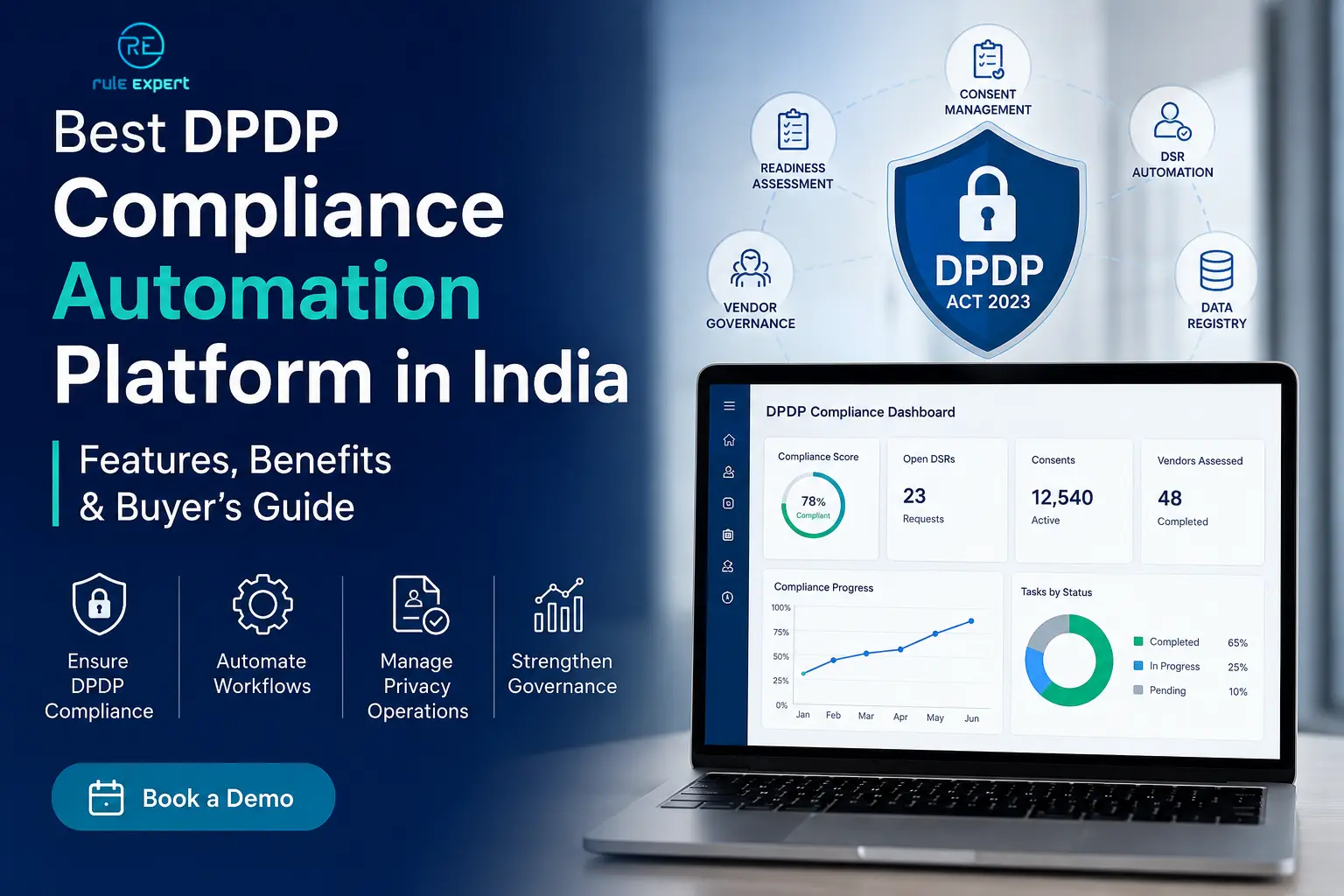
RuleExpert is an AI-powered DPDP Compliance Automation Platform that helps organizations operationalize privacy compliance through centralized workflows, automation, and audit-ready documentation. Instead of relying on spreadsheets, emails, and disconnected systems, organizations can manage their DPDP compliance program through a unified platform.
Rather than functioning as a collection of standalone tools, RuleExpert brings together the key operational components required to support privacy governance throughout the organization.
A Unified Platform for End-to-End DPDP Compliance
Privacy compliance involves multiple business functions including Compliance, Legal, HR, IT, Information Security, Procurement, and Operations.
Managing these responsibilities through separate applications often creates information silos, inconsistent documentation, and duplicated effort.
RuleExpert centralizes privacy operations into a single platform, enabling organizations to:
- Assess DPDP readiness
- Manage the consent lifecycle
- Handle Data Principal requests
- Maintain a centralized data registry
- Coordinate personal data breach response
- Govern third-party vendors
- Automate compliance workflows
- Maintain audit-ready documentation
- Monitor compliance through executive dashboards
By integrating these capabilities into one platform, organizations can improve visibility, strengthen accountability, and standardize privacy operations across departments.
The Six Core Modules of RuleExpert
Instead of purchasing separate point solutions for different privacy functions, organizations can manage key DPDP compliance activities through six integrated modules.
1. DPDP Readiness Assessment
Every compliance journey begins with understanding the organization’s current level of preparedness.
RuleExpert’s DPDP Scorecard helps organizations evaluate their compliance maturity, identify operational gaps, and prioritize improvement initiatives through a structured assessment process. The module includes readiness scoring, executive dashboards, actionable recommendations, and a compliance roadmap to support informed decision-making.
Benefits include:
- Identify compliance gaps early
- Prioritize improvement initiatives
- Measure organizational readiness
- Support strategic planning
- Track compliance progress
Internal Link Suggestion: DPDP Scorecard
2. Consent Management
Managing consent effectively requires more than recording acceptance.
RuleExpert supports the complete consent lifecycle by enabling organizations to collect, manage, track, and maintain consent records within a centralized environment. It also supports purpose management, consent history, withdrawal tracking, and audit trails, helping organizations maintain consistent and verifiable records.
Benefits include:
- Centralized consent records
- Improved traceability
- Better transparency
- Consistent consent governance
- Audit-ready documentation
Internal Link Suggestion: Consent Manager
3. Data Subject Request (DSR) Automation
Managing Data Principal requests manually often involves multiple departments, email chains, and inconsistent tracking.
RuleExpert standardizes this process through automated workflows that support request intake, responsibility assignment, approval workflows, status tracking, SLA monitoring, and centralized documentation.
Benefits include:
- Faster request handling
- Improved accountability
- Standardized workflows
- Centralized tracking
- Better operational visibility
Internal Link Suggestion: DSR Automation
4. Data Registry
Effective privacy governance begins with understanding what personal data the organization processes and where it resides.
RuleExpert’s Data Registry helps maintain a centralized inventory of personal data by supporting data mapping, processing activity records, data classification, business system mapping, data owner identification, and processing purpose documentation.
Benefits include:
- Better visibility into personal data
- Improved governance
- Centralized inventory
- Simplified data mapping
- Enhanced operational control
Internal Link Suggestion: Data Registry
5. Breach Management
Responding effectively to a personal data breach requires coordination, documentation, and timely decision-making.
RuleExpert helps organizations manage the breach lifecycle through structured incident reporting, investigation workflows, risk assessment, evidence management, corrective action tracking, breach documentation, and audit-ready records.
Benefits include:
- Structured incident management
- Improved investigation workflows
- Centralized evidence management
- Better documentation
- Enhanced operational accountability
Internal Link Suggestion: Breach Management
6. Vendor Governance
Organizations increasingly rely on third-party vendors to process personal data.
RuleExpert helps strengthen third-party oversight through vendor inventories, risk assessments, due diligence tracking, compliance reviews, documentation management, review reminders, and governance workflows.
Benefits include:
- Better vendor oversight
- Standardized due diligence
- Centralized vendor records
- Improved compliance tracking
- Stronger third-party governance
Internal Link Suggestion: Vendor Governance
AI-Powered Compliance Assistance
Beyond workflow automation, RuleExpert incorporates AI-powered capabilities to improve operational efficiency.
The platform assists compliance teams by supporting:
- Intelligent workflow guidance
- Documentation assistance
- Compliance insights
- Automated reminders
- Operational recommendations
- Risk visibility
These capabilities are intended to reduce repetitive administrative work while helping teams make informed decisions and maintain consistent privacy operations.
Built for Cross-Functional Collaboration
DPDP compliance is a shared responsibility across multiple business functions.
RuleExpert enables collaboration by providing:
- Role-based access controls
- Department-specific permissions
- Workflow approvals
- Centralized task management
- Secure collaboration
- Executive dashboards
This approach helps teams work together within a structured governance framework while maintaining appropriate access controls.
Why Organizations Choose RuleExpert
Organizations evaluating a DPDP compliance automation platform often look beyond individual features. They need a solution that can support long-term privacy governance and adapt as compliance programs mature.
RuleExpert is designed to help organizations:
- Replace fragmented manual processes with centralized workflows
- Improve visibility into privacy operations
- Standardize compliance activities across departments
- Strengthen documentation and audit readiness
- Support AI-assisted compliance operations
- Build scalable privacy governance
Instead of treating DPDP compliance as a one-time project, RuleExpert enables organizations to establish repeatable operational processes that support continuous compliance management.
How RuleExpert Supports Your DPDP Compliance Journey
A typical compliance journey with RuleExpert may include:
| Compliance Stage | How RuleExpert Helps |
|---|---|
| Assess Readiness | Evaluate current compliance maturity and identify gaps |
| Build Governance | Establish structured privacy workflows |
| Manage Consent | Centralize consent lifecycle management |
| Handle DSRs | Automate Data Principal request workflows |
| Improve Visibility | Maintain a centralized data registry |
| Respond to Breaches | Manage investigations and documentation |
| Govern Vendors | Strengthen third-party oversight |
| Monitor Progress | Track compliance through dashboards and reports |
This integrated approach helps organizations move from reactive compliance management to proactive privacy governance.
Ready to Operationalize DPDP Compliance?
Choosing the right DPDP compliance automation platform is not just about meeting today’s regulatory expectations—it’s about building a scalable foundation for long-term privacy governance.
RuleExpert combines DPDP Readiness Assessment, Consent Management, DSR Automation, Data Registry, Breach Management, and Vendor Governance into a single AI-powered platform designed to simplify compliance operations, improve visibility, and support audit-ready documentation.
Book a personalized demo to see how RuleExpert can help your organization centralize privacy operations, automate compliance workflows, and build a structured approach to DPDP compliance.
DPDP Compliance Automation Platform vs Manual Compliance
Many organizations begin their DPDP compliance journey using existing business tools such as spreadsheets, emails, shared folders, and manually maintained documents. While these methods may appear sufficient during the early stages, they often become difficult to manage as privacy responsibilities expand across departments, business units, and third-party vendors.
As organizations grow, compliance is no longer about maintaining a checklist—it becomes an ongoing operational function that requires coordination, accountability, documentation, and visibility.
A DPDP compliance automation platform helps organizations move from fragmented compliance management to structured, repeatable, and scalable privacy operations.
Manual Compliance vs DPDP Compliance Automation Platform
The following comparison illustrates how automation transforms day-to-day privacy operations.
| Manual Compliance | DPDP Compliance Automation Platform |
|---|---|
| Compliance activities tracked in spreadsheets | Centralized compliance workspace |
| Email-based task coordination | Automated workflow management |
| Scattered documentation | Centralized document repository |
| Manual approval processes | Configurable approval workflows |
| Difficult to monitor progress | Real-time dashboards and reporting |
| Separate systems for different compliance activities | Unified privacy operations platform |
| Manual follow-ups | Automated reminders and notifications |
| Limited visibility for leadership | Executive dashboards and compliance metrics |
| Time-consuming audit preparation | Audit-ready documentation and activity history |
| Inconsistent collaboration across departments | Structured cross-functional collaboration |
Automation does not replace governance—it enables organizations to manage governance more consistently and efficiently.
Operational Benefits of Compliance Automation
Organizations often evaluate compliance software based on individual features. However, the greatest value comes from the operational improvements that automation delivers across the business.
Improved Productivity
Manual compliance requires employees to spend considerable time on administrative tasks such as collecting documentation, following up on approvals, maintaining spreadsheets, and coordinating activities across departments.
Automation reduces repetitive work by standardizing workflows, enabling teams to focus on higher-value compliance and risk management activities.
Better Decision-Making Through Centralized Visibility
Leadership teams require accurate information to monitor privacy operations.
With centralized dashboards, organizations can quickly understand:
- Current compliance status
- Pending privacy activities
- Open Data Principal requests
- Ongoing breach investigations
- Vendor governance progress
- Compliance maturity improvements
This visibility supports more informed business decisions and proactive governance.
Stronger Accountability
Privacy compliance involves multiple stakeholders.
A centralized platform establishes clear ownership by assigning responsibilities, tracking progress, recording approvals, and maintaining complete activity histories.
This reduces uncertainty while improving operational consistency.
Improved Documentation Quality
Documentation is one of the most resource-intensive aspects of compliance.
Automation helps organizations maintain:
- Structured evidence
- Centralized records
- Workflow history
- Activity logs
- Compliance reports
- Audit trails
Instead of searching through emails and shared folders, teams can access information from a single platform.
Consistent Privacy Operations
Standardized workflows help ensure privacy activities are managed consistently regardless of department, location, or business unit.
This improves operational maturity and reduces dependence on individual processes.
Return on Investment Beyond Compliance
Organizations often evaluate software based solely on implementation costs.
A better approach is to consider the broader operational value generated over time.
A DPDP compliance automation platform can contribute to:
- Reduced manual administrative effort
- Improved cross-functional collaboration
- Faster completion of recurring compliance activities
- Better visibility into privacy operations
- More consistent documentation
- Improved governance maturity
- Stronger executive reporting
- Better preparedness for internal reviews and audits
Rather than viewing compliance automation as an operational expense, many organizations see it as an investment in governance efficiency and business resilience.
Who Should Invest in a DPDP Compliance Automation Platform?
While every organization has different operational requirements, compliance automation becomes increasingly valuable when privacy responsibilities involve multiple departments, systems, or third-party vendors.
Organizations that may benefit include:
Healthcare
Hospitals, diagnostic centers, clinics, healthcare technology providers, and laboratories processing sensitive personal data.
BFSI
Banks, NBFCs, insurance companies, fintech organizations, and financial service providers managing large volumes of customer information.
IT and SaaS Companies
Organizations developing digital products, cloud platforms, enterprise software, and technology services.
Manufacturing
Manufacturers processing employee, supplier, distributor, and customer personal data across multiple locations.
Retail and E-commerce
Businesses managing customer accounts, loyalty programs, online transactions, marketing databases, and delivery networks.
Education
Universities, colleges, schools, and EdTech organizations maintaining student, faculty, and administrative records.
Professional Services
Legal firms, consulting organizations, accounting firms, payroll providers, HR outsourcing companies, and business service providers processing client information.
Example Use Cases
While every organization’s privacy program is unique, the following examples illustrate how automation supports common operational scenarios.
Example 1: Managing Customer Consent
Instead of storing consent information across multiple applications and spreadsheets, organizations can maintain centralized consent records with complete lifecycle visibility.
Example 2: Responding to Data Principal Requests
A standardized workflow enables requests to be assigned, reviewed, approved, documented, and monitored through one platform rather than multiple email conversations.
Example 3: Coordinating Breach Response
When a personal data breach occurs, Compliance, IT, Legal, and Security teams can collaborate through structured workflows while maintaining centralized documentation.
Example 4: Vendor Governance
Organizations can maintain vendor inventories, perform due diligence, monitor review schedules, and document governance activities through a centralized workflow.
Example 5: Executive Reporting
Instead of manually preparing compliance updates for leadership meetings, dashboards provide real-time visibility into ongoing privacy operations.
Building Long-Term Privacy Governance
Compliance should not be viewed as a project that ends after implementation.
Organizations should aim to establish operational processes that continuously support:
- Privacy governance
- Personal data management
- Cross-functional collaboration
- Risk monitoring
- Documentation management
- Continuous improvement
A centralized DPDP compliance automation platform provides the operational framework needed to support these activities as organizations grow and regulatory expectations evolve.
Why Organizations Are Moving Toward AI-Powered Compliance Automation
Organizations increasingly recognize that manual compliance processes cannot scale with growing privacy responsibilities.
AI-powered compliance automation helps teams by supporting:
- Workflow prioritization
- Documentation assistance
- Compliance insights
- Operational recommendations
- Risk visibility
- Automated reminders
Combined with structured workflows and centralized governance, AI enables compliance teams to work more efficiently while maintaining appropriate human oversight.
Key Takeaways
Organizations that rely on manual compliance processes often face increasing operational complexity as privacy responsibilities expand.
A DPDP compliance automation platform provides a structured approach to managing privacy operations by centralizing workflows, improving collaboration, maintaining audit-ready documentation, and increasing visibility across the organization.
Rather than simply replacing spreadsheets or emails, automation enables organizations to build a scalable privacy governance framework that supports long-term compliance, operational efficiency, and informed decision-making.
Frequently Asked Questions
1. What is a DPDP compliance automation platform?
A DPDP compliance automation platform is a centralized software solution that helps organizations operationalize compliance with the Digital Personal Data Protection (DPDP) Act, 2023 through workflow automation, documentation management, consent management, Data Principal request handling, data registry, breach management, vendor governance, and compliance reporting. It replaces fragmented manual processes with structured, audit-ready privacy operations.
2. Why do organizations need a DPDP compliance automation platform?
Organizations often manage privacy activities across multiple systems, spreadsheets, and email workflows. As compliance responsibilities grow, these manual processes become difficult to coordinate and monitor. A DPDP compliance automation platform helps centralize workflows, improve operational visibility, standardize documentation, and support ongoing privacy governance.
3. How does AI support DPDP compliance automation?
AI supports compliance teams by assisting with repetitive operational activities rather than replacing human decision-making. Practical capabilities may include workflow assistance, documentation support, compliance insights, operational recommendations, automated reminders, and risk visibility. AI helps improve efficiency while enabling compliance professionals to maintain oversight of critical privacy decisions.
4. What features should I look for in a DPDP compliance automation platform?
Organizations should evaluate platforms that provide:
- DPDP Readiness Assessment
- Consent Lifecycle Management
- Data Subject Request (DSR) Automation
- Centralized Data Registry
- Personal Data Breach Management
- Vendor Governance
- Workflow Automation
- AI-powered Compliance Assistance
- Documentation Automation
- Audit-ready Reporting
- Role-based Access Control
- Enterprise Scalability
A platform that integrates these capabilities provides better operational value than isolated compliance tools.
5. Can a DPDP compliance automation platform replace manual compliance processes?
A compliance automation platform does not replace governance or compliance professionals. Instead, it replaces repetitive manual activities such as spreadsheet tracking, email-based coordination, document management, workflow follow-ups, and status reporting with centralized, structured processes that improve efficiency and accountability.
6. Which organizations should consider implementing a DPDP compliance automation platform?
Organizations that process digital personal data across multiple departments or business systems can benefit from compliance automation. This includes:
- Healthcare organizations
- Banks and NBFCs
- Insurance companies
- IT and SaaS companies
- Manufacturing organizations
- Retail and e-commerce businesses
- Educational institutions
- Professional service providers
Any organization looking to strengthen privacy governance and operational efficiency can benefit from a structured compliance platform.
7. How does RuleExpert help organizations operationalize DPDP compliance?
RuleExpert is an AI-powered DPDP Compliance Automation Platform that brings together DPDP Readiness Assessment, Consent Management, Data Subject Request (DSR) Automation, Data Registry, Breach Management, and Vendor Governance into one centralized platform. It helps organizations automate privacy workflows, maintain audit-ready documentation, improve operational visibility, and support scalable privacy governance.
8. How should organizations evaluate a DPDP compliance automation platform?
Decision-makers should evaluate platforms based on:
- Workflow automation capabilities
- Ease of implementation
- AI-assisted compliance features
- Documentation management
- Reporting and dashboards
- Role-based access controls
- Enterprise scalability
- Integration capabilities
- Audit readiness
- Vendor support and long-term roadmap
Evaluating operational capabilities rather than feature counts helps organizations choose a solution that supports long-term compliance objectives.
9. Does a DPDP compliance automation platform help with audit readiness?
Yes. Modern platforms help organizations maintain centralized documentation, activity logs, workflow history, evidence repositories, compliance reports, and audit trails. These capabilities simplify internal governance activities and support audit preparedness by keeping compliance records organized and accessible.
10. How can organizations get started with RuleExpert?
Organizations can begin by evaluating their current privacy maturity and identifying operational gaps. A personalized RuleExpert demonstration provides an opportunity to explore how the platform supports DPDP readiness assessments, consent management, Data Subject Request automation, data registry, breach management, vendor governance, and AI-powered compliance workflows tailored to organizational requirements.
Conclusion
As organizations adapt to the Digital Personal Data Protection (DPDP) Act, 2023, privacy compliance is becoming an ongoing operational responsibility rather than a periodic regulatory exercise. Managing consent records, Data Principal requests, personal data inventories, breach response, vendor governance, and compliance documentation through manual processes can become increasingly complex as organizations grow.
A DPDP compliance automation platform helps transform these fragmented activities into structured, workflow-driven privacy operations. By centralizing governance, automating repetitive tasks, improving collaboration, and maintaining audit-ready documentation, organizations can strengthen their compliance posture while improving operational efficiency.
When evaluating solutions, decision-makers should look beyond individual features and focus on how well a platform supports end-to-end privacy operations. Capabilities such as DPDP readiness assessment, consent lifecycle management, DSR automation, centralized data registry, breach management, vendor governance, AI-assisted workflows, and executive reporting should work together as part of an integrated compliance ecosystem.
RuleExpert is designed with this objective in mind. As an AI-powered DPDP Compliance Automation Platform, it enables organizations to operationalize privacy compliance through centralized workflows, automation, and audit-ready documentation—helping build scalable and sustainable privacy governance that evolves with business needs.
Ready to Simplify DPDP Compliance?
Managing DPDP compliance doesn’t have to rely on spreadsheets, emails, and disconnected processes.
With RuleExpert, you can centralize privacy operations, automate compliance workflows, strengthen governance, and maintain audit-ready documentation through one integrated platform.
Book a Personalized Demo
Discover how RuleExpert can help your organization:
- Assess DPDP readiness
- Automate consent management
- Streamline Data Principal request handling
- Maintain a centralized data registry
- Manage personal data breaches
- Strengthen vendor governance
- Improve operational visibility with AI-powered compliance automation
Book your personalized RuleExpert demo today and see how your organization can operationalize DPDP compliance with confidence.