

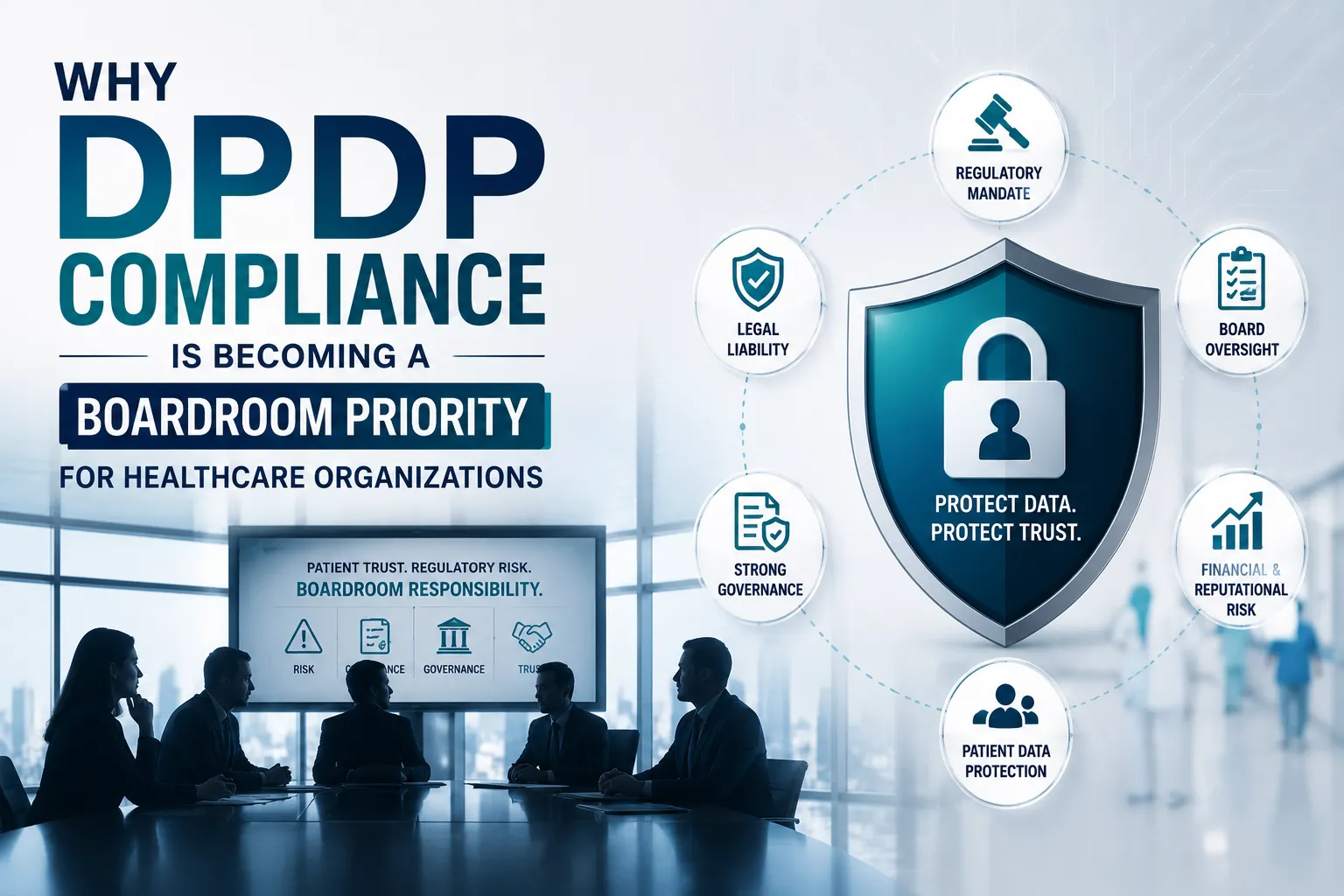
A year ago, most healthcare boards treated data protection the way they treated server maintenance — necessary, invisible, somebody else’s job. That’s over. Walk into a board meeting at a hospital group, a diagnostic chain, or a health-tech platform today and you’ll likely hear a question about consent architecture or vendor exposure sitting right next to the quarterly clinical outcomes review. DPDP in healthcare has become a boardroom priority in Indian healthcare specifically, and faster than most leadership teams planned for.
The reason isn’t abstract. MeitY notified the Digital Personal Data Protection Rules, 2025 in November 2025, alongside a separate notification establishing the Data Protection Board of India — a detail confirmed directly in the government’s own press release on the notification. Full substantive enforcement lands May 13, 2027. That’s a genuinely tight runway once you factor in how long legacy hospital IT systems take to overhaul, and it’s the actual clock this conversation should be running against — not a vague sense that “the law exists.”
The Accountability Shift Boards Didn’t See Coming
Here’s the mechanism worth understanding. The Act designates the hospital, diagnostic chain, or health-tech platform as the Data Fiduciary — the entity that decides why and how personal data is used. That label carries the liability with it. Penalties, Board scrutiny, adjudication proceedings: all of it travels up to whoever actually owns the governance decision, not down to whoever configured the firewall.
For most healthcare boards, that’s new territory. Clinical risk has a home in the quality committee. Financial risk sits with audit. Data risk has historically had no fixed address — it lived wherever IT decided to put it, checked occasionally, rarely questioned.
The Act removes that option. If a hospital network is large enough to be designated a Significant Data Fiduciary — a status many large networks will likely meet given the volume of health data involved, though the government hasn’t finalized the exact designation criteria yet — it’s required to appoint an India-based Data Protection Officer with a real reporting line to the board or a board-designated committee. Once that line exists on paper, ignoring it becomes a much harder position to defend. This shift is central to understanding DPDP in healthcare.
Why Healthcare Draws Sharper Regulatory Attention Than Most Sectors
Three things stack against healthcare specifically. The data itself is unusually revealing — diagnostic results, mental health notes, and reproductive health records tell regulators and the public far more than a retail purchase history ever could, and incidents involving this kind of data tend to get judged more harshly.
The ecosystem is genuinely sprawling — a single patient visit can touch a hospital’s EHR, a lab’s reporting system, an insurer’s claims platform, and the ABDM/ABHA digital health network, and each handoff is a place where consent quietly breaks or a vendor’s weak controls become the hospital’s problem. And scale works against large networks in particular, since high processing volume is one of the factors pushing hospital chains toward Significant Data Fiduciary territory, with its added DPIA and audit obligations.
Put those three together — sensitive data, a sprawling vendor chain, and scale — and healthcare ends up under noticeably sharper scrutiny than most other industries navigating this same law.
What Boards Actually Need to See, in Numbers
The ₹250 crore penalty ceiling for serious security safeguard failures gets the headlines, and it’s real — but it’s the least interesting number for a board actually managing this risk. More relevant: procurement risk, since insurers and referral networks are starting to ask for documented DPDP in healthcare readiness before signing anything, and a shaky record can cost revenue before a regulator ever gets involved.
M&A due diligence, where data governance maturity is becoming a standard line item for hospital acquisitions and health-tech funding rounds, capable of denting valuation on its own. Cyber insurance pricing, where insurers are starting to base premiums on demonstrable governance controls rather than just firewall configuration. And the basic economics of prevention versus cleanup — building consent systems and vendor contracts properly now is consistently cheaper than rebuilding them under pressure after an incident.
None of these are decisions a compliance manager can make alone. They involve budget, risk appetite, and genuine strategic trade-offs — exactly why they’ve moved up the org chart and onto the board agenda.
Reputation Moves Faster Than Any Regulatory Process
Healthcare trust is unusually fragile once it breaks, and there’s real data behind that, not just intuition. A 2026 peer-reviewed study examining data security perceptions across 132 Indian hospitals found that patient and stakeholder trust in data handling is actively eroding, not holding steady — a genuinely uncomfortable finding given how fast the sector is digitizing. That makes DPDP in healthcare as much a trust imperative as a regulatory one.
A leaked report or a breached vendor doesn’t wait for a Board ruling to become a story; local news and patient advocacy groups move faster than any formal proceeding, and the reputational damage regularly outlasts the regulatory process itself. For listed healthcare companies, or ones eyeing a public listing, this exposure also runs straight into investor confidence and disclosure obligations.
The question boards are increasingly asking isn’t “are we compliant” — it’s “how does this look tomorrow morning.” That’s a board-level question by nature, not a compliance-team one.
Building Governance That Actually Holds Up
None of this means directors start reviewing consent forms line by line. It means the board owns the scaffolding that makes implementation credible over time, not just at the moment of an audit.
Give data risk an actual seat — a board risk committee, an audit committee extension, or a standalone privacy function, with someone who has real board visibility owning this the way finance owns financial risk. Make the DPO’s reporting line mean something; a DPO buried three layers down with no clear escalation path produces paperwork, not oversight. Fold data risk into the existing risk register rather than a separate silo that only gets attention during audit season. And ask for evidence, not reassurance — consent logs, vendor DPAs, breach drill results, reviewed on a fixed schedule, not “we’re compliant” taken at face value.
Boards that get this right tend to have a recurring quarterly agenda slot dedicated specifically to DPDP in healthcare posture, a small set of tracked metrics — consent capture rates, DSR resolution time against the statutory clock, vendor DPA coverage — and a named escalation path reaching the board within hours of anything that could plausibly become a reportable breach, not weeks. None of that requires new bureaucracy. It’s the same governance muscle healthcare boards already apply to clinical quality, pointed at a new domain.
In practice, the hospitals furthest along on this aren’t the ones with the biggest compliance budgets — they’re the ones where a specific board member actually asks for the consent-log evidence every quarter, rather than accepting a verbal update. That single habit tends to predict readiness better than headcount does.
A Few Real-World Scenarios
Take a multi-city diagnostic chain gearing up for a private equity round. Its data governance maturity now shows up as a specific line in the due diligence questionnaire, right alongside financial audits and clinical accreditation — investors want documented consent flows and vendor contracts on paper, not verbal assurances.
Or a hospital group entering a data-sharing arrangement with an insurer for cashless claims processing. It turns out the hospital’s own vendor governance, not just its internal systems, determines how fast claims data can move, because the insurer’s compliance team won’t proceed without visibility into what’s happening downstream. Scenarios like this are becoming increasingly common under DPDP in healthcare.
Then there’s a hospital network still working out whether it actually qualifies as a Significant Data Fiduciary. That classification decision ends up shaping budget planning well before any deadline looms — DPO hiring, DPIA processes, independent audits all need lead time that only becomes obvious once the board treats it as something to plan for, rather than something to react to later.
Where This Leaves Boards
DPDP in Healthcare is becoming a boardroom priority isn’t a compliance team’s PR effort — it’s a direct consequence of where the Act places accountability, how sharply healthcare data gets scrutinized, and how fast reputational damage outruns any formal process. Boards that treat this as a recurring governance function, with real evidence and a real escalation path, are in a materially different position from boards still treating it as an IT update that surfaces occasionally.
If your organization needs a clearer picture of where its consent architecture, vendor governance, and breach readiness currently stand — the specific evidence a board should actually be asking for — RuleExpert’s vendor governance and breach management tools are built to produce exactly that kind of documented proof rather than a verbal reassurance. You can also run a free five-minute organizational assessment at ruleexpert.com to see where the gaps sit before a board meeting finds them for you.
Nitin Ray is a thought leader in DPDP compliance, data privacy, breach management, and governance technology. He regularly publishes insights on the Digital Personal Data Protection (DPDP) Act, 2023, helping organizations understand data protection obligations, manage privacy risks, and strengthen compliance programs. His articles focus on practical strategies for Breach Management in DPDP, incident response, privacy governance, vendor risk management, and compliance automation, enabling organizations to protect personal data, improve audit readiness, and build lasting stakeholder trust.
Sources: PIB press release on the DPDP Rules, 2025 notification; Gupta, Gupta & Kumar, “Analysing perception of data security and privacy framework of patients’ data in Indian hospitals,” International Journal of Human Rights in Healthcare (2026).
Frequently Asked Questions About DPDP in Healthcare as a Boardroom Priority
Why has DPDP compliance moved from IT to the boardroom?
Because the DPDP Act designates the organization itself — not IT or the compliance team — as the Data Fiduciary legally accountable for how personal data is handled, meaning penalties and regulatory scrutiny travel directly to leadership rather than staying at the operational level.
What is a Significant Data Fiduciary, and why does it matter for healthcare boards?
It’s a designation for organizations processing high volumes of sensitive data, requiring an India-based Data Protection Officer with a direct board reporting line, plus mandatory DPIAs and independent audits. Many large hospital networks are likely to meet this threshold, though the exact designation criteria aren’t fully finalized yet. For many organizations, this will be one of the defining compliance obligations under DPDP in healthcare.
How does DPDP compliance affect M&A and investment activity in healthcare?
Data governance maturity is increasingly a standard line item in due diligence for hospital acquisitions and health-tech funding rounds, with documented consent flows and vendor contracts expected on paper rather than as verbal assurances.
What financial risks does poor DPDP compliance create beyond regulatory penalties?
Procurement risk from insurers and referral networks requiring documented readiness, valuation impact during M&A due diligence, and higher cyber insurance premiums as insurers begin pricing based on demonstrable governance controls.
What evidence should a board actually ask for on DPDP compliance, instead of a status update?
Documented consent logs, current vendor Data Processing Agreements, DPIA records, and results from breach response drills — reviewed on a fixed schedule rather than accepted as a verbal assurance that the organization is compliant.
How quickly can a healthcare data breach affect reputation compared to regulatory action?
Reputational damage typically moves much faster than any formal Data Protection Board proceeding — local news and patient advocacy groups can turn an incident into a public story well before a regulatory ruling is finalized.
What does good board-level oversight of DPDP compliance actually look like?
A recurring quarterly agenda item specifically for DPDP posture, a small set of tracked metrics like consent capture rates and DSR resolution time, a named fast escalation path for potential breaches, and independent verification rather than the compliance team grading its own work.