On 21 October 2026, State Bank of India told the stock exchanges that customer records had surfaced on the dark web. The SBI data breach is still being investigated, and plenty of answers are missing. The questions it raises, though, are not really about banking. Any company that holds customer names, phone numbers and loan details is one leaked file away from the same headline.
What is the SBI data breach? SBI disclosed on 21 October 2026 that, after reviewing about 3.75 lakh records found on the dark web, it identified 3,897 customer records containing personal information. The bank says the source and extent are still under investigation and that core operations are unaffected.
What happened in the SBI data breach
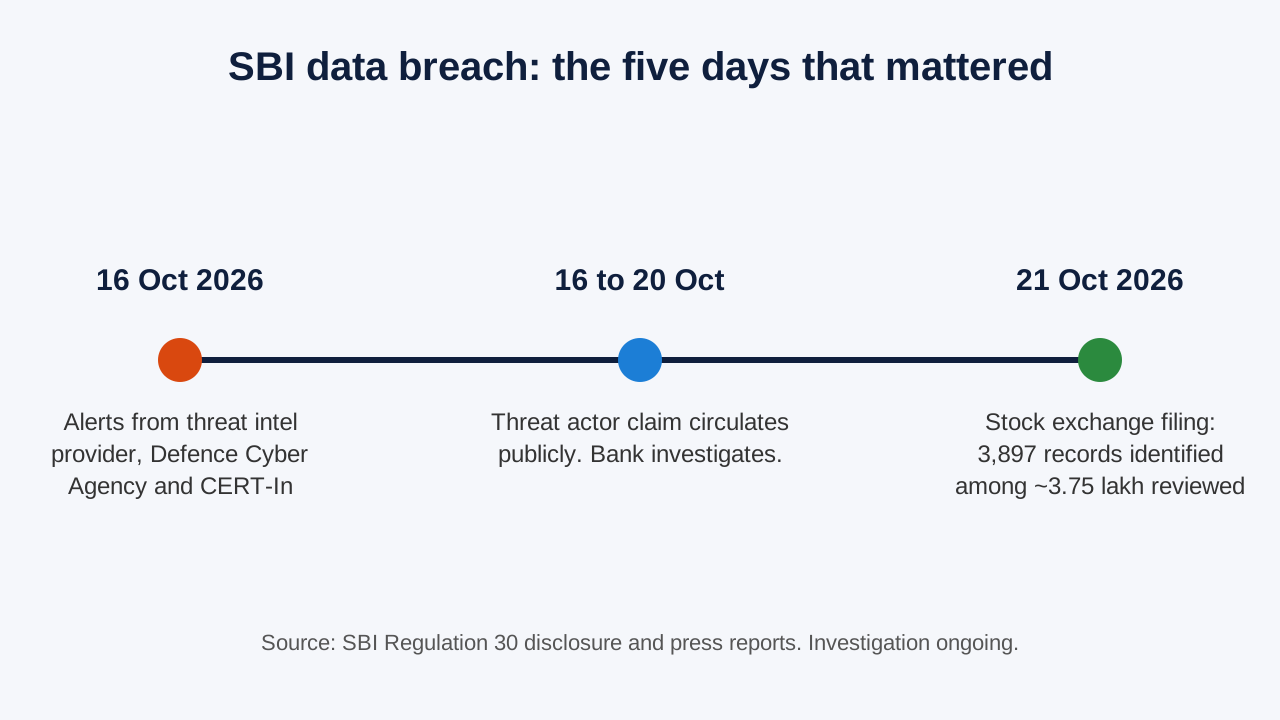
The sequence matters, because the gap between the first alert and the first customer message is where the debate sits.
16 October 2026: SBI received alerts from its threat intelligence provider, the Defence Cyber Agency and CERT-In about suspected customer data on the dark web. The same day, a threat actor calling itself “Siriusim” was reported to have claimed a release of 3.75 lakh rows of data and 2,722 PDF documents linked to SBI.
21 October 2026: SBI filed a disclosure titled “Incident involving Data Loss” with BSE and NSE under Regulation 30 of the SEBI listing regulations. The bank said a preliminary review of roughly 3.75 lakh records found 3,897 containing personally identifiable information. It has activated incident response protocols and engaged an independent CERT-In empanelled agency. It also said the incident has no material impact on core business, financial performance or continuity.
What data was exposed, and why it matters
The identified records reportedly include names, registered mobile numbers, dates of birth, gender, email and residential addresses, branch and customer identification numbers, and metadata tied to loan and lead records. No single field is dramatic. Together they are exactly what a fraud caller needs.
Picture a call from someone who knows your name, date of birth, branch and the loan you applied for. They sound like the bank. The usual advice, never share your OTP, assumes people can tell a fraudster from an official, and leaked data weakens that. This is why who gets told matters as much as what leaked.
What is still unknown
SBI has not yet established whether the data is authentic and complete, where it came from, or how far the exposure goes. Several questions are open:
What do the remaining records, beyond the 3,897 identified, contain?
Are the 2,722 documents claimed by the threat actor genuine, and do they carry identity copies?
How did the data leave the bank’s environment, and did a partner or vendor handle it?
Have the affected customers been told directly? As of the Internet Freedom Foundation’s 21 October analysis, it could find no customer notice.
Which rules apply today
A common assumption is that India has no breach law until the DPDP Act bites. Not quite. Several duties already run to regulators and investors.
Rule or direction
Who it covers
What it requires
Status
CERT-In Directions, 28 April 2022
Service providers, intermediaries, body corporates, government bodies
Report listed cyber incidents to CERT-In within 6 hours of noticing them
In force
RBI cyber security framework for banks
Banks
Initial report to RBI, reported as within 2 to 6 hours
In force
SEBI LODR, Regulation 30
Listed companies
Disclose material events to the exchanges
In force
RBI Advisory No. 3/2026 (25 March 2026)
RBI-supervised entities
Recommends notifying affected customers
Advisory, not binding
DPDP Act s.8(6) and Rule 7
Every Data Fiduciary
Inform the Data Protection Board and each affected person
Commences May 2027
A company can satisfy every row in force today and still leave customers uninformed. That gap closes in May 2027.
What the DPDP Act will require from May 2027
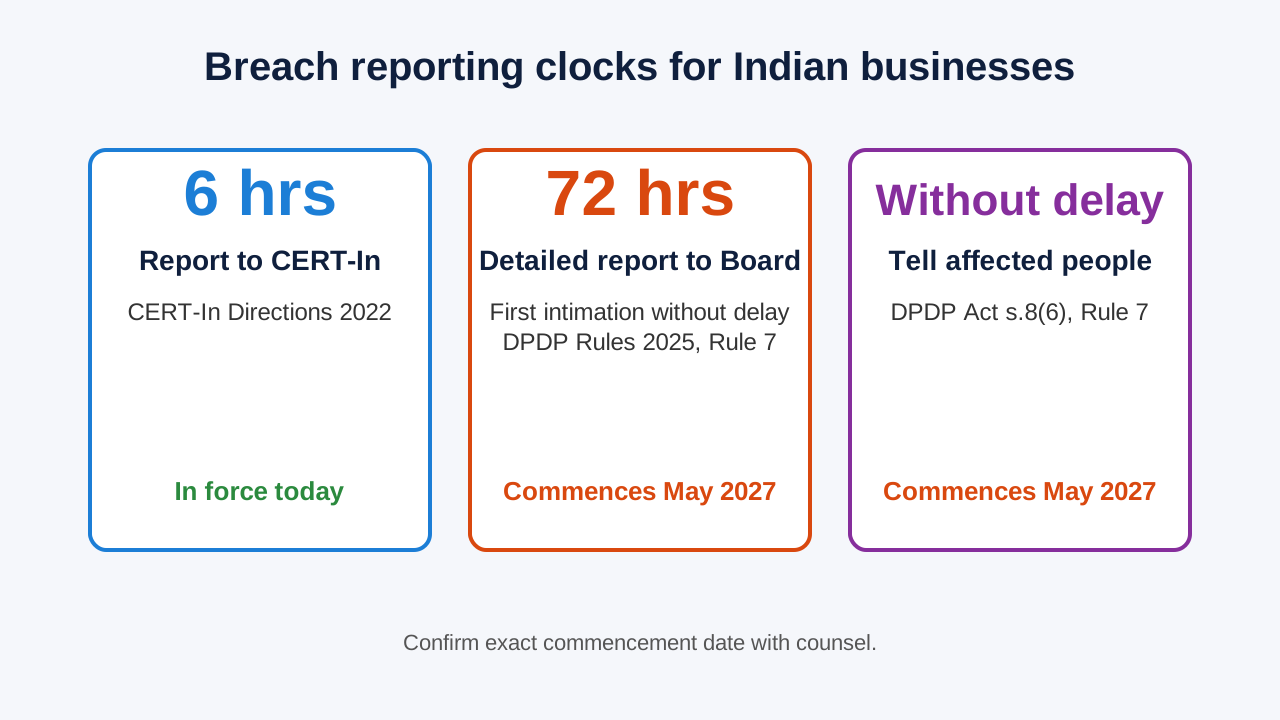
Section 8(6) of the Digital Personal Data Protection Act, 2023 requires a Data Fiduciary to inform the Data Protection Board and every affected Data Principal about a personal data breach. Rule 7 of the DPDP Rules, 2025 supplies the mechanics: an initial intimation to the Board without delay, then detailed particulars within 72 hours, unless the Board allows longer on written request. Affected individuals must also be told without delay, in clear and plain language.
Commentary on the Rules widely notes there is no severity threshold. A small leak is still reportable. Rule 6 adds reasonable security safeguards, and the Act’s Schedule sets penalties of up to ₹250 crore for failing to take them and up to ₹200 crore for failing to notify a breach.
Most of the Rules, including 6 and 7, commence 18 months after the November 2025 notification, which puts them in mid-May 2027. Sources cite 13 or 14 May, so confirm the exact day with your counsel. See also our guides on DPDP breach notification requirements and DPDP penalties and enforcement.
Three clocks start together when you become aware of a breach. Two of them become law in May 2027.
Lessons from other recent banking incidents
SBI is not an outlier. Business Standard’s roundup shows how different the causes can be.
Incident
What happened
Lesson for your business
Bank of Baroda, July 2026
Business email compromise; dataset advertised on a dark-web site
One compromised mailbox can expose a great deal. Enforce multi-factor login and review mailbox access.
C-Edge Technologies, 2024
Ransomware at a technology provider disrupted payments at nearly 300 cooperative and regional rural banks
Your resilience depends on your vendor’s. Map which suppliers sit in your critical path.
ICICI Bank, April 2024
A technical error mapped about 17,000 new credit cards to the wrong users
Not every breach is an attack. Errors that expose data to the wrong person are breaches too.
An illustrative scenario: a lending startup
This is a hypothetical, not a real case. A mid-size lending startup shares loan enquiry data with three sourcing partners through a shared drive. One partner’s employee account is compromised. A week later, a security researcher emails: your leads are on a forum.
Who owns that data? Which systems feed the drive? Which partners hold copies, and what does each contract say about breach notice? Companies with a live data inventory and a vendor register answer in minutes. Companies without one spend the first 24 hours building the list, and the clocks are already running.
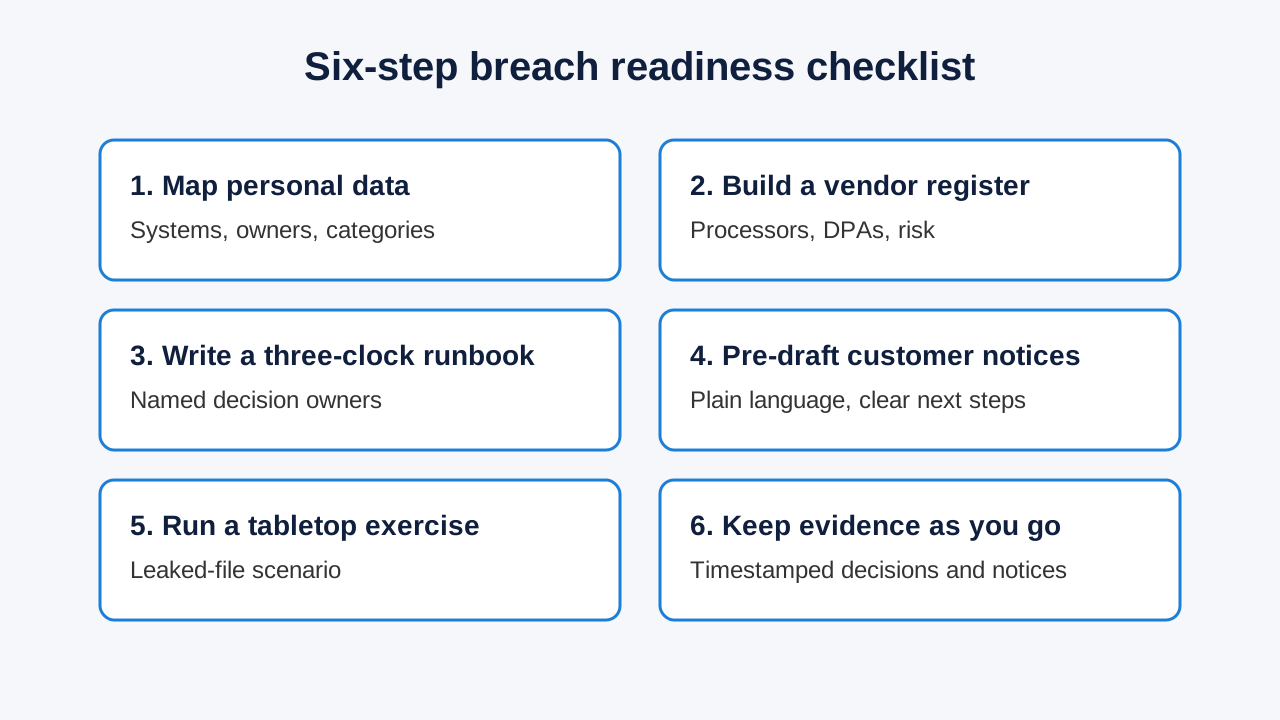
Six steps for your business this quarter
Map where personal data lives. List every system, owner and category. You cannot scope a breach you cannot see.
Build a vendor register. Record who processes data for you, what they touch, and whether a data processing agreement is in place and current.
Write a breach runbook with three clocks. Six hours for CERT-In today, plus Board and individual notice from May 2027. Name the person who decides at each step.
Pre-draft customer notices. Plain language, what was exposed, what to watch for, how to reach you. Writing these at 2 a.m. goes badly.
Run a tabletop exercise. Test with a leaked-file scenario and note where decisions stall.
Keep evidence as you go. Timestamps, decisions and notices should be recorded when they happen, not reconstructed later.
Common mistakes after a breach
Treating a stock exchange or regulator filing as customer notification. They serve different audiences.
Assuming a small leak does not count. The DPDP Rules apply no minimum size.
Waiting for a vendor to call. SBI learnt of its exposure from outside alerts, after the data was already circulating. Monitoring is your job too.
Waiting for 2027. CERT-In’s six-hour direction is already in force.
Where RuleExpert fits
Software does not stop a breach, and it does not replace legal advice or your security team. What it can do is remove the scramble from the response. RuleExpert’s Breach Management module is built to declare, scope and notify against the Rule 7 clock. Vendor Governance keeps a processor register with agreement status and risk scoring, and the Data Registry maps which systems hold which data.
SBI has confirmed that customer records were found on the dark web and is investigating the source. It has not publicly stated how the data left its environment. Until the independent investigation reports, the cause remains unconfirmed.
How many SBI customers were affected?
SBI identified 3,897 customer records containing personal information out of about 3.75 lakh records reviewed. The final number could change, because the bank is still verifying authenticity, completeness and extent.
What SBI customer data was leaked?
Reports of the filing list names, mobile numbers, dates of birth, gender, email and home addresses, branch and customer identification details, and metadata linked to loan and lead records.
Are my SBI account and money safe?
SBI says the incident has no material impact on core operations. Customers should still be careful with calls or messages quoting personal or loan details, never share OTPs or PINs, and report unauthorised transactions to their bank and to 1930.
Is a bank required to tell customers about a data breach?
Not under a binding statute today. RBI Advisory No. 3/2026 recommends customer notification, and the DPDP Act will make individual notice mandatory for all Data Fiduciaries from May 2027.
What is the DPDP breach reporting deadline?
Under Rule 7, intimate the Data Protection Board without delay, then file detailed particulars within 72 hours, unless the Board extends the period. Affected individuals must be told without delay. The rule commences in May 2027.
Does the DPDP Act apply to the SBI incident?
Its breach provisions had not yet commenced when the incident was disclosed. Existing obligations such as CERT-In’s six-hour reporting and RBI and SEBI requirements apply instead.
What is the penalty for failing to report a breach under the DPDP Act?
The Act’s Schedule provides for penalties of up to ₹200 crore for failing to notify a breach and up to ₹250 crore for failing to take reasonable security safeguards. The Data Protection Board decides actual amounts.
Does a small business need a breach response plan?
Yes. The DPDP Act has no revenue or headcount threshold, and CERT-In’s directions cover body corporates broadly. A short runbook, a data inventory and a vendor list are a sensible starting point.
How can a company detect a breach early?
Combine access logging, alerts on unusual downloads, dark-web monitoring through a threat intelligence provider, and a clear route for outsiders to report issues. SBI’s own alerts came from such sources.
I am a Compliance Manager at RuleExpert, focused on helping organizations navigate the evolving landscape of data protection and privacy regulations in India.
With the introduction of the Digital Personal Data Protection (DPDP) Act, businesses are facing new challenges in managing personal data, ensuring consent, and maintaining compliance across systems. My work revolves around simplifying these complexities and enabling organizations to adopt structured, scalable compliance practices.
I specialize in:
DPDP compliance and privacy frameworks
Data governance and risk management
Consent lifecycle and user rights handling
Compliance automation and operational workflows
At RuleExpert, I work closely with startups, SaaS companies, and enterprises to transform compliance from a manual, documentation-heavy process into an automated, infrastructure-driven system.
I am particularly interested in how AI and automation can reshape privacy operations and help businesses build trust in a data-driven world.
In their words
What compliance teams tell us
“We always thought DPDP compliance was the client’s responsibility
since we were only executing services. The evaluation made it clear that how we handle
client data creates risk on our side too. It changed how we work internally.”
DSFounderDigital services firm
“We had a basic understanding of DPDP requirements, but the scorecard
highlighted gaps we hadn’t identified internally — especially around consent handling
and data visibility. It gave us a much clearer starting point.”
BSFounderB2B SaaS company
“The DPDP score was surprisingly insightful. Within minutes we could see
where we stood and what needed immediate attention. It simplified something that initially
felt quite complex.”
FPProduct HeadFintech platform
“After reviewing our score we opted for a consultation. The discussion was
very practical — we got clear direction on what to fix first and how to approach DPDP
compliance in a structured way.”
LGFounderLogistics company
Real client quotes, attributed by role and sector — we never name a client.
Enquiry
Talk to the team
Your enquiry is with the team
Thank you — we have it. Someone will reply by email, usually within one working day.
Nothing else is needed from you. If it is urgent, email
tushar@ruleexpert.com and it will reach the same
people.
Allowing it lets Google Analytics and Google’s advertising measurement set an
identifier and receive your IP address, the pages you view and how you reached them
— used only to see which pages work and whether a campaign led to an enquiry, never to
build a profile or to decide anything about you. Google processes this outside India, a
cross-border transfer under Section 16. Declining changes nothing about the site, and you
can change your mind any time from the footer.
An analytics identifier is personal data, so the DPDP Act applies to
it — though no Indian cookie statute requires this banner. We ask because we would
rather you chose. What we collect and why
 RuleExpert