 RuleExpert
A hospital admission desk in India today is quietly managing more overlapping legal obligations than almost any other single point of data collection in the country. The same patient intake form touches the DPDP Act, the HIV and AIDS (Prevention and Control) Act if a test result turns out positive, the Mental Healthcare Act if the admission involves psychiatric care, the PCPNDT Act if there's any prenatal ultrasound involved, and quite possibly the Ayushman Bharat Digital Mission if the hospital is ABHA-linked. Most generic DPDP content treats healthcare as just another regulated sector. It isn't. It's the sector where the DPDP Act has to coexist with the most pre-existing, sector-specific privacy law already in force.
This guide is built around that reality rather than around a generic compliance checklist. We walk through what actually changes for hospitals, clinics, diagnostic labs, telemedicine platforms, and insurance-linked healthcare operations, grounded in India's specific regulatory landscape rather than a framework borrowed from elsewhere.
If you're new to DPDP's consent mechanics generally, our pillar guide to DPDP consent management for businesses covers the foundational six-pillar standard this piece builds on.
1. Why Healthcare Data Carries Extra Weight Under DPDP
Here's a detail worth correcting early, because it surprises people coming from GDPR or HIPAA backgrounds: the DPDP Act does not create a separate statutory category called "sensitive personal data" the way some other privacy frameworks do. Health data isn't given a formally heavier tier inside the Act itself. Instead, DPDP takes a more uniform, risk-based approach, and the weight health data carries comes from elsewhere: the sheer sensitivity of what's being processed, the scale at which hospitals and labs process it, and critically, the dense layer of sector-specific Indian laws that already governed health data before DPDP existed and continue to apply alongside it.
The 2022 AIIMS Delhi ransomware incident, which compromised tens of millions of patient records and paralysed hospital operations for weeks, is frequently cited precisely because it illustrates what's actually at stake operationally: not just a regulatory fine, but a genuine breakdown in care delivery when health data systems fail. That's the backdrop this guide is written against.
2. Who Counts as a Data Fiduciary in a Hospital Setting
Under the Act, a Data Fiduciary is whoever determines the purpose and means of processing personal data. In a healthcare context, that's a wider net than people initially assume: hospitals and nursing homes, standalone clinics, diagnostic and pathology labs, pharmacy chains, telemedicine platforms, health insurance companies, and Third Party Administrators processing claims all independently qualify. A single patient episode can easily involve four or five separate Data Fiduciaries, each with its own obligations, not one hospital acting alone.
This matters practically because compliance can't stop at the hospital's own four walls. Every lab partner, every TPA, every referral destination that receives patient data is either a Data Fiduciary in its own right or a Data Processor acting on the hospital's instructions, and the contracts governing that relationship need to reflect which one it actually is.
3. The Compliance Stack: DPDP Layered on Existing Health Law
This is the section most generic DPDP content skips, and it's the one that matters most for getting healthcare compliance right rather than generically right.
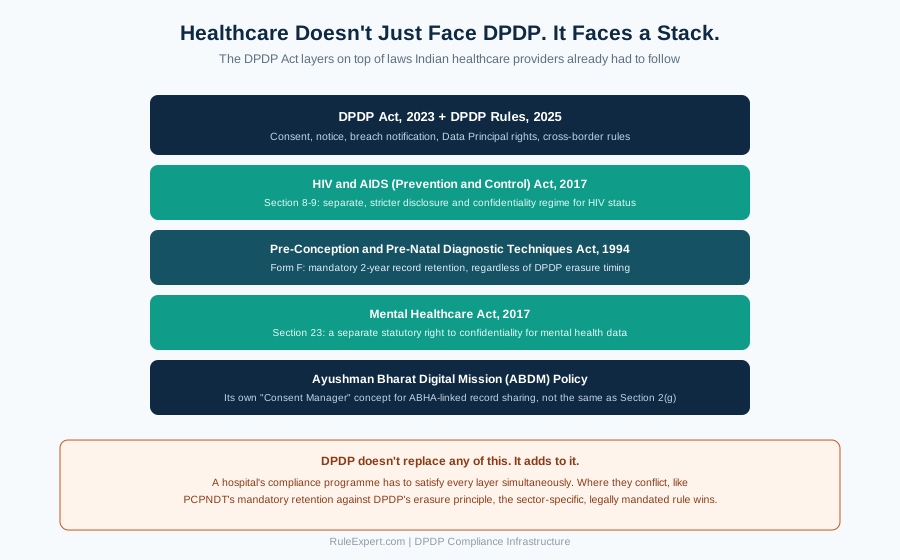
DPDP doesn't arrive in a vacuum. It sits on top of a set of laws Indian healthcare providers already had to comply with, and none of those laws disappear because DPDP exists. The HIV and AIDS (Prevention and Control) Act, 2017 imposes its own, stricter confidentiality regime specifically for HIV-related data. The Pre-Conception and Pre-Natal Diagnostic Techniques Act, 1994 mandates specific record-keeping with its own retention timeline. The Mental Healthcare Act, 2017 gives a separate statutory right to confidentiality for mental health information under Section 23. And the Ayushman Bharat Digital Mission runs its own policy framework for health record sharing, with a consent concept that shares a name with DPDP's but isn't the same thing.
A compliance programme that only maps against the DPDP Act and ignores this stack will pass a generic audit and fail a healthcare-specific one. Where these laws conflict with DPDP's general principles, and they do, in at least one concrete, recurring way, the sector-specific, legally mandated rule generally wins, a point we'll return to below.
4. One Patient, Six Consent Questions
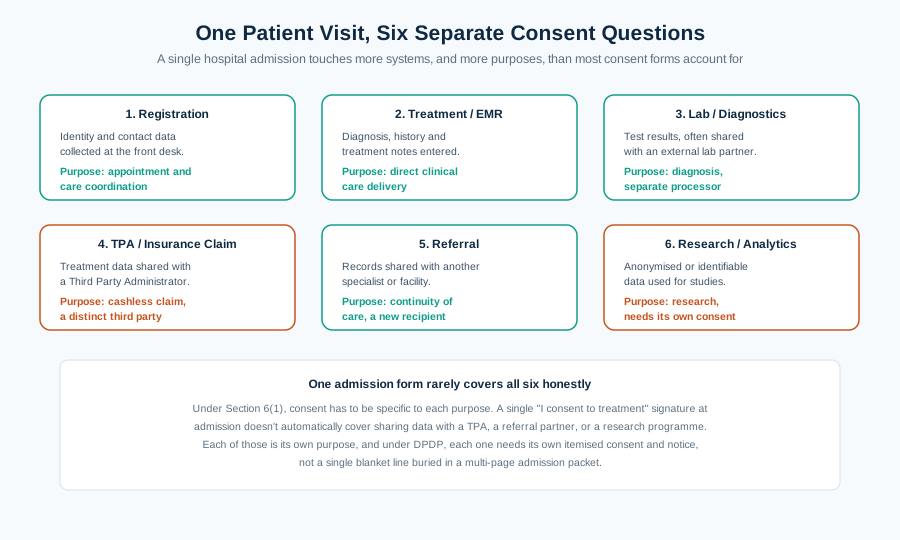
A single hospital visit generates far more distinct "purposes" of processing than most admission forms account for, and under DPDP's Section 6(1), each distinct purpose needs its own specific consent, not one blanket signature.
Registration captures identity and contact data for appointment and care coordination. Treatment and EMR entry captures clinical data for direct care delivery. Lab and diagnostic work often means sharing data with an external partner lab, a separate processing relationship. TPA and insurance claims processing means sharing treatment data with a distinct third party for a cashless claim, arguably the purpose most often bundled incorrectly into a generic admission consent. Referrals to another specialist or facility introduce a new recipient entirely. And research or analytics use, even when data is meant to be anonymised, is its own purpose requiring its own basis.
A single "I consent to treatment" line at admission doesn't honestly cover all six. Hospitals that itemise this properly, even if it means a slightly longer admission process, are the ones actually meeting Section 6(1)'s specificity requirement rather than assuming a broad signature covers everything that happens downstream.
5. HIV Status: A Stricter Regime That Predates DPDP
The HIV Act deserves its own section because its protections are genuinely stronger than DPDP's general consent framework, and healthcare providers need to understand that DPDP compliance doesn't substitute for HIV Act compliance on this specific category of data.
Section 8 of the HIV Act establishes a strong general rule against disclosing a person's HIV status or related information received in confidence or in a fiduciary relationship, without informed consent. Section 9 then carves out a narrow, specifically limited set of exceptions, among them disclosure between healthcare providers directly involved in that person's treatment, and disclosure under a court order. Section 34 separately requires courts to keep the identity of parties anonymous in related legal proceedings, a protection that traces back to the landmark Mr. X v. Hospital Z case and was later written directly into statute.
The practical implication: a hospital's general DPDP-compliant consent form, however well drafted, is not sufficient authorisation to disclose a patient's HIV status to, say, an employer, an insurer, or even a family member, unless that disclosure independently fits within Section 9's specific exceptions. HIV status needs its own explicit handling instructions in any healthcare provider's data governance policy, separate from the general consent and sharing rules that apply to other clinical data.
6. PCPNDT and the Retention Rule That Overrides Erasure
This is the clearest, most concrete example of sector-specific law overriding DPDP's general principles, and it's worth understanding precisely because it illustrates a pattern that shows up elsewhere in healthcare compliance too.
DPDP's Section 8(7) generally expects personal data to be erased once its purpose is served, unless retention is required by another law. The PCPNDT Act is exactly that other law, and it's specific down to the form number. Form F, the mandatory record maintained for every prenatal diagnostic procedure performed on a pregnant woman, must be preserved for a minimum of two years, or until the final disposal of a case if legal proceedings are filed, regardless of whether the hospital's own DPDP-driven data minimisation policy would otherwise call for earlier deletion. Getting Form F wrong, even through an incomplete entry rather than an outright violation, has been treated by courts as an independent offence under the Act, not a mere procedural lapse.
The lesson generalises: wherever a sector-specific Indian health law sets its own explicit retention requirement, that requirement controls, and a hospital's DPDP data minimisation policy needs a documented exception list naming each of these retention mandates individually, rather than a single generic "retain as required by law" clause that doesn't specify which law or for how long.
7. ABDM's Consent Manager Is Not DPDP's Consent Manager
This is a healthcare-specific version of a confusion we've flagged in our broader consent management guide, and it deserves direct attention here because the stakes of getting it wrong in a compliance filing are higher in healthcare specifically.
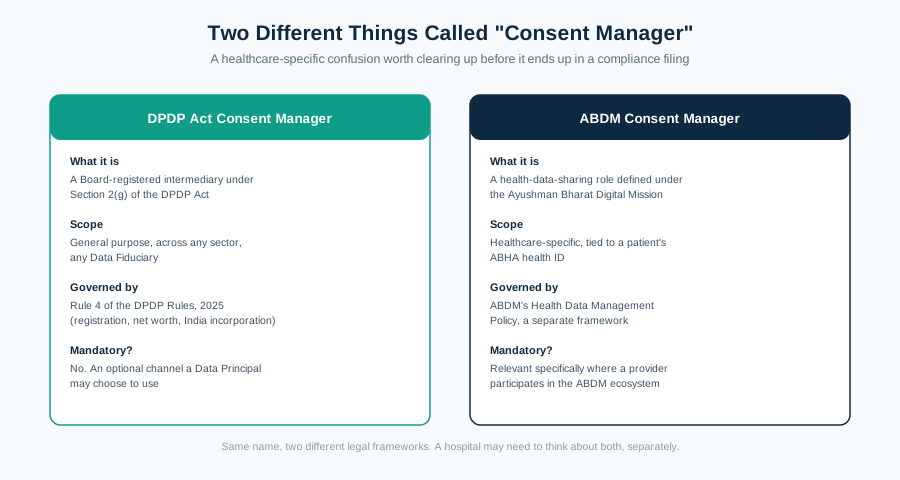
The DPDP Act's Consent Manager, defined under Section 2(g), is a Board-registered intermediary, general-purpose across any sector, governed by Rule 4 of the DPDP Rules, and entirely optional for a Data Principal to use. The Ayushman Bharat Digital Mission operates an entirely separate concept, also called a Consent Manager, under its own Health Data Management Policy, specifically designed to let patients authorise sharing of their health records between providers through their ABHA health ID. These are not the same institution, not governed by the same rules, and not interchangeable in a compliance document.
A hospital participating in the ABDM ecosystem needs to think about both frameworks, separately, and should not assume that integrating with an ABDM Consent Manager automatically satisfies anything related to the DPDP Act's own Consent Manager provisions, or vice versa.
8. TPAs, Insurers, and Third-Party Data Sharing
Cashless insurance claims are one of the most routine, high-volume data flows in Indian healthcare, and one of the most commonly under-governed from a DPDP perspective. Processing a cashless claim means a hospital shares diagnosis, treatment, and billing data with a Third Party Administrator, who in turn shares it with the insurer, all for a purpose distinct from the clinical care itself.
Getting this right requires two things most hospitals don't have in place by default: an itemised consent specific to TPA and insurance sharing, distinct from general treatment consent, and a proper data-sharing agreement with the TPA that establishes whether the TPA is acting as an independent Data Fiduciary or as a Data Processor for that specific flow, since that classification changes who's answerable for what if something goes wrong downstream. Our guide to Vendor Governance under DPDP covers the broader third-party accountability principles this connects to.
9. Could Your Hospital Chain Become a Significant Data Fiduciary?
Large hospital chains and health-tech platforms processing data at scale are genuinely plausible candidates for Significant Data Fiduciary designation once the government begins issuing notifications, given the volume and sensitivity of health data involved and the direct bearing it can have on individual rights. If that designation lands on your organisation, the obligations change substantially: a resident Data Protection Officer answerable to the board, an independent data auditor, annual impact assessments, and algorithmic due diligence for any automated systems touching patient data, diagnostic algorithms and triage tools included.
We've covered the full mechanics of this heavier compliance tier in our dedicated guide to Significant Data Fiduciary obligations under the DPDP Rules, which is worth reading in full if your organisation operates at meaningful scale.
10. What a Breach Actually Looks Like in Healthcare
Healthcare breach response carries stakes beyond the statutory penalty itself. A compromised EMR system doesn't just expose data; it can directly disrupt care delivery, as the AIIMS incident demonstrated at scale. Under the DPDP Act's breach notification framework, there's no materiality threshold: any breach involving patient data triggers notification to both the Data Protection Board and every affected individual, regardless of how contained the incident seemed internally. Given how much of a hospital's data touches multiple systems, EMR, lab systems, TPA integrations, pharmacy records, a breach originating in one system can have downstream notification obligations across several Data Fiduciaries simultaneously. Our complete guide to DPDP breach notification requirements walks through the exact timelines and content requirements this triggers.
11. How to Build Healthcare-Specific DPDP Compliance
A few concrete, healthcare-specific steps worth prioritising:
- Map every distinct processing purpose per patient episode, not just a general "treatment" bucket, covering registration, clinical care, diagnostics, TPA and insurance sharing, referrals, and research separately.
- Build a sector-law retention registry, listing each sector-specific law that mandates its own retention period, PCPNDT's two years being the clearest example, so your DPDP erasure policy has documented, specific exceptions rather than a vague catch-all.
- Separate HIV status and other specially protected data categories into their own handling policy, with disclosure rules that reflect the HIV Act's narrower exceptions rather than general DPDP consent.
- Clarify your ABDM posture explicitly, if you participate in that ecosystem, documenting how the ABDM Consent Manager relationship is distinct from your DPDP consent infrastructure.
- Audit every TPA and lab-partner contract to confirm whether that partner is being treated as a Data Fiduciary or a Data Processor, and whether the paperwork actually reflects that choice.
- Build a healthcare-specific breach response plan, recognising that a single incident can trigger notification obligations for multiple Data Fiduciaries across the patient's care journey simultaneously.
This is precisely the kind of layered, sector-specific gap RuleExpert's platform is built to surface rather than paper over with a generic checklist. If you want to see where your specific hospital or healthcare operation stands against this stack, not just against DPDP in isolation, book a demo with RuleExpert and we'll map it against your actual patient data flows.
12. Mistakes Healthcare Providers Make
- Treating one admission-time consent as covering everything downstream. TPA sharing, referrals, and research use each need their own specific consent under Section 6(1).
- Assuming DPDP consent authorises HIV status disclosure. It doesn't, unless the disclosure independently fits within the HIV Act's own, narrower exceptions.
- Applying a blanket data retention policy without sector-specific exceptions. PCPNDT's Form F retention requirement, and others like it, override general DPDP erasure timing.
- Confusing ABDM's Consent Manager with DPDP's Consent Manager in internal documentation or compliance filings, two different frameworks that happen to share a name.
- Treating TPAs as a simple data transfer rather than a governed relationship requiring a proper contract that specifies Data Fiduciary versus Data Processor status.
- Underestimating SDF exposure for large hospital chains and health-tech platforms, given how directly health data processing touches the volume, sensitivity, and individual-rights factors the Act uses to determine significance.
13. Frequently Asked Questions
Does the DPDP Act treat health data as a special, more sensitive category? Not through a formally named category inside the Act itself. Health data's heightened handling requirements come from a combination of DPDP's general risk-based approach and the separate, pre-existing Indian laws, including the HIV Act, the Mental Healthcare Act, and the PCPNDT Act, that continue to apply alongside it.
Who is considered a Data Fiduciary in a healthcare setting? Hospitals, clinics, diagnostic labs, pharmacy chains, telemedicine platforms, health insurers, and Third Party Administrators processing claims can each independently qualify as Data Fiduciaries, depending on who determines the purpose and means of processing a given set of data.
Does DPDP consent cover disclosure of a patient's HIV status? No. The HIV and AIDS (Prevention and Control) Act, 2017 imposes its own, stricter disclosure regime under Sections 8 and 9, and general DPDP consent does not substitute for the specific exceptions that Act requires.
How does the PCPNDT Act interact with DPDP's data erasure requirements? The PCPNDT Act requires Form F records for prenatal diagnostic procedures to be preserved for a minimum of two years, or until case disposal if proceedings are filed. This sector-specific retention mandate overrides DPDP's general expectation of erasure once a processing purpose is served.
Is ABDM's Consent Manager the same as the DPDP Act's Consent Manager? No. They share a name but are governed by entirely separate frameworks: the DPDP Act's Consent Manager is a Board-registered intermediary under Section 2(g), while ABDM's Consent Manager is a healthcare-specific role under the Ayushman Bharat Digital Mission's own Health Data Management Policy.
Do hospitals need separate consent for sharing data with a TPA or insurer? Yes. Sharing treatment and billing data with a Third Party Administrator for a cashless insurance claim is a distinct processing purpose and generally requires its own specific consent, separate from consent given for clinical treatment.
Can a hospital chain be designated a Significant Data Fiduciary? Yes, this is genuinely plausible for large hospital chains and health-tech platforms, given the volume and sensitivity of the health data they process and its direct bearing on individual rights, once the government begins issuing SDF notifications.
What happens if a hospital's EMR system is breached? Under DPDP's no-threshold breach notification framework, any breach involving patient data must be notified to both the Data Protection Board and every affected individual, regardless of scale, and a single incident can create overlapping obligations for multiple Data Fiduciaries if the breached system is shared across institutions.
Does the Mental Healthcare Act add separate obligations beyond DPDP? Yes. Section 23 of the Mental Healthcare Act, 2017 provides an independent statutory right to confidentiality for mental health information, operating alongside, not replaced by, DPDP's general consent and notice requirements.
Where should a healthcare provider start building DPDP compliance? With a purpose-by-purpose map of a typical patient journey, registration, treatment, diagnostics, TPA sharing, referrals, and research, followed by a sector-specific retention registry that documents every overriding law like the PCPNDT Act, rather than starting from a generic, non-healthcare DPDP checklist.