

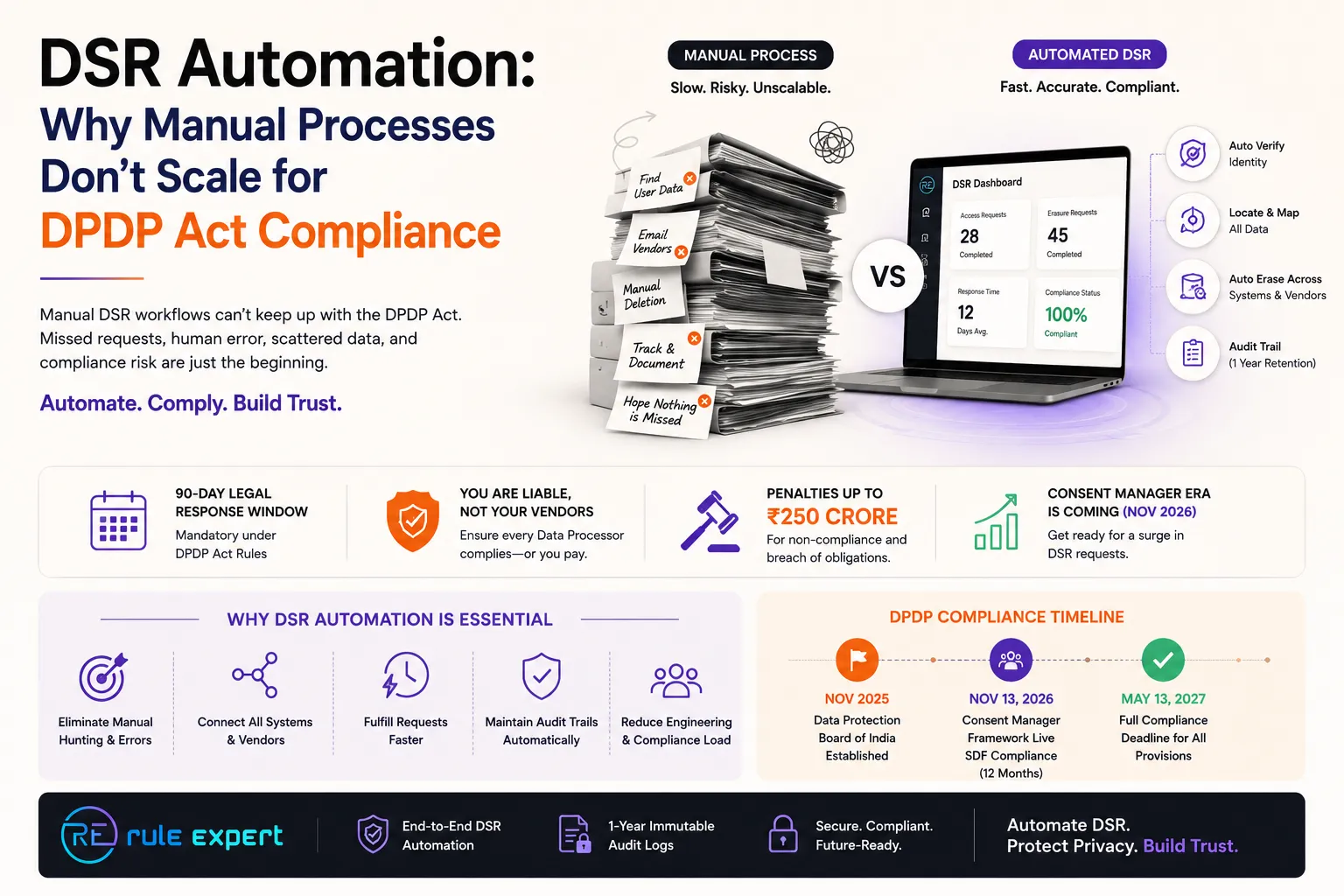
We’ve all been there. Despite the growing importance of DSR Automation, a customer emails support asking to delete their account and all associated data. A support rep forwards the ticket to engineering. Engineering drops it into a Jira backlog. Three weeks later, a developer runs a manual SQL query, deletes a row in the main database, and calls it a day.
That loose, patched-together workflow might have survived five years ago. Today? It’s a massive legal liability.
In November 2025, the Indian government officially notified the operational rules for the Digital Personal Data Protection Act, fully setting the wheels in motion. As a result, DSR Automation has become a critical requirement for organizations preparing for compliance. With the Data Protection Board of India already established and the hard compliance deadline of May 13, 2027 looming, the era of “we’ll figure it out when someone asks” is officially over. Every Data Fiduciary operating in India now faces a very real, strict mandate to give users control over their digital footprints.
If your business relies on humans copying and pasting database IDs to fulfill these requests, you are going to fail. You need DSR automation. Trying to manage consumer privacy rights manually at scale is a guaranteed path to missed deadlines, exhausted engineering teams, and potentially ruinous fines.
The New Rules of the Game
Let’s set the stage. As the need for DSR Automation continues to grow, the DPDP Act 2023 flipped the script on how businesses interact with the people who buy their products or use their services. Under this law, the individual is the Data Principal. They own their information. You—the business deciding how and why that information is used—are the Data Fiduciary.
If you collect Personal Data (anything that can identify someone, directly or indirectly), you are entirely on the hook for protecting it and respecting the owner’s wishes.
The recently notified rules clarify exactly what this looks like in practice. For organizations implementing DSR Automation, these requirements are especially important. Individuals now have legally enforceable rights to access their data, correct inaccuracies, and demand total erasure when the data is no longer needed. And you don’t get to take your time. The government has mandated a strict 90-day maximum window to respond to these requests.
Ninety days might sound generous. It isn’t. Not when you consider the sheer mess of modern data architecture.
The Anatomy of a Manual Nightmare
Think about where a single customer’s data actually lives within your company. This complexity is one of the key reasons DSR Automation has become essential for modern businesses. They sign up on your website. Their email goes into your marketing platform. Their payment details hit your billing software. Their behavior is tracked in product analytics. Their support tickets live in your helpdesk.
When a Data Principal exercises their right to erasure, you can’t just delete their login credentials. You have to purge them from every single system.
Handling this manually is a logistical horror story. Here is what a non-automated process usually looks like:
- Verification: Someone has to make sure the person requesting the data is actually who they claim to be.
- The Hunt: A privacy officer or IT admin messages half a dozen department heads to track down the user’s footprint across 20 different SaaS tools.
- The Vendor Web: You have to contact your third-party vendors (Data Processors) to ensure they also delete the information.
- Execution: Engineers manually comb through databases, terrified of accidentally deleting critical operational metrics while trying to isolate one user’s Personal Data.
- Documentation: You have to log the entire process because the Data Protection Board of India requires proof that you actually did it. In fact, the new rules require you to retain processing logs for a minimum of one year.
Now, imagine doing that 50 times a month. Or 500 times.
Manual processing doesn’t just eat up thousands of expensive engineering hours; it’s inherently prone to human error. A single overlooked database or a misconfigured third-party integration means you haven’t actually complied with the law.
Enter DSR Automation: The Only Way Out
This is exactly why DSR automation has shifted from a “nice-to-have” luxury to absolute baseline infrastructure.
DSR automation is software that connects your entire digital ecosystem—your internal databases, your CRMs, your marketing tools—and centralizes the fulfillment of user privacy requests. Instead of relying on a frantic chain of Slack messages, the software handles the heavy lifting instantly.
When a user submits an access or deletion request, a DSR automation platform takes over. It verifies the user’s identity automatically. It scans your connected systems to locate every instance of that individual’s Personal Data. If it’s a deletion request, the system systematically purges or anonymizes the data across all platforms simultaneously, without a developer ever needing to write a line of SQL.
Most importantly, it generates an immutable, timestamped audit log. If the Data Protection Board of India ever comes knocking, you have immediate, undeniable proof that the request was handled correctly and within the 90-day legal window.
Wrangling Your Data Processors
One of the sneakiest traps in the DPDP Act 2023 is third-party liability. This is another area where DSR Automation plays a critical role. If you share a user’s data with a cloud hosting provider, an email marketing tool, or a payment gateway, they are acting as your Data Processor.
But guess what? If your Data Processor drops the ball and fails to delete a user’s information, you are the one held responsible. The Data Fiduciary bears the ultimate burden of compliance.
You cannot afford to trust manual emails sent to vendor support teams. High-quality DSR automation integrates directly via APIs with your major Data Processors. When you hit “delete” on your end, the automation cascades that command down the supply chain, ensuring the data is wiped everywhere it legally needs to be.
The 2026 Reality Check: Consent Managers and Beyond
We are in a critical transition period. While the Data Protection Board of India was established late last year, the next massive shift hits in November 2026, when the Consent Manager framework becomes operational.
Consent Managers will be registered intermediaries that allow users to manage, review, and withdraw their consent across multiple platforms from a single dashboard. For organizations relying on DSR Automation, this represents a major shift in how privacy requests will be handled. Once this ecosystem is live, the friction for a user to withdraw consent or demand data erasure will drop to zero.
You can expect the volume of Data Principal requests to skyrocket. If your business hasn’t implemented DSR automation before the Consent Manager floodgates open, your compliance team will drown.
The ₹250 Crore Reason to Get This Right
Let’s talk about what happens if you ignore this. The financial teeth of the Digital Personal Data Protection Act are sharp.
₹250 Crore Failing to implement reasonable security safeguards or utterly botching data privacy obligations
₹200 Crore Failing to notify the board or affected users of a breach
₹50 Crore Routine violations of the rules
These aren’t empty threats. The government has explicitly designed the penalty structure to force behavioral change at the corporate level. Investing in robust DSR automation is essentially an insurance policy against catastrophic regulatory fines.
Why RuleExpert is the Smart Play
Navigating this regulatory minefield requires more than just a generic tech tool. You need a platform built specifically for the nuances of Indian privacy law.
This is where RuleExpert separates itself from the pack. Built from the ground up to address the specific requirements of the DPDP Act 2023, RuleExpert delivers end-to-end DSR automation that actually scales with your business.
It doesn’t just automate data deletion. RuleExpert provides:
- Structured, built-in workflows that align perfectly with the latest 2025 rule notifications
- Real-time tracking of the 90-day response window
- Secure handling of identity verification
- Maintenance of the exact one-year audit logs required by law
By deploying RuleExpert, you strip away the administrative chaos and give your engineering teams their time back, all while ensuring your compliance posture is bulletproof.
The May 2027 deadline is approaching fast, but the operational groundwork has to be laid now. DSR automation isn’t just about avoiding fines; it’s about building genuine trust with your users in a privacy-first world.
Author Bio
Nitin Ray is a Compliance Manager at RuleExpert with expertise in DPDP compliance, data privacy, consent management, and governance. He helps organizations implement practical compliance frameworks and automation strategies to meet the requirements of India’s Digital Personal Data Protection Act, 2023.
Frequently Asked Questions (FAQs) About DPDP Act Compliance
1. What exactly is a Data Subject Right (DSR) under the DPDP Act?
While the global standard uses “Data Subject,” India’s law uses the term “Data Principal.” Their rights include the ability to access their personal information, correct any inaccuracies, and request the complete erasure of their data when it’s no longer serving its original purpose.
2. How long do businesses have to respond to a data request?
According to the operational rules notified in late 2025, a Data Fiduciary must respond to and fulfill requests related to access, correction, or erasure within a mandatory maximum window of 90 days.
3. Do you still need DSR automation if you are a small startup?
Yes. Unlike the GDPR, which offers certain exemptions for smaller enterprises, the Digital Personal Data Protection Act applies regardless of your organization’s size. If you process digital Personal Data within India, you must comply. Automation is often even more critical for startups because they lack the massive legal and compliance teams of larger corporations.
4. What happens to data you share with third-party vendors?
Your vendors are classified as Data Processors. Under the law, the Data Fiduciary (you) remains entirely responsible for compliance. If a user requests erasure, you must ensure your Data Processors also delete that data. DSR automation handles this by pushing automated deletion requests via API to your vendor network.
5. How long are you legally required to keep processing logs?
The new rules stipulate that Personal Data processing logs, including records of fulfilled user requests and consent trails, must be retained for a minimum period of one year from the date of processing, unless another specific law mandates a longer retention period.
6. What are the penalties for failing to comply with data requests?
The penalties are severe. General violations of the Act or its associated rules can result in fines up to ₹50 crore. More severe breaches, such as failing to maintain reasonable security safeguards, can trigger massive penalties reaching up to ₹250 crore.
7. When does the law fully take effect?
The government is taking a phased approach. The Data Protection Board of India was established in November 2025. The Consent Manager framework is slated to become operational in November 2026. The absolute deadline for full, comprehensive compliance across all provisions is May 13, 2027.
8. How does the law treat children’s data?
The DPDP Act 2023 is incredibly strict regarding minors. Processing the data of anyone under 18 requires verifiable consent from a parent or lawful guardian. Furthermore, tracking, behavioral monitoring, or targeted advertising directed at children is strictly prohibited, with limited exemptions only for essential healthcare, education, or immediate safety.