 RuleExpert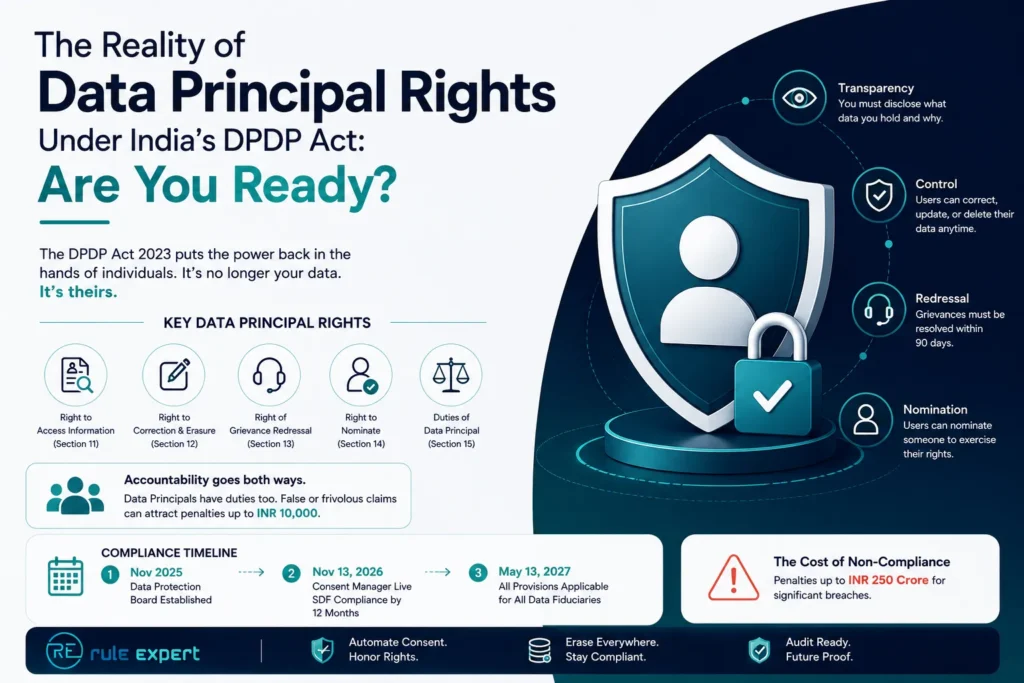
We waited years for clarity around data principal rights, and on November 14, 2025, the Ministry of Electronics and Information Technology (MeitY) finally flipped the switch. The Digital Personal Data Protection (DPDP) Rules 2025 are officially live, moving the legislation from theoretical debate into hard operational reality. If you process the personal information of Indian users, the waiting game is completely over.
The entire philosophy of this law hinges on a radical shift in power back to the individual. Specifically, the framework is built entirely around data principal rights, essentially handing the control of personal data back to the person who generated it. It’s no longer your data. It’s theirs.
Why does this matter right now? Because for the last decade, companies harvested data without looking back. You clicked ‘accept’, and your digital shadow belonged to the platform. You had no real recourse to take it back.
The DPDP Act, and the newly minted 2025 Rules, shatter that dynamic permanently. They formalize the concept of the “Data Principal”—the natural person to whom the data relates. If that person is a child, the parent or lawful guardian holds that title. If it’s a person with a disability who cannot legally act on their own behalf, their guardian steps in to exercise those rights.
But here is the catch that most businesses are currently missing. This isn’t just about obtaining consent anymore. Grabbing consent at the point of sign-up is just table stakes. The core of this legislation is operationalizing data principal rights across your entire tech stack, every single day.
When a user knocks on your digital door and demands to know what you know about them, you can’t just point to a vague, heavily lawyered privacy policy. You have to show them the actual data. If they want it gone, you have to delete it. Everywhere. Not just in your main CRM, but in your backups, your marketing automation tools, and the siloed systems of the third-party vendors you hired.
What Chapter III of the DPDP Act really means
Let’s tear down the specific data principal rights guaranteed under Chapter III of the DPDP Act.
These aren’t casual suggestions. They are statutory mandates enforceable by the newly established Data Protection Board of India (DPBI).
The Right to Access Information (Section 11)
Imagine a user emailing your support team tomorrow asking, “What exactly do you have on me?” Under their data principal rights, you must provide a clear, understandable summary of the personal data you process. They are entitled to know the exact processing purpose.
- They have the right to know what personal data you process.
- They are entitled to know the exact purpose of processing.
- They have the right to know the identities of all third-party Data Fiduciaries and Data Processors who received their data.
Even more challenging for most companies: if your marketing team handed a list of emails to an ad agency, or if your HR department uses a cloud-based payroll vendor, the user has a right to know those specific names. You can no longer hide behind blanket statements like “we share data with trusted partners.” Transparency is now mandatory.
The Right to Correction and Erasure (Section 12)
Data rots. It gets outdated fast. People move, change phone numbers, or simply decide they no longer want to be in your system. This specific facet of data principal rights forces businesses to be hyper-reactive.
- If a user flags inaccurate or misleading data, you must correct it without delay.
- If a profile is incomplete, you fill in the gaps.
- Unless a specific, overriding law requires you to keep the data, you must delete the user’s personal data when consent is withdrawn or the purpose is no longer served.
But the real heavyweight here is the right to erasure. Unless a specific, overriding law requires you to keep the data—like tax regulations or financial anti-money laundering laws—you must delete a user’s personal data when they withdraw consent or when the specified purpose for processing is no longer served.
The DPDP Rules 2025 prescribe strict timelines for e-commerce entities, social media intermediaries, and online gaming platforms to erase data. You cannot hold onto consumer data “just in case” it becomes useful for a future marketing campaign.
The Right of Grievance Redressal (Section 13)
You can’t hide behind a generic ‘no-reply’ email address anymore. The law demands accessible, highly visible grievance redressal mechanisms. If a user feels their data principal rights are being ignored, they need a fast, clear path to complain directly to your organization.
- Grievance channels must be accessible and visible.
- Data Fiduciaries and Consent Managers must resolve grievances within a reasonable period.
- The timeline is strictly capped at 90 days.
If you ignore them or give them a corporate runaround, the issue doesn’t just fade away. The user can escalate the complaint directly to the Data Protection Board. And the DPBI has teeth. They have the power to inquire, summon executives, and levy massive fines for non-compliance.
The Right to Nominate (Section 14)
This is a globally unique feature of the Indian framework. The law recognizes that digital identity outlives physical life. Users have the right to nominate another individual who will exercise their data principal rights in the event of their death or physical/mental incapacity.
- Think of it as a digital will for personal information.
- The nominated person can act when the Data Principal dies or becomes incapable.
- Businesses need a system to verify and authorize that nominee.
Have you built a system to verify and authorize a nominated representative? Most companies haven’t even started thinking about this yet.
The Extraterritorial Reality
You might be reading this from a high-rise in San Francisco or a tech hub in London, assuming Indian domestic law doesn’t apply to your servers. Think again.
The DPDP Act has explicit extraterritorial reach. If you process digital personal data outside of India, but that processing is connected to offering goods or services to Data Principals within India, you are fully bound by this law.
A US-based SaaS company serving Indian clients must honor data principal rights just as strictly as a company headquartered in Mumbai.
The Complexities of Children’s Data
One of the stickiest parts of the 2025 Rules involves children and the protection of data principal rights. Minors cannot grant consent; only their parents or lawful guardians can. This means your platforms need robust mechanisms to verify age and then securely obtain verifiable parental consent before tracking or processing any data.
- Minors cannot consent on their own.
- Only a parent or lawful guardian can consent.
- Platforms must verify age and obtain verifiable parental consent.
- The rules heavily restrict behavioral monitoring and targeted advertising aimed at children.
Honoring the data principal rights of minors requires entirely separate, highly secure workflows that most legacy databases simply aren’t built to handle.
The Duties of the Data Principal (Section 15)
It’s not entirely a one-sided affair. While the legislation heavily arms the consumer with data principal rights, it introduces a fascinating counterbalance: the duties of the Data Principal.
Users can’t just weaponize these rights to harass businesses or commit fraud.
- They must not suppress material information while providing personal data for state-issued IDs or official documents.
- They cannot register false or frivolous grievances with a company or the Board.
- When invoking correction or erasure, they must furnish only verifiable and authentic information.
If a user tries to game the system or harass a fiduciary with bogus claims, they themselves can face a penalty of up to INR 10,000. It’s a small fine compared to corporate penalties, but it establishes a vital legal principle: accountability goes both ways.
The Hard Timelines for Compliance
You might be thinking you have plenty of time to figure this out. That’s a highly dangerous assumption. Let’s look at the enforcement reality based on MeitY’s phased rollout.
Phase one
November 2025 saw the establishment of the Data Protection Board. The regulator is officially in the building and taking shape.
Phase two
Phase two hits fast on November 13, 2026. This is when the Consent Manager framework becomes fully operational.
Furthermore, MeitY is heavily pushing to compress the compliance deadline for Significant Data Fiduciaries (SDFs) down to 12 months. If your business processes high volumes of sensitive data, or poses a significant risk to the rights of data principals, you will likely be classified as an SDF.
- You need a Data Protection Officer based in India.
- You need an independent data auditor.
- You must conduct periodic Data Protection Impact Assessments (DPIAs).
Phase three
Phase three drops on May 13, 2027. That is the absolute final deadline for all other substantive provisions of the DPDP Act and Rules.
- Every single company must fully honor all data principal rights by this date.
- Startups aren’t exempt.
- B2B enterprise platforms aren’t exempt.
- Small e-commerce stores aren’t exempt.
The Operational Nightmare of Manual Compliance
Honoring these data principal rights sounds perfectly reasonable when you read the legal text. Down in the server room, it is an absolute nightmare.
Where does customer data actually live in your organization? It’s rarely confined to a single, neat database.
- It’s in marketing spreadsheets sitting on an intern’s desktop.
- It’s in the raw logs of your customer support software.
- It’s floating around in Slack channels and email threads.
When a user exercises their data principal rights and demands full erasure, how do you track down every instance of their personal data? How do you propagate that deletion command to your third-party vendors? More importantly, how do you prove to the DPBI that you actually deleted it without keeping a record of the data you were supposed to delete?
Manual compliance is a dead end. You cannot manage data principal rights using shared Google Sheets, endless email chains, and sticky notes. The sheer volume of consumer requests, combined with the strict 90-day statutory limit for grievance redressal, will instantly overwhelm a manual process.
If a human error causes you to miss a deadline or botch an erasure request, the penalties are catastrophic—reaching up to INR 250 crore for significant breaches.
Automating the Future with RuleExpert
This is where intelligent automation transitions from a luxury to your only viable survival strategy. RuleExpert was built specifically for this exact regulatory environment.
Instead of throwing panic and extra headcount at the problem, RuleExpert acts as the central nervous system for your DPDP compliance. Think about the Consent Manager framework rolling out in late 2026. RuleExpert integrates directly into your existing data flows to intercept, record, and track user consent dynamically.
- Instant data summaries when a user requests a data report.
- Automated deletion workflows across internal systems and vendors.
- Secure audit trails for compliance proof.
When a user exercises their data principal rights to request a data summary, RuleExpert doesn’t require a legal analyst to spend three days querying disconnected databases. It pulls the mapped data instantly, formatting it into a legally compliant, plain-language response that the user can actually read and understand.
What about the dreaded right to erasure? When a deletion request drops into the queue, RuleExpert triggers automated, system-wide workflows. It executes the deletion command across your connected internal systems and automatically pings your third-party Data Processors with the exact compliance requirements.
Most importantly, it logs the entire interaction securely. It creates an immutable audit trail. When the Data Protection Board eventually comes knocking to verify your compliance practices, you don’t offer them a fragmented spreadsheet. You hand them a cryptographically secure, chronological log of every single time you successfully executed a user’s data principal rights.
The New Digital Reality
The era of unchecked data hoarding in India is officially dead. The November 2025 notification of the DPDP Rules wasn’t just another bureaucratic milestone; it was a fundamental rewiring of the entire digital economy. The focus has completely shifted to the user.
If your core business strategy for 2026 and 2027 doesn’t center around flawlessly operationalizing data principal rights, you are actively inviting regulatory disaster. This isn’t just about updating your website’s privacy policy to sound a bit friendlier. It requires deep, structural changes to how you collect, handle, store, and ultimately destroy human information.
Embrace the shift early. Use purpose-built automation tools like RuleExpert to turn compliance from a massive legal liability into a streamlined, silent background process. Respecting data principal rights isn’t just the law now—it is the absolute baseline for earning customer trust and surviving in India’s new digital reality.
Nitin Ray is a Compliance Manager at RuleExpert with expertise in DPDP compliance, data privacy, consent management, and governance. He helps organizations implement practical compliance frameworks and automation strategies to meet the requirements of India’s Digital Personal Data Protection Act, 2023.
Follow: Medium · Patreon · Pinterest · Quora · Reddit · Tumblr