 RuleExpert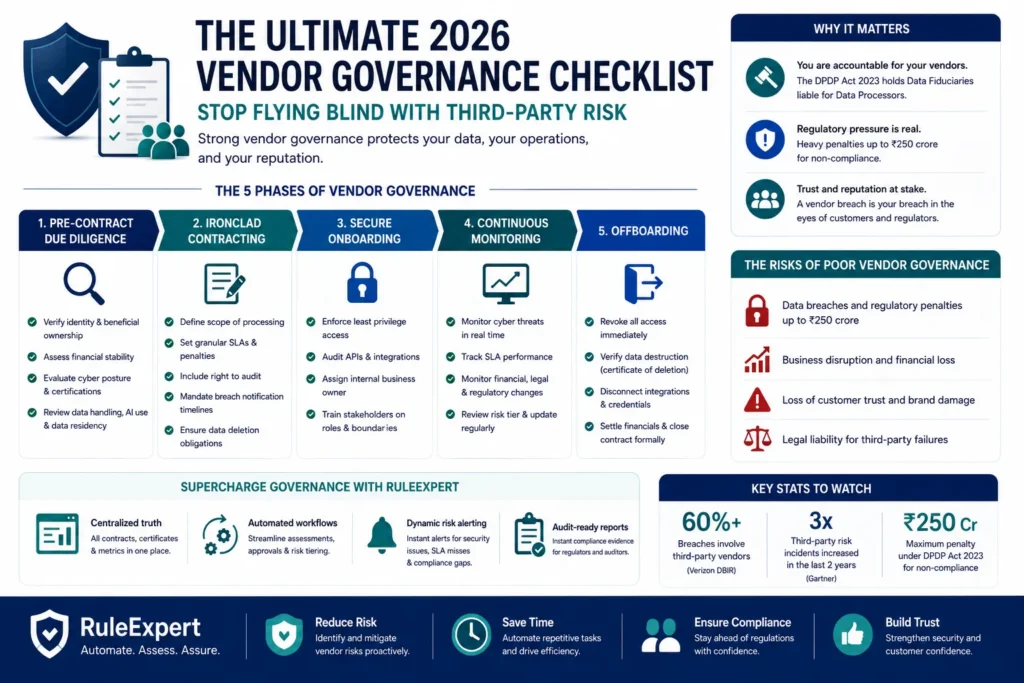
We used to say a company was only as secure as its weakest link. Today, that weak link isn’t even in your building. It’s sitting on a cloud server three time zones away, managed by a subcontractor you didn’t know existed, feeding data into an AI model you don’t control. Welcome to the reality of modern enterprise operations in DPDP Act. If you haven’t overhauled your vendor governance strategy lately, you are operating on borrowed time.
Gone are the days when managing suppliers just meant haggling over software licenses and filing away a static Service Level Agreement (SLA). As organizations weave complex networks of external APIs, logistics partners, and outsourced tech stacks, third-party risk management (TPRM) has morphed into a board-level survival tactic. You are literally handing the keys to your kingdom to outsiders.
So, how do you trust them without getting burned? You stop trusting blind. You verify constantly.
In this deep dive, we’ll tear apart the old, broken ways of managing supplier relationships. We will explore the harsh realities of the 2026 regulatory landscape and hand you a battle-tested vendor governance checklist to lock down your supply chain. We’ll also look at how smart teams are ditching manual spreadsheets in favor of automation tools like RuleExpert.
Why the Old Playbook is Broken
Let’s be honest. For years, the standard approach to managing vendors was basically a paperwork exercise. Procurement would send over a massive, soul-crushing Excel questionnaire. The vendor would check “yes” on every security question, sign the contract, and everyone went back to their day jobs.
That point-in-time approach is dead.
Think about the massive supply chain breaches we’ve witnessed recently. Attackers aren’t kicking down your heavily fortified front door anymore. They are slipping through the side window via a compromised marketing pixel, an over-permissioned analytics tool, or a vulnerability in your vendor’s software.
A static snapshot of a supplier’s health in January tells you absolutely nothing about their risk profile in October. Financial stability shifts. Key security personnel quit. New zero-day vulnerabilities emerge. If your vendor governance framework relies on annual check-ins, you are flying blind the other 364 days of the year.
The 2026 Regulatory Squeeze
Regulators are entirely fed up with companies passing the buck when a third party fails. Across the globe, the leash is getting incredibly tight.
If you do business in or with Europe, you are already feeling the heat of the Digital Operational Resilience Act (DORA), which mandates aggressive oversight of ICT third-party service providers. In the US, frameworks like CMMC (for defense contractors) and updated guidance from the NYDFS are pushing severe mandates onto senior leadership. They demand continuous vulnerability management and explicit third-party cyber risk oversight. You can no longer shrug and say, “Our vendor got hacked, it’s not our fault.” The regulators consider it your fault.
The Modern Vendor Governance Checklist
To survive this hostile landscape, your third-party risk management needs teeth. It needs to span across departments—bridging the silos between procurement, legal, IT, and compliance.
Here is the comprehensive vendor governance checklist designed for the realities of today.
Phase 1: Pre-Contract Due Diligence
Don’t sign anything until you know exactly who you are getting into bed with. This phase isn’t just about functionality; it’s about uncovering hidden skeletons.
- Deep Identity and Beneficial Ownership Verification Who actually owns this company? Are there hidden shell companies, or ties to sanctioned entities?
- Financial Health Stress-Testing A vendor with cash flow problems will inevitably cut corners on security and service delivery. Pull credit behavior indicators and check their financial stability.
- Cyber Posture Assessment Request their SOC 2 Type II or ISO 27001 certifications, but don’t stop there. Run external scans to look for unpatched vulnerabilities on their public-facing assets.
- AI and Data Governance Review Are they feeding your proprietary data into a public Large Language Model? You need explicit answers regarding how they use artificial intelligence and where your data physically lives.
Phase 2: Ironclad Contracting
A handshake means nothing when a server crashes. Your contracts must be weaponized to protect your business.
- Granular SLAs Vague promises of “high availability” are useless. Define exact uptime percentages, latency thresholds, and support response times.
- Financial Penalties Map out clear, enforceable financial clawbacks for SLA failures. If they drop the ball, they pay.
- The “Right to Audit” Clause You must retain the legal right to send in your own auditors (or a certified third party) to inspect their operations at any time.
- Breach Notification Timelines Mandate that the vendor must notify your security team within a specific window (e.g., 24 to 72 hours) of discovering a data breach.
Phase 3: Secure Onboarding
This is where most companies screw up. They sign the deal and immediately grant the vendor admin access to everything.
- Enforce the Principle of Least Privilege (PoLP) The vendor gets access only to the exact systems and data required to do their job. Nothing more.
- API and Integration Audits Map exactly how their software connects to yours. Monitor these digital bridges relentlessly.
- Internal Stakeholder Training Assign an internal business owner to the relationship. They need to understand the boundaries of the contract and the red flags to watch for.
Phase 4: Continuous Monitoring
You’ve segmented your suppliers by risk tier (High, Medium, Low). Now, you monitor them accordingly. Manual tracking won’t scale here; you need automation.
- Real-Time Cyber Threat Intelligence Track their security posture dynamically. If a vendor suddenly leaves a database exposed to the internet, you should get an alert before the attackers find it.
- SLA Performance Tracking Are they actually hitting the metrics they promised? Collect objective performance data, not just what the vendor reports.
- Regulatory and Legal Tracking Set up alerts for adverse media, sudden litigation, or shifts in their tax compliance behavior. A lawsuit against a key supplier is your problem, too.
Phase 5: Offboarding
When a contract ends, the risk doesn’t magically evaporate. A messy offboarding can leave dangerous backdoors wide open.
- Instant Credential Revocation The minute the contract terminates, shut off all physical and digital access. Terminate VPNs, disable shared accounts, and cut API connections.
- Verifiable Data Destruction Demand proof that they have securely wiped your corporate data from their servers. A simple email saying “we deleted it” isn’t enough; require a certificate of destruction.
- Final Legal and Financial Reconciliation Ensure all outstanding invoices are settled and final SLA penalties are applied before closing the books.
Why Manual TPRM is a Ticking Time Bomb
If you look at that checklist and think, “We can handle that with a few spreadsheets and a shared drive,” you are wildly underestimating the complexity of modern vendor governance.
When organizations try to scale manual oversight, the cracks show immediately:
- Procurement teams get crushed by administrative bloat.
- Security analysts suffer from alert fatigue, unable to distinguish a critical vendor vulnerability from a low-level glitch.
- Departments operate in total silos—legal doesn’t know what IT is doing, and compliance is always playing catch-up.
Worst of all? You end up punishing your vendors with endless, redundant questionnaires that take weeks to process, slowing down business critical initiatives.
Supercharging Governance with RuleExpert
You can’t out-work third-party risk with raw manpower anymore. You have to out-smart it with technology. This is where a dedicated compliance and automation platform changes the entire game.
Using an advanced solution like RuleExpert takes the heavy lifting out of vendor governance. Instead of chasing down signatures and cross-referencing PDFs, you let the software run the engine.
- Centralized Truth RuleExpert pulls every contract, compliance certificate, and SLA metric into a single, un-siloed dashboard. No more hunting through email threads to find out if a critical supplier updated their SOC 2 report.
- Automated Workflows From onboarding questionnaires to automated risk tiering, the software guides suppliers through the exact friction points you require, dropping them right into your approval queues.
- Dynamic Risk Alerting This is the killer feature. RuleExpert continuously monitors your ecosystem. If a high-risk vendor falls out of compliance, misses an SLA target, or gets flagged for a security vulnerability, the system fires off instant alerts to the right internal stakeholders.
When you automate the grunt work, your teams can stop acting like administrative paper-pushers and start acting like strategic risk managers.
The Bottom Line
Effective vendor governance isn’t a defensive chore; it’s a competitive weapon. When you know your supply chain is bulletproof, you can move faster, integrate deeper, and innovate harder than competitors who are still terrified of their own shadow.
Stop accepting blind risk. Demand transparency, enforce your contracts, and leverage smart automation to keep your digital borders secure.
Frequently Asked Questions (FAQs)
1. What is the difference between vendor management and vendor governance?
Vendor management usually focuses on the day-to-day operational relationship—getting the product delivered and paying the invoices. Vendor governance is the overarching strategic framework. It dictates the rules, risk controls, compliance checks, and SLA enforcements that govern how that relationship operates safely.
2. How often should we reassess our vendors?
It depends entirely on their risk tier. Low-risk vendors (like an office supply company) might only need an annual or bi-annual check. High-risk vendors (like a cloud hosting provider or a payroll processor) require continuous, real-time monitoring and strict quarterly reviews.
3. What is “Concentration Risk” in third-party ecosystems?
Concentration risk happens when you rely too heavily on a single vendor for critical operations, or when multiple vendors in your supply chain all rely on the same downstream provider (an Nth-party risk). If that single node fails, your entire business grinds to a halt.
4. Can we be held legally responsible if our vendor suffers a data breach?
Absolutely. Under frameworks like GDPR, DPDP Act, and various state-level privacy laws, the data owner (you) bears ultimate responsibility for protecting user information. If your vendor leaks it, regulators will penalize you for failing to implement adequate third-party oversight.
5. How do we handle vendors who refuse to sign our standard security agreements?
This is a major red flag. If a vendor refuses to agree to right-to-audit clauses or basic data protection standards, you have two choices: mandate a compensating control (like keeping their access heavily restricted and monitored) or find a new vendor. Never compromise your core security posture to accommodate a stubborn supplier.
6. What role does AI play in modern vendor risks?
AI complicates things immensely. Vendors might use your proprietary data to train their internal models, leading to data leakage. Additionally, AI-driven tools often update outside of normal change-management cycles. You must demand transparency about how a vendor uses AI and explicitly restrict them from using your confidential data for model training without consent.
7. Why is continuous monitoring better than point-in-time assessments?
A point-in-time assessment (like an annual questionnaire) only proves the vendor was secure on the day they filled it out. Continuous monitoring uses automated threat intelligence and API connections to track their security posture, financial health, and compliance status 24/7, catching sudden deteriorations instantly.
8. How can small businesses implement vendor governance without a massive team?
Start small but strict. Categorize your vendors to identify the top 10% that actually pose a risk to your business. Focus your energy there. Leverage standardized templates for contracts and adopt affordable automation tools like RuleExpert to handle the repetitive tracking and alerts, freeing up your limited headcount for actual decision-making.