 RuleExpert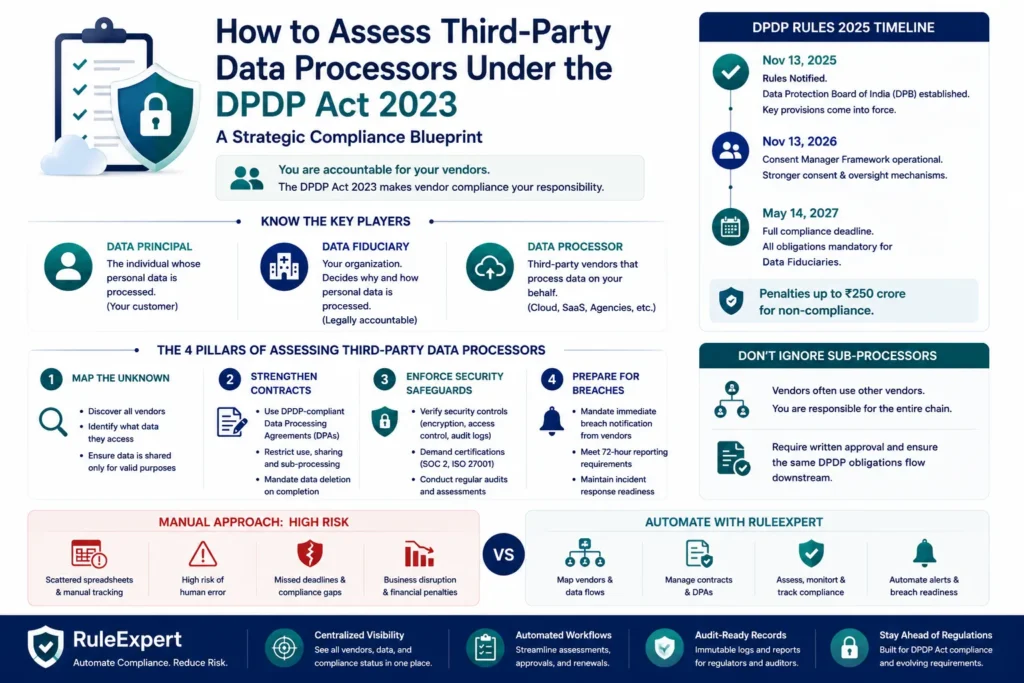
In the modern digital economy, no business is an island. We operate in a deeply interconnected ecosystem where your organization likely shares data with dozens, if not hundreds, of external partners every single day. From cloud storage vendors and payroll processors to AI-driven marketing analytics tools, the machinery of modern business relies heavily on the outsourcing of data operations. However, this convenience comes with a catch. Under the Digital Personal Data Protection Act (DPDP Act) 2023, you cannot simply outsource your responsibilities. When you hand off data, you are handing off your accountability. Knowing how to assess third-party data processors is no longer just a technical checkbox—it is a foundational pillar of your organization’s survival, legal standing, and reputation.
For businesses acting as Data Fiduciaries, the legal landscape has shifted dramatically. The DPDP Act 2023 isn’t a suggestion; it is a rigid mandate that holds the primary entity—you—responsible for the integrity, security, and ethical handling of the data processed by your vendors. This guide moves past the dry legalese to offer a practical, strategy-driven approach to assessing your vendor ecosystem, ensuring you stay ahead of the curve, and building a compliant, trust-centric brand in the process.
The Reality of Outsourcing: Who Actually Handles Your Data?
Before we dive into the “how,” we need to confront the “who.” A common mistake businesses make is assuming that only their biggest cloud provider acts as a processor. The truth is far more sprawling.
Under the DPDP Act 2023, a Data Processor is defined broadly as any person or entity that processes personal data on behalf of a Data Fiduciary. This covers the obvious suspects—like CRM platforms and payroll services—but it also hides in the nuances of your supply chain. Do you use an external agency for lead generation? Do you utilize a specialized firm for customer support ticketing? Even the maintenance company that manages your physical server racks might cross the threshold depending on their access rights.
If you are a Data Fiduciary, the burden of proof rests on your shoulders. You must be able to demonstrate, to the Data Protection Board of India if necessary, that you have vetted these entities thoroughly. When you fail to assess third-party data processors effectively, you aren’t just inviting regulatory risk; you are effectively blind to the vulnerabilities inherent in your own data lifecycle.
The Regulatory Framework: Why Due Diligence is Non-Negotiable
The DPDP Act 2023 changed the rules of engagement. Before the act, a standard service agreement was often enough to wash a company’s hands of liability. Those days are gone. Section 8(2) of the Act is explicit: a Data Fiduciary may engage a Data Processor only under a valid contract. This isn’t just about getting a signature on a document; it’s about ensuring that the contract carries enough weight to enforce compliance.
Consider the potential fallout. If a breach occurs within a vendor’s infrastructure, the regulator will knock on your door first. The penalties under the DPDP Act 2023 are not slaps on the wrist; we are talking about financial consequences that can reach hundreds of crores. More damaging, perhaps, is the erosion of consumer trust. Data Principals—your customers—are becoming increasingly savvy. They know their rights, and they know who is responsible for their data. If you lose control of that data because you didn’t properly vet a vendor, you aren’t just facing legal action—you’re facing a brand crisis.
A Strategic Approach to Assessing Third-Party Data Processors
Assessing a vendor isn’t a one-time “set it and forget it” task. It is a continuous loop. Here is how to structure your assessment process to ensure you are fully compliant and operationally resilient.
Phase 1: The Initial Data Inventory and Risk Audit
You cannot protect what you cannot see. Your first step is to conduct a comprehensive data audit. Map out exactly where the data flows.
- Classification: Identify which vendors handle sensitive personal data versus non-sensitive data.
- Access Review: Determine the scope of access. Does this vendor have broad, unrestricted access, or is it limited to specific, necessary datasets?
- Vendor Tiering: Categorize your vendors based on risk. A vendor that processes millions of customer records is in a different risk tier than one managing a small, internal HR utility.
Phase 2: Verifying Security Posture and Rule 6 Compliance
The DPDP Rules 2025 (which supplement the Act) demand strict technical and organizational measures. You must demand evidence that your vendors are not just talking about security, but living it.
- Evidence over Affirmation: Don’t just take their word for it. Ask for their SOC2 Type II reports, ISO/IEC 27001 certifications, or equivalent security audits.
- The “Need to Know” Principle: Verify that the vendor enforces privilege restrictions. Can their employees access your data without clear authorization? If the answer is yes, that is a red flag.
- Data Residency and Erasure: Check their protocols regarding data storage locations and, crucially, their ability to purge data when the contract expires or the processing purpose is fulfilled, per Rule 8 requirements.
Phase 3: The Data Processing Agreement (DPA)
Your contract is your primary shield. A generic Service Level Agreement (SLA) is insufficient. You need a robust Data Processing Agreement (DPA) that explicitly binds the processor to the DPDP Act 2023. This contract must clearly outline:
- Scope of Processing: Define exactly what they can do, why they can do it, and what they absolutely cannot do.
- Breach Notification Obligations: Your vendor must have a contractually obligated timeline to inform you of a breach. Given the regulatory requirement to report breaches to the Data Protection Board within 72 hours, your contract should mandate vendor reporting to you within 24 hours.
- Right to Audit: Ensure you retain the right to conduct, or commission, independent security audits of their systems.
Phase 4: Managing the Sub-Processor Web
This is where many businesses trip up. Your processor might be compliant, but who are they using? If your cloud vendor outsources to a smaller, unsecured third-party data processor, you are still exposed. Your DPA must include “flow-down” clauses—meaning your vendor is contractually obligated to impose the same strict DPDP standards on their own subcontractors.
The Human Error Factor
Even with a perfect checklist, things fall through the cracks. Why? Because manual compliance is prone to human fatigue. Your legal team is busy. Your IT team is focused on uptime. The assessment of third-party data processors often becomes a frantic, last-minute sprint right before contract renewal.
This is exactly where the risk resides—the “check-the-box” mentality that misses the subtle signs of non-compliance. When you rely on spreadsheets to track vendor risk, you miss the version control, you miss the expiring certifications, and you miss the evolving threat landscape. You need a centralized, automated source of truth.
How RuleExpert Streamlines the Process
For businesses navigating the complexities of the DPDP Act 2023, manual oversight is an outdated strategy. RuleExpert is designed to remove the friction from compliance by automating the very assessments that often trip up growing organizations.
- Automated Risk Scoring: RuleExpert instantly evaluates the security posture of your third-party data processors against the specific mandates of the DPDP Act. It moves you from subjective opinion to objective data-driven risk management.
- Contract Lifecycle Management: Never let a compliance clause lapse. RuleExpert tracks your DPAs, ensuring that every vendor relationship is backed by valid, legally binding terms that meet current regulatory notices.
- Real-Time Monitoring and Reporting: Compliance isn’t a snapshot; it’s a video. RuleExpert provides ongoing oversight, ensuring that your vendors maintain their security standards throughout the entire contract lifecycle, not just at the time of signing.
- Centralized Audit Trail: When the Data Protection Board of India comes knocking, you don’t want to be scrambling through emails. RuleExpert maintains a pristine, audit-ready repository of every assessment, every contract, and every security credential, giving you instant evidence of your compliance.
By leveraging automation, you are not just saving time—you are building a repeatable, scalable, and defensible compliance strategy. You are moving from a state of reactive panic to a state of proactive readiness.
Conclusion: Compliance as a Competitive Advantage
The shift toward strict data protection in India is not a temporary trend; it is the new baseline for doing business. The DPDP Act 2023 is a signal that the era of “move fast and break things” is over. The new mantra is “move securely and build trust.”
Assessing third-party data processors is a task that never truly ends. It requires constant vigilance, a structured approach, and the right tools. By taking ownership of your vendor risk today, you are insulating your business against the catastrophic costs of non-compliance and, more importantly, showing your customers that their privacy is a priority, not an afterthought.
Don’t wait for a breach to realize where your gaps are. Build a robust vendor assessment framework now, automate the heavy lifting with RuleExpert, and position your company as a leader in the data-driven economy.
Frequently Asked Questions (FAQs)
1. Does the DPDP Act 2023 hold me responsible if my vendor has a data breach? Yes. As a Data Fiduciary, you are the primary point of accountability. While you can seek indemnity from your vendor through contracts, you remain responsible for the data breach in the eyes of the law and the regulator.
2. What is the difference between a Data Fiduciary and a Data Processor? A Data Fiduciary is the entity that determines the purpose and means of data processing (typically the business collecting customer data). A Data Processor is the third-party entity (vendor) that processes that data on your behalf.
3. Are there specific requirements for cross-border data processing? Yes. The DPDP Act 2023 empowers the government to restrict data transfers to certain countries. You must ensure that your third-party data processors adhere to any specific notifications regarding cross-border flows issued by the government.
4. How often should I reassess my third-party data processors? Compliance is not a one-time event. You should conduct a formal reassessment at least annually, or immediately following any significant changes in the vendor’s services, a reported data breach, or a change in the regulatory framework.
5. What happens if I don’t sign a DPA with my vendors? Operating without a valid contract that mandates DPDP Act compliance is a direct violation of Section 8(2) of the Act. This can lead to heavy financial penalties and severe regulatory scrutiny during an audit.
6. Can I delegate my accountability to a large, reputable cloud provider? No. You cannot outsource your legal obligations. While a reputable provider may offer strong security features, you are still responsible for ensuring those features are configured correctly to meet your specific compliance requirements under the Act.
7. Does the RuleExpert platform help with managing sub-processors? Yes. RuleExpert includes features designed to map the supply chain, including the oversight of sub-processors used by your direct vendors, ensuring your compliance umbrella covers the entire data flow.
8. What constitutes a “Data Breach” that needs to be reported? Any unauthorized access, disclosure, use, alteration, or destruction of personal data that leads to a risk of harm to the Data Principal constitutes a breach. Under the DPDP Act, these must be reported to the Data Protection Board of India within 72 hours.
“`html “`