 RuleExpert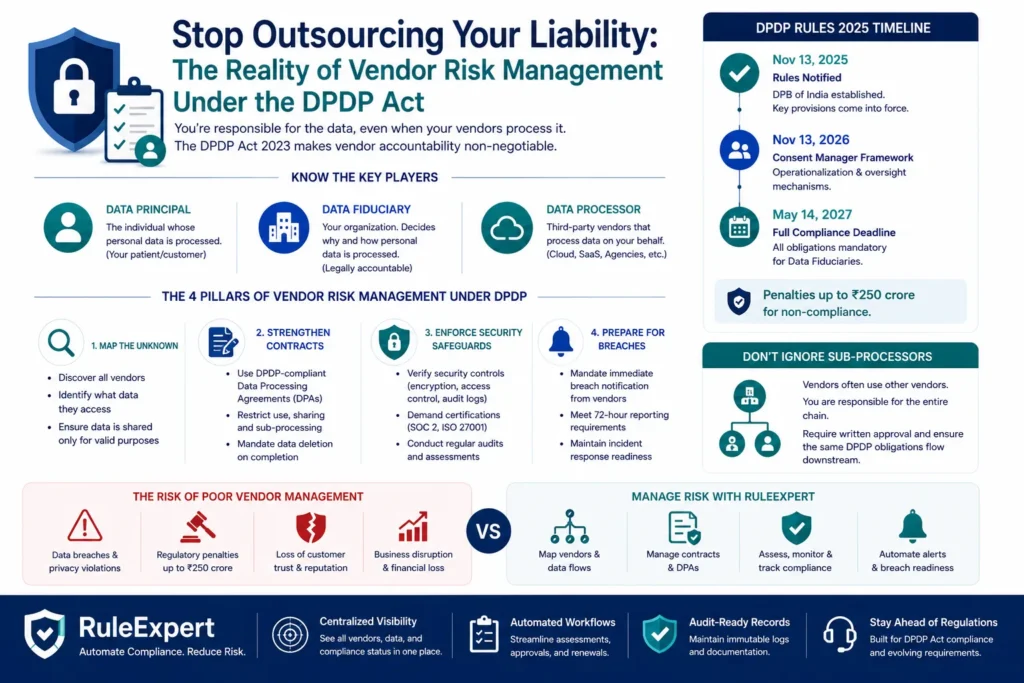
We operate in an API-first world, where vendor risk management has become a critical business function. You run a business, but how much of your tech stack is actually yours? Chances are, you rely on a complex web of cloud providers, marketing agencies, analytics tools, and CRM platforms. You share user information with these third parties every single day just to keep the lights on. But here is the hard truth: every time you pass user information to an external partner, you open a backdoor to your own legal liability. Closing those doors—and rigorously policing who gets to walk through them—is the entire point of vendor risk management.
If your current strategy for handling third-party data sharing is a basic non-disclosure agreement saved in a dusty Google Drive folder, you are walking into a regulatory minefield. Effective vendor risk management is no longer optional. With the Ministry of Electronics and Information Technology (MeitY) officially notifying the rules for the Digital Personal Data Protection Act late last year, the era of handshake deals and assumed trust is over. The law demands strict, demonstrable accountability.
Let’s look at exactly why the DPDP Act 2023 completely rewrites the rules of engagement with your vendors, and what you actually need to do about it before the enforcement deadlines hit.
The Death of “Not Our Fault”
Before we get into the weeds, we need to clear up the biggest misconception about India’s new privacy regime.
When a data breach happens—say, your email marketing platform gets hacked and millions of your customers’ email addresses leak—your first instinct might be to point the finger at the vendor. They got hacked, so it is their problem, right?
Wrong.
Under the Digital Personal Data Protection Act, the buck stops with you. The law classifies your business as the Data Fiduciary—the entity that decides why and how personal data is processed. Your vendor is merely the Data Processor, acting on your behalf. Section 8 of the DPDP Act 2023 makes it painfully clear: the Data Fiduciary is strictly liable for the actions of its Data Processors. You cannot contract away your accountability. If your vendor messes up, the Data Protection Board of India (DPB) will be knocking on your door, and they bring the threat of penalties up to ₹250 crore with them. This is precisely why robust vendor risk management practices are essential.
That right there is why vendor risk management is suddenly keeping compliance officers awake at night. You are financially and legally responsible for the security posture of companies you do not even own.
The November 2025 Rules and the Ticking Clock
We aren’t just talking about abstract laws anymore. On November 13, 2025, the government officially notified the DPDP Rules 2025, giving us the practical playbook for how this law works.
The rules laid out a staggered enforcement timeline. While the Data Protection Board was established immediately, businesses were given an 18-month grace period for the heavy lifting. That means by May 14, 2027, the main compliance duties—including strict vendor governance, breach notifications, and security protocols—will be fully enforced, making vendor risk management a compliance priority.
Eighteen months might sound like a long time, but anyone who has ever tried to renegotiate software contracts with giant tech monopolies knows it is barely enough time to get a meeting, let alone overhaul your entire data supply chain.
The Four Pillars of Compliance for Third Parties
So, how do you actually protect yourself? Good vendor risk management under this framework requires you to stop treating vendors as black boxes. You have to look inside. Here are the four non-negotiable steps you need to take right now.
1. Mapping the Unknown
You cannot protect what you do not know you have. Most organizations suffer from severe shadow IT. A marketing team might swipe a corporate card to use a new analytics tool, completely bypassing the IT department.
Your first step is mapping every single place your data goes. Who are your vendors? What specific personal data do they hold? Why do they have it? If you cannot answer these questions for a specific vendor, you need to cut off their access immediately. The DPDP Rules demand purpose limitation; if the data isn’t necessary for the job, the vendor shouldn’t have it. This foundational exercise is at the heart of effective vendor risk management.
2. Tearing Up the Old Contracts
Those standard terms of service you blindly clicked “Agree” on? They won’t cut it anymore. The Digital Personal Data Protection Act mandates that Data Fiduciaries must engage processors only under a valid, written contract.
These aren’t your typical NDAs. A DPDP-compliant Data Processing Agreement must strictly dictate what the vendor can and cannot do with the data. They cannot use your users’ information to train their own AI models. They cannot sell it to data brokers. Furthermore, the contract must include explicit clauses for data deletion. When the contract ends, or when a user exercises their right to be forgotten, the vendor must prove they have wiped the data from their servers. Strong contractual controls are a cornerstone of vendor risk management.
3. Enforcing Rule 6 Security Safeguards
Rule 6 of the DPDP Rules 2025 gets highly specific about “reasonable security safeguards.” It mentions encryption, access controls, audit logs, and breach detection systems.
Because you are liable for your vendor, your vendor risk management program must ensure they actually meet these standards. You can no longer just take their word for it. You need to demand third-party security audits (like SOC 2 or ISO 27001 certifications), run regular security questionnaires, and reserve the right to audit their systems if something looks off.
4. The Breach Notification Scramble
The new rules impose incredibly tight, dual-notification requirements for data breaches. If a breach happens, you have to notify both the affected users (Data Principals) and the Data Protection Board almost immediately.
If your vendor experiences a breach, they need to tell you instantly so you can meet your regulatory deadlines. Your contracts must mandate aggressive service level agreements (SLAs) for breach reporting. If a vendor waits three weeks to mention that they lost your data, you are the one who will face the regulatory fines for delayed reporting. This makes incident response planning a critical component of vendor risk management.
The Nightmare of Sub-Processors
Let’s add a layer of complexity. What happens when your vendor uses a vendor?
Imagine you hire a customer support agency. That agency uses a cloud-based ticketing software, which in turn runs on Amazon Web Services. This chain of sub-processors is incredibly common, and it is a massive blind spot for most companies.
Under your new vendor risk management strategy, you must have visibility into this chain. Your primary vendor cannot be allowed to hire a sub-processor without your explicit, written consent. And if they do, the same strict DPDP Act 2023 obligations must flow all the way down the chain. If a fourth-tier cloud host leaks your data, the liability still rolls right back up to you.
You Can’t Fix This with Spreadsheets
If you are looking at this mountain of work and thinking about managing it with a giant Excel file, stop. Manual compliance tracking is broken, easily ignored, and prone to human error. Managing hundreds of vendor contracts, tracking their security certifications, and mapping data flows manually is a recipe for a catastrophic slip-up.
This is exactly where purpose-built automation becomes your best friend. Instead of throwing more lawyers at the problem, modern businesses use platforms like RuleExpert to automate the heavy lifting.
RuleExpert acts as the nerve center for your DPDP Act compliance and vendor risk management program. It allows you to automatically deploy dynamic security assessments to all your vendors, flagging high-risk partners instantly. It serves as a centralized repository for all your updated Data Processing Agreements, tracking expiration dates and sub-processor lists so you never have a blind spot. Most importantly, it maps your data flows visually, making it incredibly easy to see exactly who holds your Data Principals’ information.
By taking the grunt work out of vendor risk management, software like RuleExpert lets your legal and IT teams focus on actual security rather than chasing people for signatures over email.
The Bottom Line
May 2027 is going to arrive faster than you think. The Digital Personal Data Protection Act fundamentally changes the cost of doing business in India. Outsourcing your operations no longer means outsourcing your risk.
If you want to survive in this new regulatory environment, you have to treat your vendors’ security posture as an extension of your own. Build the maps, rewrite the contracts, demand the audits, and automate the tracking. A proactive approach to vendor risk management is no longer a best practice—it is a business necessity. Your business, your reputation, and your balance sheet depend on it.
Frequently Asked Questions (FAQs)
1. What is the deadline for updating vendor contracts under the DPDP Rules 2025?
While the Data Protection Board was established in November 2025, the government has provided a staggered timeline for the substantive provisions of the Act. Businesses have an 18-month grace period from the notification date, meaning your vendor risk management protocols and updated contracts must be fully compliant and operational by May 14, 2027.
2. Can a Data Fiduciary transfer penalty liability to a Data Processor in their contract?
No. The DPDP Act 2023 strictly holds the Data Fiduciary accountable to the Data Protection Board and the Data Principals. While you can include indemnification clauses in your vendor contracts to sue them civilly after the fact to recover costs, the regulatory fines and the immediate legal liability remain entirely yours.
3. What happens if a vendor refuses to sign a DPDP-compliant agreement?
If a vendor flat-out refuses to sign an updated Data Processing Agreement that limits data use and mandates security safeguards, you have a hard decision to make. Continuing to use them puts you in direct violation of the Digital Personal Data Protection Act. The standard legal advice is to terminate the relationship and migrate to a compliant alternative before the May 2027 enforcement deadline.
4. How quickly do we need to report a vendor data breach?
The November 2025 rules mandate rapid, dual-notification for any personal data breach. You must notify the DPB and the affected users without undue delay. Because the clock starts ticking the moment you become aware of the incident, your vendor contracts must legally force them to notify you immediately—often within 24 to 48 hours of discovering the breach on their end.
5. Does the DPDP Act restrict us from using foreign vendors?
Generally, no. The DPDP Rules adopted a relatively business-friendly approach to cross-border data transfers. You can use foreign data processors and transfer personal data outside of India, provided the destination country has not been explicitly blacklisted by the Central Government. However, the exact same contractual and security obligations apply regardless of where the vendor is located.
6. How do user rights (Data Principals) impact our third-party vendors?
Under the Act, users have the right to access, correct, or erase their personal data. When a user tells you to delete their account, you must ensure that data is also purged from your marketing tools, cloud backups, and CRMs. Your vendor risk management process must ensure your partners have the technical capability to locate and delete specific user data upon request.
7. Do we need to use a Consent Manager for vendor risk management?
Consent Managers are a new class of intermediaries introduced by the DPDP Act to help users manage their consent preferences across different platforms. While you will likely interact with them to capture user consent by the November 2026 deadline, they are not a tool for managing your vendors. You will still need dedicated compliance software or internal protocols to handle B2B vendor oversight.
8. What are the specific security safeguards our vendors need to have?
Rule 6 of the DPDP Rules 2025 outlines baseline technical and organizational measures. Your vendors should, wherever applicable, implement strong encryption, robust authentication and access controls, comprehensive audit logging, breach detection mechanisms, and reliable backup protocols. Your job is to verify they actually do this rather than just taking their marketing site’s word for it.