 RuleExpert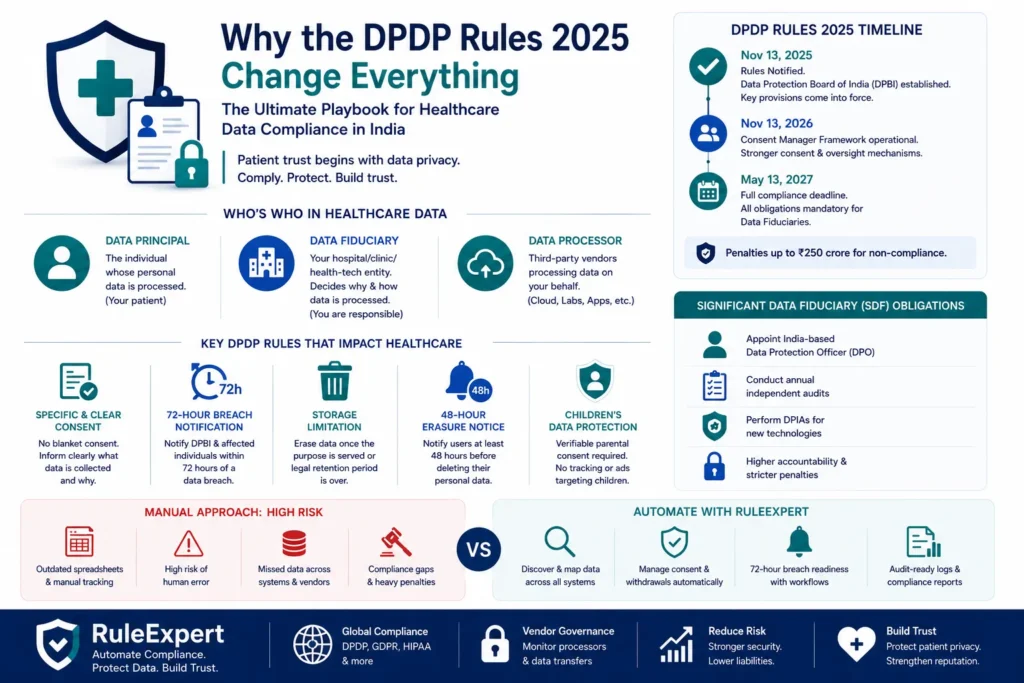
Let’s be entirely honest for a second. Healthcare data compliance is no longer a niche concern reserved for legal teams and IT departments. When a patient sits across from a doctor and shares deeply personal details about their physical or mental health, they expect that conversation to stay in the room. But in our hyper-connected reality, that intimate dialogue immediately transforms into a string of code. It bounces from hospital electronic medical records (EMRs) to third-party diagnostic labs, telemedicine apps, and cloud servers. Keeping all those digital breadcrumbs secure used to be a best practice. Now, it’s the law. If your hospital, clinic, or health-tech startup isn’t actively prioritizing healthcare data compliance, you are standing on very thin ice.
On November 13, 2025, the Indian government officially dropped the Digital Personal Data Protection (DPDP) Rules, bringing the sweeping DPDP Act of 2023 into full, operational force. We aren’t just talking about vague privacy guidelines anymore. We are looking at a hard-hitting, legally binding framework that demands massive shifts in how medical institutions collect, store, and eventually destroy patient information.
If you are running a medical facility right now, ignoring this shift is not an option. A single data leak could invite regulatory penalties pushing up to ₹250 crore. But more importantly, a breach shatters the one thing medical professionals value most: patient trust. Let’s break down what these new rules actually mean for your day-to-day operations and how healthcare data compliance can help you navigate this tricky landscape without pulling your hair out.
The Reality Check Indian Hospitals Desperately Needed
For years, the medical sector in India operated in a bit of a gray area regarding digital privacy. Sure, doctors took the Hippocratic Oath, but the IT systems backing them up were often porous. Reception desks routinely asked for excessive information, printed diagnostic reports were left lying around, and health apps shared user habits with advertisers without batting an eye. The growing emphasis on healthcare data compliance is intended to address precisely these long-standing vulnerabilities.
The November 2025 notification of the DPDP Rules slammed the brakes on that culture. The government essentially laid out a phased roadmap, telling the industry to clean up its act. Immediate provisions kicked in right away, while the consent manager frameworks are slated for November 2026, leading up to full, uncompromising compliance by May 2027. For organizations focused on healthcare data compliance, these deadlines serve as critical milestones.
What this translates to on the ground is a massive scramble. Achieving true healthcare data compliance means overhauling your legacy software, retraining your staff, and rethinking the very nature of why you ask a patient for their phone number or Aadhaar details in the first place.
Decoding the Jargon: Who is Who in the Medical Data Game?
You can’t play by the rules if you don’t know the players. The DPDP Act uses specific terms that might sound like they belong in a courtroom, but they have very practical meanings on the hospital floor.
The Data Principal
This is your patient. Under the new law, the patient is the absolute boss of their own information. Whether it’s a blood test result, a psychiatric evaluation, or just their home address, they own it.
The Data Fiduciary
That’s you—the hospital, the diagnostic center, or the health-tech app. You are the entity deciding why patient data needs to be collected and how it will be processed. With great power comes immense legal responsibility.
The Data Processor
Think of the vendors you hire. The cloud storage provider hosting your EMRs, the external payroll company handling your staff salaries, or the specialized lab analyzing complex biopsies. They process the data on your behalf, but if they mess up and leak a patient’s file, you as the Fiduciary are the one facing the firing squad.
The Core Pillars of the New Medical Privacy Era
So, how exactly does the 2025 mandate disrupt the usual hospital routine? It boils down to a few fundamental shifts in behavior.
The End of the “Sign Here” Blanket Consent
Remember those five-page admission forms filled with tiny legal print that patients blindly signed while in pain? Those are legally useless now. The DPDP Rules demand itemized, plain-language notices. You have to tell the patient exactly what data you are taking, precisely why you need it, and who you might share it with. And yes, you must provide this in multiple languages if necessary. Consent has to be a clear, affirmative action. If a patient is just coming in for a sprained ankle, you have absolutely no legal right to demand their entire family’s medical history for “marketing purposes.” These requirements sit at the core of modern healthcare data compliance.
The 72-Hour Ticking Clock
Cyberattacks against hospitals are escalating globally, and Indian healthcare networks are prime targets for ransomware. The government knows this. Under the new rules, if your system gets breached and patient records are compromised, you cannot quietly sweep it under the rug while your IT guy tries to fix it. You have exactly 72 hours to notify the Data Protection Board of India and the affected patients. That is an incredibly tight window to figure out what happened, patch the hole, and draft a public statement. Effective healthcare data compliance strategies can significantly improve an organization’s ability to respond within this timeframe.
Erasing the Past
You can no longer hoard data forever. The law enforces strict storage limitations. Once a patient’s treatment is entirely complete and the legal requirement to hold their medical records (usually a few years depending on Medical Council guidelines) expires, that digital file must vanish. Furthermore, the 2025 rules stipulate that you must notify the individual at least 48 hours before you hit the delete button on their personal data. Proper healthcare data compliance frameworks help ensure these retention and deletion requirements are met consistently.
Handling the Most Vulnerable: Children’s Health Data
Pediatricians and children’s hospitals have a massive new hurdle. The law strictly regulates how the data of minors (anyone under 18) is handled. You need verifiable parental consent before you process a child’s health record. Furthermore, any sort of behavioral tracking or targeted advertising directed at kids is completely outlawed. Building a system that accurately verifies a parent’s identity without collecting excessive data is currently one of the biggest headaches for tech developers in the medical space, making healthcare data compliance even more challenging.
The Big Leagues: Significant Data Fiduciaries
Not all healthcare providers are treated the same. A neighborhood dental clinic has a different risk profile than a massive, multi-city hospital chain handling millions of sensitive oncology and genetic records.
If your organization processes vast volumes of highly sensitive data, the government will likely classify you as a “Significant Data Fiduciary” (SDF). This tag comes with a heavy regulatory burden. You won’t just be expected to keep things secure; you have to constantly prove it.
- Must appoint a resident Data Protection Officer (DPO) based in India—a designated human who takes the heat if things go wrong.
- Must conduct rigorous, independent data audits annually.
- Must run Data Protection Impact Assessments (DPIAs) every time you roll out a new piece of technology, like an AI-driven diagnostic tool or a new patient portal.
The Technological Reality: You Can’t Do This With Spreadsheets
Let’s be pragmatic. Tracking whether a patient consented to share their blood work with an external lab, ensuring logs are retained for exactly one year as mandated by the November rules, and mapping data flows across twenty different hospital departments is completely impossible to manage manually. If you are relying on Excel sheets and memory to maintain healthcare data compliance, you are walking into a trap.
This is exactly where smart automation platforms like RuleExpert step into the spotlight.
Instead of hiring an army of administrators to chase down paper trails, specialized compliance software acts as your digital nervous system. Imagine having a centralized dashboard where you can track every single consent form in real-time. When a patient decides to invoke their new legal right to withdraw consent—a right they absolutely have under the DPDP Act—an automated system instantly flags their data across all your connected servers, preventing unauthorized sharing. This is where healthcare data compliance technology delivers tangible value by simplifying complex regulatory obligations.
- 72-Hour Breach Workflows Built-in incident response workflows automatically generate the required regulatory reports, saving precious hours when you are under extreme duress.
- Vendor Data Mapping Seamlessly maps your data across vendors, ensuring your Data Processors aren’t quietly violating your contracts.
- Immutable Audit Trails Keeps your audit trails pristine and ready for inspection at any time.
Why Bother Adapting Early?
It is incredibly tempting to look at the May 2027 full compliance deadline and decide to kick the can down the road. Don’t do it. Transforming a hospital’s digital infrastructure takes time. Discovering where all your legacy data lives, renegotiating contracts with every single software vendor you use, and retraining a stubborn medical staff to care about data privacy is a brutal, slow-moving process.
Institutions that tackle healthcare data compliance right now are finding a surprising upside. Patients are getting smarter. They read the news. They know their data is valuable, and they are terrified of identity theft. When a hospital can transparently demonstrate that it treats a patient’s digital privacy with the exact same reverence it treats their physical health, it creates a massive competitive advantage. Trust is the currency of the medical profession, and robust data protection is how you mint it in the 21st century.
Frequently Asked Questions (FAQs)
1. Does the DPDP Act apply to paper medical records?
The Act specifically targets digital personal data. However, if your clinic takes a handwritten prescription or a physical patient intake form and scans it, types it into an EMR, or digitizes it in any way, it immediately falls under the jurisdiction of the DPDP Act.
2. We use an overseas cloud provider to back up our hospital data. Is this allowed?
Yes, but with caveats. The DPDP Act allows the transfer of data outside India unless the government specifically restricts a particular country. However, as the Data Fiduciary, you remain entirely responsible for that data. Your contract with the overseas cloud provider must be incredibly airtight regarding security standards and breach reporting.
3. What happens if a patient demands we delete their medical history?
Patients have the “Right to Erasure.” But healthcare is tricky because you also have overlapping medical and legal obligations (like the Medical Council of India’s retention rules) requiring you to keep records for a certain number of years. You cannot delete data if a specific law requires you to keep it for legal or treatment purposes. You must clearly explain this limitation to the patient.
4. How quickly do we need to respond to a patient’s privacy grievance?
Under the 2025 DPDP Rules, if a patient files a complaint regarding how their data is being handled, or requests access to their information, your organization must resolve the issue within 90 days. If you fail, the patient can escalate the issue directly to the Data Protection Board.
5. Are employee health records covered under the same strict rules as patient records?
Absolutely. The law applies to any individual whose data you process. The health data, payroll details, and biometric attendance records of your nurses, doctors, and administrative staff are all protected under the DPDP Act. You need their explicit consent to process their data, just like your patients.
6. What is the maximum penalty for failing to maintain healthcare data compliance?
The penalties are severe and designed to hurt. If a hospital fails to implement reasonable security safeguards resulting in a data breach, the Data Protection Board can levy fines up to ₹250 crore per instance. There are also steep fines for failing to notify the board of a breach or mishandling children’s data.
7. Do we really need to hire a Data Protection Officer (DPO)?
If the government classifies your hospital or health-tech company as a “Significant Data Fiduciary” due to the volume or sensitivity of the data you handle, hiring an India-based DPO is a strict legal mandate. Even if you aren’t officially classified as one, having a dedicated privacy officer is highly recommended as a best practice to navigate these complex rules.
8. Can we still share patient data with pharmaceutical companies for research?
You can, but the wild west days of selling bulk patient data are over. If the data is completely and irreversibly anonymized (meaning it cannot be traced back to the individual under any circumstances), the DPDP Act does not apply. However, if the data retains any personal identifiers, you must obtain explicit, informed consent from the patient specifically stating that their data will be used for third-party research.