 RuleExpert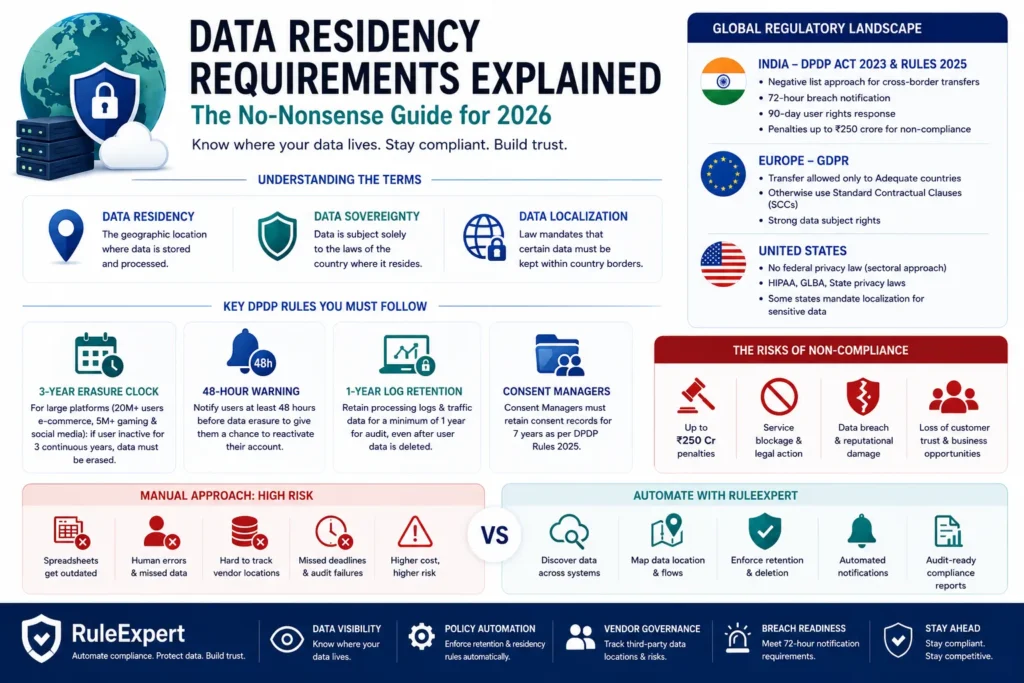
Think about how we used to treat cloud storage just a decade ago. You’d spin up an AWS or Azure instance, dump your user records into the cheapest available server region, and call it a day. Nobody asked where the physical hard drives were spinning. Those days are completely dead. Today, data residency has become a defining concern for organizations handling personal information. If you collect someone’s digital footprint, you have to know exactly which geographic borders that information sits behind. This brings us to data residency, a concept that has rapidly evolved from a niche IT headache into a massive boardroom priority.
Understanding data residency isn’t just about keeping the compliance team happy anymore. It dictates your cloud architecture, how you negotiate vendor contracts, and whether you can legally enter new international markets. When governments decide they want to protect their citizens’ digital privacy, they start by restricting where those bits and bytes can physically travel.
If your business moves personal information across borders, you are operating in a minefield of shifting rules. In this guide, we are going to strip away the legal fluff. We’ll look at what these requirements actually mean, how the freshly minted regulations like India’s DPDP Rules 2025 change the game, and how data residency obligations are reshaping compliance strategies worldwide. We’ll also explore how platforms like RuleExpert can keep your infrastructure on the right side of the law.
Cutting Through the Jargon: Residency vs. Sovereignty vs. Localization
Before we look at the specific laws, we need to get the terminology straight. People throw these terms around in meetings as if they mean the same thing. They don’t, and mixing them up can cost you millions in regulatory fines.
Data Residency
This simply refers to the specific geographic location where your organization’s data is stored and processed. It’s a deliberate business decision, often driven by tax advantages or local privacy expectations. If you choose to store your European user logs in Frankfurt because it makes your customers feel better, that’s a data residency strategy.
Data Sovereignty
This takes residency a step further. Sovereignty means that the information stored in a specific country is subject exclusively to the laws of that country. If you host servers in Germany, the German government’s data privacy laws apply to those servers, overriding foreign subpoenas or external government requests.
Data Localization
This is the heavy-handed cousin of residency. Localization happens when a government explicitly mandates, by law, that certain types of data generated within its borders must remain there. There is no choice here. For example, India’s banking regulator (the RBI) demands that core payment transaction records stay strictly within Indian territory.
The Global State of Play: Major Frameworks to Watch
The regulatory map is fragmenting fast. If you want to operate globally in 2026, you have to play by a patchwork of localized rules. Here is what the landscape looks like right now based on confirmed, enforceable legislation governing data residency and cross-border data transfers.
India: The DPDP Act 2023 and the 2025 Rules
If you do business in India, this is the most critical update on your radar. The Digital Personal Data Protection Act (DPDP Act 2023) fundamentally changed the rulebook. But it was the official notification of the DPDP Rules on November 13, 2025, that finally put the law into motion, bringing data residency considerations into sharper focus for organizations handling personal data.
The government has given organizations an 18-month window to get their house in order, making May 2027 the hard deadline for full compliance. When it comes to cross-border transfers and data residency requirements, India adopted a surprisingly pragmatic approach. Instead of forcing blanket localization for everything, the DPDP framework uses a “negative list” model. You can transfer personal data outside of India, provided the destination country isn’t on the government’s restricted list.
However, you still have to meet incredibly strict conditions. You must enforce verifiable purpose-based retention, implement hardened security safeguards, and give users ironclad rights to access, correct, or erase their information. If you are classified as a Significant Data Fiduciary (based on the volume and sensitivity of what you process), the rules hit even harder. You’ll need a resident Data Protection Officer and mandatory independent algorithmic audits. The penalties? A staggering ₹250 crore for failing to secure user records or comply with key data residency obligations.
Europe: The General Data Protection Regulation (GDPR)
Europe set the gold standard years ago, and they aren’t backing down. Under GDPR, you can only move EU citizens’ data to countries that the European Commission deems to have “adequate” privacy protections. If the destination country lacks that adequacy status, you are forced to rely on Standard Contractual Clauses (SCCs). These legally binding agreements essentially force the receiving company to treat the data with GDPR-level respect, regardless of where their servers physically sit, making data residency planning a critical operational requirement.
The United States: A Sectoral Maze
The US famously refuses to pass a single federal privacy law. Instead, data residency is dictated by the industry you operate in and the state you live in. In healthcare, HIPAA doesn’t technically ban offshore storage, but the liability is so massive that most providers restrict health records (ePHI) to US-based servers to minimize risk. In finance, the GLBA requires aggressive vendor oversight. Meanwhile, individual states are going rogue—Utah and Texas have recently pushed bills mandating severe localization for genetic and electronic health records.
The Real-World Tech Impact: Why This is So Hard to Build
It’s one thing to have a lawyer write up a privacy policy. It’s entirely another to force your AWS environment to obey it. Enforcing data residency breaks a lot of the assumptions modern cloud architecture is built on.
Think about disaster recovery. The traditional way to keep an app from going offline is to automatically replicate its database to a different region—maybe from a server in Mumbai to a backup server in Singapore. Under strict data residency and localization laws, that automated backup might suddenly become an illegal cross-border transfer.
Engineering teams are now forced to architect “region-locked” environments. You have to hunt down default cloud settings that silently mirror storage across availability zones. You have to ensure that your encryption keys are stored in the same jurisdiction as the data they protect. Even your logging tools can get you in trouble. If your app in Berlin generates an error log containing a user’s IP address, and that log is shipped to a centralized monitoring dashboard in California, you just violated a data residency or cross-border transfer rule.
The Headaches of Vendor Sprawl
You might have your primary databases locked down, but what about your vendors? The average enterprise relies on dozens of SaaS platforms for marketing, customer support, and analytics.
If your marketing agency uses an email tool that processes your Indian customers’ data on a server in a restricted country, you are the one who gets fined. This creates a massive administrative burden. You have to map the physical server locations of every single sub-processor you work with, renegotiate Business Associate Agreements (BAAs) or Data Processing Agreements (DPAs), and continuously audit them to ensure they haven’t quietly migrated to a cheaper data center halfway across the world, creating unforeseen data residency risks.
Bringing Order to the Chaos with RuleExpert
Manual spreadsheets and endless legal reviews don’t scale. When you are dealing with millions of API calls and dynamic cloud workloads, human oversight fails. This is exactly why organizations are moving toward DPDP compliance solutions like RuleExpert.
RuleExpert takes the theoretical requirements of the DPDP Act 2023, GDPR, and other global mandates and turns them into enforceable, automated workflows.
- Consent and Rights Management: The DPDP Rules 2025 demand that consent be free, specific, and easily withdrawable. RuleExpert automates the entire consent lifecycle, tracking user preferences and handling erasure requests within the mandated 90-day window.
- Infrastructure Mapping: Instead of guessing where your data lives, the platform helps map your cross-border digital footprint, identifying exactly which jurisdictions your vendors operate in.
- Audit-Ready Documentation: When regulatory bodies like the Data Protection Board of India come knocking, you don’t want to be scrambling. RuleExpert maintains centralized, immutable logs of your compliance checklists, security safeguards, and vendor agreements.
- Breach Readiness: The new Indian rules mandate a 72-hour notification window for data breaches. RuleExpert integrates with your incident response protocols so you can generate the required regulatory reports immediately.
Staying compliant shouldn’t require you to slow down your product roadmap. By automating the heavy lifting, platforms like RuleExpert let your engineers focus on building features rather than chasing down rogue server instances.
The True Cost of Getting It Wrong
We aren’t just talking about a slap on the wrist anymore. The era of regulators sending polite warning letters is over. Non-compliance today results in immediate, severe consequences. Beyond the financial ruin of massive fines, governments now have the authority to block your digital services entirely. If an app violates data residency or localization mandates, telecom providers can be ordered to block its traffic at the ISP level.
Furthermore, enterprise buyers are spooked. In B2B software, passing a procurement security review is impossible if you can’t definitively prove where your data resides. A sloppy geographic footprint won’t just get you fined; it will actively kill your sales pipeline.
Embracing data residency requirements early isn’t a burden; it’s a massive competitive advantage. When you can look a customer in the eye and guarantee their digital life won’t leave their home borders, you build a level of trust that your competitors simply cannot match. The laws are written. The deadlines are set. The only thing left to do is build the infrastructure to meet them.
Frequently Asked Questions
1. Does the DPDP Act 2023 require all Indian data to be stored within India?
No, it does not mandate blanket data localization. The DPDP Act operates on a “negative list” mechanism. This means you can transfer personal data outside of India unless the destination country has been specifically restricted or banned by the central government. However, sectoral regulators like the RBI still enforce strict local storage for specific data types like payments.
2. What happens if our cloud provider automatically backs up data to a foreign region?
If that foreign region is restricted under applicable laws, or if you haven’t put the proper transfer mechanisms (like SCCs under GDPR) in place, that automated backup is a legal violation. You must explicitly configure your cloud infrastructure to disable cross-region replication that breaches your compliance boundaries.
3. What are the key deadlines for the newly notified DPDP Rules 2025?
The rules were officially notified on November 13, 2025. While provisions establishing the Data Protection Board took effect immediately, businesses have an 18-month transition period to fully implement their data fiduciary obligations, making May 13, 2027, the hard deadline for total compliance.
4. How does data residency affect third-party SaaS vendors?
You are legally responsible for the data you collect, even when you pass it to a third-party processor. If your SaaS vendor routes your data through a server in a non-compliant jurisdiction, you carry the liability. You must ensure your vendor contracts explicitly dictate where they are allowed to store and process your information.
5. What is an Adequacy Decision under GDPR?
An adequacy decision is a formal ruling by the European Commission stating that a non-EU country provides a level of personal data protection equivalent to the GDPR. If a country has adequacy status, data can flow from the EU to that country freely, without needing additional safeguards like Standard Contractual Clauses.
6. Can a business ignore residency requirements if the data is encrypted?
No. While encryption is a mandatory security safeguard under almost every modern framework, it does not exempt you from residency laws. Regulators generally treat encrypted data as personal data because the key exists to unlock it. The location of the encrypted files still matters legally.
7. How can RuleExpert help with a 72-hour breach notification rule?
Gathering incident details manually during a crisis is chaotic. RuleExpert centralizes your infrastructure maps, vendor contacts, and data logs. If a breach occurs, the platform streamlines the generation of required regulatory reports, helping you meet the strict 72-hour reporting window mandated by laws like the DPDP Act.
8. Are employee records subject to these data residency regulations?
Yes. Whether you are dealing with consumer app users or your own internal workforce, human resources data is classified as personal data. Multinational companies must be incredibly careful when using centralized global HR software, as transferring employee details to a foreign headquarters often triggers cross-border transfer laws.