 RuleExpert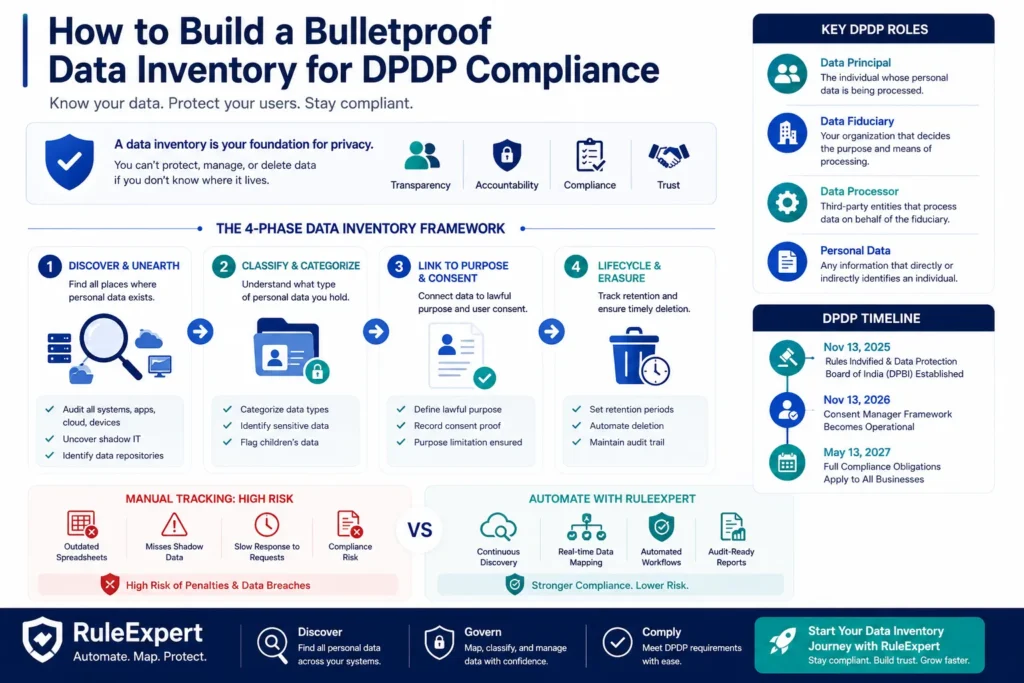
Data inventory is not exactly the first thing most companies think about when managing customer information. Let’s be honest about how most companies actually handle their customer information. It usually starts with good intentions. You capture an email here, a phone number there, maybe a shipping address. But flash forward a few years, and suddenly you have user details scattered across a dozen different software platforms, employee laptops, third-party marketing tools, and forgotten cloud servers. You cannot protect what you don’t even know exists. And that exact problem is why building a comprehensive data inventory has become the absolute non-negotiable starting point for surviving India’s privacy shift.
With the Government of India officially notifying the Digital Personal Data Protection Rules in November 2025, the grace period is officially ticking down. We have a clear 18-month runway—ending in May 2027—to get our operations completely aligned with the law. If your business collects, stores, or uses the personal information of Indian citizens, you are firmly on the clock. So, let’s cut through the dense legalese and talk about how a robust data inventory helps map your digital landscape without losing your mind in the process.
The Elephant in the Server Room: Dark Data
Most founders and IT leads swear they know exactly where their data lives. But if you dig a little under the surface, you almost always find a marketing intern using a random free tool to blast out a newsletter, or a seasoned sales rep keeping a rogue, unencrypted spreadsheet of client contacts on their local hard drive. We call this “dark data.” A comprehensive data inventory is often the only way to bring these hidden repositories into view.
Before the DPDP Act 2023, turning a blind eye to dark data was just a sloppy operational habit. Today, it’s a massive legal liability.
A data inventory isn’t simply a static list of folders. It is a dynamic, living map that answers the core questions demanded by the regulator: Whose information do you have? Why do you have it? Who else can see it? And exactly when are you going to get rid of it?
To make sense of this mapping process, you need to understand the official vocabulary laid out in the Digital Personal Data Protection Act. Knowing these terms isn’t just for lawyers; they dictate how you categorize everything in your systems:
- Data Principal This is the actual human being whose information you hold. Your inventory must clearly track what specific data points belong to which principal.
- Data Fiduciary That’s your organization. You are the one deciding why and how the information is collected. The ultimate responsibility rests on your shoulders.
- Data Processor Any third-party vendor handling information on your behalf. Think of AWS, your CRM provider, or the agency running your ad campaigns. Your inventory must aggressively track where information flows to these external parties.
- Personal Data Any piece of information capable of identifying an individual, directly or indirectly. It goes far beyond just a name or government ID; it includes behavioral data, IP addresses, and purchasing habits.
Why Spreadsheets Are a Ticking Time Bomb
You might think you can just spin up an Excel file, ask your division heads to fill in what they use, and call it a day. That approach might have barely passed muster a decade ago. Under the newly finalized rules, relying on manual tracking is essentially setting yourself up to fail.
Consider the new incident response mandates. The DPDP Rules 2025 dictate that if a data breach occurs, Data Fiduciaries must notify both the Data Protection Board and the affected individuals within 72 hours. If you rely on a static spreadsheet instead of a dynamic data inventory, you will spend those precious 72 hours just trying to figure out which server was compromised, what information was actually stored there, and whether it was encrypted. You’ll miss the deadline entirely. The Data Protection Board is not going to accept “we were updating our Excel file” as a valid excuse.
Then there is the issue of consent. The law mandates that consent must be free, specific, informed, unconditional, and unambiguous. More importantly, users have the absolute right to withdraw that consent at any time. If a customer hits “unsubscribe” or submits a formal request for data erasure, you have to be able to find and eliminate every trace of their digital footprint across your entire infrastructure. Finding a single user’s data tangled up in multiple databases, third-party apps, and email chains is virtually impossible without an automated, centralized data inventory.
The Blueprint: Steps to Map Your Digital Footprint
So, how do you actually go about building this thing? It requires a methodical approach that touches every corner of your business.
1. Discovery and Unearthing
The first step is finding out where your data actually lives. You have to audit all digital assets. This means looking past the obvious CRM systems and diving into cloud storage environments, legacy databases, HR software, and yes, employee devices. You need to interview department heads to uncover “shadow IT”—the unsanctioned apps teams use to get work done faster. Every discovery should ultimately feed into your data inventory.
2. Granular Classification
Once you locate the information, you have to categorize it. Under the Digital Personal Data Protection Act, not all information is treated equally. You need to know exactly what kind of personal data you are holding so you can apply the appropriate security safeguards. Is it basic contact info? Financial records? Health data? A well-maintained data inventory helps answer these questions quickly. You also need to identify if you are holding data belonging to children, which now requires strictly verifiable parental consent under the new rules.
3. Connecting the Lawful Purpose
This is where many companies stumble. You cannot just hoard data because it might be useful someday. The law relies heavily on purpose limitation. Your data inventory must explicitly link every single dataset to its specific lawful purpose. You must also record the proof of user consent obtained for that specific purpose. If you have a database of phone numbers but no record of why you collected them or whether the users agreed to it, that data is toxic.
4. Establishing Erasure Protocols
Organizations are strictly obligated to erase information once the purpose for collecting it is no longer being served. A compliant data inventory tracks the lifecycle of the information and establishes clear retention periods. When the clock runs out, the data must be purged.
The Heavy Lifting (And How to Automate It)
Doing all of this manually is soul-crushing, tedious work. People leave the company, new software gets purchased, APIs break, and business models pivot. Maintaining the map is infinitely harder than creating it in the first place.
This is exactly where modern compliance software becomes your best friend. A platform like RuleExpert takes the heavy lifting completely out of the equation. Instead of chasing down your marketing team every quarter to see if they bought a new analytics tool, RuleExpert hooks directly into your existing infrastructure. It automatically scans and flags when new types of personal data are collected, continuously enriching your data inventory.
More importantly, it tracks where that information flows, keeping a watchful eye on the Data Processors you share it with. If a user withdraws consent, the software pinpoints exactly where their data sits so you can purge it without disrupting your entire operation. A real-time data inventory makes that level of visibility possible. Let’s be clear—the goal isn’t just to check a box to keep a regulator happy. The goal is to build an operational system that doesn’t fracture every time your business scales up.
The November 2025 Rules and Your Timeline
There has been a lot of noise and speculation in the market, so let’s ground this in reality. The government officially notified the DPDP Rules on November 13, 2025. This was a massive milestone. It established the Data Protection Board immediately, meaning the regulatory watchdog is already alive and breathing.
| Milestone | What It Means | Date |
|---|---|---|
| DPDP Rules Notified | Official clock starts. Data Protection Board established and fully operational. | November 13, 2025 Live Now |
| Consent Manager Framework | Fully operational, allowing users to manage their permissions through centralized third-party platforms. | Late 2026 |
| Full Compliance Deadline | The full weight of the law—every single compliance obligation—applies to all businesses. | May 13, 2027 |
If your organization is eventually classified as a Significant Data Fiduciary—meaning you process massive volumes of data, or data that carries high risk to users—your burden is significantly heavier. You will be legally required to run annual independent audits, conduct rigorous Data Protection Impact Assessments (DPIAs), and appoint a Data Protection Officer who resides in India. If you haven’t even mapped out your basic data inventory today, you will never survive an independent algorithmic audit next year.
The Real Cost of Sticking Your Head in the Sand
We’ve all seen the dramatic headlines about the ₹250 crore maximum penalty for failing to implement reasonable security safeguards. That number is terrifying, but the financial hit is only part of the story.
Think about the catastrophic brand damage. The finalized rules state that if a breach happens, you don’t just quietly tell the government and sweep it under the rug. You have to actively notify the affected individuals in plain, simple language. You have to tell them exactly what happened, what the risks are, and what you are doing to fix it. Without an accurate data inventory, delivering those answers becomes far more difficult.
Imagine having to email your entire customer base to admit, “We lost your information, and to be perfectly honest, we don’t even know what was taken because our backend is an unorganized mess.” A neglected or incomplete data inventory often leads directly to that scenario. It destroys consumer trust faster than a bad product ever could.
On the flip side, getting this right offers a massive competitive advantage. When users see that you handle their privacy with transparency and respect, they stick around. You can respond to grievance requests within the mandated 90-day window effortlessly. You cut your cloud storage costs by finally deleting terabytes of useless, redundant files. A strong data inventory becomes the foundation for both compliance and operational efficiency.
Final Thoughts
Getting your digital house in order isn’t a glamorous project. Nobody is going to pop a bottle of champagne when the data inventory is finally finished. But it is the undeniable bedrock of your entire strategy under the Digital Personal Data Protection Act. Take it one system at a time, rely on smart automation like RuleExpert to handle the tedious tracking, and get a crystal-clear picture of what you are actually holding. May 2027 sounds far away, but in the world of enterprise IT, it is practically tomorrow. Start mapping.
Frequently Asked Questions (FAQs)
1. What exactly constitutes a data inventory under the DPDP Act 2023?
It is a centralized, actively managed record of all the personal information your business collects. It tracks what the data is, where it is stored, the lawful purpose for holding it, who has access to it internally, and which external vendors (processors) it is shared with.
2. Does our data inventory need to include employee information, or just customer data?
Yes, it must include employee information. The law applies to any digital personal data processed within India. While there are some practical exemptions for employment purposes, you still act as a Data Fiduciary for your staff’s data and must map it accordingly.
3. What happens if we discover “dark data” while building our inventory?
You need to assess it immediately. If the data has no lawful purpose or you lack verifiable consent to hold it, you must securely erase it. If it is necessary for your business, you must retroactively document its purpose and ensure it is protected by reasonable security safeguards.
4. How does the November 2025 rules notification affect our timeline?
The November 2025 notification started the official clock. While the Data Protection Board is already established, businesses generally have an 18-month phased window—ending around May 2027—to achieve full compliance, including finalizing their data mapping and consent mechanisms.
5. We use a cloud provider to store our files. Who is responsible for that data?
You are the Data Fiduciary, meaning you bear the ultimate legal responsibility. Your cloud provider acts as a Data Processor. Your inventory must document this relationship, and you must ensure your contract with them mandates strict security controls.
6. What is the 72-hour breach reporting rule I keep hearing about?
Under the finalized rules, if a personal data breach occurs, you have a maximum of 72 hours to notify both the Data Protection Board and the impacted individuals. Without a real-time inventory, identifying the scope of a breach within three days is nearly impossible.
7. Can we just use a manual spreadsheet for our data inventory?
While the law doesn’t strictly forbid spreadsheets, relying on them is highly risky. Because data flows are constant and users can withdraw consent at any time, a static spreadsheet becomes outdated the moment you save it, leaving you vulnerable to compliance failures.
8. How do we handle data belonging to minors in our inventory?
The rules place strict guardrails around minors. Your inventory must specifically flag data belonging to anyone under 18. You are legally required to obtain verifiable parental consent before processing this data, and you are prohibited from tracking or targeting advertisements to children.