 RuleExpert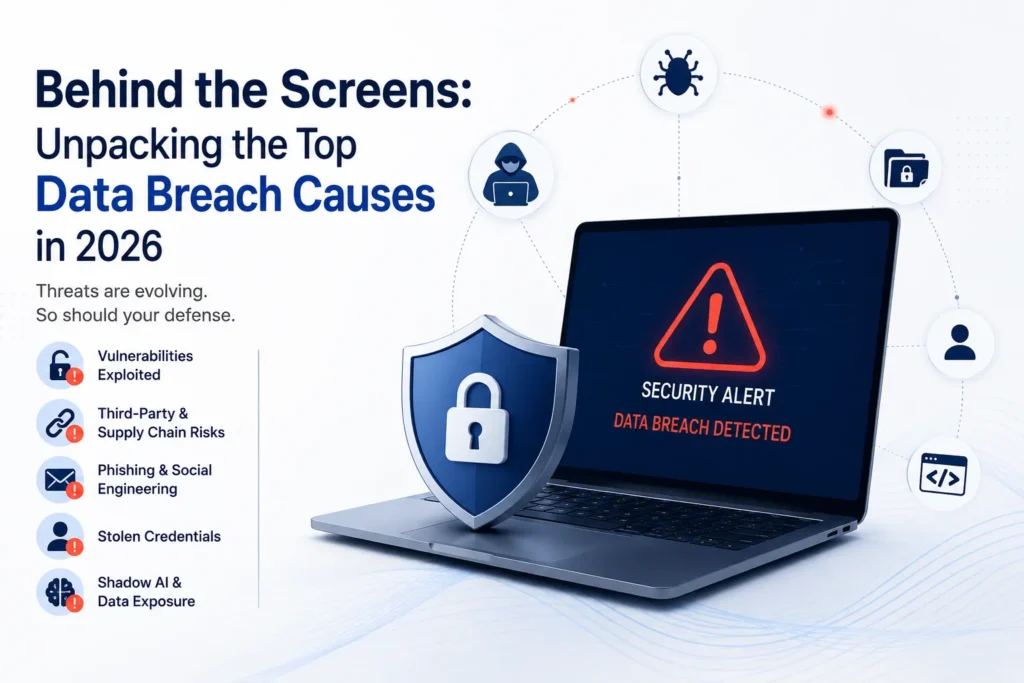
Let’s be honest. When you sit down to map out the data breach causes threatening your business today, the playbook you used even two years ago is already completely obsolete. We aren’t just dealing with clumsy, typo-ridden phishing emails or lone-wolf hackers trying to guess your admin passwords anymore. The modern threat landscape has morphed into a highly organized, AI-driven machine. Threat actors operate like Fortune 500 companies—with R&D departments, customer service desks for their ransomware victims, and automated tools that scan the entire internet for a single cracked window.
If you want to protect your digital assets, understanding the primary data breach causes isn’t just an IT exercise—it’s a survival tactic. Regulatory frameworks like the DPDP Act 2023 demand it, and your customers absolutely expect it. Let’s dive deep into what’s actually breaking through our defenses in 2026, and how the right strategies—and automation tools like RuleExpert—can help you lock the doors before anyone gets inside.
The True Cost of a Breach Right Now
Before we tear into the mechanics of how these attacks happen, we need to look at what happens when they succeed. According to the latest 2025/2026 figures from IBM and the Ponemon Institute:
- $4.44MGlobal average cost of a data breach
- $10.22MAverage cost per incident in the United States
- $10.9MAverage cost per healthcare breach — the most expensive sector
Why the massive price tag? Because a breach isn’t just a stolen file anymore. It’s system downtime, forensic investigations, lost revenue, crippling regulatory fines, and a brand reputation that might never fully recover. Threat actors are increasingly using double and triple extortion—meaning they don’t just lock your data and demand a ransom; they threaten to leak your most sensitive customer records to the public if you don’t pay up.
The Shifting Landscape: Unpacking the Top Data Breach Causes
If you asked a cybersecurity expert a few years ago how attackers were getting in, the answer was almost always stolen passwords. But according to the recently released Verizon 2026 Data Breach Investigations Report (DBIR), the tectonic plates of cybersecurity have shifted. Here is what is actually causing the breaches tearing through corporate networks today, highlighting the most significant data breach causes organizations face.
1. Software Vulnerability Exploitation (The New #1)
For the first time in the 19-year history of the Verizon DBIR, the exploitation of software vulnerabilities has overtaken stolen credentials as the number one entry point for attackers. In fact, exploited vulnerabilities now account for a massive 31% of all breaches.
Here is what that looks like in practice: A software vendor discovers a flaw in their code. They issue a patch. But your IT team, swamped with a hundred other alerts, takes a few weeks to test and deploy that patch across your network.
In the past, you might have gotten away with that delay. Not anymore. Artificial intelligence has fundamentally compressed the timeline between when a vulnerability is announced and when attackers start exploiting it. Threat actors use automated scripts to continuously scan the internet for unpatched servers, routers, and firewalls. Verizon found that in 2025, only 26% of critical vulnerabilities were fully remediated by organizations, with a median resolution time of 43 days. That is a 43-day window where the front door is left wide open—one of the most common data breach causes today.
2. The Third-Party and Supply Chain Trap
You might have a fortress of a network. You might enforce multi-factor authentication (MFA) for every employee, run advanced endpoint detection, and conduct weekly security training. But what about your payroll vendor? What about the marketing agency that holds your customer email list? What about the software tool your HR team uses to track applicants?
Third-party breaches have absolutely surged, and they are now one of the most insidious data breach causes on the map. Nearly half (48%) of all breaches now involve a vendor, supplier, or service provider.
Attackers have realized something vital: why bother spending months trying to break into a highly secured enterprise when you can just compromise a smaller, less-secure vendor that already has trusted access to the enterprise’s network? The trust relationship itself has become the attack surface, making third-party risk one of the fastest-growing data breach causes. Managing this risk requires rigorous vendor assessments and strict, zero-trust access controls, ensuring that partners only have access to the exact data they need—and nothing more.
3. Mobile Phishing and the “Human Element”
We can talk about firewalls and zero-day exploits all day, but the truth is, the human element is still involved in a whopping 62% to 68% of all breaches. People make mistakes. They get tired, they get distracted, and they click things they shouldn’t. Human error remains one of the leading data breach causes worldwide.
But attackers aren’t relying on those terrible, grammatically incorrect emails from “foreign princes” anymore. Email filters have gotten incredibly good at catching those. Instead, attackers have pivoted to your phone.
Mobile-centric social engineering—specifically text message scams (smishing) and voice phishing (vishing)—has exploded. According to recent data, these mobile-focused attacks achieve a 40% higher click-through rate than traditional email phishing campaigns. Why? Because when our phone buzzes with a text from “IT Support” telling us we need to urgently re-authenticate our Microsoft 365 account, our guard is down. We react quickly. We click the link. And just like that, an attacker has our credentials and our session token, bypassing our defenses entirely.
4. Stolen Credentials (A Lingering Heavyweight)
While vulnerability exploitation has taken the top spot, credential theft is still right behind it, causing nearly a fifth of all breaches globally and remaining one of the most persistent data breach causes.
People reuse passwords. It’s a bad habit, but it’s human nature. If an employee uses the same password for their personal Spotify account as they do for their corporate VPN, and Spotify (or any other third-party service) suffers a data dump, that password ends up on the dark web. Attackers buy lists of millions of these leaked passwords and use automated tools to try them against corporate login portals in “credential stuffing” attacks.
Once an attacker has legitimate credentials, typical network defenses often fail to flag their activity. As far as the system is concerned, it’s just Susan from Accounting logging in. By the time the security team realizes Susan is somehow downloading 500 gigabytes of customer data at 3:00 AM on a Sunday, the data is already gone.
5. The Explosion of “Shadow AI”
This is the newest, most alarming entry on the list of data breach causes. Artificial intelligence isn’t just helping the attackers; the reckless use of AI inside your own company is exposing your data.
We call it “Shadow AI.” Employees want to work faster and smarter, so they turn to generative AI tools (like ChatGPT, Claude, or Gemini). According to the latest Verizon data, 67% of users access GenAI services through non-corporate accounts on corporate devices, creating new data breach causes that many organizations are still struggling to address.
Think about the implications of that. Engineers are pasting proprietary source code into public LLMs to help debug it. Financial analysts are uploading quarterly spreadsheets into AI tools to generate summaries. HR reps are dropping performance reviews into chatbots to smooth out the language.
All of that is corporate data leaving your controlled environment and entering a third-party system that you have zero visibility into. It is a massive data loss problem and a compliance nightmare. Shadow AI has seen a 400% increase year-over-year as a non-malicious insider risk.
The Regulatory Reality: DPDP Act 2023 and Beyond
Understanding these data breach causes isn’t just about keeping the hackers out; it’s about keeping the regulators happy.
Governments worldwide are tired of seeing consumer data spilled across the dark web. In India, the Digital Personal Data Protection (DPDP) Act 2023 fundamentally shifted the legal landscape. The law demands that businesses take explicit, proactive measures to secure personal data. It enforces strict consent mechanisms, mandates rapid breach reporting, and imposes massive financial penalties (running into hundreds of crores) for organizations that fail to protect user information.
And it’s not just the DPDP Act. Whether you are dealing with GDPR in Europe, CCPA in California, or HIPAA in the healthcare sector, the mandate is exactly the same: ignorance is not a defense. If your organization suffers a breach because you failed to patch a known vulnerability or allowed an employee to be phished without MFA in place, the regulatory bodies will hold you directly accountable.
How RuleExpert Changes the Game
Trying to plug all these holes manually is impossible. You can’t rely on spreadsheets to track vendor compliance, monitor access logs, and ensure every endpoint is patched. The sheer volume of data and the speed of modern attacks demand automated defense mechanisms to address evolving data breach causes.
This is where RuleExpert steps in. As a premier compliance and automation platform, RuleExpert takes the chaos of data security and turns it into a structured, manageable workflow.
- Automated Compliance Workflows RuleExpert helps you track consent, run automated data audits, and generate the exact reports required by the DPDP Act 2023.
- Vendor Risk Management Address the supply chain threat directly by using built-in checklists to audit and enforce third-party security standards.
- Real-Time Monitoring Stop breaches before they escalate. RuleExpert helps track compliance status and identify security gaps instantly, so you aren’t waiting 43 days to realize a server is vulnerable.
By taking the heavy lifting out of compliance and security governance, RuleExpert allows your IT team to focus on active threat hunting rather than drowning in paperwork.
The Bottom Line
The harsh truth of 2026 is that the bad guys are getting faster, smarter, and more organized. They don’t care how big or small your business is; they only care if you have a door they can kick open. Don’t wait for a ransom note to find out where your weak spots are.
By understanding the real data breach causes—from the hidden dangers of unpatched software to the silent creep of Shadow AI—you can build a defense strategy that actually works. Security is no longer an IT hurdle. It is the very foundation of customer trust.
Nitin Ray is a Compliance Manager at RuleExpert with expertise in DPDP compliance, data privacy, consent management, and governance. He helps organizations implement practical compliance frameworks and automation strategies to meet the requirements of India’s Digital Personal Data Protection Act, 2023.
Frequently Asked Questions (FAQs)
1. What is the most common cause of data breaches in 2026?
According to the 2026 Verizon Data Breach Investigations Report, the exploitation of software vulnerabilities has officially overtaken stolen credentials as the leading cause of breaches, accounting for 31% of incidents.
2. How much does a data breach actually cost a company?
The costs vary widely by region and industry, but the 2025/2026 global average sits at roughly $4.44 million per incident. In the US, the average is much higher at $10.22 million, and healthcare breaches average a staggering $10.9 million.
3. What is a “supply chain” or third-party data breach?
This occurs when an attacker gains access to your systems or data by hacking into an external vendor, supplier, or partner that has legitimate access to your network. Nearly half of all modern breaches involve a third-party connection.
4. Why is mobile phishing more dangerous than email phishing?
Email security filters have become highly adept at blocking malicious emails. Attackers have shifted to text messages (smishing) and phone calls (vishing) because users are generally less suspicious on their phones, leading to click-through rates that are up to 40% higher than traditional email attacks.
5. What exactly is “Shadow AI” and why is it a risk?
Shadow AI refers to employees using unauthorized or personal generative AI tools (like public chatbots) for work tasks. If an employee pastes proprietary code or sensitive customer data into a public AI tool to get help summarizing or debugging it, that data has effectively been leaked outside the corporate environment.
6. How does the DPDP Act 2023 impact how I handle a data breach?
The Digital Personal Data Protection Act of 2023 requires businesses to implement robust security measures to protect personal data. If a breach occurs due to negligence, businesses can face severe financial penalties and are legally required to report the incident and notify affected individuals promptly.
7. How can automation tools help prevent data breaches?
Automation platforms, like RuleExpert, continuously monitor your systems for compliance gaps, track vendor security postures, and ensure that access controls are properly enforced. This eliminates the human error of manual tracking and speeds up the identification of vulnerabilities.
8. What is the single best thing I can do today to secure my business?
Enable strong Multi-Factor Authentication (MFA) across every single application and VPN, and establish a strict patch management schedule to ensure software updates are applied immediately. Those two steps alone drastically reduce the most common data breach causes.