 RuleExpert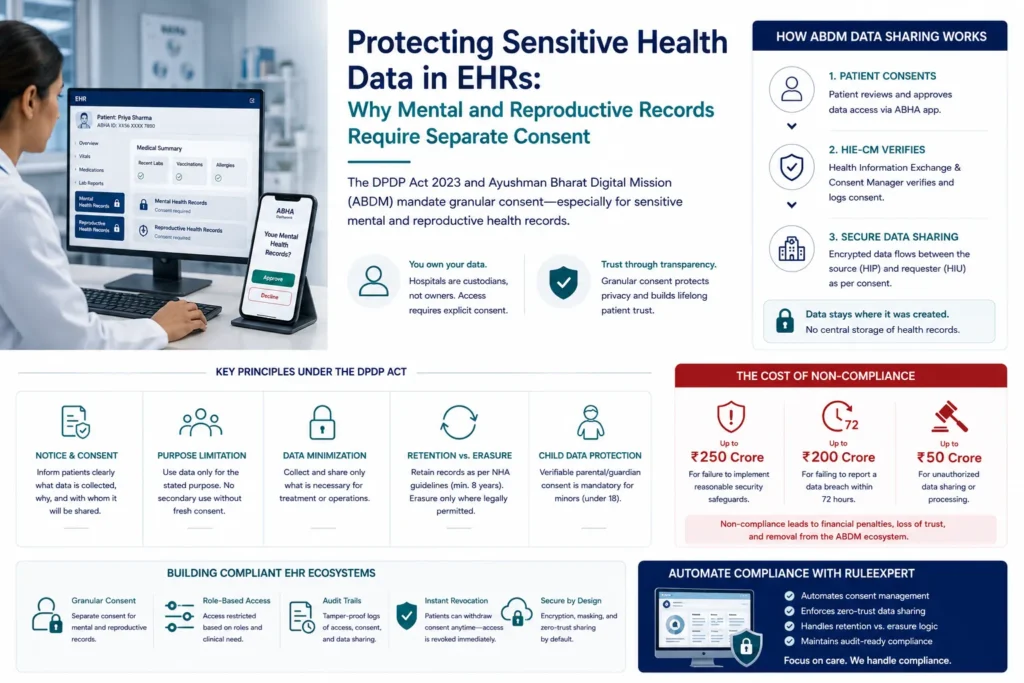
Imagine walking into a bustling clinic for a routine physical exam, expecting your health data to be accessed only for that specific visit. The attending physician opens your file on their tablet, and instantly, your entire medical history floods the screen. Alongside your recent cholesterol numbers and vaccination records, the screen also displays the fertility treatments you underwent three years ago, as well as notes from the therapy sessions you attended to manage severe anxiety.
Unsettling, isn’t it? As the healthcare industry aggressively digitizes its infrastructure, this scenario isn’t just a hypothetical privacy nightmare; it represents a massive legal liability. Electronic Health Records (EHR) have undoubtedly transformed patient care. They make diagnoses faster, reduce deadly medication errors, and allow for a seamless continuum of care across different specialists. But this incredible convenience brings a heavy burden of responsibility. At the very center of this digital shift is your Health Data, a deeply personal and highly sensitive asset that government regulators are now strictly protecting.
With the rollout of India’s Digital Personal Data Protection Act (DPDP Act 2023) and the nationwide implementation of the Ayushman Bharat Digital Mission (ABDM), the era of blanket patient approvals is officially over. Patients no longer sign a single piece of paper at the reception desk to surrender lifetime access to their health data and medical history. Instead, federal guidelines demand granular, separate consent mechanisms—especially for high-risk, special categories like mental health and reproductive records.
Let’s break down exactly what the official mandates require, why special category data handling is an absolute necessity, and how modern healthcare providers must overhaul their systems to stay compliant and protect patient trust.
The Evolving Legal Landscape of Indian Healthcare
For decades, the Indian healthcare system operated in a regulatory gray area regarding digital privacy. Hospitals collected whatever health data they deemed necessary, stored it in sprawling internal servers (or dusty basement filing cabinets), and shared it across departments without much oversight. Data was treated as a business asset belonging to the hospital.
The DPDP Act 2023 completely inverted that dynamic.
The new legislation introduced a rigorous framework centered entirely around the individual’s fundamental right to privacy. To understand how this impacts hospital IT systems and EHR software, you have to look at the core terminology the government uses to define the digital ecosystem. Under this law, the roles are clearly defined:
- Data Principal That’s the patient. The individual to whom the medical records belong. Under the new legal framework, the patient holds the ultimate authority over their information.
- Data Fiduciary This is the hospital, the specialized clinic, the telemedicine platform, or the health-tech app. They are the entities that determine exactly why and how the patient’s information is processed.
- Data Processor Think of third-party diagnostic laboratories, cloud storage providers hosting the EHR, or external billing agencies. They handle and process the information solely on behalf of the Data Fiduciary.
- Personal Data Any piece of information that can identify an individual. In a medical context, this ranges from a basic phone number and residential address to an MRI scan and genetic markers.
The regulatory body established to enforce this act—the Data Protection Board of India—expects organizations to prove beyond a shadow of a doubt that every piece of health data they hold was obtained legally. That means the patient explicitly, knowingly agreed to it.
Why Mental and Reproductive Records Are a Different Beast
Not all medical information carries the same societal weight. A clinical record of a broken arm or a seasonal flu doesn’t carry the same potential for devastation as a schizophrenia diagnosis, a history of multiple miscarriages, or notes regarding gender transition.
When highly sensitive health data leaks, the real-world fallout is catastrophic. Patients face severe workplace discrimination, sudden denial of insurance claims, family rejection, and intense emotional distress. Because of these incredibly high stakes, regulatory frameworks demand “special category” handling for this type of information.
Interestingly, while the final draft of the DPDP Act 2023 moved away from strictly defining a separate list of “sensitive personal data” (unlike earlier drafts), its core mandate remains clear: processing must not cause “significant harm” to the individual. By default, this forces hospitals to treat mental and reproductive health files with extreme caution. The Ayushman Bharat digital architecture echoes this by demanding high transparency.
Think about it from a clinical perspective. If a hospital’s EHR system bundles highly sensitive health data, such as a psychiatric evaluation, with a routine blood test under a single “view patient file” button, that hospital is violating the core legal principle of purpose limitation. A dermatologist checking a patient for a skin rash does not need to know about that patient’s past clinical depression. If the software gives them that access by default, it’s a massive compliance breach waiting to happen.
The Mechanics of Granular Consent in the ABDM Ecosystem
So, what does official, iron-clad compliance actually look like on the ground? It boils down to one concept: granular consent.
The days of handing a patient a clipboard with a generic “I agree to share my medical history for treatment purposes” form are dead. According to the guidelines set forth by the ABDM’s Health Data Management Policy, consent must be free, specific, informed, unconditional, and unambiguous.
What does “specific” actually mean for a complex EHR system handling health data? It means the software must physically decouple general medical history from highly sensitive records. When a doctor requests access to a patient’s profile, the system must trigger a separate, explicit request if they want to view mental health or reproductive files.
The Ayushman Bharat Digital Mission handles this elegantly through the Health Information Exchange Consent Manager (HIE-CM). This digital infrastructure acts as a highly secure traffic cop for medical records.
Let’s look at a real user journey. A patient creates an Ayushman Bharat Health Account (ABHA) and links it to a Personal Health Record (PHR) app on their smartphone to manage their health data. When they visit a new specialist (a Health Information User or HIU), that specialist requests access to the patient’s past records from their previous hospital (the Health Information Provider or HIP).
- Specialist (HIU) Requests Records
↓ - HIE-CM pings the patient’s ABHA-linked phone
↓ - Patient sees an itemized list of exactly what is being requested
↓ - ✓ Checked: blood work, allergy info✕ Unchecked: fertility / psychological records
↓ - Specialist receives only what was authorized
If your hospital’s EHR system cannot support this level of itemized, line-by-line permission, it is simply not compliant with India’s modern digital health infrastructure.
Overhauling Hospital IT: Strict Rules for EHR Compliance
Handling high-risk information requires a fundamental shift in how hospital IT departments and administrative staff operate. It’s not just about installing a stronger firewall or updating antivirus software; it’s about fundamentally redesigning the workflow of patient information.
Here is what official mandates practically require from healthcare providers acting as Data Fiduciaries:
1. Mandatory Notice Before Consent
You cannot ask for permission without explaining what you are asking for. The law requires fiduciaries to provide a clear, jargon-free notice before obtaining consent. This notice must detail exactly what Health Data is being collected, the specific purpose for processing it, and how the patient can exercise their rights.
2. Strict Role-Based Access Control (RBAC)
Internal hospital systems must enforce rigid digital boundaries to protect health data. An administrative billing clerk should only ever see billing codes and insurance details—never the detailed clinical notes of a therapy session. Access to reproductive and mental health files must be restricted mathematically to the specific attending specialist. If a nurse logs into the system, their view should be automatically filtered based on their exact role in that patient’s care.
3. Purpose Limitation and Secondary Use
Hospitals generate massive amounts of health data that researchers and tech companies desperately want to use for AI model training or clinical trials. Under the DPDP Act 2023, you cannot repurpose treatment data for research without going back to the patient for fresh, separate consent. If a hospital transfers patient files to a Data Processor for research, special category records must be strictly masked, aggressively anonymized, or entirely excluded unless explicitly authorized.
4. Instant Revocation Mechanisms
The law is uncompromising on this point: a patient must be able to withdraw their consent just as easily as they gave it. If a patient decides they no longer want a specific specialist to view their psychiatric history or other sensitive health data, they should be able to revoke access instantly through their patient portal. The moment they tap “revoke,” the EHR system must instantly drop a digital padlock on those files across the entire hospital network, immediately cutting off access.
5. Tamper-Proof Audit Trails
If a patient files a grievance, or if the Data Protection Board of India initiates an investigation, the hospital cannot rely on verbal assurances. They must produce a detailed, tamper-proof audit log for every instance of health data access. This log needs to show exactly when a sensitive file was opened, the specific staff member who viewed it, and the exact digital consent artifact that legally authorized the action.
The True Cost of Non-Compliance
Ignoring these specialized mandates is an incredibly expensive gamble. The government is no longer treating digital privacy as a polite suggestion or a secondary priority.
Under the provisions of the DPDP Act 2023, the penalties for failing to protect personal data or failing to implement reasonable security safeguards are financially devastating. Fines can reach a staggering INR 250 crore per contravention.
But the direct financial hit is only a fraction of the real problem. A breach involving highly sensitive psychological or reproductive health data permanently shatters patient trust. Healthcare is an industry built entirely on confidentiality. If the public believes a hospital cannot keep their most intimate secrets safe, they will simply take their healthcare needs elsewhere. Even worse, patients will begin lying or withholding crucial medical information from their doctors out of fear of a data leak, leading directly to misdiagnoses, dangerous drug interactions, and poor clinical outcomes.
Bridging the Gap with Automation Software
Managing this intricate web of rules manually is virtually impossible. A busy multi-specialty hospital handling thousands of patients a day cannot realistically rely on exhausted receptionists to manually track which patient approved which specific doctor to see which exact reproductive file. Human error is inevitable, and in the eyes of the law, human error is no excuse.
This is exactly why healthcare organizations are increasingly turning to purpose-built automation software to manage health data and survive the regulatory landscape. Systems designed around the DPDP Act 2023, such as RuleExpert and similar compliance engines, integrate directly into a hospital’s existing technical architecture to handle the heavy lifting.
Instead of drowning in manual paperwork, these platforms deploy intelligent digital consent modules for health data access. When a patient registers, the software presents them with a clean, intuitive interface to approve or deny access to different categories of their medical history. The compliance engine then dynamically updates access permissions across the entire hospital network in real time. It automatically handles the zero-trust data sharing rules, manages the instant revocation requests, and constantly maintains the flawless audit trails required by regulators, ensuring the hospital is perpetually ready for an audit.
By automating the brutal complexities of special category data handling, technology allows doctors to actually focus on practicing medicine, while the software quietly enforces the law in the background.
The Future of Ethical Healthcare
The push toward a fully digitized healthcare system is unstoppable. The overarching benefits for public health tracking, rapid medical research, and hyper-personalized individual care are simply too massive to ignore. However, this technological progress cannot and must not come at the expense of human dignity.
Mental and reproductive histories are among the most vulnerable, intimate forms of health data a person possesses. The official guidelines stemming from the Ministry of Health, the ABDM architecture, and the strict framework laid out by the DPDP Act 2023 deeply recognize this reality. By mandating separate, explicit consent and enforcing special category handling, the law ensures that patients retain absolute sovereignty over their own narrative.
For modern healthcare providers, the path forward is non-negotiable. Upgrading EHR systems to handle granular consent isn’t just an IT chore meant to avoid crushing regulatory fines. It is a fundamental demonstration of respect for the patient. When a hospital proves it can handle the most sensitive information with airtight security and absolute transparency, it doesn’t just check a compliance box. It builds the kind of unwavering, lifelong patient trust that defines true healthcare excellence.
Frequently Asked Questions (FAQs)
1. What exactly qualifies as Health Data under India’s current privacy regulations?
It includes any personal information related to a person’s physical or mental health condition, their complete medical history, diagnostic reports, genetic data, and records of past or present treatments. Because it can easily be used to identify, profile, and potentially discriminate against individuals, regulators subject it to intense scrutiny.
2. Why do the DPDP Act 2023 and ABDM require separate consent specifically for mental health records?
Mental health and reproductive histories carry uniquely high risks of social stigma, workplace discrimination, and emotional harm if exposed. Official guidelines require a separate, granular consent mechanism so patients can safely share basic medical information (like a blood type or a vaccination record) without exposing sensitive psychiatric or fertility notes to practitioners who don’t need them.
3. Who is considered a Data Fiduciary in the healthcare sector?
Any entity that dictates how and why patient information is collected and processed is a Data Fiduciary. In healthcare, this includes large hospitals, private clinics, telemedicine applications, and health insurance providers. They bear the ultimate legal responsibility for protecting patient records and obtaining valid consent.
4. Can a patient completely withdraw their consent after giving it to a doctor?
Yes, absolutely. The law mandates that withdrawing consent must be just as easy as giving it. If a patient revokes access to their reproductive records via an app or portal, the hospital’s EHR system must immediately lock those specific files from view, without disrupting the patient’s ongoing general medical treatment.
5. How does the Health Information Exchange Consent Manager (HIE-CM) work?
Built by the Ayushman Bharat Digital Mission, the HIE-CM is a digital public infrastructure gateway that allows patients to control their data-sharing preferences. It acts as a secure traffic controller, ensuring no medical record moves between hospitals, doctors, or health lockers without the patient’s explicit, itemized digital approval.
6. What are the penalties for mishandling patient records under the DPDP Act 2023?
The regulatory body, the Data Protection Board of India, has the authority to impose severe financial penalties. For a major data breach, or for failing to implement adequate security safeguards around sensitive data, fines can reach up to INR 250 crore per contravention.
7. Does emergency medical treatment require this granular, separate consent?
No. The DPDP Act 2023 includes specific exemptions for medical emergencies. If a patient is unconscious, incapacitated, or facing a severe, immediate threat to their life, hospitals are legally permitted to access and process necessary medical information without waiting for explicit consent, ensuring life-saving care is never delayed by administrative red tape.
8. What is the role of a Data Processor in managing Electronic Health Records?
A Data Processor is any third-party entity—such as a cloud storage provider hosting the EHR, a SaaS compliance tool, or an external diagnostic laboratory—that handles the data on behalf of the hospital. While the hospital (Fiduciary) is ultimately responsible to the patient, the Processor is legally bound to strictly follow the Fiduciary’s rules and maintain robust cybersecurity measures.