
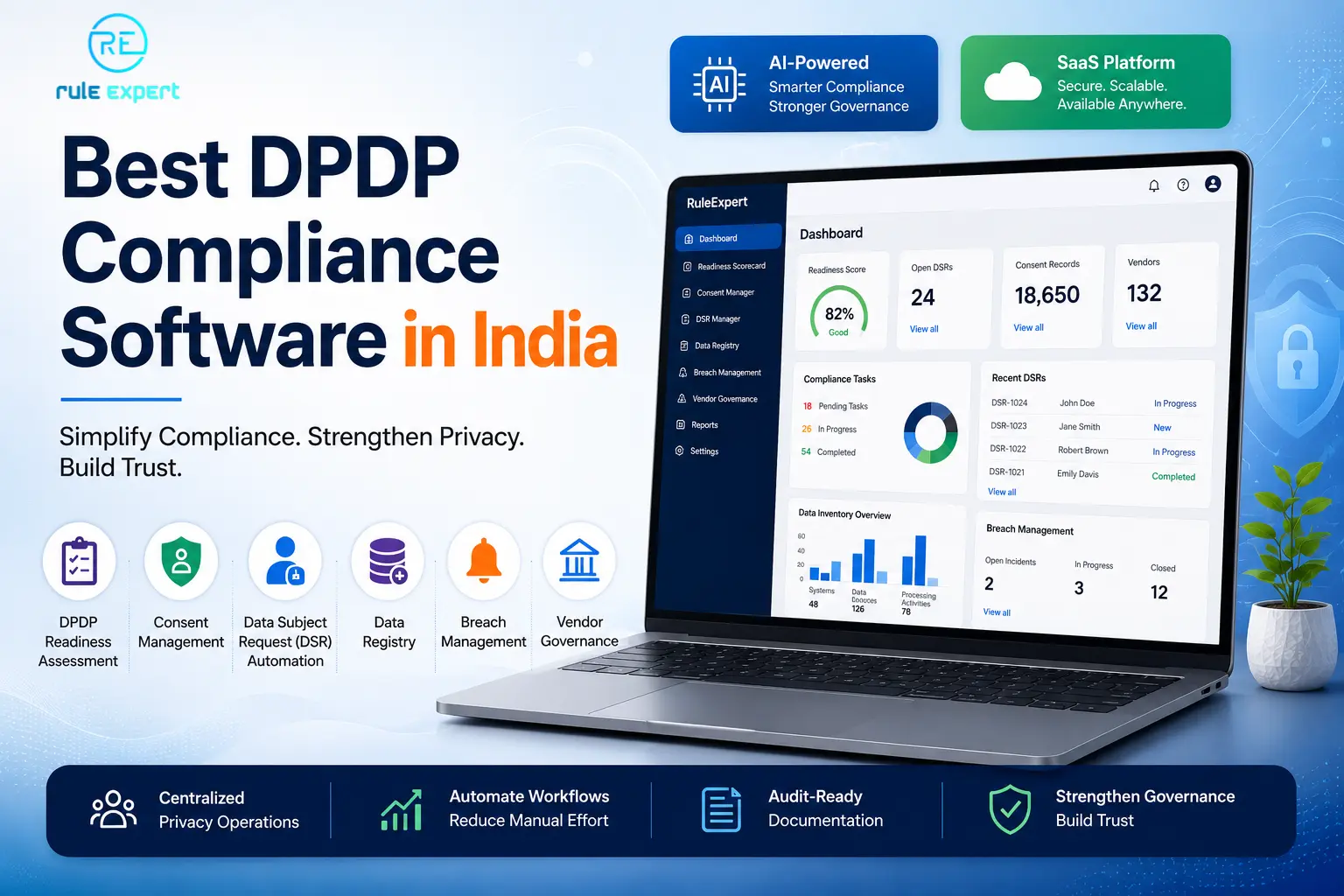
Choosing the best DPDP compliance software in India can be challenging as organizations evaluate different platforms, features, and compliance capabilities. Rather than focusing only on feature lists, decision-makers should assess how well a solution supports consent management, Data Subject Request (DSR) automation, breach management, vendor governance, and overall privacy operations. This guide explains what DPDP compliance software does, the essential features to evaluate, and how to choose the right solution for your organization.
As organizations across India prepare to strengthen their privacy governance under the Digital Personal Data Protection (DPDP) Act, 2023, managing compliance has become more than just a legal obligation—it has become an operational priority.
Businesses today process large volumes of digital personal data across websites, mobile applications, cloud platforms, HR systems, CRMs, ERPs, healthcare systems, and third-party vendors. Managing privacy obligations across these disconnected environments using spreadsheets, emails, and manual processes can quickly become inefficient, difficult to monitor, and challenging to scale.
This is why many organizations are evaluating DPDP compliance software to help centralize privacy operations, improve accountability, and support ongoing compliance activities.
Whether you’re a CEO, CIO, CTO, Compliance Officer, Data Protection Officer (DPO), Legal Head, or IT leader, selecting the right platform requires more than comparing feature lists. It involves understanding how the software supports day-to-day privacy operations, enables collaboration across teams, and helps your organization build a structured approach to compliance.
In this guide, we’ll explain:
- What DPDP compliance software is
- Why organizations are investing in DPDP compliance solutions
- The key features every platform should offer
- How AI-powered DPDP compliance software is transforming privacy operations
- Why DPDP compliance SaaS platforms are gaining adoption
- How to evaluate and choose the best DPDP compliance software in India
- Questions to ask before purchasing a solution
By the end of this guide, you’ll have a practical framework for evaluating solutions and selecting a platform that aligns with your organization’s privacy governance goals.
What is DPDP Compliance Software?
DPDP compliance software is a technology platform designed to help organizations operationalize activities associated with the Digital Personal Data Protection (DPDP) Act, 2023 through structured workflows, centralized documentation, and process automation.
Rather than relying on multiple spreadsheets, emails, or disconnected systems, a DPDP compliance platform provides a unified environment where organizations can manage privacy-related activities consistently across departments.
Depending on the platform, organizations may use DPDP compliance software to support activities such as:
- Assessing DPDP readiness and identifying compliance gaps
- Managing consent records and consent lifecycle processes
- Handling Data Subject Requests (DSRs) through structured workflows
- Maintaining an inventory of personal data and its processing activities
- Coordinating personal data breach response and documentation
- Managing third-party vendor governance
- Maintaining records and evidence that support internal governance and audit preparedness
The purpose of a DPDP compliance solution is not to replace an organization’s legal or compliance teams. Instead, it helps those teams execute compliance-related processes more efficiently, improve visibility across privacy operations, and maintain consistent documentation.
As organizations grow, privacy responsibilities often span multiple business functions—including IT, Information Security, Compliance, Legal, HR, Procurement, and Business Operations. A centralized platform can help these teams collaborate more effectively by assigning responsibilities, tracking progress, and maintaining a single source of truth for privacy activities.
For organizations evaluating software, the objective should not simply be to find a tool that helps “meet DPDP requirements.” Instead, they should look for a solution that enables scalable privacy governance, supports operational efficiency, and adapts as regulatory expectations and business needs evolve.
Key Takeaway: The best DPDP compliance software does more than digitize compliance tasks. It helps organizations build repeatable, accountable, and well-documented privacy processes that support long-term governance and operational readiness.
Why Organizations Need DPDP Compliance Software
As organizations accelerate digital transformation, the amount of personal data they collect, process, and store continues to grow. Customer records, employee information, supplier details, website registrations, mobile applications, cloud platforms, and third-party integrations all contribute to an increasingly complex data environment.
Managing these privacy responsibilities through spreadsheets, emails, and disconnected processes may work for small-scale operations, but it becomes increasingly difficult as organizations expand.
The Digital Personal Data Protection (DPDP) Act, 2023 reinforces the importance of protecting digital personal data and encourages organizations to establish appropriate governance processes for handling personal information responsibly.
For many organizations, the challenge is no longer understanding the law—it’s operationalizing compliance across multiple teams, systems, and business processes.
This is where DPDP compliance software provides value by bringing privacy operations into a centralized, structured environment.
Common Operational Challenges Organizations Face
Organizations evaluating a DPDP compliance solution often encounter similar operational challenges, regardless of their industry.
1. Personal Data is Scattered Across Multiple Systems
Digital personal data rarely exists in a single application.
It may be stored across:
- ERP systems
- CRM platforms
- HRMS applications
- Finance software
- Customer support tools
- Hospital Information Systems (HIS)
- Electronic Health Records (EHR/EMR)
- Websites and mobile applications
- Cloud storage platforms
- Third-party SaaS applications
Without centralized visibility, organizations often struggle to answer a fundamental question:
Where is our personal data actually stored?
A modern DPDP compliance tool should help organizations build and maintain visibility into their personal data landscape, making governance more structured and manageable.
2. Compliance Activities Are Managed Through Manual Processes
Many organizations continue to rely on:
- Excel spreadsheets
- Email threads
- Shared folders
- Paper-based approvals
- Individual trackers maintained by different departments
While these methods may seem convenient initially, they often create inconsistencies as compliance activities grow.
Common issues include:
- Duplicate records
- Missed follow-ups
- Lack of version control
- Difficulty tracking responsibilities
- Limited visibility into progress
A centralized platform helps standardize workflows and reduce dependence on fragmented manual processes.
Privacy governance is rarely managed by a single department.
Typical stakeholders include:
- IT
- Information Security
- Compliance
- Legal
- Human Resources
- Procurement
- Operations
- Business Units
Each team performs different activities while working with the same personal data.
Without a structured workflow, organizations may experience:
- Communication gaps
- Delayed approvals
- Unclear ownership
- Inconsistent documentation
A centralized DPDP compliance SaaS platform enables departments to collaborate through clearly defined roles, workflows, and responsibilities.
4. Consent Records Become Difficult to Manage
Organizations often collect consent through multiple channels, including websites, mobile applications, customer portals, registration forms, and digital onboarding processes.
Over time, maintaining accurate consent records can become challenging without a centralized process.
Organizations may need to answer questions such as:
- When was consent obtained?
- What purpose was the consent provided for?
- Has the consent been updated or withdrawn?
- Can the organization demonstrate an auditable record of consent?
Managing these records manually can increase administrative effort and make information retrieval time-consuming.
5. Handling Data Subject Requests Requires Cross-Team Coordination
As organizations mature their privacy programs, responding to requests from individuals may involve several departments.
For example, a request to access, correct, or erase personal data may require coordination between:
- IT teams
- Customer support
- Compliance
- Legal
- Business functions
Without standardized workflows, requests may require manual follow-ups, making progress difficult to monitor.
A structured process can improve consistency while helping organizations maintain documentation throughout the request lifecycle.
6. Third-Party Vendor Oversight Is Becoming More Important
Many organizations engage external service providers that process personal data on their behalf.
These may include:
- Cloud service providers
- Payroll partners
- Marketing platforms
- CRM vendors
- Payment service providers
- Healthcare technology vendors
- Outsourced support providers
Managing vendor information, risk assessments, contractual documentation, and ongoing reviews through separate spreadsheets can become increasingly complex as the vendor ecosystem grows.
Organizations benefit from a structured approach to maintaining visibility over third-party relationships.
7. Maintaining Audit-Ready Documentation Can Be Time-Consuming
Privacy-related activities often generate a significant amount of documentation.
Examples include:
- Compliance assessments
- Consent records
- Risk reviews
- Investigation reports
- Internal approvals
- Policy acknowledgements
- Vendor evaluations
- Corrective actions
When documents are stored across different locations, retrieving information for internal reviews or governance activities can consume valuable time.
A centralized compliance platform helps organize records, improve traceability, and maintain evidence in a more structured manner.
How DPDP Compliance Software Helps Address These Challenges
Rather than managing privacy operations through disconnected processes, organizations are increasingly adopting DPDP compliance software to centralize and streamline compliance activities.
A well-designed platform can help organizations:
- Conduct DPDP readiness assessments
- Manage consent records through structured workflows
- Handle Data Subject Requests (DSRs) more efficiently
- Maintain a centralized inventory of personal data
- Coordinate breach response activities
- Govern third-party vendors
- Maintain evidence and documentation
- Improve visibility across privacy operations
- Support collaboration between multiple departments
Instead of treating compliance as a one-time project, organizations can build repeatable processes that support ongoing privacy governance as business operations evolve.
Key Takeaway: The value of DPDP compliance software lies not only in helping organizations understand compliance requirements but also in enabling them to operationalize privacy governance through centralized workflows, better visibility, and structured documentation.
Key Features Every DPDP Compliance Software Should Offer
Choosing the best DPDP compliance software in India involves more than comparing pricing or marketing claims. Organizations should evaluate whether a platform can support their day-to-day privacy operations, improve governance, and adapt as compliance requirements evolve.
The right DPDP compliance solution should simplify complex workflows, enable collaboration across teams, and provide greater visibility into how personal data is managed across the organization.ok for when choosing the best DPDP compliance software in India.
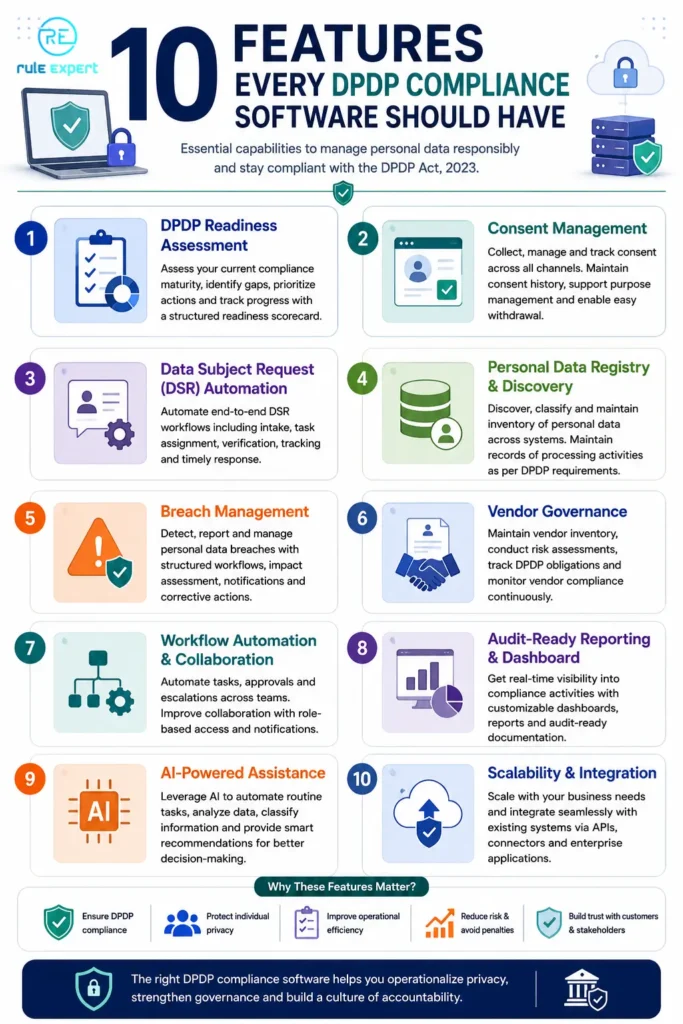
Below are the key capabilities decision-makers should evaluate before selecting a DPDP compliance tool.
1. DPDP Readiness Assessment
Every compliance journey begins with understanding your organization’s current state.
Before implementing new policies or technology, organizations should identify their existing privacy practices, governance processes, and operational gaps.
A robust DPDP compliance platform should help organizations:
- Assess current privacy maturity
- Identify compliance gaps
- Prioritize improvement areas
- Generate actionable recommendations
- Track progress over time
A structured readiness assessment enables leadership to make informed decisions instead of relying on assumptions.
Evaluation Tip: Look for platforms that provide a structured readiness assessment with measurable outputs rather than generic questionnaires.
2. Consent Management
Managing consent consistently becomes increasingly challenging as organizations collect personal data across websites, mobile applications, customer portals, and business systems.
An effective DPDP compliance software should help organizations manage the complete consent lifecycle through centralized workflows.
Key capabilities include:
- Recording consent
- Managing consent purposes
- Maintaining consent history
- Tracking consent updates
- Supporting consent withdrawal
- Maintaining audit trails
Instead of maintaining consent information in multiple systems, organizations benefit from a centralized repository that improves visibility and accountability.
Evaluation Tip: Choose a platform that treats consent as an ongoing operational process rather than a one-time activity.
3. Data Subject Request (DSR) Automation
Managing Data Subject Requests manually can require coordination between several departments, especially in organizations with large volumes of personal data.
A modern DPDP compliance SaaS platform should provide structured workflows that help teams manage requests efficiently from submission through completion.
Important capabilities include:
- Centralized request intake
- Role-based assignment
- Workflow tracking
- Status monitoring
- Documentation of actions taken
- Complete audit history
Automation reduces manual coordination while improving consistency and transparency throughout the request lifecycle.
Evaluation Tip: Assess whether the platform supports configurable workflows and clear ownership of each request.
4. Personal Data Registry and Data Discovery
One of the biggest challenges organizations face is identifying where personal data resides.
Without a reliable inventory, responding to privacy requests, managing retention, or assessing potential risks becomes significantly more difficult.
A comprehensive platform should help organizations:
- Maintain a centralized inventory of personal data
- Map personal data across systems
- Classify information based on business requirements
- Document processing activities
- Improve visibility across departments
A well-maintained data registry forms the foundation of effective privacy governance.
Evaluation Tip: The value of a data registry lies in its accuracy, visibility, and ability to support ongoing governance—not just documentation.
5. Breach Management
Even organizations with mature security programs should be prepared to respond effectively if a personal data breach occurs.
A structured breach management capability helps organizations coordinate incident response through documented workflows instead of ad hoc communication.
Key features may include:
- Incident reporting
- Responsibility assignment
- Investigation tracking
- Risk assessment
- Evidence management
- Corrective action tracking
- Response documentation
Centralized breach management helps improve accountability and supports consistent incident handling across teams.
Evaluation Tip: Evaluate how the platform helps manage the entire breach lifecycle, from reporting through resolution and documentation.
6. Vendor Governance
Many organizations rely on external vendors to process or access personal data.
As vendor ecosystems expand, maintaining visibility into third-party relationships becomes increasingly important.
A strong DPDP compliance solution should support:
- Vendor inventory management
- Vendor risk assessments
- Due diligence tracking
- Contract documentation
- Periodic reviews
- Ongoing governance activities
Managing vendors through a centralized platform can help organizations maintain more consistent oversight of third-party privacy practices.
Evaluation Tip: Look for solutions that make vendor governance part of your broader privacy program rather than treating it as a standalone activity.
7. Workflow Automation and Cross-Functional Collaboration
Privacy governance is a shared responsibility involving IT, Legal, Compliance, HR, Information Security, Procurement, and Business Operations.
Without structured workflows, responsibilities may become fragmented, leading to delays and inconsistent documentation.
An effective DPDP compliance software should support:
- Role-based access
- Workflow automation
- Task assignment
- Approval processes
- Notifications
- Collaboration across departments
These capabilities help ensure that privacy activities are managed consistently and that responsibilities are clearly defined.
Evaluation Tip: Evaluate how easily different teams can collaborate within the platform without relying on email chains or manual follow-ups.
8. Audit-Ready Reporting and Documentation
Privacy programs generate significant documentation over time.
Organizations should be able to retrieve information efficiently when conducting internal reviews, responding to governance requests, or preparing for audits.
Useful capabilities include:
- Centralized evidence repository
- Activity logs
- Investigation records
- Consent history
- Vendor documentation
- Risk assessments
- Compliance dashboards
- Exportable reports
Maintaining organized documentation improves operational efficiency and supports stronger governance practices.
Evaluation Tip: Ask vendors how their platform helps maintain traceable records and demonstrate completed compliance activities.
9. Scalability and Integration
As organizations grow, privacy operations often become more complex.
The best DPDP compliance software in India should be capable of supporting changing business needs without requiring organizations to rebuild their compliance processes.
Consider whether the platform can:
- Scale across business units
- Support multiple departments
- Integrate with existing enterprise systems
- Adapt to future operational requirements
- Expand as privacy programs mature
Selecting a scalable solution helps organizations avoid repeated software migrations as their compliance programs evolve.
10. AI-Powered Assistance
Organizations increasingly expect technology to reduce repetitive administrative work.
An AI-powered DPDP compliance software platform may assist teams by:
- Organizing compliance information
- Supporting documentation workflows
- Identifying process gaps
- Summarizing compliance activities
- Improving operational efficiency
AI should enhance decision-making and streamline routine tasks while ensuring that organizations maintain appropriate human oversight for compliance-related decisions.
Evaluation Tip: Evaluate AI capabilities based on practical business outcomes rather than marketing claims. Ask vendors how AI is applied within specific compliance workflows.
Feature Evaluation Checklist
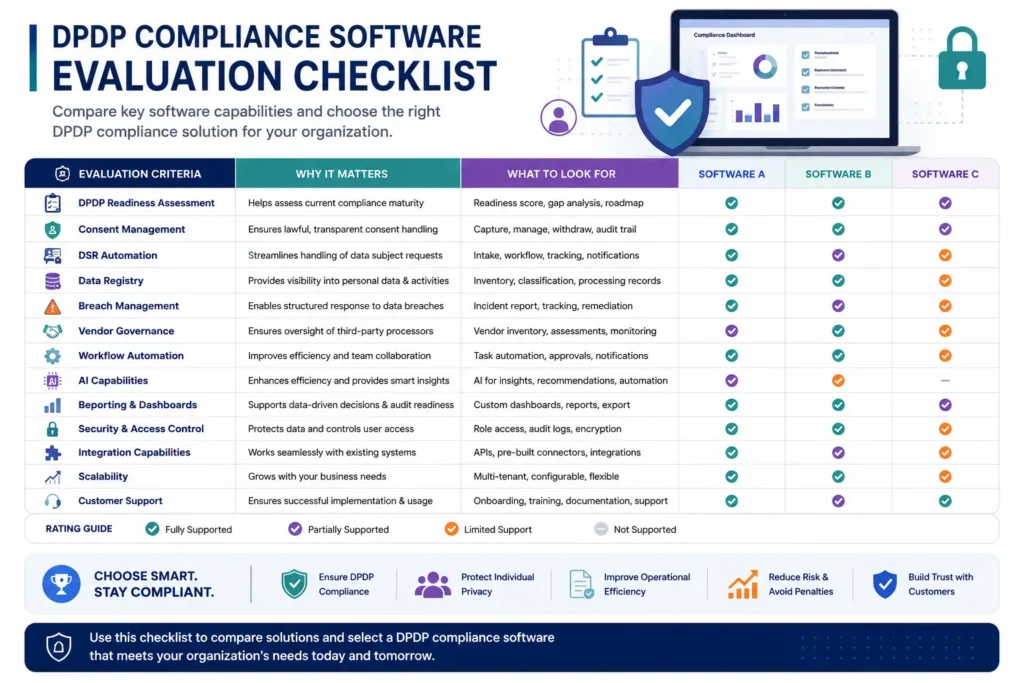
When comparing vendors, use the following checklist to assess whether a DPDP compliance tool in India aligns with your organization’s needs.
| Capability | Why It Matters |
| DPDP Readiness Assessment | Identifies current compliance gaps and priorities |
| Consent Management | Centralizes consent records and lifecycle management |
| DSR Automation | Streamlines handling of data subject requests |
| Personal Data Registry | Improves visibility into personal data across systems |
| Breach Management | Supports structured incident response and documentation |
| Vendor Governance | Strengthens oversight of third-party data processors |
| Workflow Automation | Improves collaboration and accountability |
| Audit-Ready Reporting | Maintains evidence and documentation for governance |
| Scalability | Supports future business growth and evolving compliance needs |
| AI Assistance | Helps improve efficiency across privacy operations |
Key Takeaway: The best DPDP compliance software is not necessarily the one with the longest feature list. It is the platform that aligns with your organization’s operational processes, supports collaboration across teams, and enables consistent, scalable privacy governance over time.
Why AI-Powered DPDP Compliance Software Is Becoming Essential
Privacy compliance is no longer a one-time implementation project. As organizations continue to collect and process digital personal data across multiple systems, compliance becomes an ongoing operational responsibility involving documentation, governance, collaboration, and continuous monitoring.
Managing these activities manually can become increasingly difficult as the volume of personal data, business processes, and stakeholders grows.
This is one of the reasons many organizations are evaluating AI-powered DPDP compliance software to improve efficiency across privacy operations.
Rather than replacing compliance professionals, AI can help reduce repetitive administrative work, improve visibility into compliance activities, and support faster decision-making.
How AI Can Improve Privacy Operations
Privacy teams often spend considerable time performing repetitive tasks that require collecting information from multiple sources, tracking progress, and maintaining documentation.
An AI-enabled platform can help streamline operational activities such as:
- Organizing compliance records
- Assisting with document preparation
- Tracking workflow progress
- Identifying missing information
- Highlighting potential compliance gaps
- Summarizing activities for internal reporting
By reducing manual effort, organizations can focus more on governance, risk management, and strategic decision-making.
AI Supports Operational Efficiency—Not Compliance Decisions
One common misconception is that AI can “make an organization DPDP compliant.”
In reality, compliance requires appropriate governance, policies, processes, and human oversight.
AI should be viewed as a technology that supports compliance operations, rather than replacing legal, compliance, or business decision-making.
Organizations should evaluate AI capabilities based on how they improve operational efficiency while ensuring that qualified personnel remain responsible for compliance decisions.
Areas Where AI Can Add Value
When evaluating an AI-powered DPDP compliance software platform, organizations should consider how AI is applied across different operational workflows.
Examples may include:
DPDP Readiness Assessment
AI can assist in organizing assessment responses, identifying incomplete information, and helping teams prioritize areas that require further review.
Consent Management
AI may help organize consent records, identify inconsistencies, and support better management of consent-related documentation.
Data Subject Request (DSR) Management
Organizations processing a large number of requests may benefit from AI-assisted workflow prioritization, request categorization, and documentation support.
Data Registry
AI can assist teams in organizing data inventories, improving classification, and maintaining structured records across business functions.
Breach Management
During incident response, AI may support documentation, timeline creation, and evidence organization, helping teams maintain complete records throughout the investigation.
Vendor Governance
Organizations managing numerous vendors may use AI-assisted workflows to organize vendor information, monitor review activities, and maintain governance documentation more efficiently.
Questions to Ask Before Choosing an AI-Powered DPDP Compliance Software
Not every platform that claims to be “AI-powered” delivers meaningful operational value.
Before selecting a solution, decision-makers should ask:
- Which compliance workflows actually use AI?
- Does AI improve productivity or simply generate content?
- Can users review and validate AI-generated outputs?
- Is AI assisting operational workflows or making compliance decisions?
- How does the platform protect sensitive organizational information?
- Does AI integrate naturally into day-to-day compliance activities?
These questions help organizations evaluate whether AI capabilities provide practical business value rather than simply serving as marketing terminology.
Why SaaS-Based DPDP Compliance Platforms Are Becoming the Preferred Choice
Many organizations today prefer DPDP compliance SaaS platforms because they offer flexibility, centralized access, and easier collaboration across distributed teams.
Unlike traditional software deployments that often require significant infrastructure and maintenance, SaaS platforms allow organizations to manage compliance activities through a centralized environment that is accessible to authorized users across locations.
For organizations with multiple business units, branch offices, or distributed compliance teams, this centralized approach can simplify collaboration and improve operational consistency.
Benefits of a SaaS-Based DPDP Compliance Platform
Faster Deployment
Organizations can begin implementing privacy workflows without lengthy software installation or infrastructure projects.
Centralized Collaboration
Compliance activities often involve multiple stakeholders.
A SaaS platform enables IT, Compliance, Legal, HR, Procurement, Information Security, and Business Operations to work from a shared environment while maintaining role-based access controls.
Easier Product Updates
As products evolve, SaaS platforms can deliver new features and enhancements more efficiently than traditional on-premises software.
This allows organizations to benefit from continuous product improvements without managing complex upgrade projects.
Improved Scalability
Business requirements change over time.
Whether an organization expands into new business units, increases its workforce, or processes greater volumes of personal data, a scalable SaaS platform can support evolving operational needs more effectively.
Better Visibility Across Privacy Operations
A centralized platform can provide management with a clearer view of ongoing privacy activities through dashboards, reporting, workflow tracking, and documentation.
This improved visibility supports stronger governance and more informed decision-making.
Is SaaS the Right Choice for Every Organization?
The answer depends on an organization’s operational, technical, and regulatory requirements.
Before selecting any DPDP compliance SaaS platform, organizations should evaluate factors such as:
- Deployment options
- Security practices
- User access controls
- Integration capabilities
- Data governance requirements
- Vendor support
- Scalability
- Business continuity considerations
A structured evaluation ensures that the selected platform aligns with both current operational needs and long-term business objectives.
AI + SaaS: A Practical Combination for Modern Privacy Operations
Many organizations are now looking beyond standalone compliance tools and instead evaluating platforms that combine centralized SaaS delivery with practical AI-assisted capabilities.
This combination can help organizations:
- Improve operational efficiency
- Reduce manual administrative work
- Standardize compliance workflows
- Enhance collaboration across departments
- Maintain organized documentation
- Support ongoing privacy governance
Ultimately, the value of a platform lies not in whether it includes AI or SaaS, but in how effectively those capabilities help organizations build repeatable, accountable, and scalable privacy processes.
Key Takeaway: AI and SaaS should be viewed as enablers of efficient privacy operations—not as guarantees of compliance. When evaluating a DPDP compliance platform, focus on how these capabilities improve governance, collaboration, documentation, and day-to-day execution while supporting appropriate human oversight.
Great. Based on the buyer journey, Part 5 is the most critical conversion section. This is where we move from “educating” the reader to “helping them make a purchase decision.” Unlike competitor pages that simply compare products, this section teaches readers how to evaluate software, which builds trust and positions RuleExpert as a thought leader.
How to Evaluate the Best DPDP Compliance Software in India
Selecting the best DPDP compliance software in India requires more than comparing feature lists or pricing. Organizations should evaluate how effectively a platform supports their privacy governance objectives, integrates with existing business processes, and scales as compliance requirements evolve.
Every organization has different operational requirements. A hospital managing patient records, a financial institution handling customer information, and a SaaS company processing user data may all require different workflows. Therefore, decision-makers should focus on how well a platform aligns with their organization’s privacy program rather than selecting software based solely on marketing claims.
The following evaluation framework can help organizations compare DPDP compliance software, ask the right questions during vendor demonstrations, and make informed purchasing decisions.
Evaluate the Platform Against Your Compliance Requirements
Start by identifying the privacy processes your organization needs to manage today—and those you may need in the future.
Consider whether the platform supports:
DPDP readiness assessments
Consent management
Data Subject Request (DSR) workflows
Personal data inventory and registry
Breach management
Vendor governance
Compliance reporting and documentation
A platform that covers these operational workflows through a unified interface can reduce the need for multiple standalone tools.
Assess Ease of Implementation
Implementation plays an important role in software adoption.
During product evaluation, consider questions such as:
How quickly can the platform be deployed?
Does it require extensive customization?
Can business users adopt it with minimal training?
Is onboarding structured and well-documented?
Are implementation services or customer success resources available?
A straightforward implementation process can help organizations begin operationalizing compliance sooner while reducing the burden on internal teams.
Evaluate Workflow Automation
Privacy operations involve recurring activities across multiple departments.
Look for a DPDP compliance solution that automates repetitive tasks while maintaining human oversight where required.
Examples include:
Task assignment
Approval workflows
Notifications
Request tracking
Evidence collection
Progress monitoring
Automation helps improve operational consistency while reducing administrative effort.
Consider Integration Capabilities
Organizations rarely operate with a single business application.
An effective DPDP compliance tool in India should integrate smoothly with existing enterprise systems wherever appropriate.
Examples include:
CRM platforms
ERP systems
HRMS applications
Identity and access management systems
Customer portals
Cloud applications
Document repositories
Integration capabilities can help reduce manual data movement and improve operational efficiency.
Review Reporting and Dashboard Capabilities
Leadership teams require visibility into ongoing privacy activities.
A comprehensive reporting framework should enable organizations to monitor:
Readiness assessment progress
Consent status
Open DSRs
Breach investigations
Vendor reviews
Compliance activities
Outstanding tasks
Interactive dashboards can help management monitor operational performance and support informed decision-making.
Assess Scalability
Privacy governance requirements evolve as organizations grow.
When comparing vendors, ask:
Can the platform support multiple business units?
Can new workflows be configured without major redevelopment?
Will the solution scale as the organization expands?
Can additional users and departments be onboarded easily?
Choosing a scalable platform helps protect long-term technology investments.
Evaluate Security and Access Controls
Since compliance platforms may contain sensitive organizational information, organizations should assess the platform’s approach to security and governance.
Key considerations include:
Role-based access controls
User authentication
Audit logs
Activity history
Secure data handling
Administrative controls
Understanding these capabilities helps organizations evaluate whether the platform aligns with their internal governance requirements.
Questions Every Organization Should Ask Before Buying DPDP Compliance Software
Before making a purchase decision, organizations should conduct a structured vendor evaluation rather than relying solely on feature lists or marketing presentations.
Consider asking the following questions during product demonstrations:
Does the platform support end-to-end DPDP compliance workflows?
Rather than using separate tools for consent, breach management, DSRs, and vendor governance, determine whether these workflows can be managed through a centralized platform.
How does the platform improve day-to-day compliance operations?
Ask vendors to demonstrate how their solution helps reduce manual effort, improves collaboration, and supports operational efficiency.
How are responsibilities assigned and tracked?
Privacy governance involves multiple departments.
Evaluate whether the platform enables:
Role assignment
Task ownership
Workflow tracking
Escalation management
Progress monitoring
How does the platform maintain documentation?
Documentation is an essential aspect of privacy governance.
Ask vendors how the platform maintains:
Activity history
Investigation records
Consent history
Workflow evidence
Reports
Audit trails
Does the platform support future growth?
Organizations should select software that continues to meet their operational requirements as privacy programs mature.
Discuss:
Scalability
Product roadmap
Future enhancements
Integration capabilities
Customer support
What level of customer support is available?
Software implementation is only the beginning.
Ask about:
Onboarding assistance
Product training
Technical support
Product documentation
Ongoing customer success
A strong support model can significantly improve long-term adoption.
Common Mistakes Organizations Make When Choosing DPDP Compliance Software
Selecting the wrong platform can create operational challenges that become more difficult to address as privacy programs expand.
Some common mistakes include:
Selecting Software Based Only on Price
Lower cost does not necessarily translate into lower long-term operational effort.
Organizations should evaluate the platform’s overall value, functionality, scalability, and ability to support evolving privacy processes.
Focusing Only on Individual Features
Buying separate tools for consent, DSRs, breach management, and vendor governance may increase complexity.
A centralized platform can often provide better operational visibility and collaboration.
Ignoring Future Requirements
Privacy programs evolve over time.
Organizations should evaluate whether the platform can adapt to new workflows, organizational growth, and changing business requirements.
Overlooking User Adoption
Even the most feature-rich platform provides limited value if employees find it difficult to use.
User experience, workflow simplicity, and ease of adoption should be part of every software evaluation.
Choosing a Platform Without a Structured Evaluation Process
Organizations often compare vendors using marketing brochures rather than objective criteria.
Developing a standardized evaluation checklist helps ensure that every solution is assessed consistently.
Key Takeaway: The best DPDP compliance software in India is not necessarily the platform with the longest feature list or the lowest price. It is the solution that aligns with your organization’s operational processes, supports collaboration across departments, scales with future needs, and helps establish a structured approach to privacy governance.
How RuleExpert Helps Organizations Operationalize DPDP Compliance
Choosing the right DPDP compliance platform is only the first step. The real value comes from how effectively the platform helps organizations translate compliance requirements into structured, repeatable, and measurable operational processes.
RuleExpert is an AI-powered DPDP compliance platform designed to help organizations move beyond manual compliance management by centralizing privacy workflows, improving visibility, and supporting ongoing governance.
Instead of relying on disconnected spreadsheets, emails, and multiple tracking systems, RuleExpert brings key privacy operations together through a unified platform.
Start with a DPDP Readiness Assessment
Many organizations know they need to strengthen their privacy program but are unsure where to begin.
RuleExpert’s DPDP Scorecard helps organizations assess their current readiness by identifying operational gaps across key privacy and governance areas.
The assessment enables organizations to:
- Evaluate their current DPDP readiness
- Identify improvement opportunities
- Prioritize compliance initiatives
- Build a structured implementation roadmap
Rather than making assumptions about compliance maturity, leadership teams gain a clearer understanding of their current position and the areas that require attention.
Centralize Consent Management
Managing consent across multiple websites, applications, and business systems can become increasingly complex.
RuleExpert’s Consent Manager helps organizations maintain structured consent records throughout the consent lifecycle.
Organizations can manage:
- Consent collection
- Consent records
- Purpose management
- Consent history
- Consent withdrawal workflows
- Audit-ready documentation
Centralized consent management improves consistency while reducing reliance on manual record keeping.
Streamline Data Subject Request (DSR) Management
Responding to Data Subject Requests often requires coordination between IT, Compliance, Legal, HR, and business teams.
RuleExpert’s DSR Automation module provides structured workflows that help organizations manage requests more efficiently.
The platform supports:
- Centralized request intake
- Responsibility assignment
- Workflow tracking
- Status monitoring
- Documentation management
- Progress visibility
This helps teams coordinate activities through a consistent process rather than fragmented communication.
Maintain a Centralized Data Registry
Understanding where personal data exists is fundamental to effective privacy governance.
RuleExpert’s Data Registry helps organizations maintain visibility into personal data across business systems.
Organizations can:
- Maintain a centralized personal data inventory
- Document processing activities
- Improve data visibility
- Support governance initiatives
- Strengthen operational accountability
A centralized registry provides a stronger foundation for privacy management across departments.
Improve Breach Management
A structured response is critical when a personal data breach occurs.
RuleExpert’s Breach Management module helps organizations manage the incident lifecycle through a centralized workflow.
Teams can:
- Report incidents
- Assign responsibilities
- Track investigations
- Maintain supporting documentation
- Record corrective actions
- Monitor response progress
By centralizing breach response activities, organizations can improve coordination and maintain more consistent documentation.
Strengthen Vendor Governance
Many organizations rely on third-party vendors to process personal data.
Managing vendor relationships through spreadsheets and emails can make ongoing oversight difficult.
RuleExpert’s Vendor Governance module helps organizations:
- Maintain vendor inventories
- Document vendor assessments
- Track review activities
- Improve third-party governance
- Support ongoing monitoring
This enables organizations to maintain greater visibility into vendor-related privacy processes.
Why Organizations Choose RuleExpert
When evaluating the best DPDP compliance software in India, organizations should look beyond individual features and consider how effectively a platform supports day-to-day privacy operations.
RuleExpert is designed to help organizations:
- Centralize DPDP compliance activities
- Replace fragmented manual workflows
- Improve collaboration across departments
- Maintain structured documentation
- Support privacy governance at scale
- Improve operational visibility
- Build audit-ready compliance processes
Instead of using multiple tools for different privacy activities, organizations can manage key workflows through a single platform designed specifically for DPDP compliance.
A Platform Designed for Modern Privacy Operations
As organizations grow, privacy responsibilities become increasingly distributed across multiple departments and business systems.
RuleExpert provides a centralized environment where Compliance, Legal, IT, Information Security, HR, Procurement, and business teams can collaborate through standardized workflows.
This helps organizations:
- Improve accountability
- Standardize compliance activities
- Reduce manual coordination
- Maintain consistent records
- Support informed decision-making
The objective is not simply to digitize compliance tasks, but to help organizations establish repeatable and scalable privacy operations.
Is RuleExpert the Right DPDP Compliance Solution for Your Organization?
Every organization has unique operational requirements, technology environments, and privacy governance objectives.
If your organization is looking for a platform that can help:
- Assess DPDP readiness
- Manage consent efficiently
- Automate Data Subject Requests
- Maintain a centralized data registry
- Improve breach management
- Strengthen vendor governance
- Support audit-ready documentation
then evaluating RuleExpert as part of your software selection process may be worthwhile.
Rather than selecting software based solely on feature lists or marketing claims, organizations should assess how well a platform aligns with their operational processes, governance requirements, and long-term privacy strategy.
Key Takeaway: The best DPDP compliance software is not defined by the number of features it offers, but by how effectively it helps organizations operationalize privacy governance, improve collaboration, maintain accountability, and support ongoing compliance activities. RuleExpert is designed with this objective in mind, helping organizations build structured and scalable DPDP compliance processes without relying on fragmented manual workflows.
Frequently Asked Questions About DPDP Compliance Software
What is DPDP compliance software?
DPDP compliance software is a platform that helps organizations manage operational activities associated with the Digital Personal Data Protection (DPDP) Act, 2023. Depending on the platform, these activities may include consent management, Data Subject Request (DSR) workflows, personal data inventory, breach management, vendor governance, and compliance documentation.
Rather than replacing legal or compliance teams, the software helps organizations standardize and streamline privacy processes through centralized workflows.
Who should use DPDP compliance software?
Any organization that processes digital personal data can benefit from a structured privacy management platform.
This may include:
- Healthcare organizations
- Banks and financial institutions
- Insurance companies
- IT and SaaS companies
- E-commerce businesses
- Educational institutions
- Manufacturing companies
- Professional service organizations
The suitability of a platform depends on an organization’s operational complexity, data processing activities, and governance requirements.
How do I choose the best DPDP compliance software in India?
When evaluating software, organizations should consider:
- Coverage of privacy workflows
- Ease of implementation
- Workflow automation
- Consent management capabilities
- DSR management
- Data registry
- Breach management
- Vendor governance
- Reporting and documentation
- Scalability
- Integration capabilities
- Customer support
Instead of focusing only on pricing, decision-makers should evaluate how well the platform supports long-term privacy governance.
Is AI-powered DPDP compliance software better than traditional software?
AI can improve operational efficiency by assisting with repetitive administrative activities such as organizing documentation, supporting workflows, and identifying information gaps.
However, organizations should evaluate AI capabilities carefully and ensure that compliance decisions continue to involve appropriate human oversight.
The value of AI depends on how effectively it supports day-to-day privacy operations rather than simply being included as a product feature.
Why are SaaS-based DPDP compliance platforms becoming popular?
Many organizations prefer SaaS platforms because they offer centralized access, easier deployment, simplified collaboration, and the ability to scale as privacy programs mature.
A SaaS platform can also make it easier for multiple departments to work together through shared workflows while maintaining role-based access and centralized documentation.
Organizations should still evaluate deployment models, security practices, and integration capabilities based on their own business requirements.
Can DPDP compliance software replace legal advice?
No.
DPDP compliance software helps organizations manage operational privacy processes more efficiently, but it does not replace legal advice or professional compliance guidance.
Organizations should continue to seek legal or regulatory advice where appropriate while using software to support governance, documentation, and workflow management.
How long does it take to implement DPDP compliance software?
Implementation timelines vary depending on factors such as:
- Organization size
- Existing privacy processes
- Number of business units
- Integration requirements
- Scope of implementation
Organizations should discuss implementation planning, onboarding support, and deployment timelines directly with prospective software vendors.
What should I ask during a product demonstration?
A product demonstration is an opportunity to understand how the platform supports real business operations.
Consider asking:
- How does the platform support DPDP readiness assessments?
- Can multiple departments collaborate within the platform?
- How are workflows assigned and tracked?
- How is documentation maintained?
- What reporting capabilities are available?
- How does the platform support future business growth?
- Which compliance activities are automated?
- What onboarding and customer support services are provided?
These questions can help organizations compare solutions using consistent evaluation criteria.
Final Thoughts
Selecting the best DPDP compliance software in India is not simply about choosing a platform with the most features—it is about finding a solution that aligns with your organization’s operational needs, privacy governance objectives, and long-term compliance strategy.
As organizations process increasing volumes of digital personal data, privacy management becomes an ongoing business function rather than a one-time compliance initiative. Managing consent, responding to Data Subject Requests, maintaining visibility into personal data, coordinating breach response, and governing third-party vendors all require structured processes and collaboration across multiple teams.
A well-designed DPDP compliance solution can help organizations centralize these activities, reduce manual effort, improve operational visibility, and maintain consistent documentation that supports governance and accountability.
If your organization is evaluating a DPDP compliance tool in India, focus on solutions that provide practical workflows, scalability, and the flexibility to adapt as your privacy program evolves.
Ready to Evaluate Your DPDP Readiness?
Choosing the right platform starts with understanding where your organization stands today.
RuleExpert’s DPDP Scorecard helps organizations assess their current privacy readiness, identify operational gaps, and build a structured roadmap for strengthening DPDP compliance.
Whether you’re beginning your compliance journey or looking to modernize existing privacy operations, a readiness assessment provides valuable insight into the areas that deserve immediate attention.
Book a personalized demo to see how RuleExpert can help your organization centralize DPDP compliance workflows, improve governance, and operationalize privacy management through a single platform.
DPDP Compliance Software Evaluation Checklist
Before selecting a DPDP compliance platform, use the following checklist to compare solutions based on your organization’s operational and governance requirements.
| Evaluation Criteria | Why It Matters | What to Look For |
| DPDP Readiness Assessment | Understands current compliance maturity | Gap assessment, readiness score, recommendations |
| Consent Management | Centralizes consent lifecycle | Consent capture, audit trail, withdrawal management |
| DSR Automation | Streamlines data subject request handling | Workflow automation, task assignment, status tracking |
| Data Registry | Improves visibility into personal data | Data inventory, classification, processing records |
| Breach Management | Supports structured incident response | Incident reporting, investigation, documentation |
| Vendor Governance | Strengthens third-party oversight | Vendor inventory, risk assessments, review tracking |
| Workflow Automation | Improves collaboration | Task management, notifications, approvals |
| AI Capabilities | Improves operational efficiency | Workflow assistance, documentation support, reporting |
| Reporting & Dashboards | Supports governance | Executive dashboards, audit-ready reports |
| Scalability | Supports business growth | Multi-department support, configurable workflows |
| Security & Access Control | Protects organizational information | Role-based access, audit logs, authentication |
| Integration Capabilities | Works with existing systems | APIs, CRM, ERP, HRMS, cloud integrations |
| Customer Support | Improves implementation success | Training, onboarding, technical support |
This checklist can help organizations compare multiple vendors objectively rather than relying solely on feature lists or marketing material.
Who Should Consider DPDP Compliance Software?
Organizations across industries process digital personal data and may benefit from a structured privacy management platform.
Examples include:
- Hospitals and healthcare organizations
- Banks and financial institutions
- Insurance companies
- NBFCs
- IT and SaaS companies
- E-commerce businesses
- Educational institutions
- Manufacturing companies
- Retail organizations
- Professional services firms
- Logistics companies
- Telecom providers
The appropriate solution depends on an organization’s data processing activities, operational complexity, and privacy governance objectives.
Why a Centralized Platform Matters
As organizations grow, privacy responsibilities often become fragmented across multiple departments.
A centralized DPDP compliance platform helps bring together key operational processes such as:
- DPDP readiness assessments
- Consent management
- Data Subject Request (DSR) workflows
- Personal data inventory
- Breach management
- Vendor governance
- Documentation management
- Compliance reporting
By managing these activities through a single platform, organizations can improve collaboration, reduce manual effort, and establish more consistent governance practices.
Key Takeaways
Choosing the right DPDP compliance software is a strategic decision that can influence how effectively an organization manages privacy operations over the long term.
Before selecting a solution, organizations should:
Understand their current DPDP readiness
Evaluate operational—not just technical—requirements
Look beyond individual features and assess end-to-end workflows
Consider AI capabilities based on practical business value
Evaluate SaaS deployment, scalability, and integration options
Choose a platform that supports collaboration across departments
Ensure documentation and reporting support ongoing governance
Compare vendors using objective evaluation criteria
A structured evaluation process helps organizations select a platform that supports both current compliance needs and future business growth.
Continue Your DPDP Compliance Journey
If you’re exploring DPDP compliance in greater detail, these resources may also be helpful:
- DPDP Compliance for Healthcare Organizations
- Healthcare Vendor Governance Under the DPDP Act
- Healthcare Data Breach Management Under DPDP
- Consent Management Under the DPDP Act
- Data Subject Requests (DSRs) Explained
- Understanding Vendor Governance in DPDP Compliance
- What Is Breach Management Under the DPDP Act?
- DPDP Readiness Assessment: Why Every Organization Needs One
(Link each topic to the relevant RuleExpert blog or solution page.)
Ready to Evaluate Your Organization’s DPDP Readiness?
Selecting the right software begins with understanding your organization’s current privacy maturity.
RuleExpert helps organizations move beyond manual compliance by centralizing DPDP workflows, improving operational visibility, and strengthening privacy governance through modules such as:
- DPDP Readiness Scorecard
- Consent Manager
- DSR Automation
- Data Registry
- Breach Management
- Vendor Governance
Whether you’re starting your DPDP compliance journey or enhancing an existing privacy program, RuleExpert provides a structured platform to help operationalize privacy management across the organization.
Book a personalized demo to see how RuleExpert can support your organization’s DPDP compliance initiatives.
Suggested Internal Links
To strengthen topical authority and improve navigation, link this article to the following pages:
Solution Pages
- DPDP Readiness Scorecard
- Consent Manager
- DSR Automation
- Data Registry
- Breach Management
- Vendor Governance
How to Compare DPDP Compliance Software
Evaluate platforms using consistent criteria rather than marketing claims.
| Criteria | Importance |
| DPDP Readiness | Gap identification |
| Consent Management | Lifecycle |
| DSR Automation | Efficiency |
| Breach Management | Incident response |
| Vendor Governance | Third-party oversight |
| AI | Automation |
| Reporting | Audit readiness |
Manual Compliance vs DPDP Compliance Software
| Manual | Software |
| Excel | Centralized |
| Emails | Workflow |
| Scattered docs | Repository |
| Manual reports | Dashboards |
| Limited visibility | Real-time |
Who Should Consider DPDP Compliance Software?
Suitable for healthcare, BFSI, NBFCs, SaaS, IT, manufacturing, retail, education, and other organizations processing personal data.
Pricing Considerations
Pricing depends on organization size, modules, users, integrations, deployment, and implementation services.
Operational Benefits
Improves governance, collaboration, visibility, documentation, and operational efficiency.
Vendor Evaluation Checklist
Assess capabilities, integrations, scalability, security, implementation, support, AI, reporting, and roadmap before selecting a platform.
Nitin Ray is a thought leader in DPDP compliance, data privacy, breach management, and governance technology. He regularly publishes insights on the Digital Personal Data Protection (DPDP) Act, 2023, helping organizations understand data protection obligations, manage privacy risks, and strengthen compliance programs. His articles focus on practical strategies for Breach Management in DPDP, incident response, privacy governance, vendor risk management, and compliance automation, enabling organizations to protect personal data, improve audit readiness, and build lasting stakeholder trust.
4 Comments
Comments are closed.