

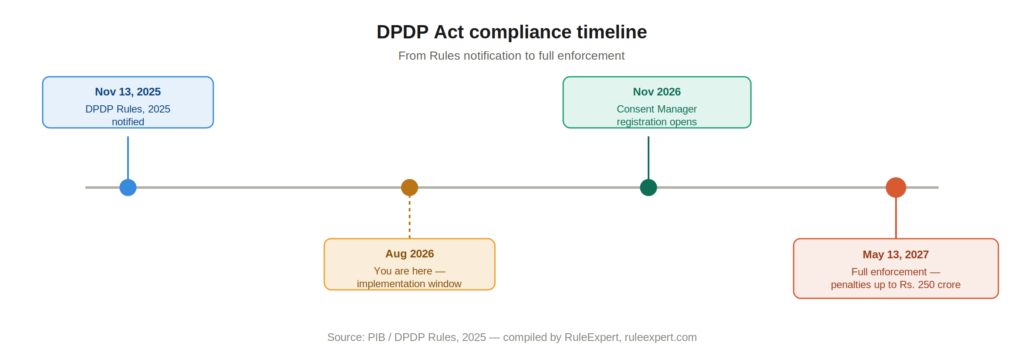
The Digital Personal Data Protection Rules, 2025 were notified on November 13, 2025, and they turned consent from a policy question into an operational one. Consent Manager registration opens in November 2026. Full substantive compliance — notice, consent, consent withdrawal, breach reporting, and Data Principal rights — becomes enforceable on May 13, 2027, with penalties running up to ₹250 crore per violation. For any organisation still tracking consent in spreadsheets, cookie banners with no records behind them, or a shared inbox for opt-out requests, that eighteen-month runway is shorter than it looks — and most of it has already elapsed.
This guide is written for the people who actually have to answer for that gap: the Compliance Manager building the programme, the CTO deciding whether to buy or build, the CFO signing off on the budget, and the Founder who needs a straight answer to “are we exposed.”
It covers what DPDP consent management software is legally required to do, how the consent lifecycle actually works section by section, what separates real infrastructure from a cookie banner with a new label, how to evaluate and implement a platform, and where sector-specific consent obligations diverge from the generic template most vendors sell. It is long because the Act itself doesn’t compress into a listicle, and a shorter answer would leave out the parts that actually determine whether an audit goes well.
Table of Contents
- What Is DPDP Consent Management Software?
- The Consent Lifecycle Under the DPDP Act, Explained Stage by Stage
- Why Manual Consent Management Fails Under the DPDP Act
- Core Capabilities to Look for in DPDP Consent Management Software
- AI Compliance Automation in India: Where Automation Actually Helps
- Privacy Automation Platform India: Point Solution, Consulting, or Infrastructure?
- DPDP Consent Management vs. GDPR Consent Tools
- How to Choose DPDP Consent Management Software: A Detailed Evaluation Framework
- Implementation Roadmap: How to Actually Deploy DPDP Consent Management Software
- Sector-Specific Consent Scenarios: Why Generic Templates Fall Short
- The Real Cost of Getting This Wrong
- Common Mistakes Organisations Make With DPDP Consent Management
- Consent Manager Registration: Building vs. Relying on One
- How RuleExpert’s Consent Manager Module Works
- Frequently Asked Questions
What Is DPDP Consent Management Software?
DPDP consent management software is a system of record that captures, stores, tracks, and honours a Data Principal’s consent for every purpose personal data is processed, in a form that can be produced as evidence if the Data Protection Board of India (DPB) asks for it. Under Sections 6 and 7 of the DPDP Act, 2023, consent must be free, specific, informed, unconditional, and unambiguous, and it must be as easy to withdraw as it was to give. That last requirement is where most manual processes break: giving consent takes one click, but withdrawing it often requires an email to a support inbox that nobody actively monitors, or a phone call that goes into a general queue.
A genuine consent management platform sits between three obligations at once — collecting consent in a way that will hold up as “specific” and “informed” under Section 6(1), maintaining an immutable log of every grant and withdrawal that can survive scrutiny, and propagating withdrawal to every downstream system, vendor, and marketing list before the delay itself becomes a violation. Most organisations underestimate the third obligation until an audit or a Data Principal complaint forces the question — by which point the answer is usually “we’re not sure how many systems still have that person’s data active for that purpose.”
It’s worth being precise about what the software is not. It is not a substitute for a lawful basis assessment — someone still has to determine whether consent, or one of the narrow “certain legitimate uses” under Section 7, is the right basis for a given processing activity. It is not a substitute for a Data Protection Officer or a compliance function — software enforces decisions; it doesn’t make the underlying legal judgment calls. And it is not the same as a Consent Manager, which is a specific, licensable intermediary role under the Rules, distinct from a fiduciary’s internal consent management tooling. We cover that distinction in detail further down.
The Consent Lifecycle Under the DPDP Act, Explained Stage by Stage
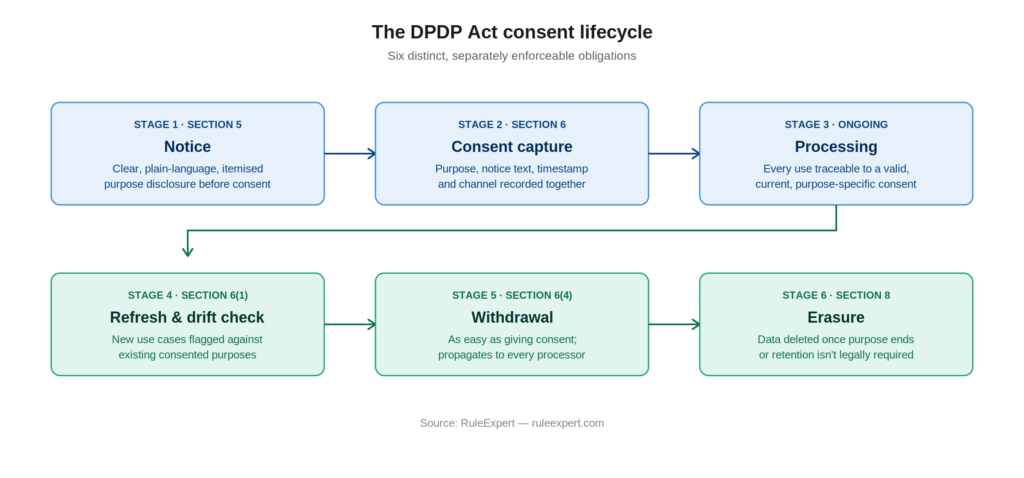
Most vendor content skips straight to “features,” which is why buyers end up with tools that handle collection well and fall apart at withdrawal. It helps to walk through the actual lifecycle the Act describes, because each stage carries a distinct, separately enforceable obligation.
Stage 1: Notice (Section 5)
Before or at the time consent is requested, the Data Principal must receive a notice describing the personal data being collected and the specific purpose of processing, in clear and plain language, itemised, and accessible in English or any language listed in the Eighth Schedule of the Constitution. A notice that buries the purpose in a 40-page privacy policy referenced by a footer link does not meet this bar. Software should generate notice text tied directly to the purpose being requested at that moment, not a static, one-size-fits-all policy page.
Stage 2: Consent Request and Capture (Section 6)
The consent request itself must be presented separately from other unrelated matters — bundling consent with terms of service, or making consent to marketing a condition of using a core product feature, both fail the “unconditional” test. Capture needs to record which specific purpose was consented to, the exact notice text shown at that moment (notice text changes over time, and the record needs to reflect what the person actually saw), the timestamp, and the mechanism (web form, app, WhatsApp, IVR, physical form digitised).
Stage 3: Processing Against Consent (Ongoing)
This is the stage almost no manual system tracks at all. Every time data is used — a marketing campaign is sent, a vendor pulls a data export, an analytics job runs — that use should, in principle, be traceable back to a valid, current consent for that specific purpose. In practice, most organisations record consent once at signup and never check it again before using the data two years later for a purpose that didn’t exist when the consent was captured.
Stage 4: Consent Refresh and Purpose Drift
Purposes evolve. A support ticketing system that starts feeding a new AI-personalisation feature is a new purpose, not a natural extension of “we’ll use your data to help you.” The Act doesn’t give an explicit re-consent trigger list, but the “specific purpose” requirement in Section 6(1) means that using data for a materially different purpose than the one consented to is functionally new, uncontested processing — exactly the kind of gap a DPB complaint surfaces.
A consent platform should flag when a new use case doesn’t map cleanly to an existing consented purpose, rather than leaving that judgment to whichever product manager happens to notice.
Stage 5: Withdrawal (Section 6(4))
Withdrawal must be at least as easy as giving consent, and the consequences of withdrawal are limited to what’s legally and reasonably necessary — an organisation can’t hold a service hostage in response to withdrawal of an unrelated consent. Once withdrawal is recorded, the Data Fiduciary must, within a reasonable time, cause its Data Processors to stop processing that data for that purpose, unless retention is required by law.
Stage 6: Erasure and Retention Expiry (Section 8)
When the purpose is no longer being served, or consent is withdrawn and no legal retention requirement applies, the data must be erased. This is where consent management and data registry obligations meet — a consent withdrawal that isn’t linked to an automated deletion workflow just creates a second, disconnected compliance gap instead of closing the first one.
Each of these six stages is a separate, auditable event. A platform that only handles Stage 2 — the moment of capture — and calls itself “DPDP consent management” is solving roughly a sixth of the actual obligation.
Why Manual Consent Management Fails Under the DPDP Act
Spreadsheet-based or CRM-bolted-on consent tracking tends to fail in the same handful of predictable ways, across industries and company sizes:
- No purpose-level granularity. The Act requires consent per processing purpose, not a single blanket “I agree.” A user who consents to order updates hasn’t consented to marketing emails, but most legacy systems record only one flag per customer, sometimes not even one per channel.
- Withdrawal doesn’t propagate. A withdrawal recorded in a support ticket rarely reaches the CRM, the analytics vendor, and the email platform on the same day — and DPDP gives no formal grace period for internal operational lag. The “reasonable time” standard in Section 6(4) is not defined in days, which means an organisation’s own delay becomes the thing an auditor scrutinises.
- No audit trail that survives scrutiny. When the DPB or an auditor asks “prove this user consented to this purpose on this date, with this notice text,” a spreadsheet with no version history, no tamper-evidence, and an editable “consent date” column doesn’t function as evidence — it functions as a claim that has to be independently verified, which is a much weaker position.
- No link between consent and downstream use. Marketing, product, and vendor teams keep processing data against a consent record nobody re-checks, so consent quietly goes stale as purposes evolve, new features ship, and new vendors get onboarded without anyone updating the original record.
- No visibility into vendor-level consent dependency. If a marketing automation vendor is processing a segment built from consented data, and that consent is later withdrawn, most manual processes have no mechanism to notify that vendor at all — the withdrawal simply stops being reflected anywhere except the original system it was recorded in.
- Consent fatigue from over-collection. Ironically, teams trying to “be safe” sometimes ask for consent to everything upfront, producing consent requests so broad they fail the “specific” test anyway, while also depressing conversion rates for no compliance benefit.
This is the operational gap that purpose-built Consent Manager infrastructure is designed to close — not by producing another policy document, but by making consent state a live, queryable, enforceable record that every other system can check against.
Core Capabilities to Look for in DPDP Consent Management Software
1. Purpose-Level Consent Capture
The platform should let you define discrete processing purposes and capture consent against each one independently — not a single opt-in checkbox covering everything from order fulfilment to third-party marketing. Ask a vendor to show you, live, how a single customer record displays five separate purpose-level consent states rather than one flag.
2. Signed, Immutable Audit Trail
Every consent event — grant, modification, or withdrawal — should be logged with a tamper-evident signature (HMAC-SHA256 is the standard most Indian compliance platforms are converging on) and a timestamp, so the record can be produced as evidence without being disputed on integrity grounds. Ask specifically whether the audit log is append-only, and whether an administrator can edit or delete a historical entry — if the answer is yes, the log is not evidentiary-grade.
3. One-Click, Equally Easy Withdrawal
Section 6(4) requires withdrawal to be at least as easy as consent. A “call our office” withdrawal flow next to a one-click sign-up flow is a compliance gap, not a UX inconvenience. A self-service trust portal where a Data Principal can see and manage every active consent in one place is the strongest version of this requirement.
4. Consent Propagation to Vendors and Downstream Systems
Withdrawal has to reach every processor touching that data — ad platforms, email tools, analytics, and any vendor under a Section 8(2) Data Processing Agreement. Software that stops at “we recorded the withdrawal” without pushing it downstream leaves the organisation exposed. Look for webhook or API-based propagation, not a manual export a compliance analyst has to email to vendors once a month.
Notices must be in clear, plain language, available in English and the languages listed in the Eighth Schedule, and must state the purpose and the categories of data collected — a generic cookie-consent banner template imported from a GDPR tool usually falls short of this on both the language and the purpose-specificity requirements.
6. Consent History Tied to Data Subject Requests
When a Data Principal exercises access, correction, or erasure rights, the system handling that request needs to see the same consent record — otherwise DSR fulfilment and consent management drift out of sync. This is why DSR automation and consent management work best as one connected system rather than two separate tools bought from two different vendors at two different times.
7. Guardian and Minor Consent Handling
Section 9 imposes specific obligations for processing children’s data, requiring verifiable parental or guardian consent and prohibiting behavioural monitoring and targeted advertising directed at children. A consent platform used by any organisation that might process a minor’s data — EdTech, healthcare, or any consumer platform without strict age gating — needs a distinct guardian-consent flow, not an adult consent form with an age checkbox bolted on.
8. Multi-Channel Intake
Consent and withdrawal in India increasingly happen outside the web form — WhatsApp, IVR, in-branch paper forms that get digitised, and app-based flows. A platform that only captures web consent misses a growing share of real interactions, particularly for consumer businesses serving Tier 2 and Tier 3 India.
9. Re-Consent and Purpose-Drift Alerts
As covered in the lifecycle section above, purposes change. Software that can flag when a new internal use case — a new analytics dashboard, a new AI feature, a new marketing segment — doesn’t map to any existing consented purpose turns a legal judgment call that used to happen accidentally (or not at all) into a deliberate, logged decision.
10. Cross-Border Transfer Flagging
Consent alone doesn’t authorise a cross-border transfer if the receiving vendor or jurisdiction isn’t otherwise cleared — this needs to cross-reference against your vendor and data registry records, not live as an isolated fact inside the consent module.
AI Compliance Automation in India: Where Automation Actually Helps
“AI compliance automation” gets used loosely in vendor marketing, so it’s worth being specific about what AI should and shouldn’t do inside a consent workflow. It should not be drafting your legal basis for processing — that judgment stays with your DPO or counsel, and no model should be making that call unsupervised. What AI automation genuinely helps with in an Indian compliance context:
- Generating purpose-specific consent language from your data registry, so notice text matches what you’re actually collecting rather than a generic template — reviewed by counsel before it ships, not published straight from a model’s first draft.
- Flagging consent-purpose drift when a new use case (say, a marketing team wanting to use support-ticket data for personalisation) doesn’t map to any existing consented purpose, and surfacing that gap to the compliance team before the campaign launches instead of after a complaint.
- Cross-referencing consent against vendor data flows to catch unauthorised cross-border transfers before they happen, rather than during an annual audit six months after the fact.
- Answering operational compliance questions — “which purposes has this user consented to,” “which vendors touch marketing-purpose data,” “which DSRs are approaching their SLA deadline” — against your live registry instead of a stale document or a compliance manager’s memory.
- Summarising incident and breach severity in the early minutes of a breach response, when the DPB notification clock (72 hours under Section 8(6)) is already running and human triage takes time the organisation doesn’t have.
- Drafting DSR responses from the underlying data registry for a compliance officer to review and approve, cutting the manual research time that otherwise dominates a 30-day DSR fulfilment window.
This is the difference between AI as a chatbot layered on top of the DPDP Act text — which can answer “what does Section 8(2) say” but nothing about your actual exposure — and AI that’s connected to your live consent log, data registry, and vendor records, which can answer “which of our vendors are processing data without a current, matching consent record.”
The second is what materially reduces manual DPO workload; the first is closer to a search engine with better phrasing. RuleExpert’s Compliance Copilot is built on the second model: it reads your live consent and vendor data rather than answering in the abstract, and cites the specific Act section or Rule behind every answer.
Privacy Automation Platform India: Point Solution, Consulting, or Infrastructure?
Indian organisations evaluating a privacy automation platform tend to face a build-vs-buy-vs-assemble decision between three broad approaches, and the right one depends heavily on processing scale and internal compliance headcount.
These handle web banner consent only, usually well, at a low price point. They don’t touch DSR fulfilment, vendor governance, guardian consent, or breach response, so they solve roughly one part of a six-part compliance programme. For a very early-stage startup with no significant vendor chain and minimal DSR volume, this might genuinely be enough for a first six months — but it is not a DPDP compliance programme, and buyers who treat it as one are the ones most likely to discover the gap during their first DPB complaint.
Consulting-Led Compliance
A consulting engagement produces policies, gap assessments, DPIA templates, and a compliance roadmap — valuable, and often a necessary first step for organisations that haven’t mapped their data flows at all. But consulting output is, by nature, a point-in-time document. It leaves ongoing operational enforcement — the day-to-day consent tracking, DSR SLA management, and vendor renewal tracking — to internal teams, usually back in spreadsheets, within a few months of the engagement ending.
Workflow-Driven Compliance Infrastructure
A single platform where consent, data registry, DSR, vendor governance, and breach management share one data model, so a withdrawal in the consent module is automatically visible to the DSR and vendor modules, without a manual sync step. This is the only approach of the three that scales past the point where a compliance team can track everything by memory — typically somewhere around a few hundred DSRs a year, or a vendor list that’s grown past what fits comfortably in a single spreadsheet tab.
What This Actually Costs and Takes
Realistic budgeting matters here, because the wrong comparison — a low-cost SaaS tool against a six-figure custom build — leads to bad decisions in both directions. A cookie-consent widget typically runs a few thousand rupees a month and can be live within a day. A consulting engagement for policy and gap-assessment work commonly runs from a few lakhs to tens of lakhs depending on organisation size, delivered over four to twelve weeks, with no ongoing enforcement included unless separately scoped.
A connected compliance platform sits between the two on setup time — commonly a few weeks to a couple of months for core modules to go live, given the integration work involved in connecting consent, data sources, and vendor records — with pricing typically structured around data volume, DSR volume, or seats rather than a flat licence fee. This is the model RuleExpert’s DPDP compliance software is built around: connected modules rather than a bundle of disconnected point tools bought from three different vendors on three different renewal cycles.
DPDP Consent Management vs. GDPR Consent Tools
Many teams start their evaluation by asking whether an existing GDPR compliance tool can simply be extended to cover the DPDP Act. In most cases it can’t, without significant rework, for reasons that go beyond a language toggle.
No Legitimate-Interest Basis
Unlike the GDPR, the DPDP Act does not recognise “legitimate interest” as a general lawful basis for processing outside a narrow list of “certain legitimate uses” in Section 7 — things like voluntary data sharing by the individual, compliance with a court order, or medical emergencies. Consent is the default basis for most commercial processing in India, which means DPDP consent workflows carry structurally more weight than their GDPR equivalents, where legitimate interest is often used to avoid needing explicit consent at all. A GDPR-first tool built around minimising consent requests, because legitimate interest was available as a fallback, will systematically under-collect consent under DPDP.
Consent Manager as a Registered Intermediary
DPDP introduces a licensed Consent Manager entity — a concept GDPR has no equivalent for — through which a Data Principal can view and manage consent across multiple fiduciaries via one interface. This changes the technical integration surface: a DPDP-native platform needs to be built to interoperate with third-party Consent Managers, not just manage first-party consent internally.
Language and Format Requirements
DPDP notices have specific plain-language and Eighth Schedule language requirements that GDPR consent-string formats (like the IAB Transparency and Consent Framework) were never built to accommodate. A TCF-based banner ported over with translated strings usually doesn’t meet the “itemised” and “clear and plain language” standard the Act sets.
Breach Notification Timing
Both frameworks impose short breach-notification windows, but they’re not identical — DPDP Section 8(6) requires notification to the Board without undue delay, with the Rules specifying a 72-hour outer limit, while GDPR’s 72-hour window runs to the supervisory authority under a different set of trigger conditions. A tool hard-coded to GDPR’s specific trigger logic can misfire on when the DPDP clock actually starts.
Data Localisation and Cross-Border Transfer
GDPR’s adequacy-decision and Standard Contractual Clause framework is mature and well-documented; DPDP’s cross-border transfer regime is still being operationalised, with the government retaining power to restrict transfers to specific countries by notification. A platform needs to track this as a live, government-notification-dependent rule set, not a static list imported once at setup.
None of this means a GDPR-experienced platform can’t be adapted well — several serious Indian compliance platforms started as GDPR tools. It means the adaptation has to touch the consent-basis logic, the notice templates, and the cross-border rule engine, not just the UI copy.
How to Choose DPDP Consent Management Software: A Detailed Evaluation Framework
A generic feature checklist is easy to satisfy on paper and hard to verify in a sales demo. Use these questions instead, and insist on seeing the answer live rather than on a slide.
1. Does it capture consent per purpose, not per form?
What good looks like: a live demo showing one customer record with independent consent states across five or more distinct purposes. What to watch for: a single “marketing consent: yes/no” field presented as purpose-level granularity.
2. Is the audit trail signed and tamper-evident?
What good looks like: a specific, named signing mechanism (HMAC-SHA256 or equivalent), append-only storage, and a demonstration of what happens when someone with admin access tries to edit a historical entry. What to watch for: “we log everything” with no answer to the follow-up question about whether logs are editable.
3. Does withdrawal propagate automatically to connected vendors and systems?
What good looks like: webhook or API-based propagation with a visible status per downstream system (delivered, pending, failed). What to watch for: a manual CSV export process described as “integration.”
4. Is it connected to DSR, vendor, and breach workflows?
What good looks like: a DSR ticket that automatically surfaces the requester’s current consent state without a separate lookup. What to watch for: consent living in a module that doesn’t share a data model with the rest of the platform, even if both are technically sold by the same vendor.
5. Was the notice and consent language reviewed by DPDP counsel?
What good looks like: a named review process, ideally with a visible “last reviewed” date on template language. What to watch for: AI-generated templates presented as final, with no legal review step at all.
What good looks like: a dashboard surfacing every vendor processing data outside India, cross-checked against consent and DPA status. What to watch for: cross-border tracking that exists only as a manual annual review checklist.
7. What’s the actual time-to-live?
What good looks like: a specific number of weeks for core modules to go live, with a named integration path for your primary data sources (CRM, website, app). What to watch for: “it depends” with no concrete range, which usually means the vendor hasn’t done many implementations like yours.
8. How does pricing scale, and what happens at renewal?
What good looks like: pricing tied to a metric you can forecast (DSR volume, data records, seats) with a clear description of what triggers a tier change. What to watch for: vague enterprise pricing that only gets disclosed after a multi-call sales process, which usually signals a large gap between list price and what similar customers actually pay.
9. Who owns the data, and what happens if you leave?
What good looks like: a documented export process for your full consent history and audit log, in a portable format, on request. What to watch for: no clear answer, or an export that strips the signed audit trail — since that trail is the evidentiary asset you were paying for.
Implementation Roadmap: How to Actually Deploy DPDP Consent Management Software
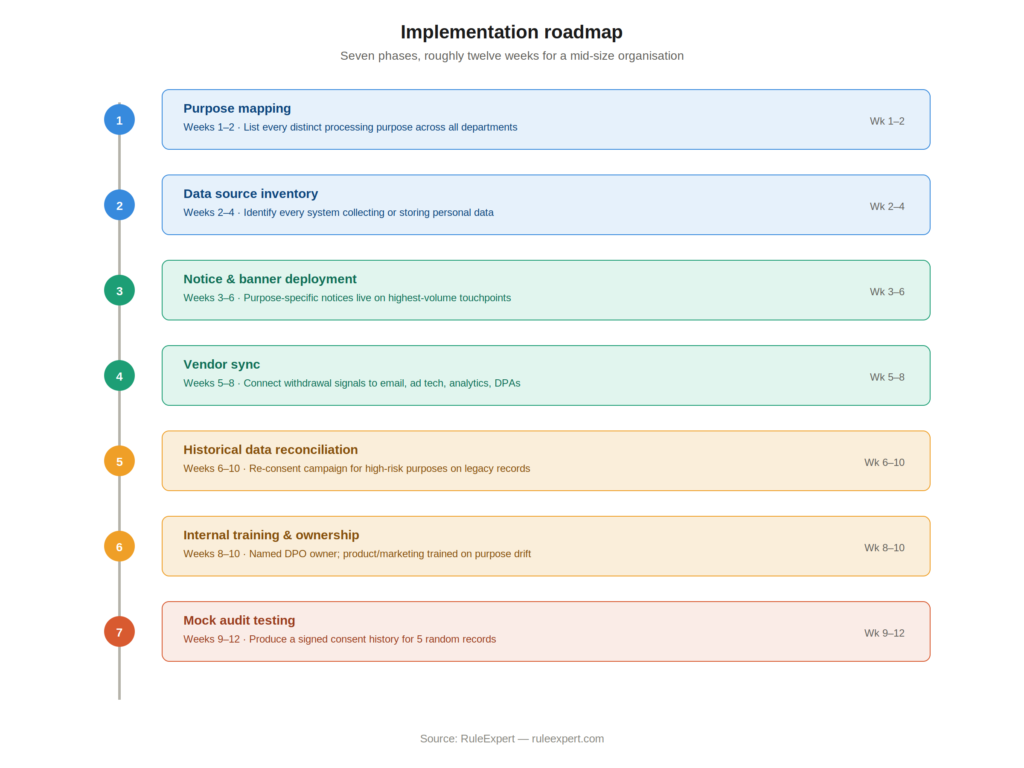
Buying the right platform solves half the problem. The other half is a rollout sequence most teams get wrong by trying to do everything simultaneously. A realistic phased approach:
Phase 1: Purpose Mapping (Weeks 1–2)
Before any banner or form changes, list every distinct purpose personal data is currently processed for, across every department — not just marketing. This routinely surfaces purposes nobody had explicitly named before, like “customer support uses purchase history to personalise responses,” which is a distinct purpose from “order fulfilment” even though the same data is involved.
Phase 2: Data Source Inventory (Weeks 2–4)
Identify every system currently collecting or storing personal data — website forms, mobile app, CRM, support tool, HR systems, offline paper forms. This phase overlaps heavily with data registry work, and doing them together avoids building a consent system that doesn’t cover a data source discovered three months later.
Deploy purpose-specific notices and consent capture across the highest-volume touchpoints first — typically the main website and app signup flow — before extending to lower-volume channels like WhatsApp intake or offline forms.
Phase 4: Vendor Sync (Weeks 5–8)
Connect the consent platform to the systems that need to receive withdrawal signals — email platform, ad tech, analytics, and any processor under an active DPA. This is usually the phase that takes longest, because it depends on each vendor’s own integration capability, not just your platform’s.
Phase 5: Historical Data Reconciliation (Weeks 6–10)
Existing customer and user records almost never have clean, purpose-level consent history. Decide, with legal input, how to treat historical data — commonly a re-consent campaign for high-risk purposes (marketing, third-party sharing) rather than assuming historical blanket consents cover current, more specific requirements.
Phase 6: Internal Training and Ownership (Weeks 8–10)
Assign a named owner for consent-related decisions — usually the DPO or Compliance Manager — and train product and marketing teams on the purpose-drift concept, so new features get checked against existing consent scope before launch rather than after a complaint.
Phase 7: Testing Against DPB Audit Scenarios (Weeks 9–12)
Before calling the rollout complete, run a mock audit: pick five customer records at random and see how long it takes to produce a complete, signed consent history for each, including the exact notice text shown at the time. If this takes more than a few minutes per record, the audit trail isn’t operational yet, regardless of what the platform’s marketing claims.
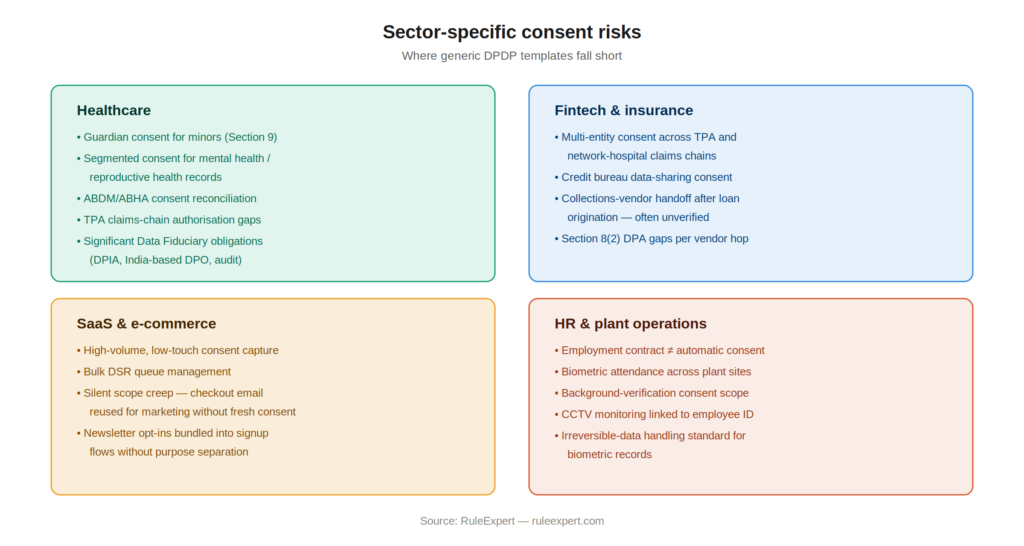
Sector-Specific Consent Scenarios: Why Generic Templates Fall Short
A recurring failure in DPDP compliance content is treating every industry as “DPDP Act plus swap in the sector name.” The actual obligations differ meaningfully by sector, because the data types, existing regulatory overlaps, and typical vendor chains differ.
Healthcare: Guardian Consent and Sensitive Records
Hospitals and health-tech platforms face consent obligations layered on top of the DPDP Act. Guardian consent for minors applies under Section 9 for patients under 18, which in a paediatric or NICU context means every consent flow needs a parent/guardian identity-verification step before capture, not just an age-declaration checkbox.
Mental health and reproductive health records warrant separate consent handling from general clinical data — a patient consenting to share records with a general physician hasn’t consented to the same records being visible to, or shared with, a different care team handling a psychiatric consult, and most hospital EHR systems don’t segment consent at that granularity today. ABDM/ABHA-linked data-sharing consent carries its own audit expectations distinct from the hospital’s internal DPDP consent record, and the two need to be reconcilable, not tracked as separate, disconnected systems.
A hospital processing volumes that qualify it as a Significant Data Fiduciary under the Rules faces additional obligations — a Data Protection Impact Assessment, an independent data auditor, and a Data Protection Officer based in India — that a generic consent tool has no visibility into at all. TPA claims processing, common in insurance-linked hospital billing, adds a vendor-chain consent question: the patient consented to the hospital processing their data, but did they consent to the specific TPA in that chain, and does that consent survive if the hospital switches TPA partners mid-treatment?
See our DPDP Act guide for healthcare organisations and our hospital-specific compliance guide for the fuller sector breakdown.
Fintech and Insurance: Vendor Chains and Claims Data
Insurers and their Third-Party Administrator networks process claims data across multiple entities, each needing its own consent basis and Data Processing Agreement under Section 8(2). A consent record that doesn’t track which vendor in the chain currently holds authorisation for a given purpose creates exactly the kind of gap a DPB audit is designed to catch — particularly when a claim moves from the insurer to the TPA to a network hospital, with personal and financial data passing through each hop.
Lending platforms face a parallel issue with credit bureau data sharing and collections-vendor handoffs, where consent captured at loan origination is often assumed to cover downstream collections activity months or years later, without being re-verified against the original purpose scope.
SaaS and E-Commerce: High-Volume, Low-Touch Consent
Consumer platforms need consent capture that works at scale — a lightweight JavaScript snippet rather than a manual review per signup — paired with a bulk DSR queue, since consumer-facing platforms generate far more Data Principal requests than B2B software typically does. The specific risk here is silent scope creep: a checkout flow that starts as “email for order confirmation” quietly expanding to include marketing use of the same email address after a product team adds a newsletter signup checkbox, without anyone updating the original consent purpose or triggering a fresh, specific consent request.
HR and Employee Data: Plant Operations and Corporate Functions
Employee personal data falls under the DPDP Act too, and HR teams routinely assume employment contracts implicitly cover consent — they don’t automatically. Background verification checks, biometric attendance systems common in manufacturing and plant environments, and CCTV monitoring linked to employee identity all need their own consent or lawful-basis analysis, distinct from the general employment contract.
A Plant HR Head managing biometric attendance across multiple manufacturing sites is handling a materially different consent surface than a corporate HR team managing payroll data alone — biometric data typically warrants stricter handling given its immutability if compromised, even though the Act doesn’t create a separate “sensitive personal data” category the way some other jurisdictions do.
EdTech and Student Data
Platforms handling India’s large student datasets face guardian consent obligations similar to healthcare, particularly for users under 18, combined with learning-analytics vendor governance — many EdTech platforms route usage data through third-party analytics tools whose own data handling needs to be covered under a matching consent scope and vendor DPA, not assumed to inherit the platform’s own consent.
The Real Cost of Getting This Wrong
Section 33 penalties are structured by violation type, and they’re designed to be severe enough to change board-level priorities rather than functioning as a cost of doing business. Failing to implement reasonable security safeguards can draw penalties up to ₹250 crore. Breach-notification failures and children’s-data violations each carry penalties up to ₹200 crore.
Significant Data Fiduciary obligation failures — the DPIA, audit, and India-based DPO requirements covered above — carry penalties up to ₹150 crore. General non-compliance, including consent and notice failures, carries penalties up to ₹50 crore. Penalties are assessed per violation and can stack, which means a breach traced back to a consent-tracking failure can trigger findings under more than one category simultaneously.
Beyond the direct penalty exposure, a consent failure surfaces at the worst possible moments — during investor due diligence, during a procurement review from an enterprise customer’s security team, or during a DPB investigation triggered by a single complaint from one dissatisfied user. In each case, the organisation is asked to produce evidence, not assurances, and a compliance programme that exists only as policy documents has nothing to produce.
Consent failures are also rarely isolated — they tend to surface alongside breach-notification gaps, since an organisation that can’t produce a clean consent trail usually can’t produce a clean incident-response trail either. Our guide to preventing data breaches through compliance automation covers that adjacent risk in more depth.
Common Mistakes Organisations Make With DPDP Consent Management
- Treating the cookie banner as the whole programme. A cookie-consent tool covers website tracking; it says nothing about consent for CRM, vendor, offline, or app-based data collection, which for most Indian businesses is the larger share of personal data processed.
- Recording consent but never revisiting it. Purposes evolve — a consent record from two years ago for “service updates” doesn’t automatically cover a new AI-personalisation feature launched last quarter, and most organisations have no process to catch that drift.
- Assuming legal counsel-approved policy language equals operational compliance. A well-drafted privacy policy that isn’t connected to an enforced consent workflow is documentation, not compliance — and it’s the documentation-versus-operation gap that most DPB findings are likely to focus on, because the Act’s obligations are operational by design.
- Ignoring the Consent Manager registration window. Registration opens in November 2026 — organisations planning to operate as a Consent Manager, or relying on integration with one, should not be figuring out the eligibility and technical requirements after the window opens.
- Under-resourcing the vendor-sync phase. Teams often budget generously for the customer-facing banner and consent form, then treat vendor governance and DPA tracking as an afterthought, even though it’s usually the phase where the actual compliance exposure lives.
- Building consent tooling in isolation from the data registry. Consent without a matching inventory of where that data actually lives is unenforceable — you can record a withdrawal perfectly and still have no way to confirm every copy of that data was actually deleted.
- Assuming DPDP consent maps one-to-one onto existing GDPR consent records. For any organisation with EU operations reusing GDPR consent infrastructure, the legitimate-interest gap covered earlier means some processing that was lawful under GDPR without explicit consent needs a fresh, DPDP-specific consent request in India.
Consent Manager Registration: Building vs. Relying on One
It’s worth separating two distinct questions that get conflated in most vendor content: does your organisation need to register as a Consent Manager, and does your consent management software need to interoperate with one?
Registering as a Consent Manager is a specific regulatory undertaking — the Rules set out eligibility criteria including net worth and operational requirements, and a registered Consent Manager operates as a neutral intermediary that any Data Principal can use to manage consent across multiple, unrelated fiduciaries.
Most organisations reading this guide are not planning to become a Consent Manager themselves; they’re a Data Fiduciary who needs their internal systems to work smoothly once Data Principals start managing consent through a third-party Consent Manager interface, which is the more common scenario after the November 2026 registration window opens. That means the practical question for most buyers is narrower: does your consent management software expose the APIs a registered Consent Manager will need to synchronise consent status, rather than requiring you to become one yourself.
How RuleExpert’s Consent Manager Module Works
RuleExpert’s Consent Manager module is built as one connected part of the wider platform rather than a standalone widget:
- Purpose management and consent collection with a signed, append-only audit log for every grant, modification, and withdrawal.
- A banner builder and Data Principal-facing trust portal for viewing and managing active consents in one place, satisfying the “as easy to withdraw as to give” requirement directly rather than as an afterthought.
- Consent-language generation tied to your actual data registry, reviewed by DPDP counsel before it reaches your notice templates, so notice text matches what you’re actually collecting rather than a generic import.
- Consent state shared live with the DSR Automation module, so an access or erasure request is checked against the same record — not a separate export someone has to reconcile manually.
- Withdrawal events cross-checked against the Vendor Governance module to flag any vendor still processing data under a revoked consent, with renewal and authorisation alerts firing automatically rather than during an annual review.
- Section 8(6) breach workflows connected to the same consent and data registry records, so if an incident touches data tied to a specific purpose, the affected Data Principal population can be identified quickly rather than reconstructed manually under the 72-hour notification clock.
A Worked Example
Consider a mid-size D2C e-commerce company with a website, an app, a WhatsApp support line, and six marketing and logistics vendors. Before implementation, marketing consent lived in the email platform, order-purpose consent lived implicitly in the order database with no explicit record, and WhatsApp opt-outs were tracked in a shared spreadsheet updated inconsistently by the support team. A customer who opted out of marketing via WhatsApp continued receiving promotional emails for weeks, because the two systems never talked to each other.
After implementation, the same customer’s WhatsApp opt-out is captured as a withdrawal event against the “marketing communications” purpose specifically — not order confirmations, which remain active under a separate purpose — and a webhook fires to the email platform within minutes, suppressing that address from the next campaign send automatically. The event is logged with a signed timestamp, visible in the audit trail, and available immediately if that customer later files a DPB complaint or simply asks the company to show what data of theirs is being used and for what.
You can run a free, section-by-section compliance score in about five minutes using the DPDP Act compliance checklist, or book a demo to see the Consent Manager module against your own data flows.
Frequently Asked Questions
What is DPDP consent management software?
It’s a system that captures, records, and manages a Data Principal’s consent for each personal-data processing purpose, maintains an auditable history of every grant and withdrawal, and propagates withdrawal to connected systems and vendors, as required under Sections 6 and 7 of the DPDP Act, 2023.
Is DPDP consent management mandatory for all businesses in India?
Any organisation processing the digital personal data of individuals in India — including startups, SaaS platforms, and vendors processing data on another company’s behalf — falls under the DPDP Act’s consent obligations, regardless of company size. There is no small-business exemption in the Act itself, though enforcement priority and audit scrutiny will likely correlate with processing scale.
What is the DPDP compliance deadline in India?
The DPDP Rules, 2025 were notified on November 13, 2025. Consent Manager registration opens around November 2026, and full substantive compliance — including consent, notice, and breach-reporting obligations — is due by May 13, 2027.
What’s the difference between DPDP compliance and DPDP consent management?
DPDP compliance is the full programme — data registry, consent, DSR fulfilment, breach response, and vendor governance. Consent management is one operational pillar within that programme, specifically covering how consent is captured, recorded, refreshed, and withdrawn across its full lifecycle.
Does the DPDP Act recognise legitimate interest as a basis for processing, like GDPR?
No. The DPDP Act does not include a general legitimate-interest basis. Processing is generally grounded in consent, with a narrow set of “certain legitimate uses” defined under Section 7 for specific circumstances such as voluntary data sharing, compliance with legal obligations, or medical emergencies.
What is a Consent Manager under the DPDP Act, and does my company need to become one?
A Consent Manager is a registered intermediary through which a Data Principal can give, manage, review, and withdraw consent across multiple data fiduciaries from a single interface. Most organisations don’t need to register as a Consent Manager themselves — the more common requirement is ensuring internal consent systems can interoperate with a registered Consent Manager once a Data Principal chooses to manage consent that way.
Can a small business or startup use DPDP consent management software?
Yes — DPDP obligations apply regardless of company size, and most platforms, including RuleExpert, offer configurable deployments so a startup isn’t paying for enterprise-scale infrastructure it doesn’t need yet, while still capturing purpose-level consent from day one.
How is consent withdrawal supposed to work under the DPDP Act?
Section 6(4) requires that withdrawing consent be as easy as giving it. In practice, that means a one-click or equivalent self-service mechanism — not a support-email request that takes days to process manually — and downstream systems should stop processing that data for that purpose within a reasonable time after withdrawal.
Penalties are set out under Section 33 and vary by violation type, running as high as ₹250 crore for security-safeguard failures, ₹200 crore each for breach-notification and children’s-data failures, ₹150 crore for Significant Data Fiduciary failures, and ₹50 crore for general non-compliance including consent and notice failures. Penalties are per violation and can stack.
How is DPDP consent management different from GDPR consent tools?
DPDP has no legitimate-interest basis, introduces the licensed Consent Manager entity, imposes specific plain-language and Eighth Schedule language requirements, and runs on a different breach-notification trigger structure — structural differences that a GDPR-first tool typically isn’t built to handle without significant rework to its consent-basis logic and notice templates.
Does consent need to be re-collected if a company’s processing purposes change?
Generally yes, if the new use is materially different from what was originally disclosed and consented to. The Act’s “specific purpose” requirement means processing for a new purpose without a matching consent record is effectively unconsented processing, even if the underlying data was collected legitimately for an earlier purpose.
What happens to consent records if a company is acquired or merges with another entity?
Consent was given for processing by a specific fiduciary for specific purposes; a change in corporate ownership doesn’t automatically extend that consent to a new entity’s purposes. Acquiring organisations should treat inherited consent records as needing review against their own processing intentions, not assume they transfer unconditionally.
Do offline businesses — retail stores, clinics, offline-first services — need DPDP consent management software?
Yes, if they collect and digitise personal data in any form, including paper forms later entered into a system, loyalty programme sign-ups, or in-branch KYC processes. The Act applies to digital personal data, which includes personal data collected offline and later digitised — a common gap for retail and healthcare businesses that assume DPDP is a web-only concern.
How long does it take to implement DPDP consent management software?
Core modules can typically go live in a few weeks for the highest-volume touchpoints, but full implementation — including vendor sync, historical data reconciliation, and staff training — realistically takes eight to twelve weeks for a mid-size organisation with multiple data sources and an existing vendor chain.
Ready to See DPDP Consent Management in Action?
Run a free DPDP compliance score in five minutes, or book a demo to see how RuleExpert’s Consent Manager, DSR Automation, and Vendor Governance modules work as one connected system. Book your demo with RuleExpert →
Sources: Press Information Bureau, Government of India — DPDP Rules, 2025 notification (November 14, 2025); Shardul Amarchand Mangaldas & Co. — Enforcement of the DPDP Act and notification of the DPDP Rules.