Most DPDP checklists open with the same line: “Publish a privacy notice.” Fine. But everyone has one. The better question is whether you can produce the dated, versioned, owned document behind it, and some sign that anyone follows it.
This DPDP gap assessment checklist is built around evidence. For each area you get what to collect, who probably holds it, what good looks like, and the red flag that says “paper only”. For the wider picture, start with our guide to what a DPDP gap assessment covers and how it runs. This page is the working list.
What is a DPDP gap assessment checklist? It is a list of the evidence you need to collect to test each duty under the DPDP Act, 2023 and the DPDP Rules, 2025: where personal data sits, your notices and consent records, vendor contracts, security logs, rights and breach records. Each item is graded Evidenced, Paper-only or Missing, so gaps surface before an auditor or the Data Protection Board finds them.
1. Checklist of Laws or Checklist of Evidence?
A checklist of laws tells you what the Act says. A checklist of evidence tells you whether your business matches it. “Privacy notice published” is a tick. A copy of the notice, its version history and the link a customer actually sees is proof. This is not legal advice, and finishing the list does not make you compliant. It shows where you stand today, on paper you can inspect.
2. Grade Every Item
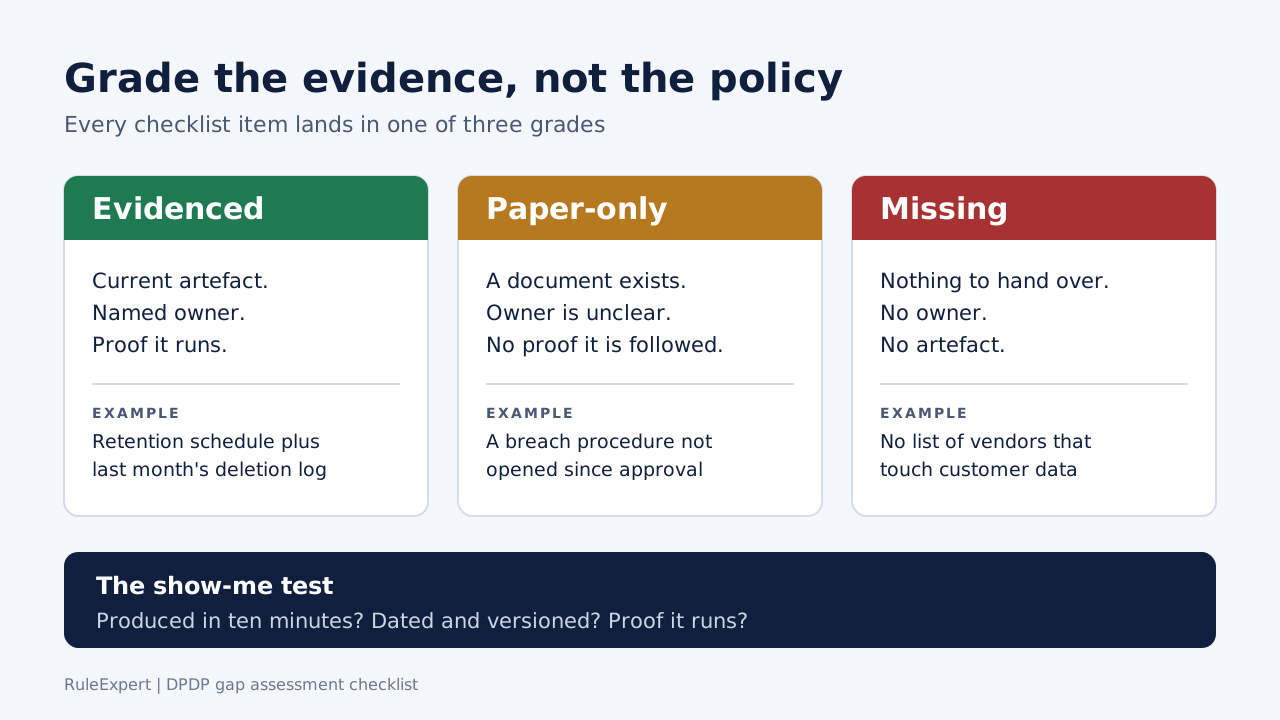
Yes-or-no scoring flatters you. It has no room for the most common answer in Indian businesses right now: “we have something, but…” So grade three ways.
Grade
What you can show
Example
Evidenced
A current artefact, a named owner, proof it runs
Retention schedule plus last month’s deletion log
Paper-only
A document, but no sign anyone follows it
A breach procedure nobody has opened since approval
Missing
Nothing you could hand over
No list of vendors touching customer data
Our rule of thumb, not the Act’s: if the owner cannot produce the artefact in ten minutes, drop it a grade. An auditor, insurer or enterprise client rarely waits while you search old email. For a quick first read, the free DPDP Scorecard takes about five minutes.
3. The DPDP Evidence Checklist: Eight Packets
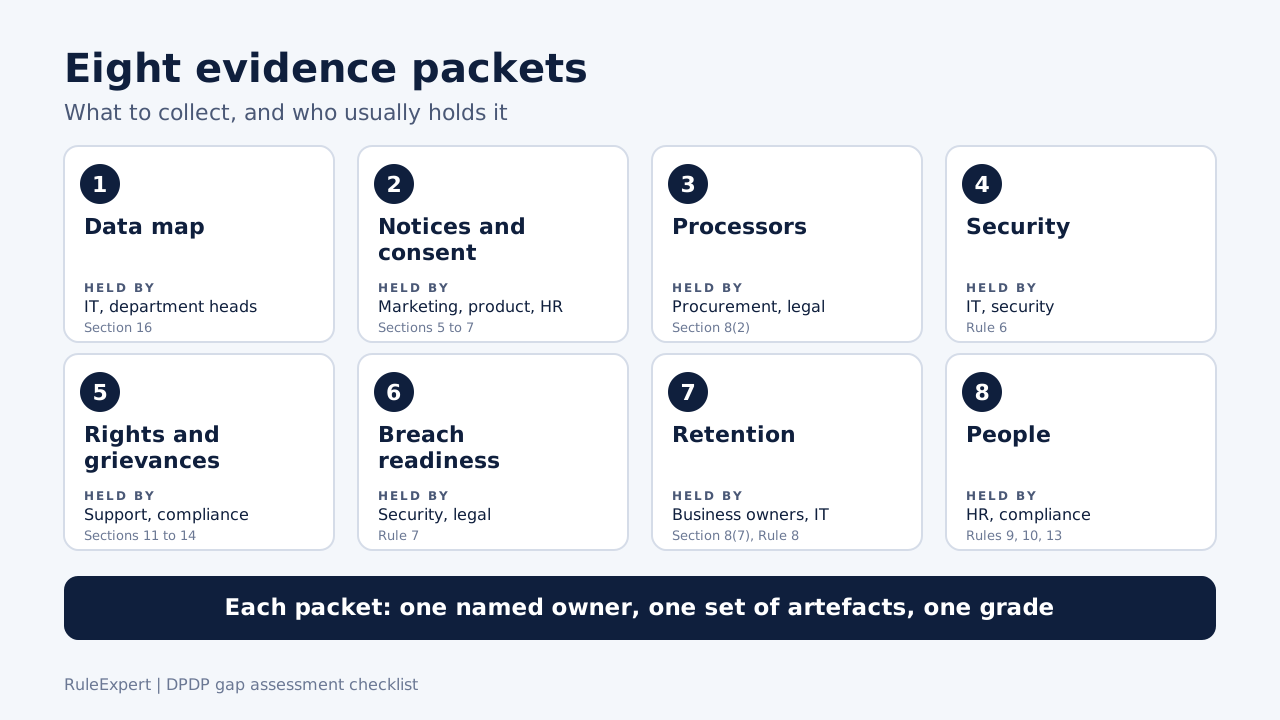
Give each packet one named owner. Section numbers refer to the DPDP Act, 2023 and rule numbers to the DPDP Rules, 2025.
Packet
Collect
Held by
What good looks like
Red flag
1. Data map
Systems holding personal data, flows, an owner per dataset, transfers outside India (Section 16)
IT, department heads
Covers paper, spreadsheets and SaaS; reviewed in six months
Built from the IT asset list alone
2. Notices and consent
Live notices, consent screens and logs, versions, legitimate-use basis (Sections 5 to 7, Rule 3)
Marketing, product, HR
Logs show which notice version each person saw
A policy page, no logs
3. Processors
Vendor list, signed contracts, service scope (Section 8(2))
Procurement, legal
List built from what teams use, not what finance pays
Contract covers a different service
4. Security
Encryption or masking, access reviews, log and backup settings (Section 8(5), Rule 6)
IT, security
Logs and related personal data kept one year; dated access sign-offs
Log retention left at tool default
5. Rights and grievances
Request log, identity checks, published grievance route and period (Sections 11 to 14, Rule 14)
Support, compliance
A test request traced end to end
Requests sit in a shared inbox
6. Breach readiness
Procedure, decision-makers, notice templates, last drill (Section 8(6), Rule 7; see our SBI breach analysis)
Security, legal
A named person can declare a breach
Procedure names someone who left
7. Retention
Retention schedule with reasons, deletion logs (Section 8(7), Rule 8)
Business owners, IT
Deletion reconciled with the one-year log duty
Nothing is ever deleted
8. People
Published contact (Rule 9), training records, children’s data check (Rule 10), SDF note (Rule 13)
HR, compliance
Contact inbox answered within days
Contact mailbox unmonitored
4. Where a Gap Assessment Goes Wrong
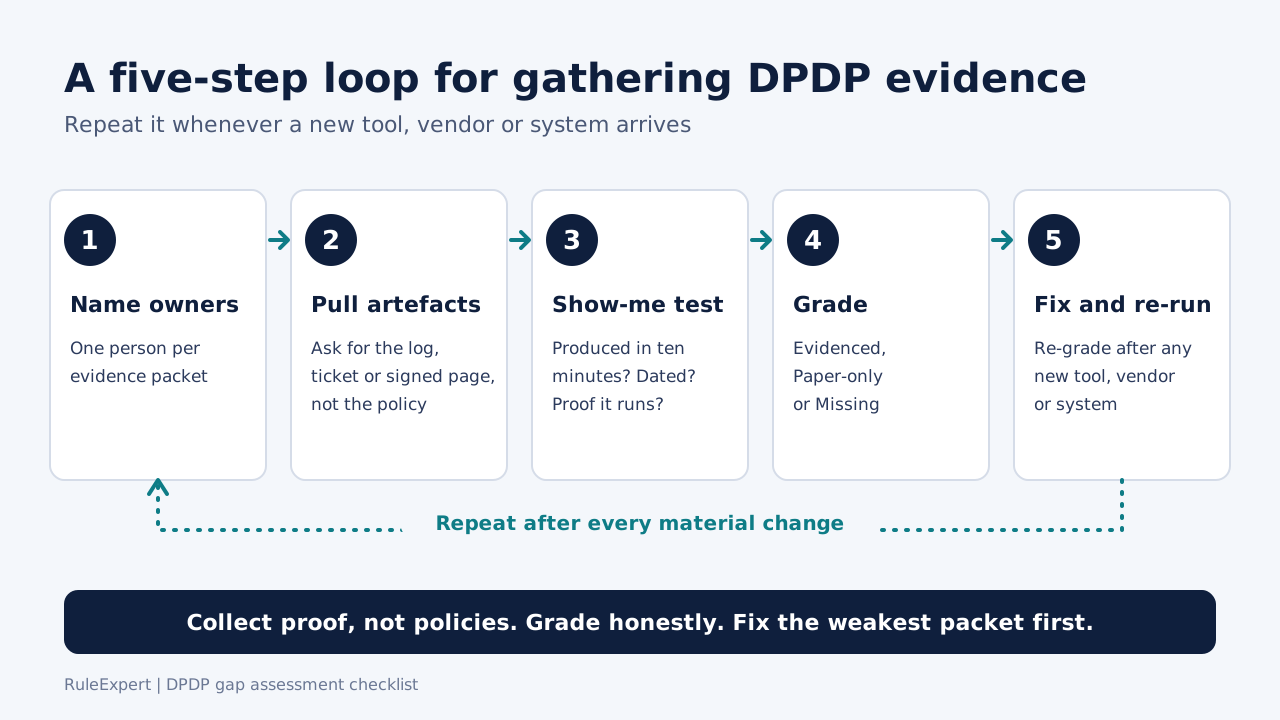
Collecting policies, not proof. A folder of PDFs feels productive. Ask for the log, the ticket or the signed page.
Building the vendor list from the accounts ledger. Free plans, form plugins and a recruiter’s spreadsheet never reach payables. Ask each team what holds customer or employee data.
Treating one-year log retention as an IT detail. Rule 6 makes it a legal duty, and it can sit awkwardly beside erasure. Reconcile the two on paper.
English-only notices. Section 5 expects people to be able to read the notice in English or any Eighth Schedule language.
Grading yourself from memory. Teams tend to score higher than their evidence supports. Have someone outside the function check.
Treating it as a one-off. Grades go stale when a new tool or vendor arrives. Re-run after material changes.
5. A Worked Example
This is hypothetical, not a client case. A 120-person software company hands over a vendor list of fourteen names from finance. The compliance lead then asks every team one question: which tools hold customer or employee data? The answers run well past thirty. A form plugin, a webinar tool, a recruiter’s spreadsheet, a screen-recording app. Nobody lied. The ledger simply cannot see free plans.
The processors packet drops from Evidenced to Missing. The first fix is a register built from team answers, with a contract status beside every name.
6. How Much Time Is Left
Rules 3 and 5 to 16 commence on 13 May 2027, about 200 days from late October 2026. Some commentary says 14 May, so confirm against the Gazette and watch MeitY for changes. When you have findings, our 90-day plan shows how to fix them, and the DPDP Rules 2025 guide lists the dates.
7. Where RuleExpert Fits
A spreadsheet is fine for the first pass. It struggles when you must prove the second pass beat the first. RuleExpert’s Data Registry keeps the inventory and owners together, Vendor Governance holds the processor register with agreement status, DSR Automation tracks requests against deadlines, and Breach Management follows the Rule 7 clock. Software does not replace your decisions or legal advice. It stops evidence going stale.
A working list of evidence used to test each duty under the DPDP Act and Rules. Each item is graded Evidenced, Paper-only or Missing.
What documents should I collect for a DPDP gap assessment?
Your data register, notices and consent logs, vendor contracts, security and log settings, rights request log, breach procedure, retention schedule, and training and contact records.
Is a DPDP gap assessment mandatory?
No. Neither the Act nor the Rules require one, though several duties are hard to meet without the visibility it gives.
How is this different from a DPDP compliance checklist?
A compliance checklist asks whether a control exists. This one asks for proof and grades how strong it is.
How long must logs be kept under DPDP Rule 6?
One year for logs and related personal data, to help detect and investigate unauthorised access, unless another law requires a different period.
Who should own the assessment?
Usually the compliance head, company secretary or COO, sponsored by a director or the CFO. Each packet still needs its own owner.
How often should we repeat it?
After any material change such as a new vendor, product or system, and at least once a year.
Does the three-year erasure rule apply to my company?
Only to specified large platforms: e-commerce and social media with 2 crore or more registered users, and online gaming with 50 lakh or more, with 48 hours’ notice before erasure. Others follow Section 8(7).
When do the DPDP Rules take effect?
Rules 1, 2 and 17 to 21 are in force. Rule 4 commences on 13 November 2026, and Rules 3, 5 to 16, 22 and 23 on 13 May 2027. Confirm against the Gazette.
Can an MSME or startup use this checklist?
Yes. The Act sets no turnover or headcount threshold for its core duties. Scale the depth of evidence to your size, but keep all eight packets.
I am a Compliance Manager at RuleExpert, focused on helping organizations navigate the evolving landscape of data protection and privacy regulations in India.
With the introduction of the Digital Personal Data Protection (DPDP) Act, businesses are facing new challenges in managing personal data, ensuring consent, and maintaining compliance across systems. My work revolves around simplifying these complexities and enabling organizations to adopt structured, scalable compliance practices.
I specialize in:
DPDP compliance and privacy frameworks
Data governance and risk management
Consent lifecycle and user rights handling
Compliance automation and operational workflows
At RuleExpert, I work closely with startups, SaaS companies, and enterprises to transform compliance from a manual, documentation-heavy process into an automated, infrastructure-driven system.
I am particularly interested in how AI and automation can reshape privacy operations and help businesses build trust in a data-driven world.
In their words
What compliance teams tell us
“We always thought DPDP compliance was the client’s responsibility
since we were only executing services. The evaluation made it clear that how we handle
client data creates risk on our side too. It changed how we work internally.”
DSFounderDigital services firm
“We had a basic understanding of DPDP requirements, but the scorecard
highlighted gaps we hadn’t identified internally — especially around consent handling
and data visibility. It gave us a much clearer starting point.”
BSFounderB2B SaaS company
“The DPDP score was surprisingly insightful. Within minutes we could see
where we stood and what needed immediate attention. It simplified something that initially
felt quite complex.”
FPProduct HeadFintech platform
“After reviewing our score we opted for a consultation. The discussion was
very practical — we got clear direction on what to fix first and how to approach DPDP
compliance in a structured way.”
LGFounderLogistics company
Real client quotes, attributed by role and sector — we never name a client.
Enquiry
Talk to the team
Your enquiry is with the team
Thank you — we have it. Someone will reply by email, usually within one working day.
Nothing else is needed from you. If it is urgent, email
tushar@ruleexpert.com and it will reach the same
people.
Allowing it lets Google Analytics and Google’s advertising measurement set an
identifier and receive your IP address, the pages you view and how you reached them
— used only to see which pages work and whether a campaign led to an enquiry, never to
build a profile or to decide anything about you. Google processes this outside India, a
cross-border transfer under Section 16. Declining changes nothing about the site, and you
can change your mind any time from the footer.
An analytics identifier is personal data, so the DPDP Act applies to
it — though no Indian cookie statute requires this banner. We ask because we would
rather you chose. What we collect and why
 RuleExpert