

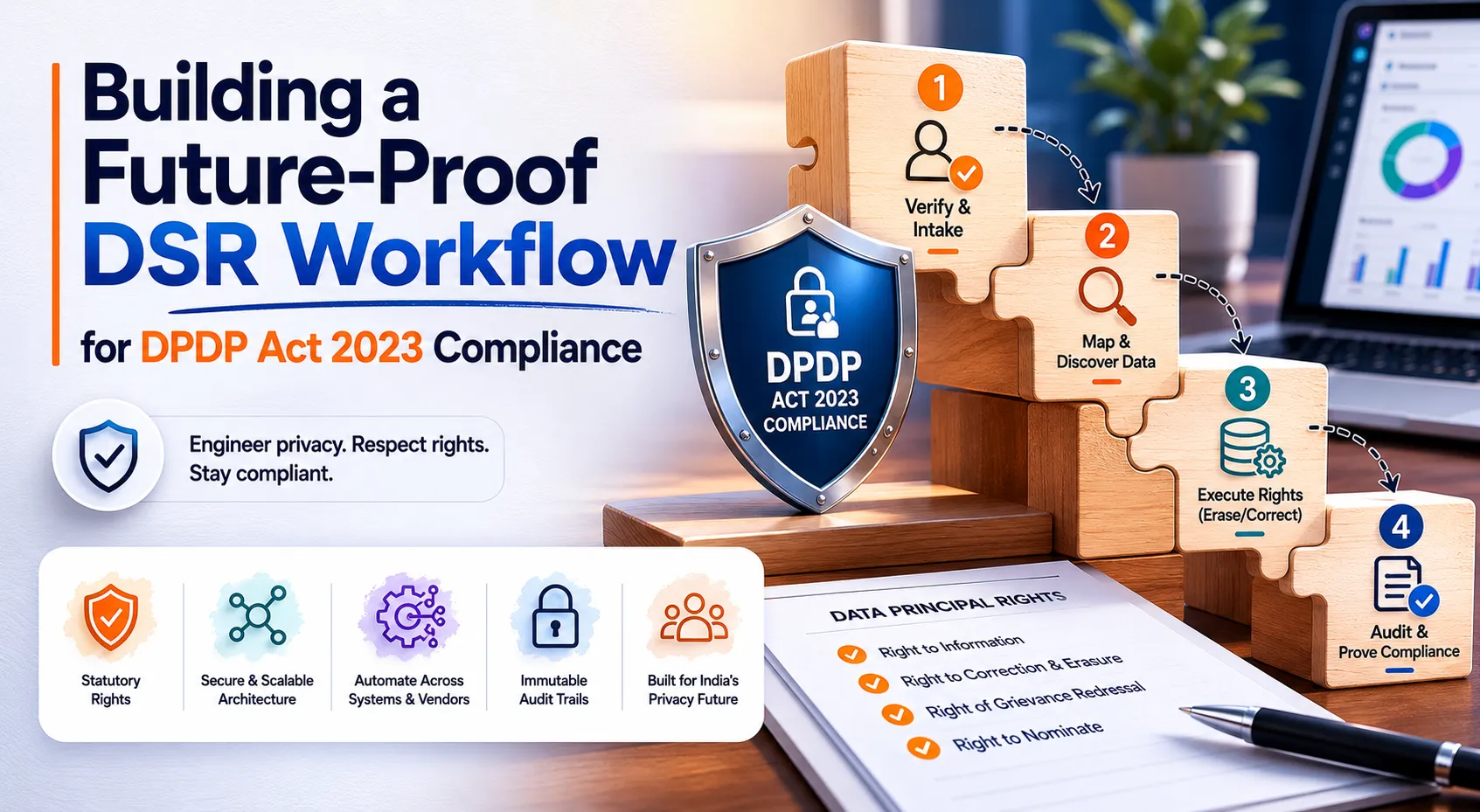
The final notification of the Digital Personal Data Protection Rules in November 2025 flipped the switch for Indian businesses, making a robust DSR workflow an immediate operational priority. We are no longer waiting on government drafts or debating what-ifs. The May 2027 deadline for full operational compliance is locked in, meaning organizations must transition from theoretical privacy policies to functional backend realities.
At the heart of this transition lies the ability to handle consumer requests without triggering a massive internal crisis every single time. To survive the scrutiny of the newly established Data Protection Board of India, mapping out a scalable DSR workflow is the single most critical engineering and legal task your team will tackle this year. Organizations that invest early in automating their DSR workflow will be far better positioned to meet compliance obligations efficiently and at scale.
Think about what happens right now when a user emails your support team asking to see all the data you hold on them. Customer success forwards the ticket to legal. Legal pings engineering. An engineer runs a manual SQL query on the primary database, completely forgetting about the marketing CRM, the third-party analytics tool, and the legacy billing system. A week passes. You send back an incomplete spreadsheet. Under the older IT Act framework, this sloppy response might have flown under the radar. Under the DPDP Act 2023, it is a direct violation of statutory rights.
The Ministry of Electronics and Information Technology (MeitY) officially laid out the implementation roadmap. The regulatory board is already active and accepting grievances. By November 2026, the external Consent Manager framework will open its doors. And exactly eighteen months from the rules notification—May 13, 2027—full operational compliance becomes legally binding. This isn’t just about updating a privacy notice on your website. It requires hardcoding user rights directly into your infrastructure. Any business processing personal data must establish an impenetrable mechanism to ingest, verify, map, and execute these requests.
Breaking Down the Statutory Rights
Let’s look at exactly what your system needs to handle. The legislation designates the individual as the Data Principal and the entity deciding the processing purpose as the Data Fiduciary. As a Data Fiduciary, your technical setup must natively facilitate four distinct rights.
- The Right to Information Users can demand an itemized summary of the personal data you process. They also have the right to know the identities of every single Data Processor or third party you’ve shared their information with. If you don’t have a live, centralized data map, generating this list accurately is physically impossible.
- The Right to Correction and Erasure If a user spots an error, they can force you to fix it across all platforms. If they withdraw consent, they can force you to delete their footprint entirely. Your backend must support aggressive, cascading deletion protocols.
- The Right of Grievance Redressal You need a dedicated, documented channel for complaints. If your front-line support ignores a privacy complaint, the user will escalate it to the Data Protection Board of India, triggering an official inquiry.
- The Right to Nominate The architecture must account for edge cases where a designated proxy executes rights on behalf of an incapacitated or deceased user. This requires unique verification steps distinct from standard user authentication.
Architecting the Engine
Slapping a web form on your site is the easy part. The real friction happens underground. A high-functioning DSR workflow relies on four non-negotiable architectural pillars. Let’s walk through the mechanics of building this out properly.
- Pillar 1: Identity Verification and Secure Intake If a bad actor submits a bogus request to extract someone else’s data and your team complies, you haven’t fulfilled a privacy request. You have orchestrated a data breach. The DPDP Rules dictate that the moment you become aware of a breach, you must immediately notify the authorities and follow up with a detailed forensic report within 72 hours. Your DSR workflow must forcefully authenticate the user before a single database query runs. This usually means routing requests behind a secure login wall or integrating with government-authorized digital identity services like DigiLocker, especially when verifying parental consent for minors.
- Pillar 2: Data Mapping and Discovery Personal data doesn’t sit in a neat little folder labeled with the user’s name. It scatters. It lives in your AWS buckets, your HubSpot CRM, your Zendesk tickets, and the logs of the third-party payroll processor. A manual DSR workflow completely collapses here. To comply with the DPDP Act 2023, your architecture needs automated data discovery tools that scan across your entire vendor ecosystem. When an erasure request triggers, the system must hunt down the user’s identifiers across all active and backup environments via robust API integrations.
- Pillar 3: The Erasure vs. Retention Conflict Logic This is where legal nuance meets engineering. The November 2025 Rules introduced a massive caveat: organizations must retain personal data, traffic data, and processing logs for at least one year to enable security investigations and detect unauthorized access. What happens when a user demands immediate deletion, but the rules mandate a one-year retention for security logs? Your DSR workflow must possess conditional logic. It needs to wipe the user from the marketing database instantly while quarantining the required security logs for the mandatory 365-day cooling-off period. Hardcoding these exemptions prevents your compliance team from breaking one law to satisfy another.
- Pillar 4: Immutable Audit Trails Regulators don’t just care that you deleted the data. They care that you can prove you deleted it. Every single interaction within your DSR workflow must generate an immutable log. When did the request arrive? How was the user authenticated? Which databases were queried? When did the Data Processor confirm deletion on their end? These logs are your shield. If the board investigates a grievance, handing over a clean, automated audit trail shuts down the inquiry instantly.
Vendor Ecosystem Dependencies: Managing the Data Processor
Your internal compliance is only as strong as your weakest vendor. The DPDP Act 2023 places the ultimate liability squarely on the shoulders of the Data Fiduciary. You cannot blame your cloud hosting provider or your external marketing agency if a user’s data isn’t erased in time. Your DSR workflow must bridge the gap between your internal servers and external Data Processors. When mapping out this architecture, you need to audit every third-party service that ingests your users’ personal data. Does your marketing agency have access to the raw email list? Does your analytics tool store IP addresses?
If a Data Principal submits a verified erasure request, your DSR workflow must execute a cascading command. It deletes the record locally, but it must also fire off API calls or automated webhooks to every associated Data Processor instructing them to purge the corresponding records. Furthermore, your contracts with these processors need immediate revision.
They must legally commit to executing the deletion commands generated by your DSR workflow within a specific timeframe. If a vendor’s API cannot support automated deletion requests, or if they refuse to sign an updated data processing agreement reflecting the May 2027 mandates, you need to offboard them. Regulators will not accept the technical limitations of a third-party vendor as a valid excuse for violating a Data Principal’s statutory rights.
Integrating with the Consent Manager Ecosystem
By late 2026, the tech landscape will shift again. The rules outline the operationalization of Consent Managers—interoperable platforms where Data Principals can manage, review, and withdraw consent across multiple businesses simultaneously from a single dashboard. Your internal systems cannot operate in a vacuum. They must feature open webhooks and APIs capable of receiving signals from these external entities. When a Consent Manager pings your server with a withdrawal request, your internal DSR workflow needs to catch that payload and trigger the downstream deletion sequence automatically, without human intervention. Once this ecosystem is live, the friction for a user to withdraw consent or demand data erasure will drop to zero.
You can expect the volume of Data Principal requests to skyrocket. If your business hasn’t implemented DSR automation before the Consent Manager floodgates open, your compliance team will drown.
The Burden on Significant Data Fiduciaries
The stakes jump significantly based on your data volume. The government classifies entities processing high volumes of sensitive information, or those posing risks to public order and electoral democracy, as Significant Data Fiduciaries (SDFs). If you hit this threshold, your DSR workflow will be subject to intense regulatory scrutiny. You must appoint an India-based Data Protection Officer and conduct annual Data Protection Impact Assessments (DPIAs).
For an SDF, an undocumented or leaky process isn’t just a compliance failure; it’s a direct threat to the company’s operating license. Your independent data auditor will test your workflow by submitting mock requests. If it fails, that failure goes straight into the audit report submitted directly to the regulator.
The 18-Month Engineering Roadmap
With the May 2027 deadline approaching rapidly, engineering and legal teams need a shared execution plan. Do not wait until the last quarter to start building.
- Phase 1: The Inventory Phase (Current Focus) You cannot delete what you cannot find. Map every single database, SaaS tool, and internal application that touches personal data. Review your vendor agreements to ensure your Data Processors are legally bound to respect the deletion signals your automated systems send them.
- Phase 2: The Middleware Phase (Mid-2026) Start building the API connectors. Your DSR workflow needs to talk to your CRM, your email marketing platform, and your customer support software. Test the deletion logic in a sandbox environment to ensure an erasure request doesn’t accidentally corrupt broader relational databases.
- Phase 3: The UI and Testing Phase (Early 2027) Design the front-end privacy center. Make the language plain and accessible, adhering to the SARAL approach (Simple, Accessible, Rational, and Actionable) championed by the government. Stress-test the authentication layer to ensure no unauthorized access slips through.
Moving from Manual Scripts to Automated Infrastructure
When you map out these dependencies, the sheer scale of engineering hours required to build and maintain an internal data compliance engine becomes glaringly obvious. Your developers would need to spend months writing custom API integrations for every SaaS application in your stack, building complex conditional logic arrays to handle the one-year security log retention overrides, and designing secure front-end portals that talk to DigiLocker.
Worse yet, every time an external marketing vendor shifts their API endpoints or the Data Protection Board issues a new structural clarification, your engineering roadmap gets hijacked by compliance maintenance.
This operational bottleneck is exactly why mid-market and enterprise engineering teams are shifting away from hardcoded, in-house solutions. Dedicated compliance infrastructure engines like RuleExpert treat the entire compliance lifecycle as an automated workflow layer rather than a series of disconnected development tickets.
Instead of writing custom discovery scripts for every database query, a specialized automation layer hooks directly into your tech stack via pre-built middleware. When a user executes a right through your privacy center, RuleExpert handles the heavy lifting behind the scenes: orchestrating the identity validation checks, mapping the user identity token across internal and third-party environments, firing off the required erasure webhooks to your external Data Processors, and writing the entire sequence to an unalterable audit log.
It essentially abstracts the legal complexity away from your primary production databases, allowing your product team to build actual features while guaranteeing that your operational systems never miss a statutory timeline.
Common Failure Points to Avoid
- Ignoring backup systems: Deleted data may still exist in archived backups.
- Untracked third-party processors: Vendors may still retain personal data.
- No workflow ownership: Requests bounce between legal, IT, and operations teams.
- Incomplete consent linkage: Withdrawal requests fail to stop downstream marketing use.
These gaps often become the root cause of regulatory escalations.
The Cost of Apathy
The financial deterrents are severe. Failing to implement reasonable security safeguards or dropping the ball on user rights can trigger penalties scaling up to ₹250 crore per instance. The government expects businesses to treat consumer rights with the exact same technical rigor applied to revenue generation and product development. Building a resilient, automated mechanism isn’t a cost center. It is a baseline operational necessity to keep your business alive in India’s regulated digital economy. Stop relying on shared inboxes and start engineering real privacy infrastructure.
Conclusion
The transition period granted by the government isn’t a buffer to delay action; it is a tight engineering window to re-architect how data moves through Indian enterprises. The DPDP Act 2023 fundamentally changes the power dynamic between businesses and consumers. Treating user data as a permanent corporate asset is a legacy mindset that now carries a ₹250 crore liability.
Building a resilient, automated DSR workflow is the only way to survive the upcoming compliance deadlines without paralyzing your internal operations. By combining clear, legally sound internal logic with an enterprise-grade automation engine like RuleExpert, you remove the risk of human error from the privacy equation. True data compliance isn’t a defensive legal shield—it’s an engineering standard that separates sustainable digital companies from businesses living on borrowed time.
Take Action Today: Stop treating privacy requests like an administrative fire drill. Talk to our team to see how RuleExpert can instantly deploy a compliant, automated DSR workflow tailored to your existing technical architecture, ensuring your systems are completely future-proofed well ahead of the regulatory deadlines.
Nitin Ray is a Compliance Manager at RuleExpert with expertise in DPDP compliance, data privacy, consent management, and governance. He helps organizations implement practical compliance frameworks and automation strategies to meet the requirements of India’s Digital Personal Data Protection Act, 2023.
Frequently Asked Questions
- 1. What is the exact deadline to implement an automated system for user rights under the DPDP Rules 2025?
Organizations have an 18-month window from the November 2025 rules notification. This makes May 13, 2027, the hard deadline for full operational compliance, including automated rights management and deletion protocols. - 2. Can we still handle data deletion requests manually via email?
While the text of the law does not explicitly ban manual processing, relying on an email inbox is practically impossible at scale. Manual processing leads to missed statutory deadlines, incomplete data mapping, and a severe lack of audit trails, which immediately exposes you to regulatory penalties. - 3. How does the new 1-year data retention mandate affect a DSR workflow?
The November 2025 rules require businesses to keep certain processing logs and traffic data for one year to detect and investigate unauthorized access. Your workflow must use conditional logic to delete a user’s active profile data while securely quarantining the specific security logs for the mandated 365 days. - 4. Will we need to build API integrations for Consent Managers?
Yes. The registration for Consent Managers opens in November 2026. These entities will act on behalf of users. Your internal architecture must be capable of receiving automated consent withdrawal signals from these external platforms and actioning them immediately. - 5. Are third-party Data Processors responsible for building their own rights intake portals?
No. The Data Fiduciary holds the primary legal responsibility to the user. The fiduciary must provide the intake portal. However, the fiduciary’s workflow must automatically trigger the Data Processor to delete or update the relevant records within their isolated environments. - 6. What happens if our team accidentally exposes another user’s data during a request?
Disclosing data to an unverified or incorrect individual constitutes a personal data breach. Under the finalized rules, you must notify the Data Protection Board of India immediately and submit a comprehensive forensic report detailing the breach within 72 hours. - 7. How do we verify parental consent for minors during an access request?
The rules provide specific pathways. You can verify parental status using existing verified data already on file, or by leveraging government-authorized digital identity services like DigiLocker to confirm the relationship without collecting excess personal data. - 8. Will the Data Protection Board of India proactively audit our systems?
The Board primarily functions as an adjudicatory body responding to user grievances. However, if your organization is classified as a Significant Data Fiduciary, you are legally required to appoint an independent data auditor to conduct annual audits of your processes, and those audit reports must be submitted to the Board.
4 Comments
Comments are closed.