


India’s data protection regime is no longer a future obligation sitting in a draft bill. DPDP in India is now a live, enforceable framework: the Digital Personal Data Protection Act, 2023 has been operationalised by the Digital Personal Data Protection Rules, 2025, the Data Protection Board of India has been constituted, and phased compliance deadlines are already running. For CEOs, founders, CFOs, CHROs, compliance heads, company secretaries and chartered accountants across every sector, the question has shifted from “should we care about this” to “how fast can we become audit-ready, and how do we prove it.”
This guide is written for exactly that audience. It is not a restatement of the bare statute. It is a practical, end-to-end explanation of what DPDP in India actually requires of your organisation, how the obligations map onto real business functions – HR, finance, product, marketing, vendor management – and how personal data processing can be governed through structured, automated compliance management rather than scattered spreadsheets and one-time legal opinions.
What Is DPDP in India?
DPDP stands for the Digital Personal Data Protection Act, 2023 – India’s first standalone data protection law. It replaces the patchwork approach that previously governed personal data in India (largely Section 43A of the IT Act and the SPDI Rules, 2011) with a single, principle-based statute that applies to the processing of digital personal data, whether that data is collected online or collected offline and later digitised.
At its core, DPDP in India is built around a simple idea: personal data belongs to the individual it describes – called a Data Principal – and any organisation that decides why and how that data is processed – called a Data Fiduciary – must have a lawful basis to process it, must be transparent about the processing, must secure the data, and must be answerable to a regulator if something goes wrong.
The Act itself received Presidential assent in August 2023, but a law of this scale cannot function on primary legislation alone – it needs subordinate rules that spell out timelines, formats, thresholds and procedures. Those rules arrived as the Digital Personal Data Protection Rules, 2025, and together the Act and the Rules now form the operative “DPDP guidelines” that every organisation processing personal data connected to India must follow.
Unlike the European Union’s GDPR, which calculates fines as a percentage of global turnover, the DPDP Act prescribes fixed, absolute penalty ceilings – up to ₹250 crore per instance for the most serious violations. That single design choice is why DPDP in India has moved so quickly from “compliance topic” to “board-level risk item.”
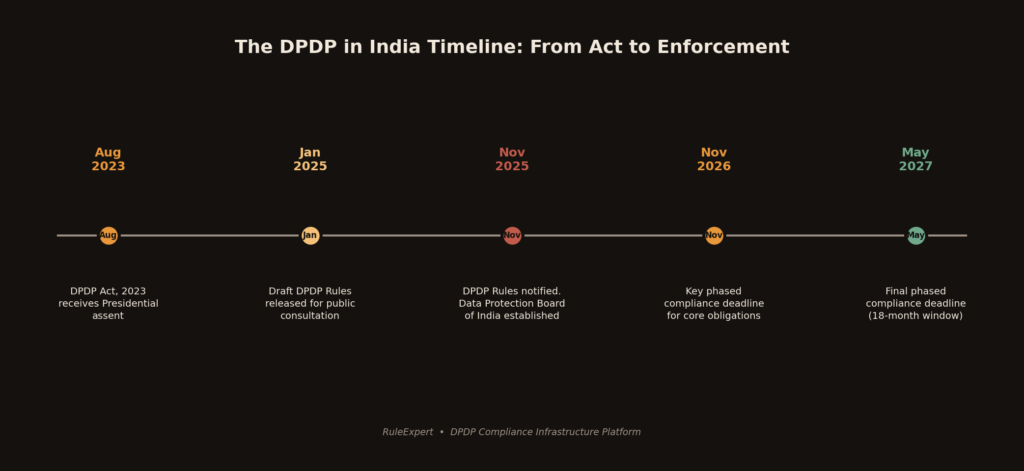
From Act to Enforcement: The DPDP Timeline
Understanding where India actually stands today requires separating three distinct milestones that are often (incorrectly) treated as one event.
| Milestone | What Happened |
|---|---|
| August 2023 | The Digital Personal Data Protection Act, 2023 received Presidential assent and was enacted, but most operative provisions were not yet in force pending rules. |
| January 2025 | The Ministry of Electronics and Information Technology (MeitY) released the Draft Digital Personal Data Protection Rules, 2025 for public consultation. Thousands of inputs were received from startups, MSMEs, industry bodies and citizens. |
| 13–14 November 2025 | MeitY formally notified the Digital Personal Data Protection Rules, 2025 in the Official Gazette, giving full operational effect to the Act. The Data Protection Board of India was simultaneously established. |
| 14 November 2025 onward | The first tranche of provisions – including the Board’s functioning and certain procedural requirements – came into force immediately. |
| Phased compliance window (up to 18 months from notification) | Core obligations for Data Fiduciaries – consent architecture, notice formats, breach-response mechanisms, Significant Data Fiduciary duties – are being phased in over a staggered timeline, with key enforcement dates set for 14 November 2026 and 14 May 2027. |
A word of caution here, because this is where many organisations get their planning wrong: in January 2026, MeitY held a stakeholder consultation that discussed the possibility of accelerating the original 18-month phased window down to 12 months in certain areas. As of this writing, that acceleration has been discussed but not formally confirmed through a gazette notification.
The prudent approach – and the one we recommend to every organisation we work with – is to plan for the earlier deadline rather than the maximum window. A compliance programme that is “on schedule” for an 18-month runway but built on a foundation of manual processes typically takes far longer than expected to actually finish; enterprise DPDP programmes commonly take 9–12 months from a standing start to genuine audit readiness.
The practical takeaway: DPDP in India is not a “wait and watch” regulation anymore. It is enacted, it is notified, the regulator exists, and the clock on phased obligations is already running.
Who Does the DPDP Act Apply To?
One of the most misunderstood aspects of DPDP guidelines is scope. Many founders and CXOs assume the law only applies to consumer-facing tech companies. It does not.
The Act applies to the processing of digital personal data where:
- The personal data is collected in digital form, or collected in non-digital form and subsequently digitised.
- The processing takes place within India, regardless of industry, company size, or whether the entity is a private company, LLP, partnership, proprietorship, non-profit, or government body.
- The processing takes place outside India, if it is in connection with offering goods or services to Data Principals located in India, or involves profiling individuals located in India. This gives the Act extraterritorial reach comparable to GDPR’s Article 3.
In practice, this means:
- A Bengaluru-based SaaS company processing its Indian employees’ payroll data is covered.
- A US-based e-commerce platform shipping to Indian customers and running analytics on their browsing behaviour is covered.
- A regional hospital chain in Indore digitising patient intake forms is covered.
- A manufacturing plant maintaining biometric attendance records for its workforce is covered.
- A three-person startup collecting email addresses through a landing page is covered.
There is no minimum company size, turnover, or data-volume threshold for baseline applicability. Thresholds do matter later – for the “Significant Data Fiduciary” classification discussed below – but the starting obligations apply broadly across “all industry,” which is precisely why DPDP compliance has become a cross-functional concern rather than a niche legal matter.
Key Roles and Definitions Under DPDP
DPDP guidelines are built around five core roles. Getting these definitions right is the foundation for every compliance decision that follows.
Data Principal – The individual to whom the personal data relates. Where the individual is a child (anyone under 18) or a person with a disability who has a lawful guardian, the parent or guardian exercises rights on their behalf.
Data Fiduciary – Any person or organisation that, alone or with others, determines the purpose and means of processing personal data. If your organisation decides why data is collected and how it will be used, you are a Data Fiduciary – this is the role that carries the primary legal burden under the Act.
Data Processor – An entity that processes personal data on behalf of a Data Fiduciary, under a contract. Payroll vendors, cloud hosting providers, CRM platforms and marketing automation tools acting under instruction typically sit in this category. Critically, the Data Fiduciary remains accountable for the Processor’s actions – DPDP does not let you outsource your liability along with your data.
Significant Data Fiduciary (SDF) – A category of Data Fiduciary that the Central Government designates based on factors such as the volume and sensitivity of personal data processed, risk to Data Principals’ rights, potential impact on India’s sovereignty and electoral democracy, and public order. SDFs carry a meaningfully heavier compliance load, covered in detail later in this guide.
Consent Manager – A new, registered intermediary role created by the Rules. A Consent Manager is an India-incorporated entity (meeting minimum net worth and technical-capability thresholds) that gives Data Principals a single interface to grant, manage, review and withdraw consent across multiple Data Fiduciaries. Consent Managers must register with the Data Protection Board and operate to prescribed technical and interoperability standards.
Data Protection Board of India (DPB) – The regulator constituted under the Act. It functions as a digital-first adjudicatory body: it receives complaints, investigates breaches, conducts inquiries, and imposes penalties. It does not make policy or issue statutory codes of practice – its role is enforcement and dispute resolution, with appeals lying to the Telecom Disputes Settlement and Appellate Tribunal (TDSAT).
Rights of Data Principals
DPDP in India is deliberately structured around individual rights, and every Data Fiduciary must build the operational capability to honour them, not just acknowledge them in a privacy policy PDF.
- Right to Access (Section 11) – A Data Principal can request a summary of what personal data an organisation holds about them, the processing activities carried out on it, and the identities of other fiduciaries or processors with whom it has been shared.
- Right to Correction and Erasure (Section 12) – Individuals can ask for inaccurate or outdated data to be corrected, completed, or updated, and can request erasure of data that is no longer necessary for the purpose it was collected for.
- Right to Grievance Redressal (Section 13) – Every Data Fiduciary must provide a readily available mechanism for Data Principals to raise complaints, and must respond within prescribed timelines before the individual can escalate to the Data Protection Board.
- Right to Nominate (Section 14) – A Data Principal can nominate another individual to exercise their rights in the event of death or incapacity – a right with few direct parallels in other global privacy regimes.
- Right to Withdraw Consent – Consent can be withdrawn at any time, as easily as it was given. Withdrawal does not affect the lawfulness of processing carried out before withdrawal, but it does require the Data Fiduciary to stop further processing (subject to any independent legal basis) within a reasonable time.
Data Principals also carry duties under Section 15 – they must not impersonate another person, must not suppress material information when applying for a document or identifier, and must not file frivolous or false grievances. This is a two-way accountability structure, but the operational burden of enabling these rights sits squarely with the Data Fiduciary.
Obligations of Data Fiduciaries
If Data Principal rights are the “what,” Data Fiduciary obligations are the “how.” Every organisation processing personal data connected to India – regardless of size – must:
- Issue a clear, itemised notice at or before the point of collecting consent, describing exactly what personal data is being collected and for what specific purpose.
- Limit processing to the purpose for which consent was given, and avoid using data for unrelated secondary purposes without fresh consent.
- Ensure data accuracy and completeness, particularly where the data will be used to make a decision about the individual or shared with another fiduciary.
- Implement reasonable security safeguards appropriate to the sensitivity and volume of the data being processed.
- Report personal data breaches to the Data Protection Board and to affected Data Principals within prescribed timelines.
- Erase personal data once the purpose has been served and retention is no longer necessary, unless retention is required under another law.
- Establish a grievance redressal mechanism and publish the contact details of a designated person able to answer Data Principal questions.
- Bind Data Processors contractually, ensuring that any vendor or sub-processor is held to equivalent security and purpose-limitation standards, since liability for a processor’s failure still lands on the fiduciary.
None of these obligations are satisfied by a static privacy policy. They require a working system – a registry of what data you hold, a workflow for responding to requests, a documented incident-response process, and a governance trail that can be produced on demand. This is the operational gap that most compliance failures actually come from, and it’s the gap automated compliance management is designed to close.
Consent and Notice Requirements
The DPDP Rules, 2025 give real texture to what “valid consent” and “adequate notice” mean in practice.
Standalone privacy notices. Under Rule 3, a Data Fiduciary must issue a standalone notice – not a notice buried inside a lengthy terms-of-service document – that clearly lists the specific personal data being collected, states the specific purpose of processing, and provides a direct, accessible mechanism for the Data Principal to withdraw consent, exercise their rights, and lodge a complaint with the Data Protection Board.
Free, specific, informed and unambiguous consent. Consent cannot be bundled, pre-ticked, or inferred from silence. It must be limited to what is necessary for the stated purpose, capable of being given as easily as it can be withdrawn, and it must be possible for the individual to give consent in English or any language listed in the Eighth Schedule of the Constitution.
Verifiable, auditable consent records. If a dispute arises before the Data Protection Board, the burden of proving that valid notice was given and valid consent was obtained sits with the Data Fiduciary, not the individual. This single evidentiary rule is the reason “we probably had consent” is not a defensible compliance posture – organisations need timestamped, retrievable consent logs tied to specific purposes and specific notices.
The role of Consent Managers. Where an organisation chooses to route consent collection through a registered Consent Manager, that Consent Manager must meet eligibility conditions set out in the Rules, including a minimum net worth threshold and demonstrated technical capability, and must operate on an interoperable basis so Data Principals get a genuinely unified view of their consents across multiple fiduciaries – not a fragmented experience dressed up as one.
Processing Without Consent: Legitimate Uses
DPDP is not an absolute consent-only regime. The Act recognises a defined set of “legitimate uses” where personal data can be processed without seeking fresh consent, because requiring consent in these situations would be impractical or contrary to public interest. Common legitimate uses include:
- Processing for the purpose for which the Data Principal voluntarily provided their data and did not indicate they did not consent (for example, sharing a phone number to receive a service update).
- Processing by the State for providing subsidies, benefits, services, permits, licences or certificates, or for issuing government-backed identifiers.
- Processing necessary for compliance with a court order or judgment.
- Processing in a medical emergency or during an epidemic or disease outbreak, or to provide medical treatment in circumstances endangering the life of an individual.
- Processing for employment purposes, including recruitment, appraisal, disciplinary action, and safeguarding the employer from loss or liability – a legitimate use with direct relevance to HR and Plant HR functions.
- Processing in the interest of public order or for purposes related to prevention, detection or investigation of an offence.
Legitimate uses reduce friction, but they are not a blanket exemption – each ground has specific conditions attached, and Data Fiduciaries relying on a legitimate use should still document why the ground applies, since that documentation is exactly what a regulator or auditor will ask for first.
Security Safeguards and Breach Notification
Security is where DPDP guidelines get most operationally demanding, and where the highest penalty tier in the entire Act is attached.
Reasonable security safeguards (Rule 6). The Rules require Data Fiduciaries to implement appropriate technical and organisational measures – encryption, access controls, monitoring for unauthorised access, and data-loss prevention measures – proportionate to the sensitivity and volume of personal data processed, along with contractual controls over processors and periodic review of these measures.
Breach reporting timelines (Rule 7). On becoming aware of a personal data breach, a Data Fiduciary must notify the Data Protection Board and, separately, notify affected Data Principals. Notification to affected Data Principals must generally happen within 72 hours of the Board notification, and it must include a plain-language description of the breach, the categories of data exposed, the protective measures individuals can take, and the fiduciary’s contact details for follow-up.
Data retention and erasure (Rule 8). Personal data must be erased once its purpose has been fulfilled and retention is no longer necessary under any other applicable law, and there are additional purpose-linked retention triggers for e-commerce, gaming and social media entities meeting prescribed user thresholds.
Why this matters financially. Failure to implement reasonable security safeguards to prevent a breach carries the single highest penalty ceiling in the Schedule to the Act – up to ₹250 crore per instance. Failure to notify the Board and affected individuals of a breach carries a separate ceiling of up to ₹200 crore per instance. These are not alternative penalties; a single incident that involves both inadequate safeguards and a delayed notification can attract both, and the Data Protection Board has explicit authority to impose penalties cumulatively.
Cross-Border Data Transfer Rules
Unlike several global data protection regimes that require case-by-case adequacy assessments for every cross-border transfer, DPDP in India adopts a “negative list” approach: personal data can generally be transferred outside India, except to countries or territories that the Central Government specifically restricts through notification. Organisations operating with a global data footprint – outsourcing centres, GCCs, SaaS platforms hosted on multi-region cloud infrastructure – should still track two things closely:
- Whether the government notifies sector-specific data localisation requirements for particular categories of data (a power reserved under the Rules), which would override the general negative-list approach for that category.
- Whether any restricted-country notifications are issued, since the negative list can be updated over time and compliance programmes built around “transfers are generally fine” need a monitoring mechanism, not a one-time legal opinion.
Children’s Data and Vulnerable Persons
DPDP sets one of the strictest child-data thresholds in the world. Under Section 2(f), a “child” is any individual who has not completed eighteen years of age – considerably higher than GDPR’s 13–16 range or COPPA’s 13-year threshold in the United States. This single definitional choice has outsized consequences for ed-tech platforms, gaming apps, social platforms and any consumer service with a meaningful teenage user base.
Core requirements:
- Verifiable parental or guardian consent (Section 9, Rule 10) must be obtained before processing a child’s personal data, with the Data Fiduciary required to verify the identity and age of the consenting adult using reliable existing details or an authorised identity-verification service such as DigiLocker.
- No tracking, behavioural monitoring, or targeted advertising directed at children is permitted, regardless of consent, subject only to narrow government-notified exemptions.
- Purpose-based exemptions exist for specific low-risk use cases – such as providing a subsidy or government benefit to a child, creating an email account, confirming that a user is not a child, or determining a child’s real-time location for safety purposes – but these exemptions come with their own conditions and the burden of proving they apply sits with the fiduciary.
- Persons with disabilities who have a lawful guardian are afforded equivalent protection, with the guardian exercising rights on the individual’s behalf.
For consumer platforms, this means age-gating and identity-assurance mechanisms are no longer optional UX polish – they are a compliance control with direct penalty exposure attached.
Significant Data Fiduciaries: Extra Obligations
Not every organisation is a Significant Data Fiduciary, but every organisation should periodically assess whether it might become one – the designation is based on factors like data volume, sensitivity, and risk, and can apply to fast-growing companies faster than founders expect. Once designated, an SDF’s obligations under Section 10 and Rule 13 go well beyond the baseline:
- Appoint a Data Protection Officer (DPO) who is based in India, reports to the Board of Directors or an equivalent governing body, and acts as the point of contact for the Data Protection Board’s grievance-redressal mechanism.
- Appoint an independent data auditor to evaluate the organisation’s compliance with the Act and the Rules.
- Conduct an annual Data Protection Impact Assessment (DPIA) and audit – once every twelve months from the date of SDF designation – assessing the rights of Data Principals affected, the purpose of processing, and the risks involved.
- Carry out algorithmic due diligence, evaluating whether any algorithmic systems used for processing create disproportionate risk to Data Principals.
- Observe any data-localisation restrictions the government specifically notifies for that class of SDF.
Failures here are treated seriously precisely because they are structural rather than incidental – no DPO, a DPO who isn’t India-resident, or a missed annual audit are all treated as independent compliance failures that can attract penalties even before any actual data breach occurs.
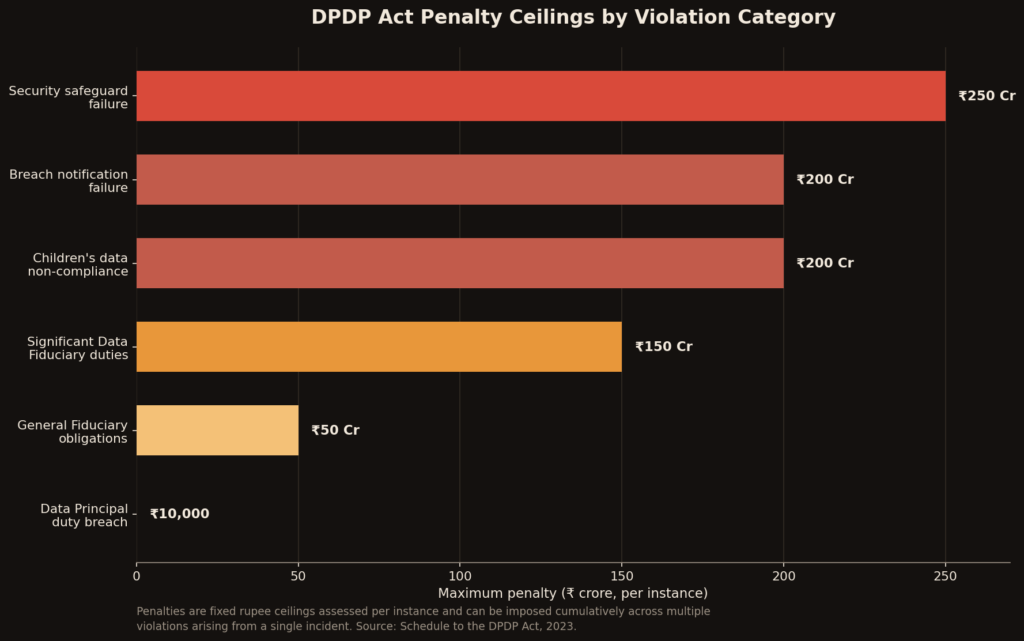
Penalties and Enforcement
This is the section that has moved DPDP in India from the legal team’s inbox to the board agenda.
| Violation Category | Maximum Penalty | Statutory Basis |
|---|---|---|
| Failure to take reasonable security safeguards to prevent a breach | Up to ₹250 crore | Section 8(5) read with the Schedule |
| Failure to notify the Board / affected Data Principals of a breach | Up to ₹200 crore | Section 8(6) read with the Schedule |
| Non-compliance with obligations regarding children’s data | Up to ₹200 crore | Section 9 read with the Schedule |
| Non-compliance with additional Significant Data Fiduciary obligations | Up to ₹150 crore | Section 10 read with the Schedule |
| Breach of general Data Fiduciary obligations (notice, consent, purpose limitation, erasure) | Up to ₹50 crore | Sections 4–8 read with the Schedule |
| Breach of duties by a Data Principal (false grievance, impersonation, etc.) | Up to ₹10,000 | Section 15 read with the Schedule |
A few enforcement mechanics matter as much as the numbers themselves:
- Penalties are fixed rupee ceilings, not a percentage of turnover – unlike GDPR, so the exposure for a smaller company is proportionally far heavier relative to its revenue.
- Penalties are assessed per instance and can be cumulative. A single incident that breaches multiple obligations – say, inadequate safeguards leading to a breach, a missed 72-hour notification, and a consent-documentation gap – can trigger separate penalties that stack well beyond any single slab, with realistic worst-case exposure running into several hundred crore.
- The Data Protection Board weighs mitigating factors – the nature and gravity of the violation, the type and volume of data affected, whether the organisation self-disclosed and cooperated, remediation speed, and prior compliance history – before fixing the final amount. A documented compliance programme is, in effect, a direct lever on financial exposure, not just a best-practice checkbox.
- Appeals against a Board order lie to the Telecom Disputes Settlement and Appellate Tribunal (TDSAT), and from there to the Supreme Court of India on limited grounds.
DPDP vs GDPR: How India’s Law Compares
Multinational teams and India-facing global companies frequently ask how DPDP guidelines stack up against the EU’s GDPR, since GDPR compliance programmes are often the template organisations reach for first. The two regimes share a consent-centric philosophy, but they diverge in several practical ways that matter for compliance planning.
| Dimension | DPDP Act, 2023 (India) | GDPR (EU) |
|---|---|---|
| Penalty structure | Fixed rupee ceilings per instance, up to ₹250 crore | Up to 4% of global annual turnover or €20 million, whichever is higher |
| Sensitive data category | No separate statutory category of “sensitive personal data” | Explicit “special category data” with heightened conditions |
| Child consent age | Under 18 (verifiable parental consent) | Generally 13–16, set by member state |
| Cross-border transfers | Negative list – allowed unless a country is specifically restricted | Adequacy decisions, SCCs, and transfer impact assessments required |
| Right to data portability | Not an explicit statutory right | Explicit right under Article 20 |
| Regulator | Data Protection Board of India (adjudicatory, digital-first) | National Data Protection Authorities in each member state |
| Legal basis for processing | Consent plus a defined list of “legitimate uses” | Six lawful bases, including consent, contract, and legitimate interest |
The practical implication: a GDPR-compliant organisation is not automatically DPDP-compliant, and vice versa. Global companies operating across both jurisdictions need parallel, not identical, compliance tracks – particularly around child-consent thresholds, breach-notification timelines (DPDP’s 72-hour window for notifying Data Principals runs from Board notification, distinct from GDPR’s 72-hour window from breach awareness), and the absence of a GDPR-style “legitimate interest” balancing test in DPDP’s more narrowly defined legitimate-use list.
What DPDP Means for Different Roles in Your Organisation
DPDP compliance is often handed to Legal or Compliance and left there – which is precisely how gaps form, because the obligations touch nearly every function.
CEO / Managing Director / Founder – DPDP is now enterprise risk, not legal housekeeping. A single ₹250 crore exposure can be existential for a mid-sized company, and due-diligence questionnaires from investors, acquirers and enterprise customers increasingly include DPDP-readiness questions directly.
CFO – Penalty exposure needs to be modelled the way any other tail risk is modelled. Compliance spend should be evaluated against realistic cumulative penalty scenarios, and vendor contracts (Data Processor agreements) need financial and liability review, not just legal sign-off.
COO – Data flows through operational processes – order management, logistics, customer support, field operations – and every one of those workflows needs a documented lawful basis and a way to honour a Data Principal’s erasure or access request without disrupting operations.
CHRO / Plant HR Head – Employee data (biometric attendance, payroll, health declarations, background checks) is squarely covered. The “employment purposes” legitimate use helps, but it does not remove the obligation to secure the data, limit its use, and respond to an employee’s access or correction request.
Chief Compliance Officer / Head of Compliance / Compliance Manager – This function owns the operating system: the data registry, the consent architecture, the DSR workflow, the breach playbook, the vendor governance process and the audit trail that proves all of it is actually working, not just documented in policy.
Admin & Legal Manager / Company Secretary – Board reporting on compliance posture, contract review for Data Processor Agreements, and coordination with the Data Protection Board’s grievance and inquiry processes typically route through this function.
Chartered Accountants – Increasingly asked by clients to assess DPDP penalty exposure as part of financial and risk due diligence, particularly ahead of fundraising, M&A, or statutory audit engagements.
Industry-Specific Impact of DPDP
DPDP applies to “all industry,” but the practical compliance burden looks different depending on the sector:
- SaaS and IT services – Multi-tenant architectures, sub-processor chains, and cross-border hosting make data mapping and processor governance the top priority.
- BFSI and fintech – Financial data is treated as sensitive by most internal risk frameworks even where the Act itself does not create a separate “sensitive data” category; combined with RBI’s existing data-localisation expectations, this sector faces the most layered compliance stack.
- Healthcare – Patient data, often digitised from paper records, intersects with existing sector laws; the “medical emergency” legitimate use provides operational relief but does not reduce baseline security or consent obligations for routine care.
- E-commerce and consumer platforms – High transaction volumes, behavioural tracking, and a large share of teenage users make consent architecture and children’s-data compliance the biggest exposure.
- Manufacturing and plant operations – Biometric attendance systems, contractor and vendor worker databases, and CCTV-linked identification systems are common, under-governed processing activities that plant HR and admin teams frequently overlook.
- EdTech – The 18-year child threshold captures nearly the entire user base of most platforms serving school and early-college learners, making verifiable parental consent a core product requirement, not an edge case.
Common DPDP Compliance Mistakes
Across compliance programmes, the same failure patterns recur:
- Treating the privacy policy as the compliance programme. A published policy with no underlying data registry, no consent logs, and no DSR workflow satisfies none of the Act’s evidentiary requirements.
- No inventory of where personal data actually lives. Most organisations underestimate how many systems – CRM, HRMS, marketing tools, spreadsheets, support ticketing – hold personal data outside any central registry.
- Assuming vendor contracts transfer liability. A Data Processor agreement does not shift accountability away from the Data Fiduciary when the processor fails.
- No response mechanism for Data Principal requests. Access, correction and erasure requests need an assigned owner, an SLA, and an audit trail – not an ad hoc email response.
- Consent collected once, never re-verified. Purpose creep – using data collected for one purpose for an unrelated new purpose – is one of the most common baseline-obligation breaches.
- No breach playbook rehearsed in advance. The 72-hour notification clock starts running the moment a breach is discovered; organisations without a pre-built escalation and notification workflow routinely miss it.
- Underestimating SDF risk. Fast-growing companies frequently cross SDF-relevant thresholds without realising it, and are unprepared when DPO, DPIA and independent-audit obligations attach.
- Children’s data handled with adult-consent assumptions. Platforms with any teenage user base often fail to build age-assurance and parental-consent flows until forced to.
Real-World Compliance Scenarios
Abstract obligations are easier to act on when grounded in situations compliance teams actually face. Here are three composite, illustrative scenarios built from patterns common across Indian organisations – not any single named company.
Scenario 1: The HRMS that outgrew its consent. A 400-employee manufacturing company had collected biometric attendance data for years under a general employment-terms clause signed at onboarding. When an employee formally requested a copy of all data held about them – exercising their right to access – the compliance team discovered biometric templates were being shared with a third-party payroll vendor with no documented Data Processor Agreement, and no record of what specific purpose the biometric data served beyond attendance. The fix required retroactively documenting the legitimate-employment-purpose basis, executing a proper processor agreement with the vendor, and building a standing process to answer future access requests within days rather than weeks.
Scenario 2: The e-commerce platform and its teenage users. A D2C fashion platform ran targeted retargeting ads across its full user base, unaware that a meaningful share of accounts belonged to users aged 15–17 who had entered a birth year during signup. Because DPDP treats anyone under 18 as a child, this qualified as prohibited targeted advertising directed at children, regardless of whether the platform’s product was designed for that age group. The remediation involved building an age-assurance layer at signup, suppressing behavioural tracking and targeted ads for flagged accounts, and building a verifiable parental-consent flow for users who self-identified as minors.
Scenario 3: The breach that missed its window. A SaaS company detected unusual access to a customer database on a Friday evening. Because there was no pre-built escalation playbook, the security team spent the weekend investigating internally before looping in legal on Monday – well past the point where a 72-hour notification clock (running from Board notification) could realistically be met once the Board was informed. The organisation ultimately self-reported with a documented remediation timeline, which the Data Protection Board’s mitigating-factors framework treats more favourably than a delayed, reluctant disclosure – but a rehearsed breach playbook would have preserved several days of response time.
Each of these scenarios shares a common root cause: the gap wasn’t a lack of awareness that DPDP existed – it was the absence of an operational system that could surface the gap before a Data Principal, an auditor, or an incident forced the issue.
Manual Compliance vs Automated Compliance Management
Most organisations begin their DPDP journey the same way: a legal opinion, a policy rewrite, and a shared spreadsheet tracking “action items.” That approach breaks down for a structural reason – DPDP compliance is not a one-time project, it is a continuous operating requirement with recurring cycles (annual DPIAs, ongoing consent tracking, live breach-response readiness, continuous vendor reviews).
| Manual Compliance | Automated Compliance Management | |
|---|---|---|
| Data inventory | Point-in-time spreadsheet, goes stale within months | Living data registry updated as systems and processing activities change |
| Consent records | Scattered across forms, CRMs, and email trails | Centralised, timestamped, audit-ready consent lifecycle records |
| DSR handling | Manual email triage, inconsistent response times | Structured intake, workflow automation, SLA monitoring |
| Breach response | Ad hoc escalation, high risk of missing the 72-hour window | Predefined workflow with automated notifications and evidence capture |
| Audit readiness | Reassembled under pressure before an audit or inquiry | Continuously maintained documentation, version history and activity logs |
| Vendor governance | One-time contract review | Ongoing risk assessments, due-diligence tracking, and review reminders |
| Cross-functional visibility | Siloed in Legal/Compliance | Executive dashboards visible to CEO, CFO, COO and Compliance simultaneously |
This is the shift that automated compliance management represents: moving from a static, backward-looking compliance record to a live system that reflects your actual data-processing reality at any given moment – which is exactly what a regulator, an auditor, or an acquirer’s due-diligence team will expect to see.
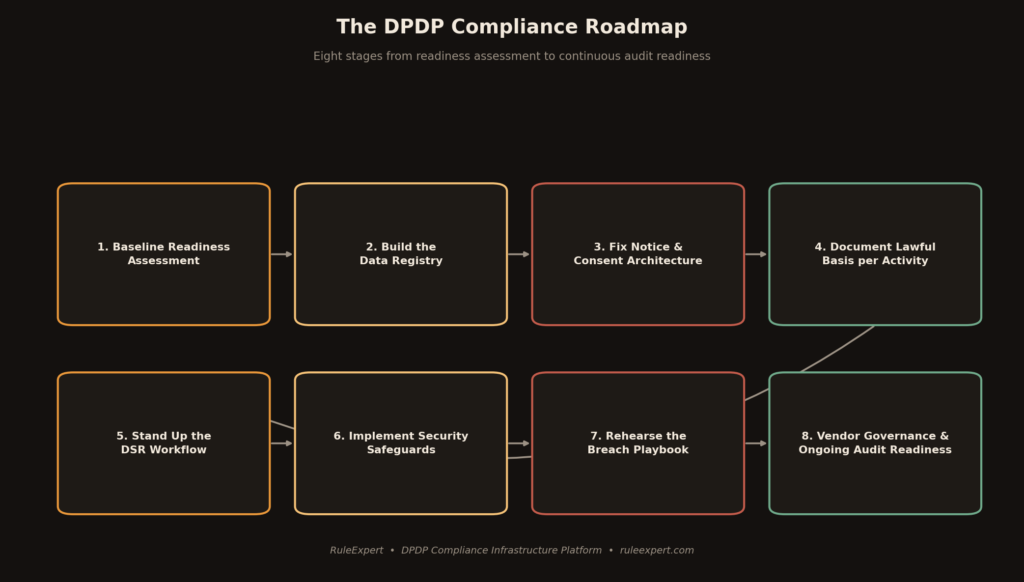
Your DPDP Compliance Roadmap (Step by Step)
A realistic DPDP compliance programme moves through eight stages. Skipping ahead – for instance, drafting a new privacy notice before the underlying data inventory exists – is the single most common reason programmes stall.
- Baseline Readiness Assessment. Score your current posture against the Act and Rules, identify gaps by function (HR, product, marketing, vendor management), and get a prioritised, board-presentable roadmap.
- Build the Data Registry. Map every system that collects, stores or processes personal data; classify data by sensitivity; assign a business owner to each processing activity.
- Fix Notice and Consent Architecture. Rewrite standalone notices per Rule 3, rebuild consent capture flows to be specific and unbundled, and stand up a system to log and retrieve consent records on demand.
- Document Your Lawful Basis for Every Processing Activity. For each entry in the data registry, record whether it relies on consent or a specific legitimate use, and keep the supporting justification on file.
- Stand Up the DSR Workflow. Build an intake channel, assign response ownership, set internal SLAs ahead of any regulatory deadline, and keep an audit trail of every access, correction and erasure request handled.
- Implement and Document Security Safeguards. Match technical and organisational controls to data sensitivity, and keep the documentation ready to demonstrate “reasonableness” if ever questioned.
- Rehearse the Breach Playbook. Predefine roles, escalation paths, and notification templates so the 72-hour clock is a formality, not a scramble.
- Operationalise Vendor Governance and Ongoing Audit Readiness. Review every Data Processor Agreement, schedule recurring vendor risk assessments, and maintain continuously updated documentation rather than reassembling it once a year.
Organisations that work through these eight stages with dedicated tooling typically reach genuine audit readiness inside the 9–12 month window referenced earlier in this guide; those relying purely on manual tracking routinely take longer, and often discover the gaps only when a Data Principal, auditor, or the Data Protection Board finds them first.
How RuleExpert Operationalises DPDP Compliance
RuleExpert is an AI-powered DPDP Compliance Platform built specifically to operationalise the Digital Personal Data Protection Act, 2023 – not just document it. Where many tools in this space stop at assessments or static documentation, RuleExpert is built as workflow-driven compliance infrastructure, spanning the full lifecycle:
DPDP Readiness Assessment (DPDP Scorecard) – Evaluates your organisation’s current compliance maturity, identifies specific gaps against the Act and Rules, generates a readiness score, and produces a prioritised, actionable roadmap with executive dashboards your leadership team can actually read.
Consent Manager – Manages the full consent lifecycle: collection, purpose-linked records, withdrawal, historical audit trail, and ongoing consent tracking – the exact evidentiary trail the Data Protection Board expects to see in an inquiry.
Data Subject (Principal) Request Automation – Structured intake for access, correction, erasure and grievance requests, with workflow automation, responsibility assignment, approval steps, SLA monitoring and audit-ready documentation for every request handled.
Data Registry – A centralised, living inventory of personal data across your organisation: data mapping, processing-activity records, classification, business-system mapping, data-owner identification and purpose documentation – the single source of truth every other DPDP obligation depends on.
Breach Management – Manages the complete lifecycle of a personal data breach: incident reporting, investigation workflows, risk assessment, evidence management, corrective-action tracking and audit-ready breach documentation, built to help you meet the 72-hour notification requirement with evidence, not scramble.
Vendor Governance – Strengthens oversight of every third party that touches your personal data: vendor inventory, risk assessments, due-diligence tracking, compliance reviews, documentation and automated review reminders.
Workflow Automation, AI-Powered Compliance Assistance, Audit-Ready Documentation, Dashboards & Reporting, Role-Based Access Control – The connective tissue that turns each of the above into a coordinated system: task assignment, escalation management, intelligent documentation support, centralised activity logs and version history, executive-level compliance reporting, and secure, department-wise collaboration across Legal, HR, IT, Finance and Compliance.
Enterprise-ready by design – Scalable architecture, configurable workflows, and integration-ready, cloud-based deployment mean RuleExpert fits organisations from early-stage startups to large multi-department enterprises without a rebuild at each growth stage.
If your organisation is still assembling DPDP compliance from spreadsheets, email trails and a policy document nobody has revisited since it was published, the fastest way to see the gap – and close it – is to see how a structured, automated system actually behaves.
[Book a demo with RuleExpert →]
Best Practices for Long-Term DPDP Compliance
- Start with a real data inventory, not a policy rewrite. You cannot govern what you cannot see; mapping every system that touches personal data is the prerequisite for everything else.
- Assign clear ownership. DPDP compliance fails fastest when it is “everyone’s responsibility,” which functionally means no one’s. Name a compliance owner and give them cross-functional authority.
- Build the breach playbook before you need it. Rehearse the 72-hour notification workflow the way you would rehearse any other business-continuity plan.
- Review vendor contracts on a schedule, not once. Data Processor Agreements should be reviewed on a recurring cadence, not filed away after signature.
- Reassess your SDF status periodically. Growth in user base, data sensitivity, or processing scale can move you into Significant Data Fiduciary territory faster than a one-time legal review anticipates.
- Treat consent as a living record, not a checkbox. Consent tied to a specific purpose should be re-verified whenever that purpose changes.
- Report compliance status to the board in business language. Executive dashboards that translate compliance posture into risk and readiness terms get sustained leadership support; buried legal memos do not.
- Choose infrastructure over documentation. A framework, a checklist, and a one-time assessment tell you where you stand today. Automated compliance management tells you where you stand every day – which is what the Act, in practice, actually requires.
Glossary of Key DPDP Terms
| Term | Meaning |
|---|---|
| Data Principal | The individual to whom the personal data relates. |
| Data Fiduciary | The organisation that determines the purpose and means of processing personal data. |
| Data Processor | An entity processing personal data on behalf of a Data Fiduciary, under contract. |
| Significant Data Fiduciary (SDF) | A Data Fiduciary designated by the government for heightened obligations, based on data volume, sensitivity and risk. |
| Consent Manager | A registered, India-incorporated intermediary giving Data Principals a unified interface to manage consent across fiduciaries. |
| Data Protection Board (DPB) | The adjudicatory body enforcing the DPDP Act and Rules. |
| DPIA | Data Protection Impact Assessment – a periodic risk assessment mandatory for SDFs. |
| DPO | Data Protection Officer – an India-based compliance officer mandatory for SDFs. |
| Legitimate Use | A defined ground for processing personal data without fresh consent. |
| Data Principal Rights / DSR | The set of statutory rights – access, correction, erasure, grievance redressal, nomination – an individual can exercise, and the requests (“Data Subject/Principal Requests”) used to exercise them. |
Frequently Asked Questions
1. What does DPDP stand for and when did it come into force? DPDP stands for the Digital Personal Data Protection Act, 2023. It received Presidential assent in August 2023, and was fully operationalised when the DPDP Rules, 2025 were notified in November 2025, with obligations being phased in over the following 18 months.
2. What is the difference between the DPDP Act and the DPDP Rules? The Act sets out the principles, rights, obligations and penalty framework at a statutory level. The Rules, notified in November 2025, provide the operational detail – formats for notices, timelines for breach notification, registration conditions for Consent Managers, and the specific obligations for Significant Data Fiduciaries.
3. Does DPDP apply to small businesses and startups? Yes. There is no minimum size or turnover threshold for baseline applicability – any organisation processing digital personal data connected to India, regardless of size, has obligations under the Act. Additional obligations apply once an organisation is designated a Significant Data Fiduciary.
4. What is the maximum penalty under the DPDP Act? The highest single-instance penalty is up to ₹250 crore, for failure to implement reasonable security safeguards that results in a personal data breach. Penalties are cumulative across violations, meaning a single incident can attract multiple penalties simultaneously.
5. Who enforces the DPDP Act in India? The Data Protection Board of India (DPB), constituted alongside the notification of the DPDP Rules, 2025. It investigates complaints and breaches, conducts inquiries, and imposes penalties, with appeals lying to the Telecom Disputes Settlement and Appellate Tribunal.
6. What is a Significant Data Fiduciary? A category of Data Fiduciary designated by the Central Government based on factors including data volume, sensitivity, and risk to Data Principals or public order. SDFs must appoint an India-based DPO, appoint an independent data auditor, and conduct an annual DPIA and audit.
7. Do employers need employee consent to process HR data? Employee data processing for legitimate employment purposes – recruitment, appraisal, disciplinary processes – is recognised as a “legitimate use” that does not always require fresh consent. However, this does not remove the obligation to secure the data, limit its use to that purpose, and honour employee access and correction requests.
8. How is children’s data treated differently under DPDP? Anyone under 18 is classified as a child, and verifiable parental or guardian consent is required before processing their personal data. Tracking, behavioural monitoring, and targeted advertising directed at children are prohibited outright, subject to narrow, government-notified exemptions.
9. What is a DPDP compliance checklist supposed to cover? At minimum: a personal data inventory, documented lawful basis for each processing activity, compliant notice and consent architecture, a data-subject-request workflow, security safeguards proportionate to data sensitivity, a breach-notification playbook, and reviewed Data Processor agreements. See our downloadable DPDP compliance checklist for the full breakdown.
10. How can automated compliance management help meet DPDP guidelines? Automated compliance management replaces static, point-in-time documentation with a continuously maintained system – a live data registry, centralised consent records, workflow-driven DSR handling, and audit-ready documentation – matching the ongoing, evidentiary nature of the obligations under the Act far more closely than manual, spreadsheet-based processes.
Conclusion
DPDP in India has moved past the “upcoming regulation” stage. The Act is enacted, the Rules are notified, the Data Protection Board is operational, and the penalty framework is among the most consequential in Indian regulatory history – fixed, absolute, and cumulative. For CEOs, CFOs, CHROs and compliance leaders, the practical mandate is the same regardless of sector: build a real inventory of the personal data you hold, give Data Principals a genuine way to exercise their rights, secure the data proportionate to its sensitivity, and be able to prove all of it on demand.
Organisations that treat this as a one-time documentation exercise will find themselves rebuilding their compliance posture under pressure, usually right when they can least afford to. Organisations that treat it as infrastructure – automated, cross-functional, and continuously maintained – turn DPDP compliance from a recurring risk into a demonstrable governance strength.
If you’re ready to see what that infrastructure actually looks like inside your organisation, RuleExpert’s team can walk you through it.
[Book a Demo with RuleExpert →]
Nitin Ray is a Compliance Manager at RuleExpert with expertise in DPDP compliance, data privacy, consent management, and governance. He helps organizations implement practical compliance frameworks and automation strategies to meet the requirements of India’s Digital Personal Data Protection Act, 2023.