Plenty of pages will help you shortlist DPDP consent management software. Fewer explain what happens after you pick one, when marketing, product, IT and legal all have to change how they work. That is where most rollouts stall.
This guide covers the inside job. If you are still comparing tools, start with our full buyer’s guide to DPDP consent management software. Most Data Fiduciary duties under the DPDP Rules, 2025 begin on 13 May 2027, so the time to wire this up is now.
Quick answer: DPDP consent management software records the notice shown, the consent given for each purpose and every later change, and lets other systems check that record before using personal data. A rollout succeeds on four things: a data inventory, named owners, enforcement where data is used, and tested withdrawal.
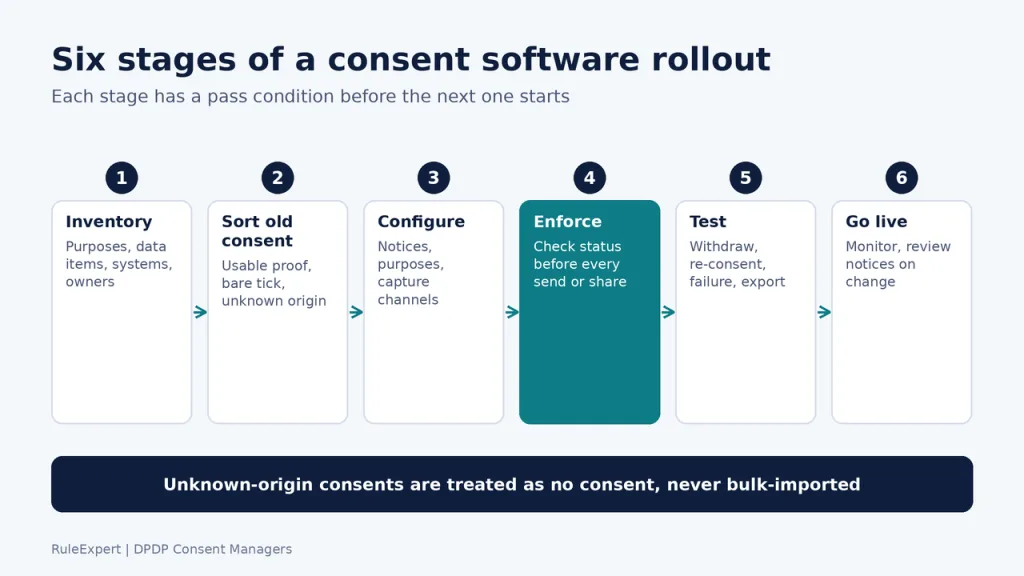
The rollout in six stages, with enforcement as the step most teams underestimate.
What the software has to prove
Section 6(10) of the DPDP Act, 2023 puts the burden on you. If consent is your basis and a dispute arises, the Data Fiduciary must prove that notice was given and consent was obtained as the Act and Rules require.
So judge the software as an evidence system. A banner that stores a bare “yes” will not do. The record should show the notice version, the purpose, the time, the channel, and every change since.
Who owns what
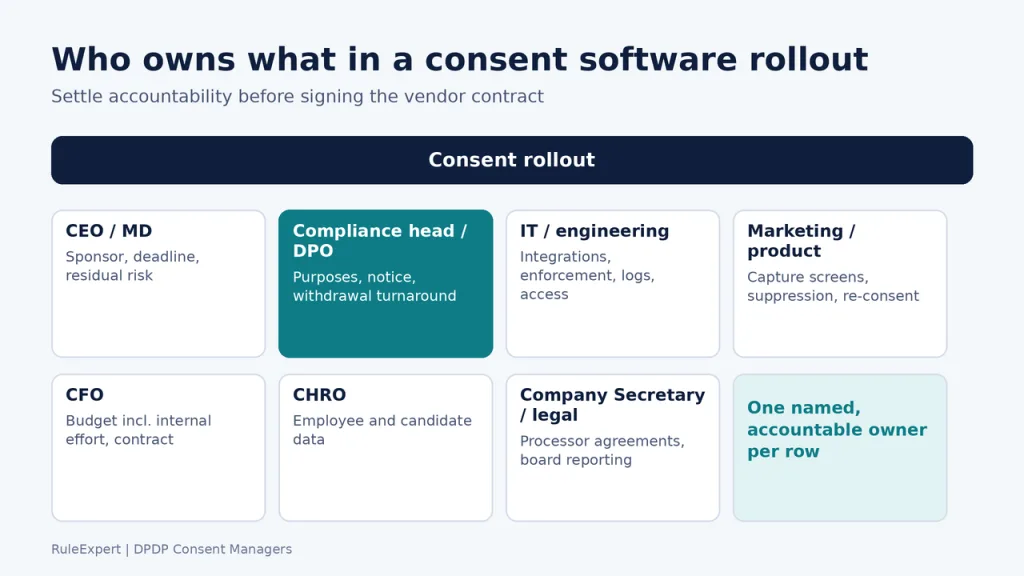
Consent projects fail when everyone is consulted and nobody is accountable. Settle this table before you sign anything.
Role
Owns
CEO or Managing Director
Sponsorship, deadline, acceptance of residual risk
Budget, including internal effort, and vendor contract terms
CHRO
Employee and candidate data: what really needs consent
Company Secretary or legal
Processor agreements, board reporting
Name one accountable owner for each part of the rollout before you sign.
Start with data, not the tool
A purpose you cannot trace to a system cannot be enforced. Before configuring anything, list each purpose, the data items, the systems that hold them and the person responsible. A spreadsheet is enough at this stage. Our Data Registry does the same job once the list outgrows one.
Expect a surprise. Some processing will not need consent at all because it falls under the legitimate uses in Section 7. Others will turn out to be unnecessary, and the cheapest consent to manage is the one you never need.
Not sure where your gaps are? The free DPDP Scorecard gives a starting read.
Handling consent you already hold
You are probably not starting from zero. Section 5(2) asks that people who consented before the Act commenced get a notice as soon as reasonably practicable. Sort your old records into three piles.
Usable proof: timestamp, wording and channel are all on file. Keep and migrate.
A tick with no trail: re-ask through a fresh notice.
Unknown origin: treat as no consent. Do not bulk-import these as “consented”.
Enforcement where data is used
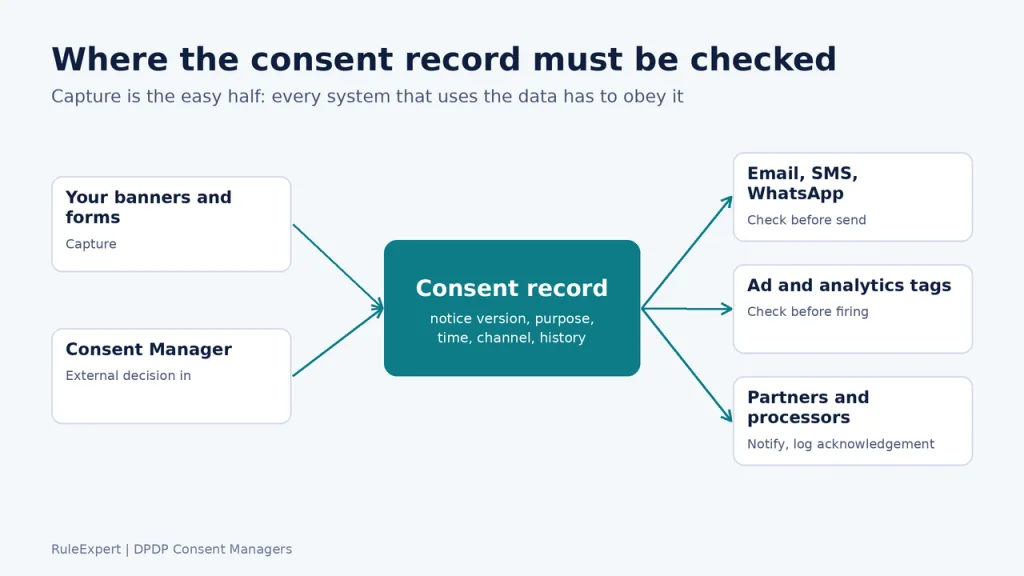
Capturing consent is the easy half. The harder half is making every system obey it. Check the status before email, SMS and WhatsApp sends, before ad and analytics tags fire, and before data goes to a partner.
There are two patterns. The consent tool pushes changes out by API or webhook, or each system asks the tool before it acts. Pick one per system and write it down. Then try it in a test environment: withdraw consent and see whether the next campaign skips that person.
Every system that uses personal data should check the consent record first.
Consent Manager signals
Section 6(7) lets a Data Principal give, manage, review or withdraw consent through a Consent Manager. Rule 4 registration opened on 13 November 2026, and the Board’s 17-document application route is live.
As a business you do not register. You should, though, be able to act on a decision that arrives from outside your own banner. Ask each vendor whether your system can accept a consent change from an external source and apply it. We have not seen the Board’s technical standards for this yet, so confirm before you promise anything. Our note on Consent Manager versus consent management platform explains the difference, and what changes on 13 November 2026 sets out the timeline.
Go-live tests
Test
Pass condition
Give consent on web
Record shows notice version, purpose, time, channel
Withdraw in the same channel
Status changes and the person gets confirmation
Next campaign runs
Withdrawn person is excluded in every sending tool
Notice text changes
Re-consent triggers for affected people only
Processor notified
Acknowledgement is logged
Integration fails
An alert fires and the change is retried
Single-person export
Full history produced in minutes
Real cost and exit
The licence is the visible part. Count staff time for the inventory, integration work in every connected system, and the periodic notice reviews that follow.
Plan your exit on day one. Those records are your proof under Section 6(10), and they must outlive any vendor contract. Ask for a full export in a readable format before you commit.
Where RuleExpert fits
RuleExpert’s Consent Manager module is built for Data Fiduciaries to run their own consent. We are not a registered Consent Manager under Rule 4, and we do not claim to be. Per the product page, it keeps a log that blocks edits and deletions, captures consent through web, QR, API, WhatsApp, SMS and email links, checks notices against Rule 3 before publishing, and gives people a withdrawal portal that needs no login. It connects with DSR Automation. Software supports compliance. It does not replace your own decisions or legal advice.
It records notices, consent per purpose and withdrawals, and lets your other systems check that record. The aim is provable consent under Section 6(10), not just a banner.
Is it legally mandatory?
The Act does not name a tool. It does require you to prove valid notice and consent where consent is your basis. At scale, software is the practical way.
Is it the same as a Consent Manager?
No. A Consent Manager is a Board-registered intermediary acting for Data Principals. Consent management software is what a business runs for itself.
How long does implementation take?
There is no fixed period. It depends on how many systems hold personal data and how clean your inventory is. Start with your highest-volume channels.
Who should own the project?
The compliance head or DPO should own purposes and wording. IT owns enforcement. A senior sponsor should hold the deadline.
Can our CRM do this alone?
Possibly, for simple cases. Check that it stores notice versions, purpose-level status and a tamper-resistant history, and that other systems can query it.
What happens to existing consents?
Give a notice as soon as reasonably practicable under Section 5(2). Keep records with usable proof and re-ask the rest.
Does withdrawal delete data?
Not automatically. Processing must stop within a reasonable time, and erasure follows unless another law requires retention. See our withdrawal guide.
When must this be ready?
Most Data Fiduciary duties begin on 13 May 2027 under the DPDP Rules, 2025. Build and test well before then.
What should we ask vendors about records?
Where they are stored, who can alter them, how you export them, and what happens to them when the contract ends.
I am a Compliance Manager at RuleExpert, focused on helping organizations navigate the evolving landscape of data protection and privacy regulations in India.
With the introduction of the Digital Personal Data Protection (DPDP) Act, businesses are facing new challenges in managing personal data, ensuring consent, and maintaining compliance across systems. My work revolves around simplifying these complexities and enabling organizations to adopt structured, scalable compliance practices.
I specialize in:
DPDP compliance and privacy frameworks
Data governance and risk management
Consent lifecycle and user rights handling
Compliance automation and operational workflows
At RuleExpert, I work closely with startups, SaaS companies, and enterprises to transform compliance from a manual, documentation-heavy process into an automated, infrastructure-driven system.
I am particularly interested in how AI and automation can reshape privacy operations and help businesses build trust in a data-driven world.
In their words
What compliance teams tell us
“We always thought DPDP compliance was the client’s responsibility
since we were only executing services. The evaluation made it clear that how we handle
client data creates risk on our side too. It changed how we work internally.”
DSFounderDigital services firm
“We had a basic understanding of DPDP requirements, but the scorecard
highlighted gaps we hadn’t identified internally — especially around consent handling
and data visibility. It gave us a much clearer starting point.”
BSFounderB2B SaaS company
“The DPDP score was surprisingly insightful. Within minutes we could see
where we stood and what needed immediate attention. It simplified something that initially
felt quite complex.”
FPProduct HeadFintech platform
“After reviewing our score we opted for a consultation. The discussion was
very practical — we got clear direction on what to fix first and how to approach DPDP
compliance in a structured way.”
LGFounderLogistics company
Real client quotes, attributed by role and sector — we never name a client.
Enquiry
Talk to the team
Your enquiry is with the team
Thank you — we have it. Someone will reply by email, usually within one working day.
Nothing else is needed from you. If it is urgent, email
tushar@ruleexpert.com and it will reach the same
people.
Allowing it lets Google Analytics and Google’s advertising measurement set an
identifier and receive your IP address, the pages you view and how you reached them
— used only to see which pages work and whether a campaign led to an enquiry, never to
build a profile or to decide anything about you. Google processes this outside India, a
cross-border transfer under Section 16. Declining changes nothing about the site, and you
can change your mind any time from the footer.
An analytics identifier is personal data, so the DPDP Act applies to
it — though no Indian cookie statute requires this banner. We ask because we would
rather you chose. What we collect and why
 RuleExpert