A customer taps “withdraw consent”. The law cares about what happens in the next few hours, not what the banner looked like. Does marketing stop? Does your SMS vendor know? Can you show that you acted?
This guide turns Section 6 of the DPDP Act into a working process. Most Data Fiduciary duties start on 13 May 2027, so build and test it before then.
Quick answer: Under Section 6(4) of the DPDP Act, a Data Principal can withdraw consent at any time, and withdrawing must be about as easy as giving it. Once she does, the Data Fiduciary must within a reasonable time stop processing and make its Data Processors stop, unless a law requires or authorises the processing.
What the Act requires
Provision
In plain terms
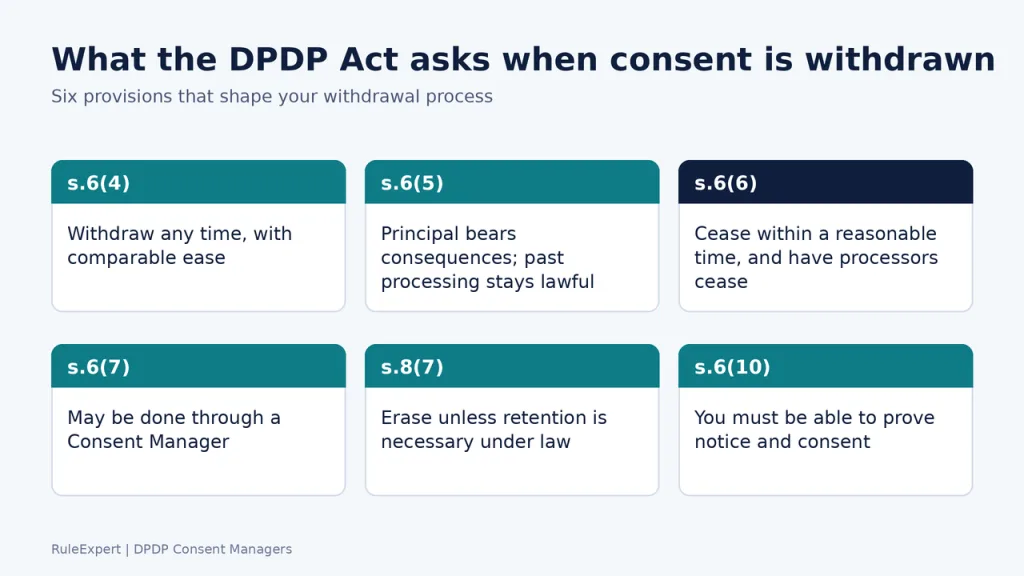
Section 6(4)
Withdraw at any time. Ease must be comparable to how consent was given.
Section 6(5)
The Data Principal bears the consequences. Earlier lawful processing stays lawful.
Section 6(6)
Cease processing, and have processors cease, within a reasonable time. Exceptions apply where law requires or authorises it.
Section 6(7)
Withdrawal may be made through a Consent Manager.
Section 8(7)
Erase personal data on withdrawal, unless retention is necessary under law.
Section 6(10)
You must be able to prove notice and consent in a dispute.
The Act gives no number of hours for “a reasonable time”. Set your own turnaround, write it down, and be ready to defend it. Same-day suppression for messaging is a sensible internal target.
The Act provisions that shape a withdrawal process.
What your notice and site must show
Rule 3 of the DPDP Rules, 2025 requires the notice to tell people how to withdraw, with the ease of doing so comparable to giving consent. Rule 14 asks Data Fiduciaries to publish prominently how rights requests are made, and to publish a grievance route that responds within a reasonable period not exceeding ninety days. That is a ceiling, not a target.
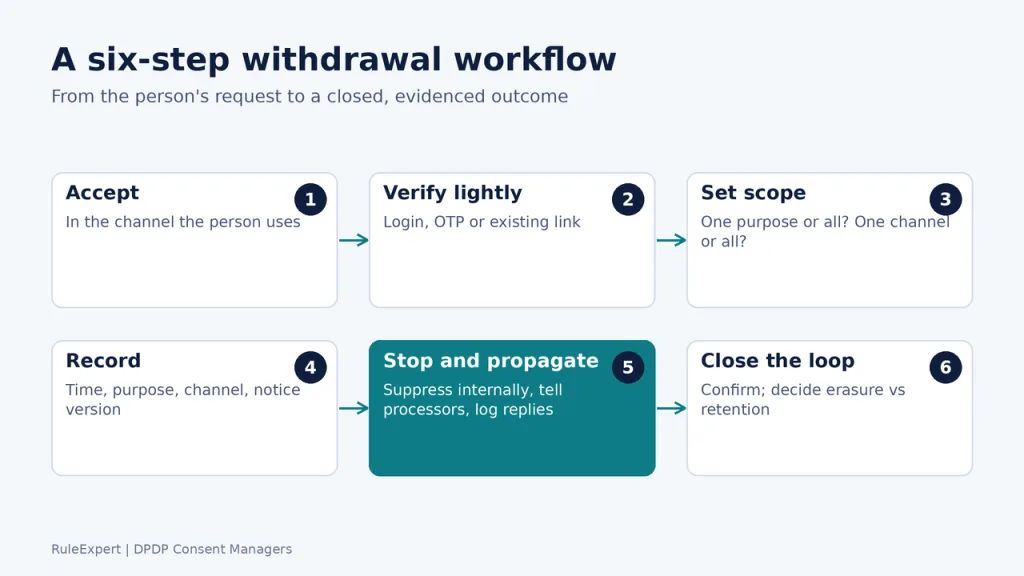
A withdrawal handled in six steps, from request to evidenced outcome.
Withdrawal, erasure and retention
These are three decisions, not one. Withdrawal stops processing that depends on consent. Section 8(7) then points to erasure, unless retention is necessary under some law. Rule 8(3) separately requires certain personal data and logs to be kept for at least a year for specified purposes, so check what applies to you.
Never delete the evidence of the consent itself. Under Section 6(10) it is how you show you acted properly. Put your retention rules in one place, as in our data retention policy guide.
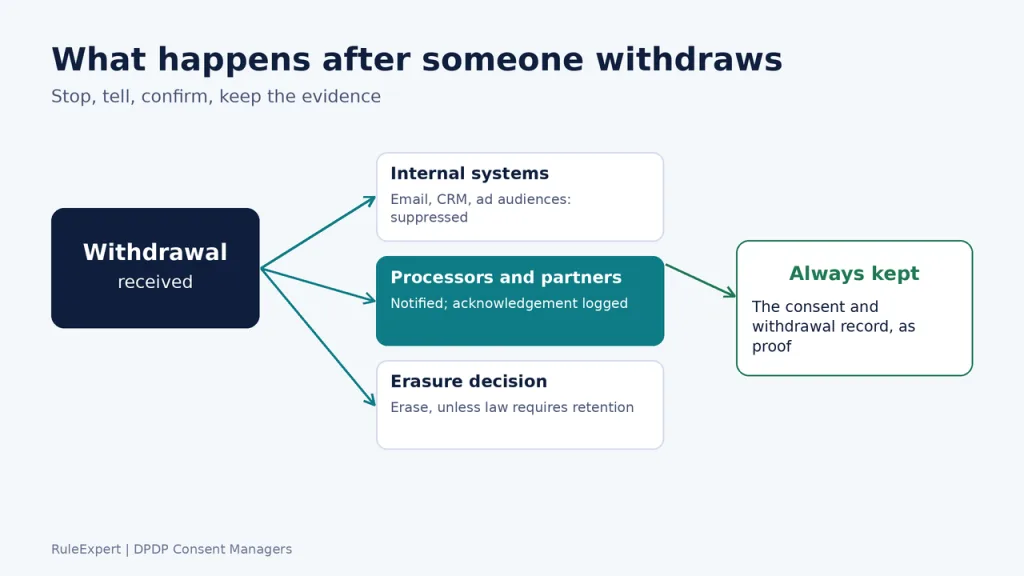
After a withdrawal: stop, tell, confirm, and keep the evidence.
When withdrawal comes via a Consent Manager
Section 6(7) and 6(8) mean a decision may reach you from a Consent Manager, which acts for the Data Principal and answers to her. Treat that withdrawal as you would one made on your own site. Rule 4 registration opened on 13 November 2026, and we are still waiting on the Board’s technical standards, so build a flexible intake. Background: DPDP Consent Managers: what changes on 13 November 2026 and our Consent Manager explainer.
An illustrative case
This is a worked example, not a real client. Meera uses a fitness app and withdraws her consent to marketing messages at 10:40. Her workout tracking is a separate purpose with its own consent, so it carries on.
The app suppresses her in the email tool, tells the SMS and WhatsApp vendors, removes her from the next ad audience export and logs each step. A confirmation reaches her within minutes. Because consent was captured per purpose, partial withdrawal was clean. Had she withdrawn consent to the tracking too, the service might stop working for her, and under Section 6(5) that consequence is hers to bear.
Mistakes we see
Unsubscribe link only. It covers email and nothing else.
Helpline-only withdrawal for consent that was given with one click.
Retention nudges that make people confirm three times.
Forgetting processors. Section 6(6) names them directly.
The RuleExpert Consent Manager module includes a withdrawal portal that needs no login, a working queue with service-level timers and grievance escalation. It can alert you to vendors who must be told. It is a tool for Data Fiduciaries, not a registered Consent Manager. Pair it with DSR Automation and Vendor Governance, and test the flow against our consent management checklist.
I am a Compliance Manager at RuleExpert, focused on helping organizations navigate the evolving landscape of data protection and privacy regulations in India.
With the introduction of the Digital Personal Data Protection (DPDP) Act, businesses are facing new challenges in managing personal data, ensuring consent, and maintaining compliance across systems. My work revolves around simplifying these complexities and enabling organizations to adopt structured, scalable compliance practices.
I specialize in:
DPDP compliance and privacy frameworks
Data governance and risk management
Consent lifecycle and user rights handling
Compliance automation and operational workflows
At RuleExpert, I work closely with startups, SaaS companies, and enterprises to transform compliance from a manual, documentation-heavy process into an automated, infrastructure-driven system.
I am particularly interested in how AI and automation can reshape privacy operations and help businesses build trust in a data-driven world.
In their words
What compliance teams tell us
“We always thought DPDP compliance was the client’s responsibility
since we were only executing services. The evaluation made it clear that how we handle
client data creates risk on our side too. It changed how we work internally.”
DSFounderDigital services firm
“We had a basic understanding of DPDP requirements, but the scorecard
highlighted gaps we hadn’t identified internally — especially around consent handling
and data visibility. It gave us a much clearer starting point.”
BSFounderB2B SaaS company
“The DPDP score was surprisingly insightful. Within minutes we could see
where we stood and what needed immediate attention. It simplified something that initially
felt quite complex.”
FPProduct HeadFintech platform
“After reviewing our score we opted for a consultation. The discussion was
very practical — we got clear direction on what to fix first and how to approach DPDP
compliance in a structured way.”
LGFounderLogistics company
Real client quotes, attributed by role and sector — we never name a client.
Enquiry
Talk to the team
Your enquiry is with the team
Thank you — we have it. Someone will reply by email, usually within one working day.
Nothing else is needed from you. If it is urgent, email
tushar@ruleexpert.com and it will reach the same
people.
Allowing it lets Google Analytics and Google’s advertising measurement set an
identifier and receive your IP address, the pages you view and how you reached them
— used only to see which pages work and whether a campaign led to an enquiry, never to
build a profile or to decide anything about you. Google processes this outside India, a
cross-border transfer under Section 16. Declining changes nothing about the site, and you
can change your mind any time from the footer.
An analytics identifier is personal data, so the DPDP Act applies to
it — though no Indian cookie statute requires this banner. We ask because we would
rather you chose. What we collect and why
 RuleExpert