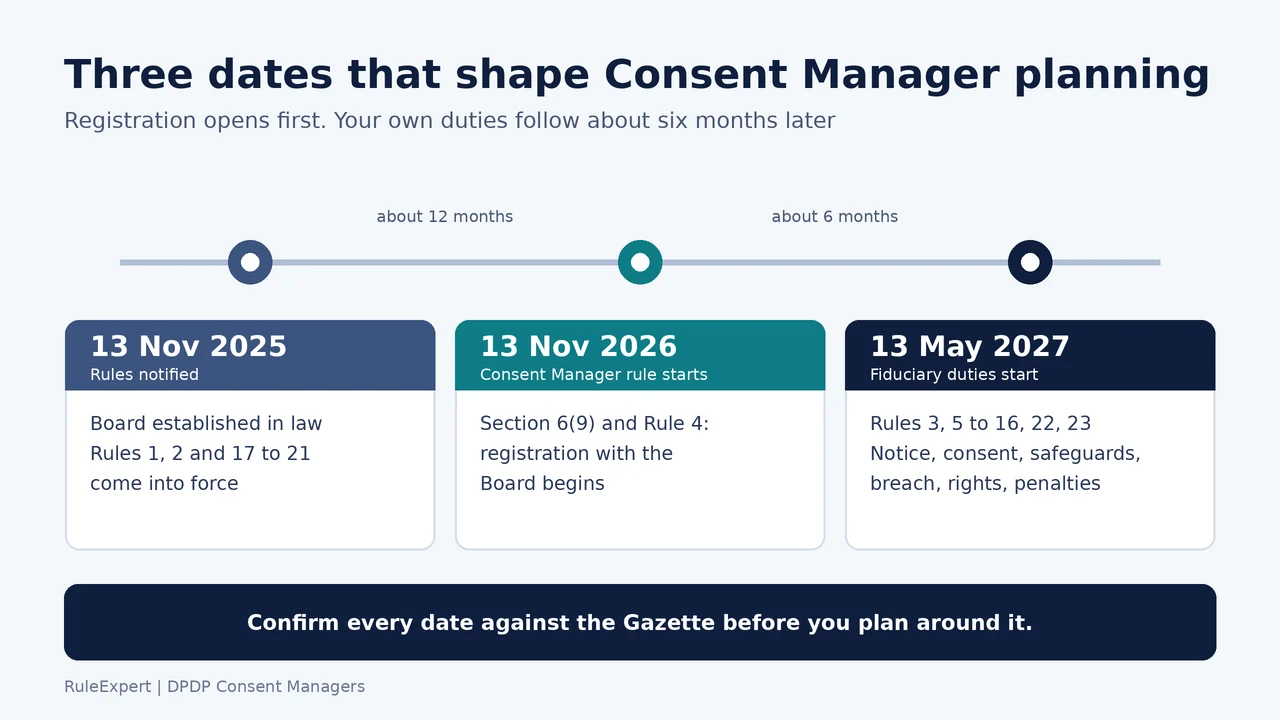
Most of the DPDP calendar belongs to 13 May 2027. One date does not. On 13 November 2026, Section 6(9) of the Act and Rule 4 of the DPDP Rules, 2025 begin, and companies can apply to the Data Protection Board to be registered as Consent Managers.
For most businesses that date does not make you a Consent Manager. It does change who might send your systems a consent instruction. Here is what starts, what waits, and what to do meanwhile.
Quick answer: A DPDP Consent Manager is a company registered with the Data Protection Board that lets a Data Principal give, review and withdraw consent across Data Fiduciaries from one place. Registration under Rule 4 starts on 13 November 2026. Using one is the individual’s choice. Businesses do not register, but should be ready to honour what one sends them.
What a DPDP Consent Manager is, and is not
Section 2(g) of the DPDP Act describes a Consent Manager as a person registered with the Board who acts as a single point of contact, through an accessible, transparent and interoperable platform, so a Data Principal can give, manage, review and withdraw consent. Sections 6(7) to 6(9) add three things. The individual decides whether to use one. The Consent Manager answers to the individual. And it must be registered.
It is not a cookie banner, or the consent module in your compliance software. Our explainer on the Consent Manager under the DPDP Act covers the legal text and registration conditions in depth. This article sticks to timing and operations.
What starts on 13 November 2026, and what waits
Date
What takes effect
Who feels it
13 Nov 2025
Rules notified. Board established in law. Rules 1, 2 and 17 to 21 in force
Government, the Board
13 Nov 2026
Section 6(9) and Rule 4: registration of Consent Managers
Companies applying to be one; the Board
13 May 2027
Rules 3, 5 to 16, 22 and 23: notice, consent, safeguards, breach, rights; penalty provisions
Every Data Fiduciary
Registration opens about six months before most fiduciary duties begin.
That gap is the useful part: a Consent Manager can be registered before your own consent duties are enforceable. Rule 4 leaves application particulars to the Board’s website, and technical standards are the Board’s to set. Watch for both. Reports suggest the Board’s Chairperson and Members were still to be named in autumn 2026, so treat approval timelines as unconfirmed. Our guide to the Data Protection Board tracks how it works. Some sources say 14 November and 14 May; confirm against the Gazette.
Register, integrate or watch?
You are
What it means
A company that wants to run a Consent Manager
Apply under Rule 4. You need to be incorporated in India, show net worth of at least ₹2 crore, and have your platform independently certified.
A Data Fiduciary (bank, retailer, SaaS, hospital)
No registration. Keep your own notice and consent records, and be able to act on a consent decision that arrives through one.
A Data Processor
Follow the fiduciary’s instructions. Your contract should say how withdrawals reach you.
A vendor calling its tool a “consent manager”
Ask whether it is on the Board’s list. A consent management platform is not the same thing.
What a registered Consent Manager can and cannot do
The First Schedule to the Rules sets the terms. The practical points:
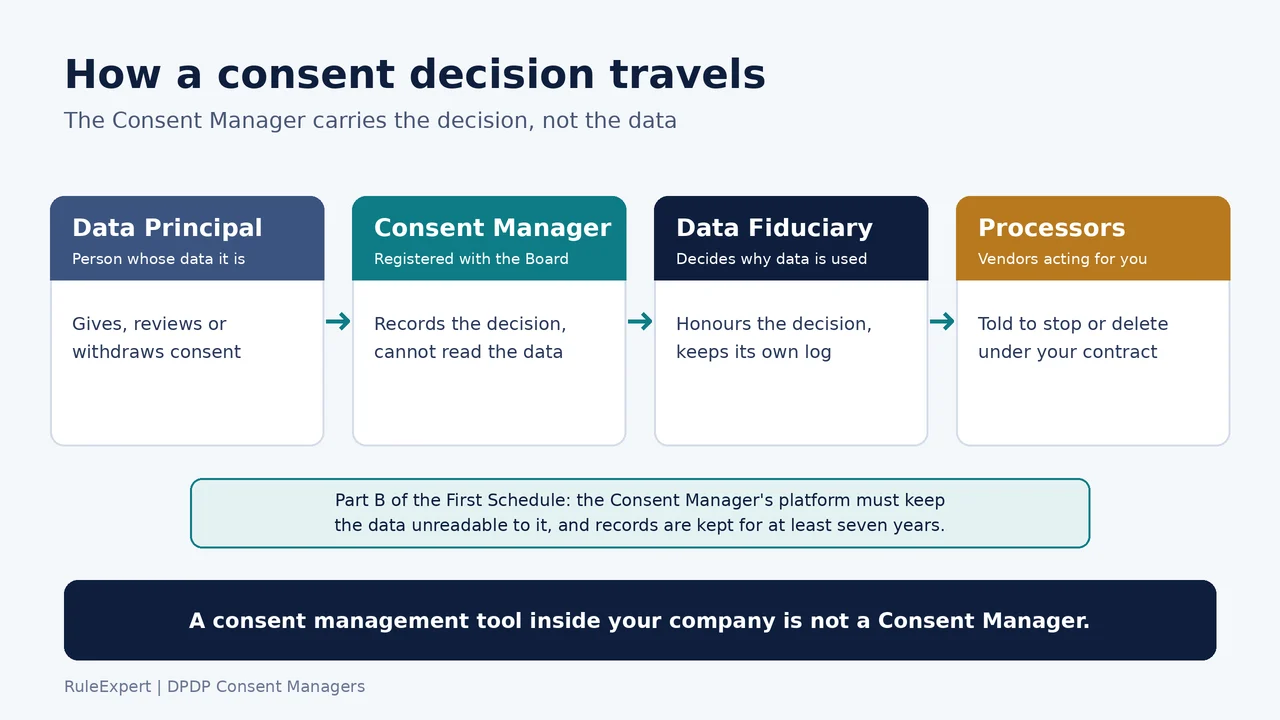
It cannot read the personal data passing through its platform. The architecture has to keep the contents unreadable to it.
It keeps records of consents given, denied and withdrawn, the notices behind them, and onward sharing, for at least seven years.
It cannot subcontract its obligations, and it acts in a fiduciary capacity toward the individual.
Its control cannot be sold or merged away without the Board’s approval.
After a hearing, the Board can direct fixes, or suspend or cancel a registration where that is needed to protect Data Principals.
Use the same list as a due-diligence sheet if a Consent Manager approaches you: ask for proof of registration, the independent certification, and how data blindness works in the architecture. The Consent Manager carries the decision. The data stays with you.
An illustration: a withdrawal arrives
Take a hypothetical lending app with an SMS vendor, an analytics tool and a collections agency. A customer, using a registered Consent Manager, withdraws consent for marketing messages.
The app needs a new log entry: what was withdrawn, when, and through whom. The SMS vendor has to stop. Analytics events tied to that purpose have to stop. Whether the loan itself continues depends on its own lawful basis, a question for counsel.
Teams usually trip on the second hop. The app complies, the vendor keeps sending, and nobody can prove either way. The Board’s technical standards for these instructions are not out yet, so build the internal path first.
A six-month readiness plan
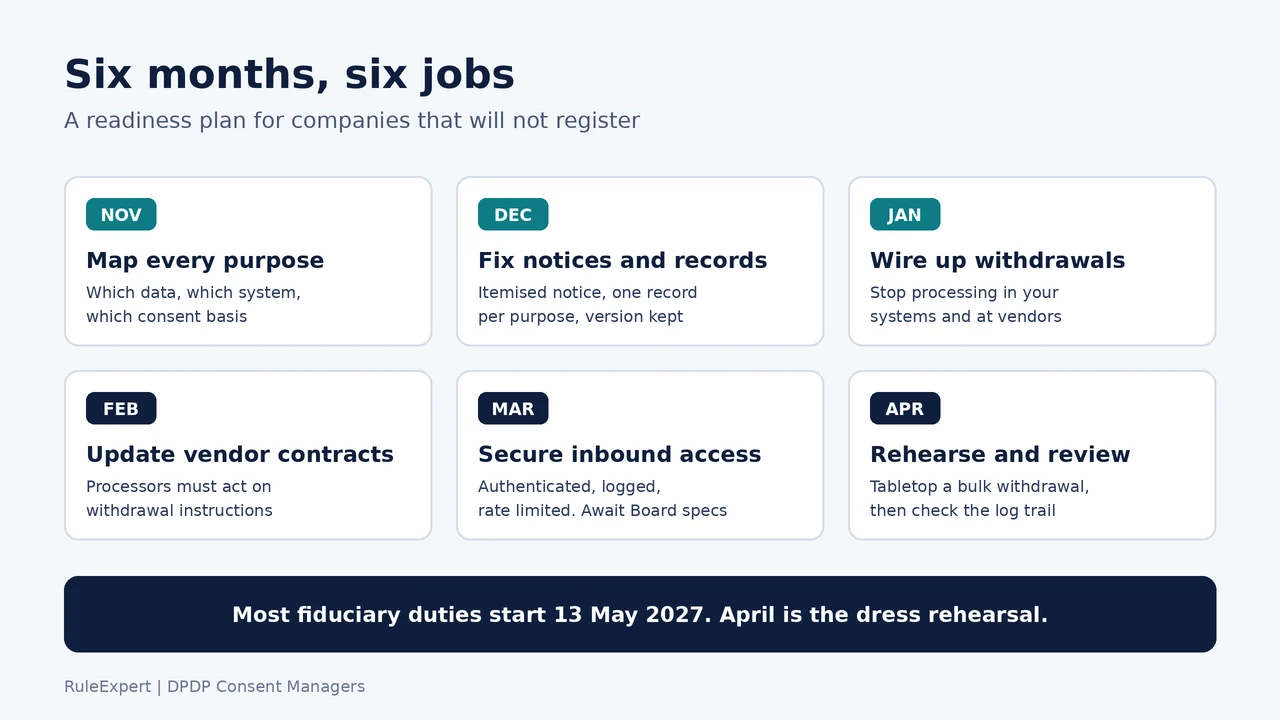
Six jobs between registration opening and the May 2027 duties.
November. List every purpose you rely on consent for, and the system holding each one. A data registry beats a spreadsheet hunt.
December. Make notices itemised, and store one record per purpose with a timestamp, notice version and channel. Our consent lifecycle guide shows the stages.
January. Build the withdrawal path through your own systems, then out to vendors. Set an internal time limit and test it.
February. Update processor contracts so withdrawals bind them. Vendor governance records belong here.
March. Plan authenticated, logged inbound access for instructions. Hold the final design until the Board publishes standards.
April. Run a tabletop on a bulk withdrawal. Check that the log tells the whole story.
Mistakes to avoid
Treating a consent platform as a registered Consent Manager. The common consent mistakes start here.
Believing every business must integrate on day one. Using one is the individual’s option under Section 6(7).
Storing the answer but not the notice it answered.
Where RuleExpert fits
RuleExpert is not a registered Consent Manager and does not claim to be. Its consent module is built for Data Fiduciaries. By its own description it captures consent across channels, keeps an append-only log, runs a no-login withdrawal portal with timers, and produces an evidence pack. Pair it with the registry and vendor records so a withdrawal reaches every place the data sits.
It is a person registered with the Data Protection Board that gives a Data Principal one interface to give, manage, review and withdraw consent across Data Fiduciaries. It answers to the individual, not to the businesses it connects.
Is it mandatory to use a Consent Manager?
No. Under Section 6(7) the Data Principal may choose one. Businesses are not required to register or buy one, but they should be able to honour consent decisions that reach them through one.
What happens on 13 November 2026?
Section 6(9) and Rule 4 begin. Eligible companies can apply to the Board for registration as Consent Managers. Most duties for ordinary Data Fiduciaries start on 13 May 2027.
Who can register as a Consent Manager?
A company incorporated in India that meets Part A of the First Schedule. That includes sound financials, directors with a record of integrity, and independent certification of its platform. The Board may inquire before deciding.
What is the net worth requirement?
Part A requires net worth of not less than ₹2 crore. It is an entry threshold, not the whole financial test.
Can a Consent Manager see the personal data it handles?
No. Part B requires the platform to keep the contents of the data unreadable to the Consent Manager. It handles the consent decision and records, not the data itself.
How long must Consent Managers keep records?
At least seven years, or longer if agreed or required by law. Records cover consents given, denied and withdrawn, the notices, and sharing with other fiduciaries.
Is a consent management platform the same as a Consent Manager?
No. A platform is software a company runs for its own consent duties. A Consent Manager is a Board-registered intermediary serving the individual. The guide to DPDP consent management sets the two side by side.
Is RuleExpert a registered Consent Manager?
No. RuleExpert offers consent management tooling for Data Fiduciaries. Any vendor claiming Board registration should be able to show it.
Do businesses need to act before 13 November 2026?
Nothing new becomes enforceable for them that day. Use the months before 13 May 2027 to map consent purposes, fix records and test withdrawals. The complete guide to DPDP in India lays out the wider timeline.
I am a Compliance Manager at RuleExpert, focused on helping organizations navigate the evolving landscape of data protection and privacy regulations in India.
With the introduction of the Digital Personal Data Protection (DPDP) Act, businesses are facing new challenges in managing personal data, ensuring consent, and maintaining compliance across systems. My work revolves around simplifying these complexities and enabling organizations to adopt structured, scalable compliance practices.
I specialize in:
DPDP compliance and privacy frameworks
Data governance and risk management
Consent lifecycle and user rights handling
Compliance automation and operational workflows
At RuleExpert, I work closely with startups, SaaS companies, and enterprises to transform compliance from a manual, documentation-heavy process into an automated, infrastructure-driven system.
I am particularly interested in how AI and automation can reshape privacy operations and help businesses build trust in a data-driven world.
In their words
What compliance teams tell us
“We always thought DPDP compliance was the client’s responsibility
since we were only executing services. The evaluation made it clear that how we handle
client data creates risk on our side too. It changed how we work internally.”
DSFounderDigital services firm
“We had a basic understanding of DPDP requirements, but the scorecard
highlighted gaps we hadn’t identified internally — especially around consent handling
and data visibility. It gave us a much clearer starting point.”
BSFounderB2B SaaS company
“The DPDP score was surprisingly insightful. Within minutes we could see
where we stood and what needed immediate attention. It simplified something that initially
felt quite complex.”
FPProduct HeadFintech platform
“After reviewing our score we opted for a consultation. The discussion was
very practical — we got clear direction on what to fix first and how to approach DPDP
compliance in a structured way.”
LGFounderLogistics company
Real client quotes, attributed by role and sector — we never name a client.
Enquiry
Talk to the team
Your enquiry is with the team
Thank you — we have it. Someone will reply by email, usually within one working day.
Nothing else is needed from you. If it is urgent, email
tushar@ruleexpert.com and it will reach the same
people.
Allowing it lets Google Analytics and Google’s advertising measurement set an
identifier and receive your IP address, the pages you view and how you reached them
— used only to see which pages work and whether a campaign led to an enquiry, never to
build a profile or to decide anything about you. Google processes this outside India, a
cross-border transfer under Section 16. Declining changes nothing about the site, and you
can change your mind any time from the footer.
An analytics identifier is personal data, so the DPDP Act applies to
it — though no Indian cookie statute requires this banner. We ask because we would
rather you chose. What we collect and why
 RuleExpert