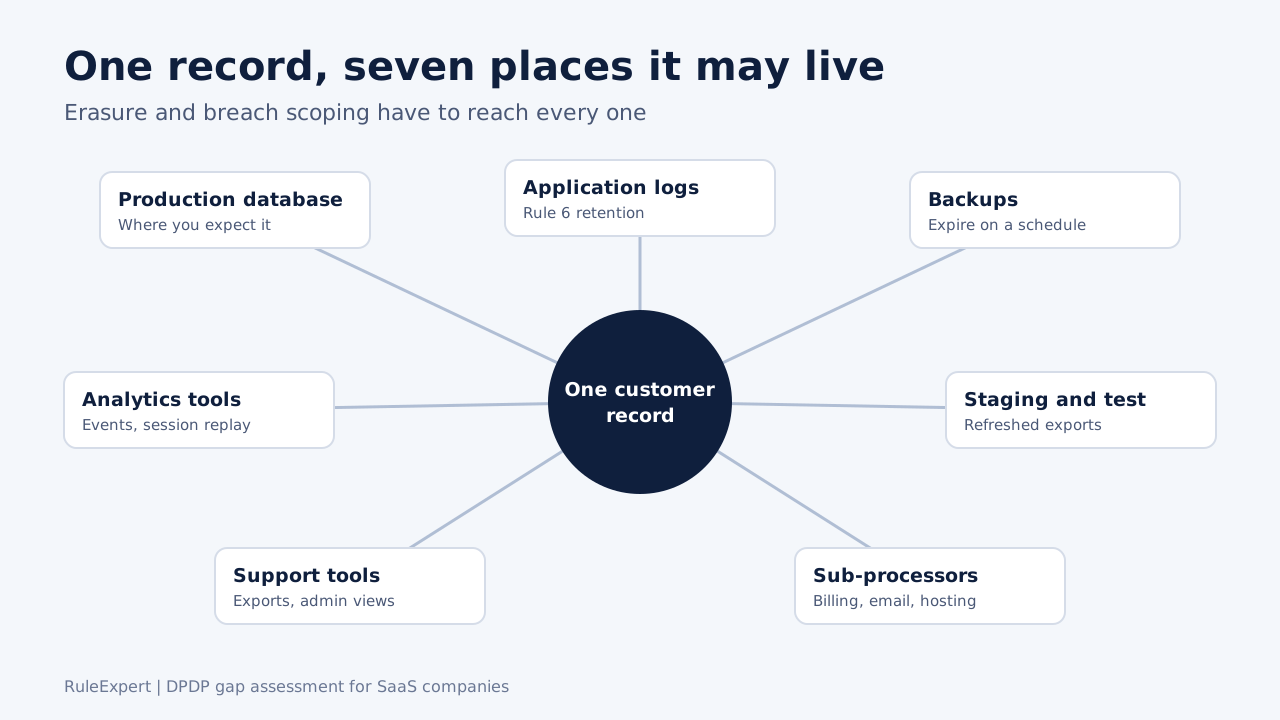
A SaaS gap assessment tends to turn on things a privacy policy never mentions. A staging database loaded with real customer records. A session-replay tool quietly capturing form fields. A log bucket that keeps everything, for ever.
This guide to DPDP gap assessment for SaaS companies shows what an assessor traces, nine gaps worth testing first, and the evidence that closes each. It assumes you know the basics of the dual role, which our SaaS compliance overview covers. For the method itself, see the gap assessment guide and the evidence checklist. For the wider law, start with DPDP in India: the complete guide.
What is a DPDP gap assessment for SaaS companies? It tests a SaaS business against the DPDP Act, 2023 and the DPDP Rules, 2025 along three data paths: its own users’ data, its customers’ data (usually held as a processor), and the data it passes to vendors. The assessor looks for proof that copies, logs, sub-processors and deletion behave the way your contracts and notices say.
1. Three Data Paths an Assessor Traces
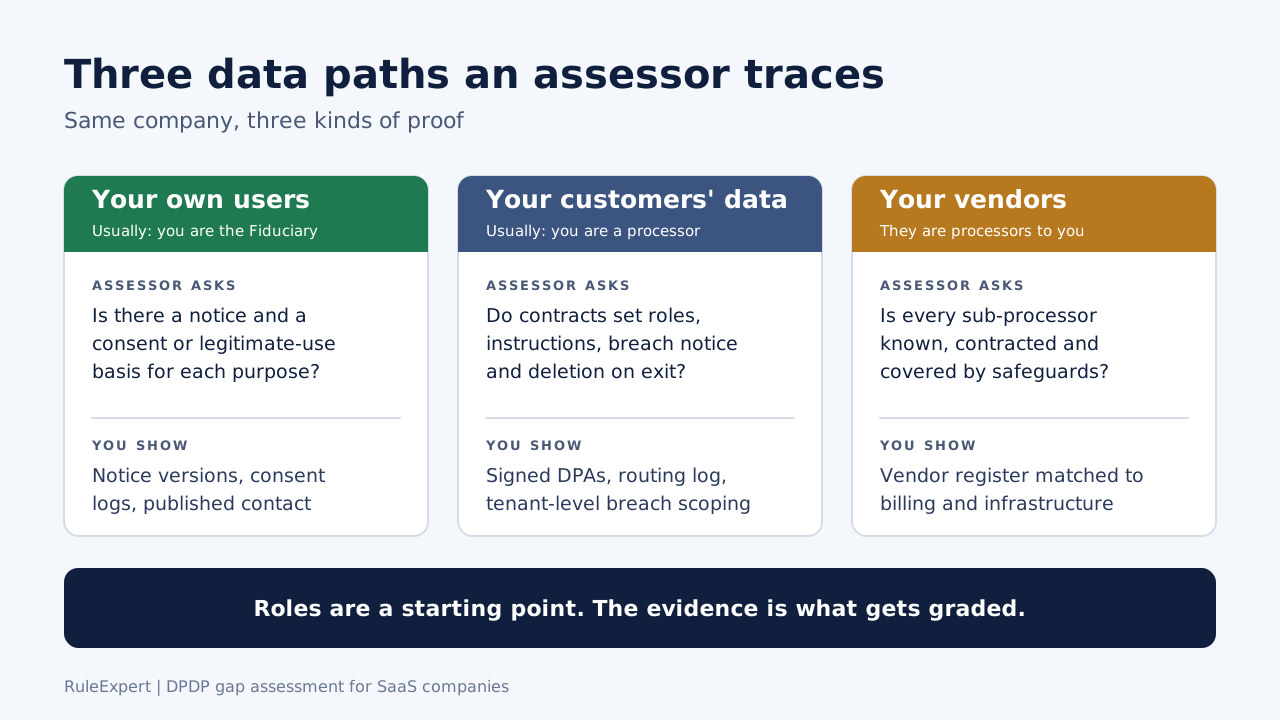
A SaaS business is rarely one thing in law. The Act’s duties sit with the Data Fiduciary, and Section 8(2) lets a Fiduciary engage a processor only under a valid contract. Your own signups, billing contacts and leads usually make you the Fiduciary. Customer data inside the product usually makes you a processor. Your vendors are processors to you.
The assessor does not argue about labels. They ask for different proof on each path.
2. Nine SaaS Gaps Worth Testing First
Section numbers refer to the DPDP Act, 2023 and rule numbers to the DPDP Rules, 2025. This is our working list, not an official one.
Gap
What the assessor tests
Passing evidence
Red flag
Telemetry and session replay
Which fields are captured, and whether the notice covers it
Tool settings showing masked inputs; notice names the purpose
Replays show whole forms
Real data in staging
Where production exports end up
Masked or synthetic data rule, refresh log
Exports sit on laptops
Application logs
Personal data inside logs, who reads them, how long they stay (Rule 6)
Real vendors versus the contracted list (Section 8(2), Rule 6)
Register matched to billing and infrastructure, with contract status
List built from procurement alone
Customer contracts and exit
Roles, instructions, deletion on termination in writing
Template mapped to clauses; signed copies for key accounts
Contract silent on personal data
Breach notice to customers
Can you say fast which tenants and records were hit (Rule 7)
Tenant-level scoping in the runbook, last drill record
Depends on one engineer’s memory
End-user rights requests
Requests about customer data are routed to the customer
Routing procedure and log
Support answers directly
AI features
Whether customer content trains or improves your models
Purpose written into the contract; opt-in or no-training default
Training use not in any contract
Two rows reward a closer read. On sub-processors, our posts on the data processor’s mandate and vendor risk management explain why accountability stays with you. On breach notice, the Fiduciary’s Rule 7 clock (a 72-hour detailed report to the Board) is its own, so your customer needs word from you quickly. More in breach management under the DPDP Act.
For rights requests, the point is routing and proof, which this DSR workflow guide walks through. Note that Rule 14(3) caps a grievance response at “a reasonable period not exceeding ninety days”. It is a ceiling, not a 30-day rule.
3. The Deletion Promise Versus the One-Year Log Rule
Many SaaS contracts promise deletion of customer data within 30 days of termination. Rule 6(e) separately expects logs and personal data to be kept for one year to support breach detection and investigation, unless another law says otherwise. Backups add a third clock.
The Rules do not settle how these fit, so your counsel should set your position. What an assessor wants is a decision on paper, with contract wording that matches what the system does: say, deletion from live systems in the promised window, and logs and backups expiring on a stated schedule. Our note on the one-year rule goes deeper.
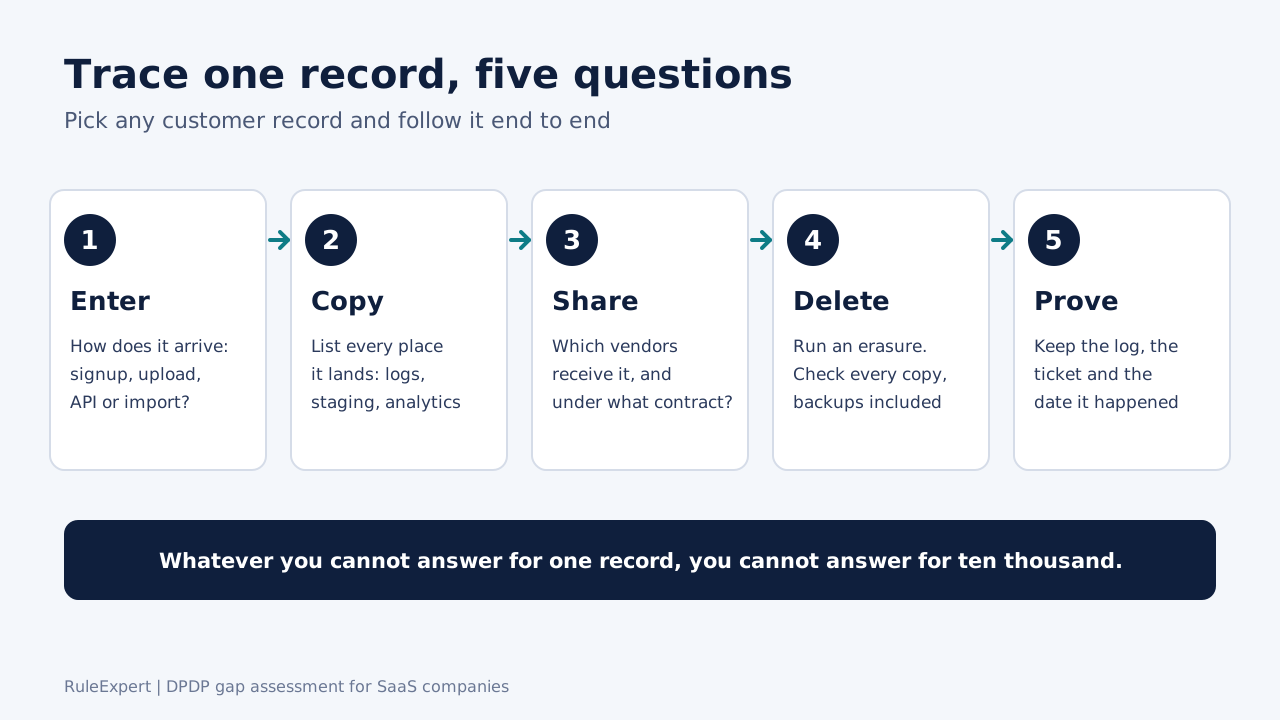
4. Trace One Record Yourself
Before anyone external arrives, pick one customer record and follow it. Where does it enter, where is it copied, who receives it, can you delete it everywhere, and can you prove that you did?
5. A Worked Example
This is hypothetical, not a client case. A 60-person HR-tech SaaS is asked to follow one employee record a customer uploaded. It sits in production, as expected. Then the engineer lists a staging refresh from last quarter, a session-replay tool on the admin dashboard, and a support export in a shared drive.
Four copies. One contract promising deletion in 30 days. One deletion job. The finding is not that copies exist. It is that the promise cannot be shown. The fix starts with a copy register: each location, an owner and an expiry. A spreadsheet works at first, as this post on moving beyond it argues, until the stack changes.
6. How Much Time Is Left
Rules 3 and 5 to 16 commence on 13 May 2027, about 28 weeks from late October 2026. Some commentary says 14 May, so confirm against the Gazette. Rule-by-rule dates are in our DPDP Rules 2025 guide.
7. Where RuleExpert Fits
Software does not decide your roles or fix your staging environment. It can keep the evidence from drifting. RuleExpert’s Data Registry maps which systems hold which data, Vendor Governance keeps a processor register with agreement status and risk scoring, DSR Automation tracks requests against their deadlines, and Breach Management follows the Rule 7 clock.
A test of a SaaS business against the DPDP Act and Rules along three paths: its own users’ data, customer data held as a processor, and vendor flows.
Is a SaaS company a Data Fiduciary or a Data Processor?
Usually both, depending on the data. Your own users’ data makes you a Fiduciary. Customer data in the tenant usually makes you a processor. Counsel should confirm each case. The complete guide to DPDP in India defines the roles in full.
What will an assessor ask a SaaS company for?
Expect a request to trace one record, plus contracts, the vendor list, log and retention settings, and the breach runbook.
Do B2B SaaS companies need consent management?
For your own users, yes where consent is your basis. For customers’ end users, the customer is usually the Fiduciary, and you follow its written instructions.
Does the DPDP Act apply to SaaS hosted outside India?
It can, where processing is connected to offering goods or services to people in India. See our cross-border transfers guide.
How long must SaaS companies keep logs?
Rule 6(e) expects logs and personal data to be retained for one year, unless another law requires a different period.
Does SOC 2 or ISO 27001 cover a DPDP gap assessment?
Partly. They help with security safeguards, not with notices, rights handling or breach intimation. See SOC 2, ISO 27001 and DPDP compared.
Who answers for a sub-processor’s failure?
The Act keeps the Fiduciary answerable even where a processor fails. Ask counsel how your contracts allocate that risk.
How long does a SaaS gap assessment take?
RuleExpert’s guide puts a single-location assessment at two to three weeks elapsed. Multi-site or cloud-heavy estates are scoped separately.
When do the DPDP Rules take effect?
Rules 1, 2 and 17 to 21 are in force. Rule 4 commences on 13 November 2026, and Rules 3, 5 to 16, 22 and 23 on 13 May 2027. Confirm against the Gazette.
I am a Compliance Manager at RuleExpert, focused on helping organizations navigate the evolving landscape of data protection and privacy regulations in India.
With the introduction of the Digital Personal Data Protection (DPDP) Act, businesses are facing new challenges in managing personal data, ensuring consent, and maintaining compliance across systems. My work revolves around simplifying these complexities and enabling organizations to adopt structured, scalable compliance practices.
I specialize in:
DPDP compliance and privacy frameworks
Data governance and risk management
Consent lifecycle and user rights handling
Compliance automation and operational workflows
At RuleExpert, I work closely with startups, SaaS companies, and enterprises to transform compliance from a manual, documentation-heavy process into an automated, infrastructure-driven system.
I am particularly interested in how AI and automation can reshape privacy operations and help businesses build trust in a data-driven world.
In their words
What compliance teams tell us
“We always thought DPDP compliance was the client’s responsibility
since we were only executing services. The evaluation made it clear that how we handle
client data creates risk on our side too. It changed how we work internally.”
DSFounderDigital services firm
“We had a basic understanding of DPDP requirements, but the scorecard
highlighted gaps we hadn’t identified internally — especially around consent handling
and data visibility. It gave us a much clearer starting point.”
BSFounderB2B SaaS company
“The DPDP score was surprisingly insightful. Within minutes we could see
where we stood and what needed immediate attention. It simplified something that initially
felt quite complex.”
FPProduct HeadFintech platform
“After reviewing our score we opted for a consultation. The discussion was
very practical — we got clear direction on what to fix first and how to approach DPDP
compliance in a structured way.”
LGFounderLogistics company
Real client quotes, attributed by role and sector — we never name a client.
Enquiry
Talk to the team
Your enquiry is with the team
Thank you — we have it. Someone will reply by email, usually within one working day.
Nothing else is needed from you. If it is urgent, email
tushar@ruleexpert.com and it will reach the same
people.
Allowing it lets Google Analytics and Google’s advertising measurement set an
identifier and receive your IP address, the pages you view and how you reached them
— used only to see which pages work and whether a campaign led to an enquiry, never to
build a profile or to decide anything about you. Google processes this outside India, a
cross-border transfer under Section 16. Declining changes nothing about the site, and you
can change your mind any time from the footer.
An analytics identifier is personal data, so the DPDP Act applies to
it — though no Indian cookie statute requires this banner. We ask because we would
rather you chose. What we collect and why
 RuleExpert