A vendor calls its product a "Consent Manager". Another sells a "consent management platform". Your board wants to know which to buy before May 2027. It sounds like one decision. It is two, and getting them confused is an expensive habit.
We have covered the definitions elsewhere, in our 13 November explainer and the consent management guide for businesses. This piece is for the buyer. Who needs which, what to ask a vendor, and how to make a platform ready for the day a Consent Manager sends it an instruction.
Quick answer: A Consent Manager is a company registered with the Data Protection Board that lets an individual give, manage and withdraw consent across businesses. A consent management platform is software your business runs for its own consent duties. Most Data Fiduciaries need the platform. Only a company planning to become a registered intermediary needs to think about registration.
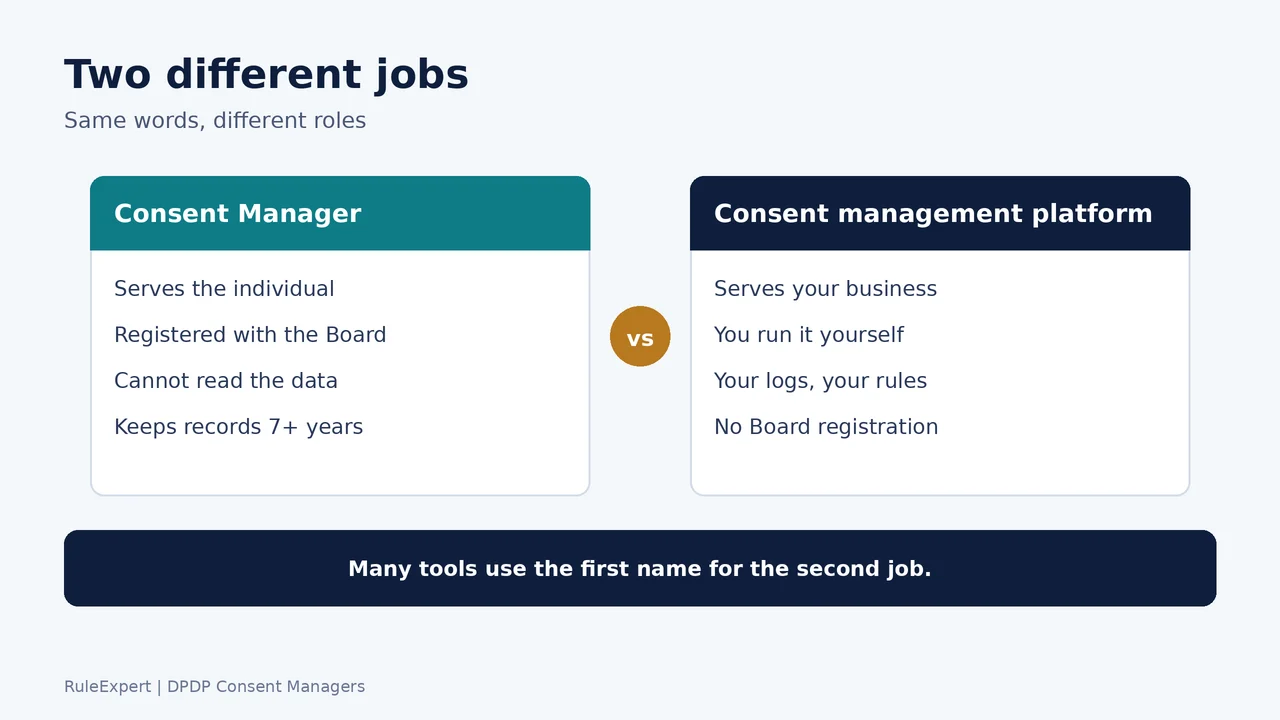
The two roles, side by side
Section 2(g) of the DPDP Act, 2023 defines a Consent Manager as a person registered with the Board who acts as a single point of contact for a Data Principal to give, manage, review and withdraw consent. Section 6(9) makes registration a condition. A platform has no such status. It is simply software.
Consent Manager
Consent management platform
Serves
The individual
Your business
Status
Registered with the Board under Rule 4
No registration exists
Who runs it
The registered company, independently
You, as Data Fiduciary
Sees the personal data?
No, per Part B of the First Schedule
Yes, within your own controls
Records
Consents, notices and sharing kept at least seven years
Whatever you configure and the Rules require of you
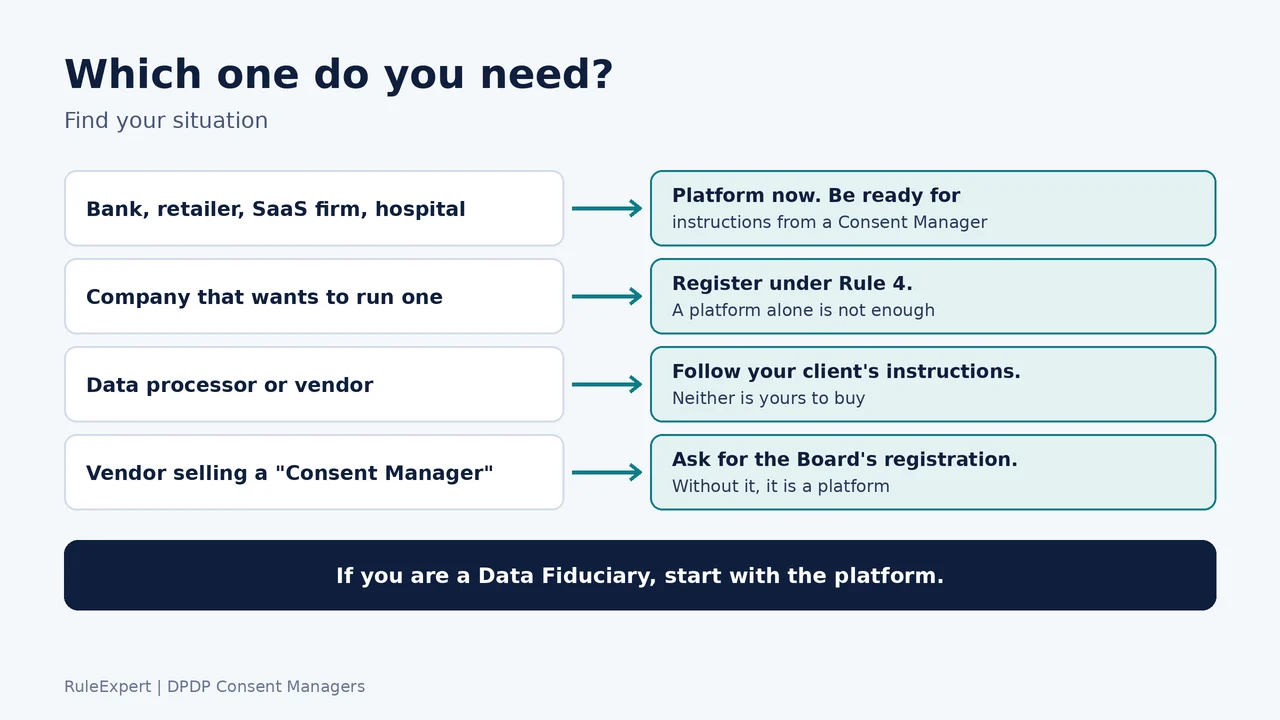
Your own consent duties apply to you whatever happens with Consent Managers
A company wanting to run an intermediary
Registration under Rule 4
A platform alone does not make you one
A processor or vendor
Your client’s instructions
Consent duties sit with the Data Fiduciary
A buyer shown a "Consent Manager" product
Proof of registration
Without it, you are looking at a platform
Find your situation, then the answer.
The Act says use of a Consent Manager is the individual’s choice. Your customer decides, not you. So the working question for most businesses is not "should we buy one?" It is "will our systems cope when someone else speaks for our customer?"
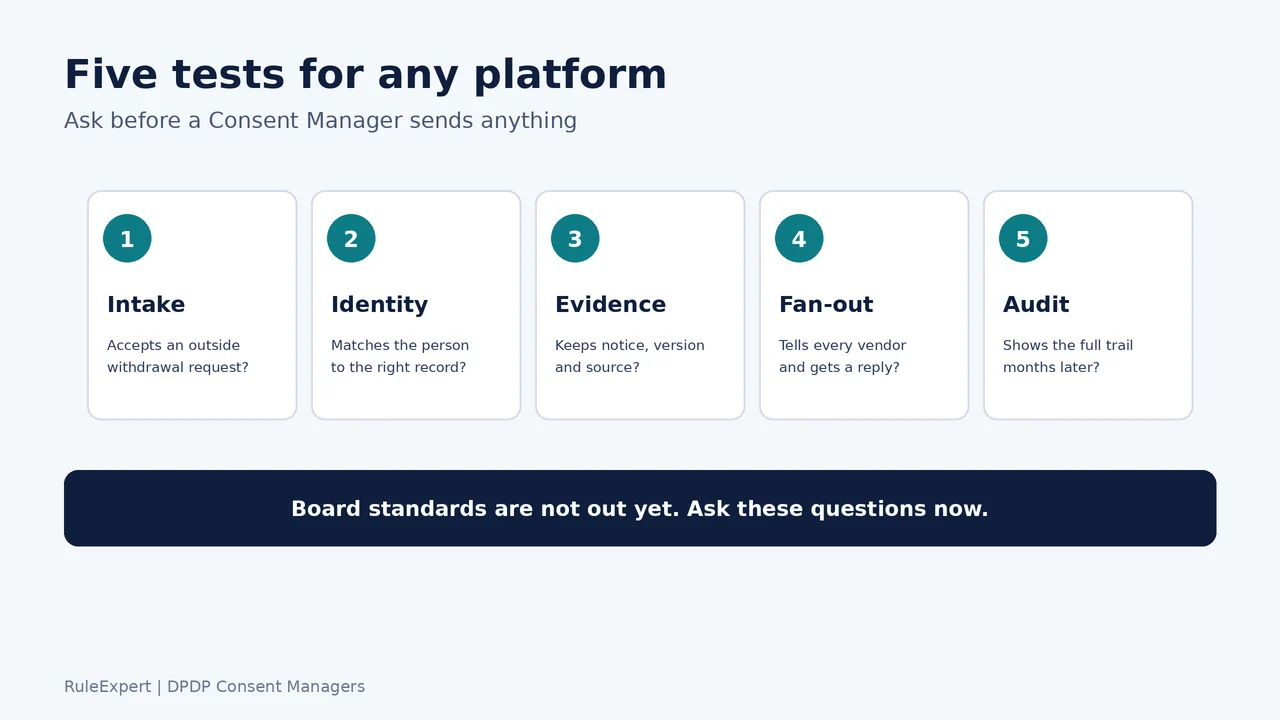
Five tests for any platform
The Board has not yet published the technical standards that will govern how Consent Managers talk to businesses. So nobody can honestly sell you "Consent Manager ready" as a certified feature. You can still test whether a platform will cope. Ask for each of these in a live demo, not a slide.
Intake. Can it accept a withdrawal that did not start in your own interface?
Identity. Can it match the person to the right record when phone numbers and emails have changed?
Evidence. Does each record keep the notice version, purpose, channel, timestamp and who made the decision?
Fan-out. When consent is withdrawn, does it tell every downstream vendor and log the reply?
Audit. Can you pull one customer’s full history, months later, in under a minute?
The five questions to put to any consent platform vendor.
A platform that fails the fifth test will struggle with everything else. The point is also practical for Rule 8 of the Rules, which sets how long logs and related data have to be kept. If you hold consent records you cannot retrieve, they are not much use in a dispute.
What the individual sees
Picture a customer of an insurer, a lender and a streaming service. With a registered Consent Manager they might see one screen listing all three and switch off a purpose at one of them. Without one, they would have to visit each company’s own preference page. In both cases the company still owes the same duties. What changes is where the instruction comes from.
That matters for your staff too. A customer care team that hears "my consent manager has already withdrawn this" needs a script, and the Data Protection Board is where disputes over how businesses handled it could end up.
Mistakes to avoid
Believing a platform licence makes you a Consent Manager, or that a Consent Manager’s existence removes your own duties.
Paying for "Consent Manager compliance" when no standards exist to comply with.
Buying on banner design alone, and skipping the withdrawal fan-out.
Ignoring vendors. A withdrawal your CRM honours and your email processor ignores is still a failure, as our consent mistakes guide explains.
Running two overlapping tools with two different versions of the truth.
Where RuleExpert fits
RuleExpert is a platform, not a registered Consent Manager. Its consent module is built for the Data Fiduciary’s side. By its own description it includes an append-only consent log, a withdrawal portal with a tracked queue, and vendor alerts. Whether it can ingest a Consent Manager’s instructions depends on standards the Board has not published, so we would rather you ask on a demo than take a promise from us. For wider context, see our consent management software guide, the consent lifecycle guide and the DPDP compliance solution overview. If a Consent Manager’s registration depends on a minimum net worth, our post on the ₹2 crore rule covers that. Book a RuleExpert Demo or start with the free DPDP Scorecard. The complete DPDP guide sets out the rest.
Frequently asked questions
What is the difference between a Consent Manager and a consent management platform?
A Consent Manager is a Board-registered company that acts for the individual across businesses. A consent management platform is software a business runs for its own consent duties. Only the first is a regulated role under Section 2(g) of the Act.
Is a consent management platform the same as a Consent Manager under DPDP?
No. A platform needs no registration and serves the Data Fiduciary. A Consent Manager must register with the Board under Section 6(9) and serve the Data Principal.
Do I need a Consent Manager to comply with the DPDP Act?
No. Use of a Consent Manager is the individual’s choice under Section 6. Your own notice, consent and withdrawal duties apply whether or not any customer uses one.
Can my consent management platform act as a Consent Manager?
Not unless the company running it is registered with the Board and meets the conditions in the First Schedule. Software alone does not confer that status.
Will a registered Consent Manager replace my consent platform?
It is unlikely to, because your duties remain yours. A Consent Manager passes the individual’s instructions along. You still need systems to record, honour and prove them.
When do Consent Managers start operating?
Rule 4, the registration route, is scheduled to begin on 13 November 2026. Most duties on Data Fiduciaries start on 13 May 2027. See our 13 November explainer for the timeline.
How can I check whether a vendor is a registered Consent Manager?
Under Rule 4(2), the Board publishes the particulars of registered applicants on its website. Ask the vendor for its registration and check it there.
Can a Consent Manager read my customers’ personal data?
No. Part B of the First Schedule requires the platform to be built so that the contents of personal data are not readable by the Consent Manager.
What should I ask a vendor selling a Consent Manager integration?
Ask whether the Board has published the technical standards it claims to meet, and ask for a live demonstration of intake, identity matching, evidence, fan-out and audit.
Should a small business wait for Consent Managers before buying a platform?
No. Your obligations come from the Act and the Rules regardless. Choose a platform that keeps good records and can add new intake channels when the Board’s standards arrive. Our guide for businesses helps with that.
I am a Compliance Manager at RuleExpert, focused on helping organizations navigate the evolving landscape of data protection and privacy regulations in India.
With the introduction of the Digital Personal Data Protection (DPDP) Act, businesses are facing new challenges in managing personal data, ensuring consent, and maintaining compliance across systems. My work revolves around simplifying these complexities and enabling organizations to adopt structured, scalable compliance practices.
I specialize in:
DPDP compliance and privacy frameworks
Data governance and risk management
Consent lifecycle and user rights handling
Compliance automation and operational workflows
At RuleExpert, I work closely with startups, SaaS companies, and enterprises to transform compliance from a manual, documentation-heavy process into an automated, infrastructure-driven system.
I am particularly interested in how AI and automation can reshape privacy operations and help businesses build trust in a data-driven world.
In their words
What compliance teams tell us
“We always thought DPDP compliance was the client’s responsibility
since we were only executing services. The evaluation made it clear that how we handle
client data creates risk on our side too. It changed how we work internally.”
DSFounderDigital services firm
“We had a basic understanding of DPDP requirements, but the scorecard
highlighted gaps we hadn’t identified internally — especially around consent handling
and data visibility. It gave us a much clearer starting point.”
BSFounderB2B SaaS company
“The DPDP score was surprisingly insightful. Within minutes we could see
where we stood and what needed immediate attention. It simplified something that initially
felt quite complex.”
FPProduct HeadFintech platform
“After reviewing our score we opted for a consultation. The discussion was
very practical — we got clear direction on what to fix first and how to approach DPDP
compliance in a structured way.”
LGFounderLogistics company
Real client quotes, attributed by role and sector — we never name a client.
Enquiry
Talk to the team
Your enquiry is with the team
Thank you — we have it. Someone will reply by email, usually within one working day.
Nothing else is needed from you. If it is urgent, email
tushar@ruleexpert.com and it will reach the same
people.
Allowing it lets Google Analytics and Google’s advertising measurement set an
identifier and receive your IP address, the pages you view and how you reached them
— used only to see which pages work and whether a campaign led to an enquiry, never to
build a profile or to decide anything about you. Google processes this outside India, a
cross-border transfer under Section 16. Declining changes nothing about the site, and you
can change your mind any time from the footer.
An analytics identifier is personal data, so the DPDP Act applies to
it — though no Indian cookie statute requires this banner. We ask because we would
rather you chose. What we collect and why
 RuleExpert