Ask ten founders what the ₹2 crore net worth rule for a Consent Manager means and you will hear ten answers. Cash in the bank. Money raised. Paid-up capital. Most are not what the rule says.
The wording sits in Part A of the First Schedule to the DPDP Rules, 2025, and it is short. This guide is written for the CFO, company secretary or chartered accountant who has to prove the number. Rule 4, which lets eligible companies apply, starts on 13 November 2026. If you are still deciding whether to apply at all, begin with our step-by-step registration guide.
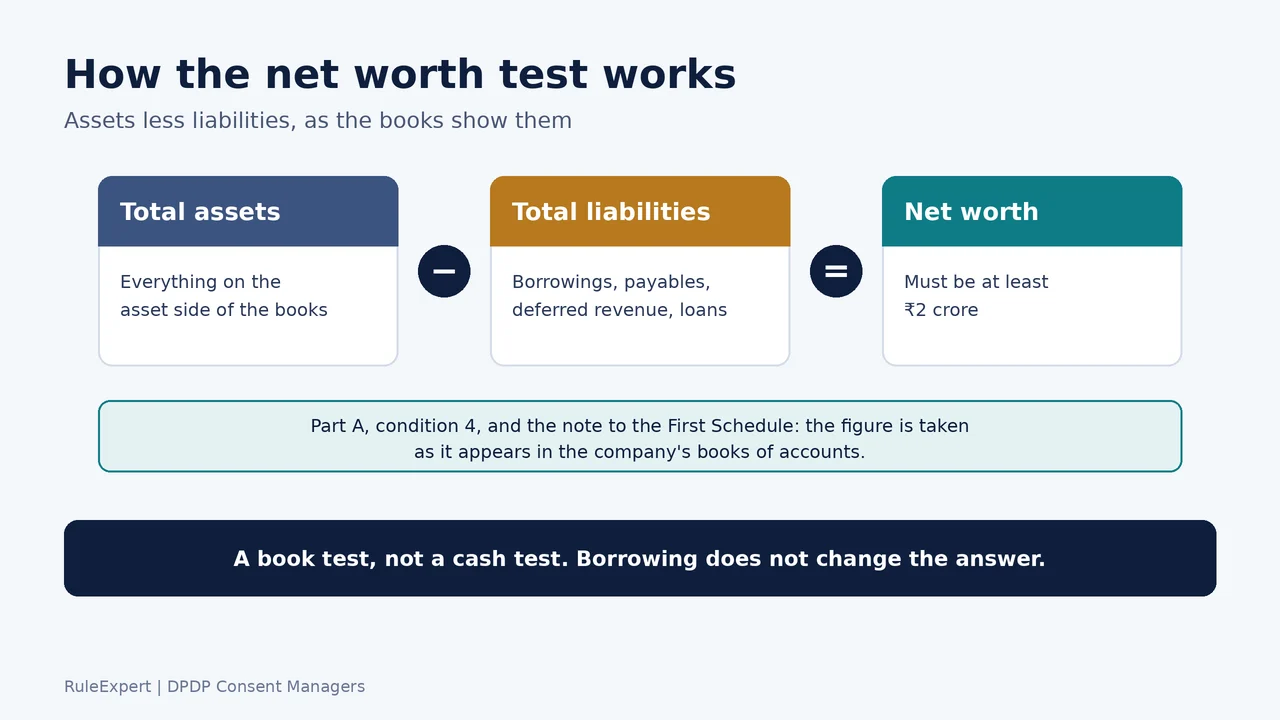
Quick answer: The Schedule requires a Consent Manager applicant to have net worth of not less than ₹2 crore. A note to the Schedule defines net worth as total assets less liabilities, as they appear in the company’s books of accounts. It is a book test, not a cash test. Borrowing does not raise it, and accumulated losses lower it.
What the Schedule says
Part A, condition four, asks for net worth "not less than two crore rupees". A note to the Schedule then defines the term as "the aggregate value of total assets as reduced by the value of liabilities of the Consent Manager as appearing in its books of accounts". You can read both in the Gazette notification, G.S.R. 846(E). We read the text from two published transcriptions, so check the wording against the Gazette itself before you file.
Three things follow. First, the test is on the books. Whatever your audited statements show is the starting point. Second, it is a net figure, so every rupee of liability counts against you. Third, the Schedule sets its own definition. The Companies Act, 2013 has a separate net worth definition built from share capital and reserves. Do not assume the two give the same answer for your company, and let your auditor decide which basis the Board’s form expects once it is published.
The legal hook is Section 6(9) of the DPDP Act, 2023, which says a Consent Manager must be registered with the Board subject to prescribed financial conditions. For the full picture of the role, see our explainer on the Consent Manager under the DPDP Act.
The Schedule’s test in one line: assets less liabilities, as the books show them.
A worked example
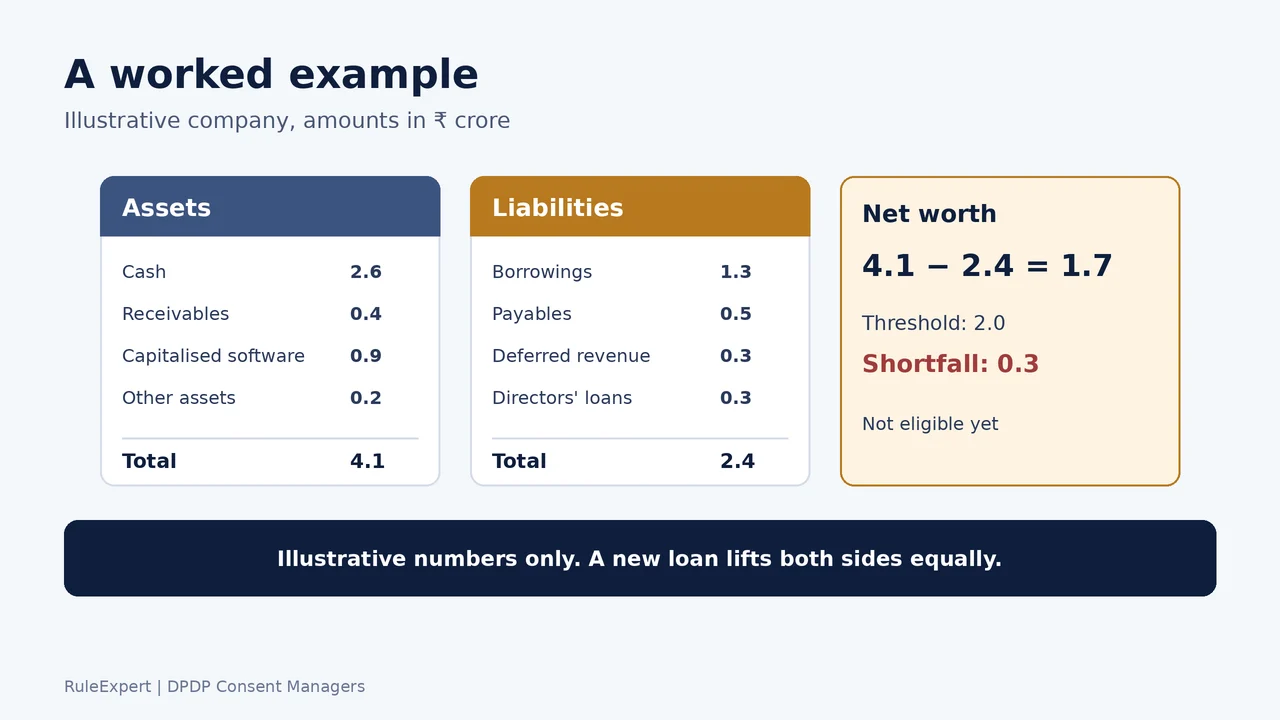
Here is a made-up company, amounts in ₹ crore. It looks healthy. It has ₹2.6 crore in the bank.
Assets
₹ crore
Liabilities
₹ crore
Cash
2.6
Borrowings
1.3
Receivables
0.4
Payables
0.5
Capitalised software
0.9
Deferred revenue
0.3
Other assets
0.2
Directors’ loans
0.3
Total
4.1
Total
2.4
Net worth is 4.1 less 2.4, which is ₹1.7 crore. The company is ₹0.3 crore short. Its cash balance said otherwise, and that gap is where most wrong assumptions come from.
Illustrative numbers only. Cash is not net worth.
What moves the number
Item
Effect on net worth
Note for the CA
Fresh equity
Up
Assets rise, liabilities do not
New loan
No change
Cash and the loan rise by the same amount
Accumulated losses
Down
Cash is spent and nothing comes back onto the balance sheet
Convertible instruments
Depends
Treatment as equity or liability follows how the books classify them
Revaluation, intangibles
Counted as booked
Expect questions on valuation and impairment
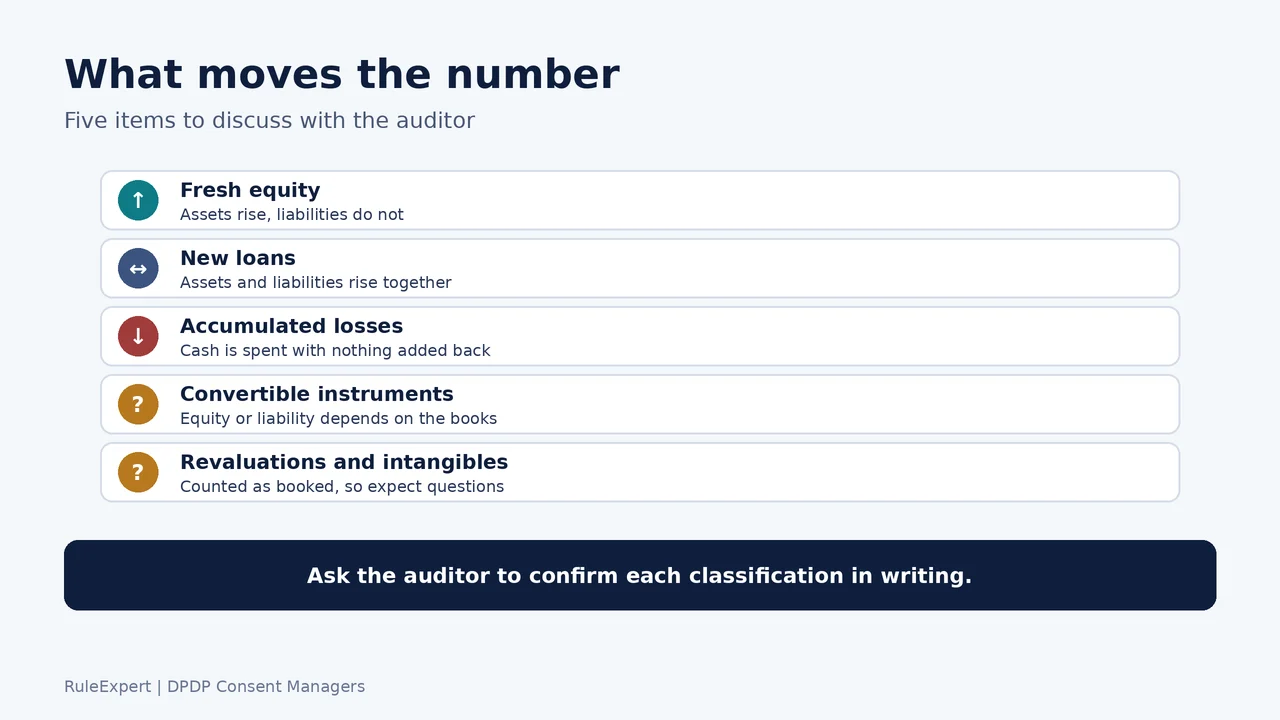
The second row is the one that surprises people. A ₹1 crore loan puts ₹1 crore in the bank and ₹1 crore on the liabilities side. The difference stays where it was. If the plan is to reach the threshold by borrowing, it will not work.
Five items to settle with the auditor before the application is prepared.
How to evidence it
The Board has not published its application particulars, and Rule 4(1) says it will specify them on its website. So this list is our suggestion, not a requirement.
Use the audited balance sheet nearest to filing. A stale year-end can mislead in both directions.
Prepare a one-page reconciliation. Total assets, total liabilities, the difference, signed by the CA.
Build headroom. Aim comfortably above ₹2 crore. A small loss in the next quarter should not undo the filing.
Write down the classification calls. For convertibles, intangibles and revaluation reserves, record what the auditor decided and why.
Keep the working versioned. If the Board asks a question under Rule 4(6), you want one current answer.
Registration does not end the matter. Part B of the Schedule requires audits that cover continued fulfilment of the conditions of registration, reported to the Board. So net worth is something to monitor every quarter, not a gate you pass once.
The conditions next door
Net worth sits between two softer tests in Part A: sound finances and management, and adequate business volume, capital structure and earning prospects. Neither carries a number. A company can clear ₹2 crore and still be asked about its cap table or projections. Keep the business plan consistent with the balance sheet. If the two tell different stories, the inquiry under Rule 4 is where that will surface. The Board runs that inquiry, and our guide to the Data Protection Board explains how it works. The wider timeline is in our 13 November explainer.
Mistakes to avoid
Quoting the bank balance or the funding round as net worth.
Counting a loan as strength.
Borrowing the Companies Act definition without checking it against the Schedule’s note.
Filing on a thin margin and then posting a loss.
Treating this as a finance-only task. Articles, governance and certification run in parallel, as the registration guide sets out.
Where RuleExpert fits
RuleExpert is not a registered Consent Manager and cannot compute, certify or vouch for your net worth. That is a job for your CA. What the platform describes itself as offering is a central evidence repository with version history and audit trails, which some applicants will find useful for the working papers. Ask on a demo whether that fits. If you are a business that will receive instructions from Consent Managers rather than become one, our consent module and the free DPDP Scorecard are the better start. Book a RuleExpert Demo, or read how a Consent Manager differs from a consent management platform and our DPDP compliance solution overview. The wider context is in our complete guide to DPDP in India.
Frequently asked questions
What is the net worth requirement for a Consent Manager?
Not less than ₹2 crore, under Part A of the First Schedule to the DPDP Rules, 2025. A note to the Schedule defines it as total assets less liabilities, as they appear in the company’s books of accounts.
How does the Schedule define net worth?
As the aggregate value of total assets reduced by the value of liabilities, as appearing in the Consent Manager’s books of accounts. It is a book figure taken from the accounts.
Is cash in the bank the same as net worth?
No. Cash is one asset. Net worth is all assets less all liabilities, so a company with ₹2.6 crore in cash can still fall short if its liabilities are high.
Does a loan help me reach ₹2 crore?
No. A loan adds to assets and to liabilities by the same amount, so net worth stays where it was. Fresh equity is the item that raises it.
Do accumulated losses reduce net worth?
Yes. Losses reduce the asset side of the books without adding anything back, so they pull the figure down. A funded company with large losses can still miss the threshold.
Is the Companies Act definition of net worth used?
The Schedule gives its own definition, so start there. The Companies Act, 2013 has a different formulation, and we could not verify it from an official source for this guide. Ask your auditor which basis the Board’s form expects.
What documents prove net worth?
The Board has not listed them. A sensible set is the latest audited balance sheet, a signed reconciliation of assets and liabilities from your CA, and notes on how contested items were classified.
Which date should the figure be taken from?
The Board’s particulars should say. Until they are published, use the audited balance sheet nearest to the filing date and keep headroom for movement since then.
Does net worth have to be maintained after registration?
Part B requires audits covering continued fulfilment of the conditions of registration, reported to the Board. Treat the threshold as ongoing. Under Section 27(1)(d) of the Act the Board can inquire into a breach of a registration condition and impose a penalty.
Can a CA certify net worth for the application?
The Board decides what it accepts. A CA’s working is useful supporting evidence, and the Part A certification condition is a separate, independent assessment of the platform. See our Rule 4 explainer for how the process runs.
I am a Compliance Manager at RuleExpert, focused on helping organizations navigate the evolving landscape of data protection and privacy regulations in India.
With the introduction of the Digital Personal Data Protection (DPDP) Act, businesses are facing new challenges in managing personal data, ensuring consent, and maintaining compliance across systems. My work revolves around simplifying these complexities and enabling organizations to adopt structured, scalable compliance practices.
I specialize in:
DPDP compliance and privacy frameworks
Data governance and risk management
Consent lifecycle and user rights handling
Compliance automation and operational workflows
At RuleExpert, I work closely with startups, SaaS companies, and enterprises to transform compliance from a manual, documentation-heavy process into an automated, infrastructure-driven system.
I am particularly interested in how AI and automation can reshape privacy operations and help businesses build trust in a data-driven world.
In their words
What compliance teams tell us
“We always thought DPDP compliance was the client’s responsibility
since we were only executing services. The evaluation made it clear that how we handle
client data creates risk on our side too. It changed how we work internally.”
DSFounderDigital services firm
“We had a basic understanding of DPDP requirements, but the scorecard
highlighted gaps we hadn’t identified internally — especially around consent handling
and data visibility. It gave us a much clearer starting point.”
BSFounderB2B SaaS company
“The DPDP score was surprisingly insightful. Within minutes we could see
where we stood and what needed immediate attention. It simplified something that initially
felt quite complex.”
FPProduct HeadFintech platform
“After reviewing our score we opted for a consultation. The discussion was
very practical — we got clear direction on what to fix first and how to approach DPDP
compliance in a structured way.”
LGFounderLogistics company
Real client quotes, attributed by role and sector — we never name a client.
Enquiry
Talk to the team
Your enquiry is with the team
Thank you — we have it. Someone will reply by email, usually within one working day.
Nothing else is needed from you. If it is urgent, email
tushar@ruleexpert.com and it will reach the same
people.
Allowing it lets Google Analytics and Google’s advertising measurement set an
identifier and receive your IP address, the pages you view and how you reached them
— used only to see which pages work and whether a campaign led to an enquiry, never to
build a profile or to decide anything about you. Google processes this outside India, a
cross-border transfer under Section 16. Declining changes nothing about the site, and you
can change your mind any time from the footer.
An analytics identifier is personal data, so the DPDP Act applies to
it — though no Indian cookie statute requires this banner. We ask because we would
rather you chose. What we collect and why
 RuleExpert