Rule 4 is the shortest rule that matters most to a Consent Manager. Six sub-rules, no timelines, and a lot left to the Board’s discretion. Most summaries paraphrase it in a sentence. This one reads it sub-rule by sub-rule and then lists what it does not say.
Rule 4 of the DPDP Rules, 2025 comes into force one year after the Gazette’s publication, which puts it at 13 November 2026. Some sources say 14 November, so confirm the commencement wording in Rule 1(3). For the business context, see our 13 November explainer.
Quick answer: DPDP Rule 4 governs how a Consent Manager is registered. A company meeting Part A of the First Schedule applies to the Data Protection Board. The Board may inquire, then registers the applicant or rejects it with reasons. After registration it can direct fixes, or suspend or cancel registration after a hearing, by a reasoned order. Rule 4 sets no deadlines.
When Rule 4 starts
Rule 1(2) brings Rules 1, 2 and 17 to 21 into force on publication. Rule 1(3) says Rule 4 comes into force one year after the date of publication of the Gazette. The Act’s own timing for Consent Managers, Section 6(9), follows the same point. Everything else, including most duties on ordinary businesses, waits until 13 May 2027, an 18-month schedule that PIB’s note on the notified Rules describes. We read Rule 1(3) from published transcriptions, so verify it in the Gazette.
The six sub-rules
Sub-rule
What it says, in plain English
What it means for an applicant
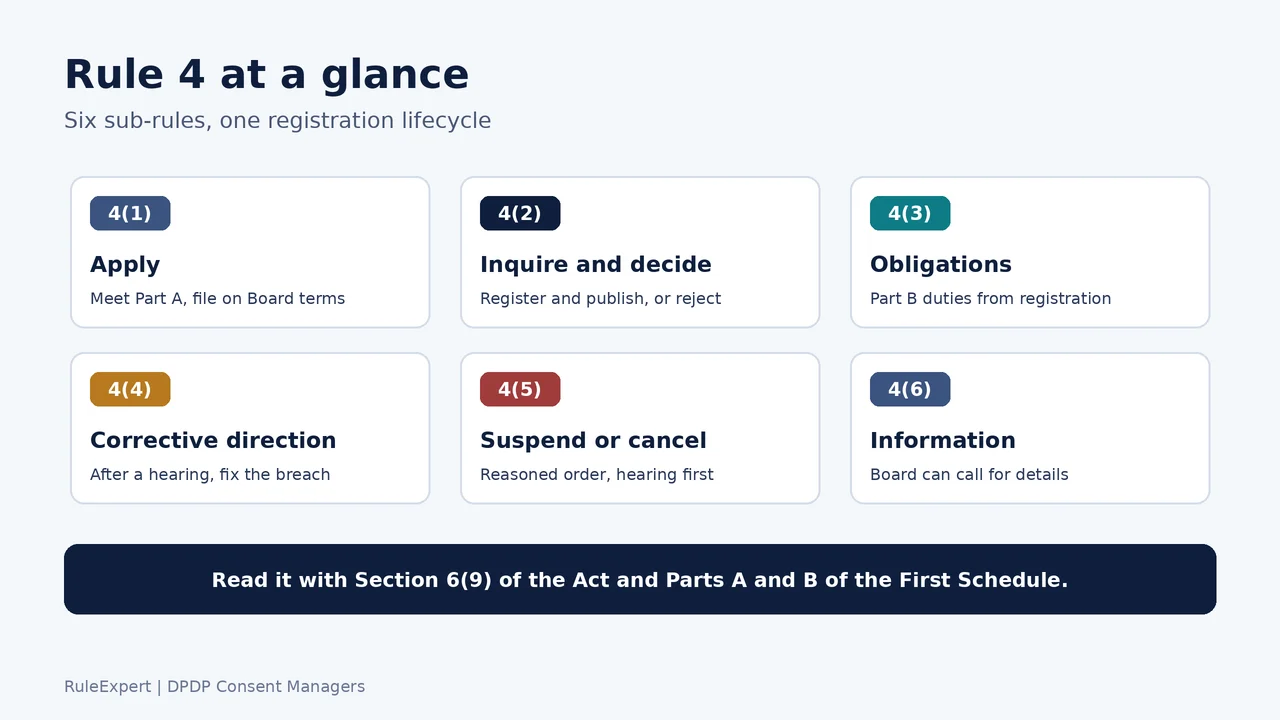
4(1)
A person meeting Part A of the First Schedule may apply, with the particulars, information and documents the Board publishes on its website
You cannot file until the Board says what to file
4(2)
The Board "may make such inquiry as it may deem fit". If satisfied, it registers the applicant, informs it and publishes its particulars. If not, it rejects and communicates its reasons
Registration is a decision, not a formality, and the outcome is public
4(3)
A registered Consent Manager must follow Part B of the Schedule
Obligations start with registration
4(4)
If the Board finds non-adherence, it informs the Consent Manager and, after a hearing, directs measures to ensure adherence
A chance to fix before anything harsher
4(5)
If necessary "in the interests of Data Principals", the Board may after a hearing, by an order "for reasons to be recorded in writing", suspend or cancel registration and give directions
The strongest tool, with a hearing and a written order in front of it
4(6)
The Board may require the applicant or Consent Manager to furnish information
Be ready to answer at any stage
Six sub-rules make up one registration lifecycle.
Part A, with its nine conditions, and Part B, with thirteen obligations, do the heavy lifting. Rule 4 is the procedure that connects them. Our guide to registering as a Consent Manager maps Part A to evidence, and the post on the ₹2 crore net worth condition goes deeper on one of the nine.
Two tracks: before and after registration
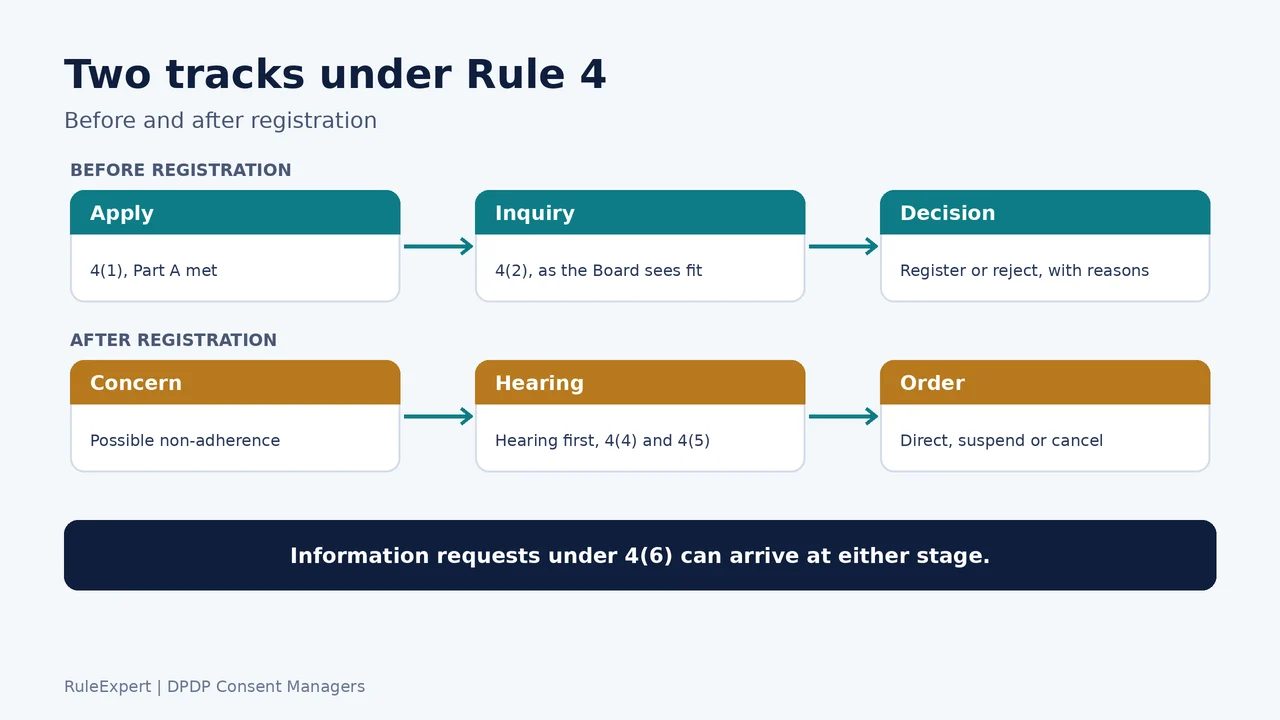
It helps to see Rule 4 as two sequences. Before registration: apply under 4(1), inquiry under 4(2), then registration or rejection. After registration: a concern about non-adherence, a hearing under 4(4) or 4(5), then a direction, suspension or cancellation. Rule 4(6) information requests can come at either stage.
Before and after registration, with information requests possible at both stages.
Notice the asymmetry. Rule 4(2) mentions no hearing before a rejection, while 4(4) and 4(5) require one before directions, suspension or cancellation. The text gives reasons on rejection and a written order on suspension. That difference matters if you are deciding how much to invest before applying.
How it connects to the Act
Rule 4 is made under the DPDP Act, 2023. Section 6(9) requires a Consent Manager to be registered with the Board on prescribed conditions, and Section 6(8) makes it accountable to the Data Principal. Section 27(1)(d) is a second route: the Board can inquire into a breach of the conditions of registration and impose a penalty. So a registered Consent Manager can face both the corrective powers in Rule 4 and a penalty under the Act. Our guide to the Data Protection Board explains how those inquiries run, and the Consent Manager explainer covers the role itself.
What Rule 4 leaves open
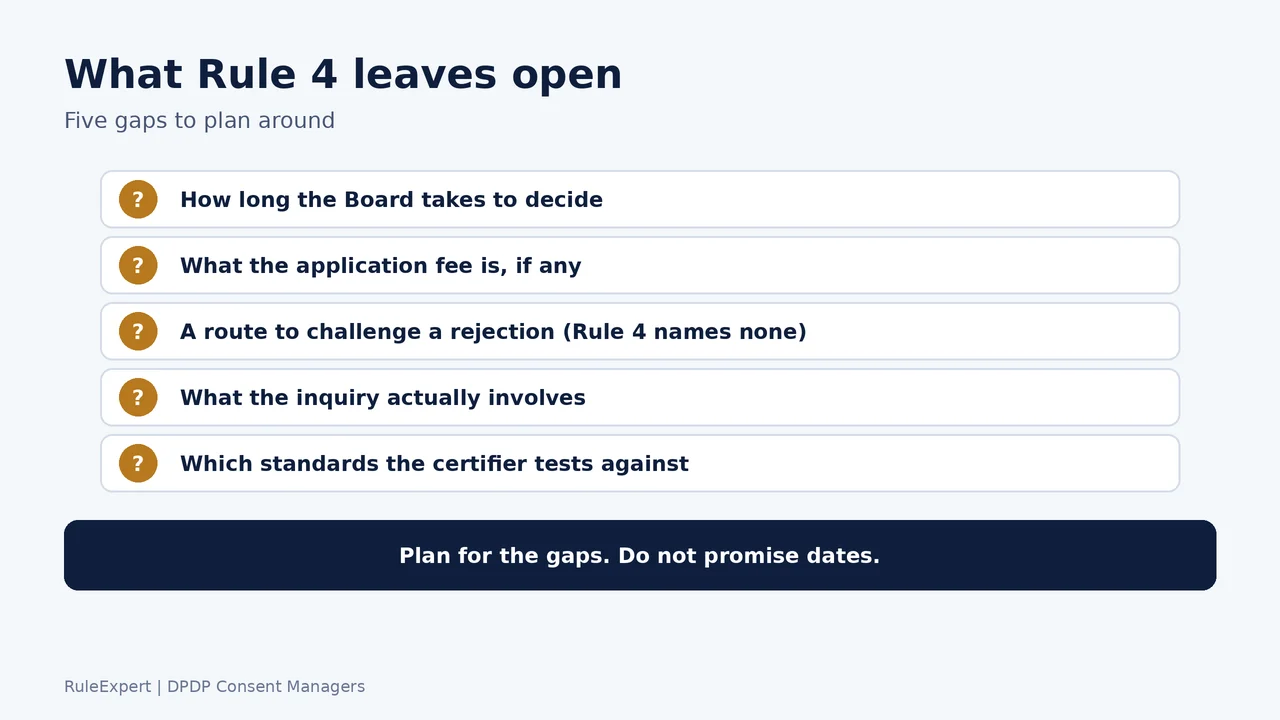
Time. No deadline for the Board to decide.
Money. No application fee is stated.
Challenge. Rule 4 names no route to challenge a rejection. Any remedy would have to come from elsewhere in the framework, so take legal advice.
The inquiry. "As it may deem fit" is wide. We do not know what it will involve.
Certification. The Part A certificate is against standards the Board has yet to publish.
Five gaps to plan around. Do not promise dates.
There is also a practical gap. As of our check on 10 November we found no published application form, and MeitY has only advertised the posts of Chairperson and four Members of the Board, with no appointments announced that we could find. Rule 4 starts on a date. Registrations may not.
Mistakes to avoid
Reading Rule 4 as an automatic right. The Board can reject.
Skipping Part B in planning. Rule 4(3) applies it from registration.
Assuming a fast decision because the text is short.
Treating information requests under 4(6) as a courtesy. Answer them promptly and in writing.
Confusing Rule 4 with your own duties as a business. Those sit in other rules and begin in May 2027.
Where RuleExpert fits
RuleExpert is not a registered Consent Manager and cannot file or support an application on the Board’s behalf. If you are applying, its documentation tools, described by the company as a central evidence repository with activity logs and version history, may help you keep inquiry responses consistent. Ask on a demo. If you are a business that will receive instructions from Consent Managers, read how a Consent Manager differs from a consent management platform, then look at our consent module and the free DPDP Scorecard. Book a RuleExpert Demo or see the solution overview. The complete DPDP guide places Rule 4 in context.
Frequently asked questions
What is Rule 4 of the DPDP Rules?
Rule 4 sets out how a Consent Manager is registered with the Data Protection Board, what obligations follow, and how the Board can direct, suspend or cancel a registration. It is in the DPDP Rules, 2025.
When does DPDP Rule 4 come into force?
One year after the Gazette’s publication under Rule 1(3), which is 13 November 2026. Some sources say 14 November, so confirm in the Gazette.
Who can apply under Rule 4?
A person who meets the conditions in Part A of the First Schedule. That includes being a company incorporated in India with net worth of at least ₹2 crore.
What does the Board do after an application?
It may make such inquiry as it deems fit. If satisfied, it registers the applicant, informs it and publishes its particulars. If not, it rejects the application and communicates its reasons.
Is there a deadline for the Board to decide?
Rule 4 states none. Plan for an open-ended wait and avoid promising launch dates to investors or customers.
Can the Board suspend or cancel a Consent Manager?
Yes. Under Rule 4(5), if necessary in the interests of Data Principals, it may do so after a hearing, by an order with reasons recorded in writing.
What is the difference between Rule 4(4) and Rule 4(5)?
Rule 4(4) lets the Board, after a hearing, direct measures to ensure adherence to the Schedule. Rule 4(5) is more serious and allows suspension or cancellation, with directions.
Does Rule 4 say anything about appeal?
Rule 4 itself names no appeal or review route for a rejection or suspension. Check the Act and Rules, and take legal advice before relying on any remedy.
How does Rule 4 relate to Section 6(9) of the Act?
Section 6(9) of the DPDP Act requires Consent Managers to register on prescribed conditions. Rule 4 is the procedure that implements that requirement.
Is there an application fee under Rule 4?
None is stated in Rule 4, and we found none published. The Board will specify application particulars on its website. See our registration guide for the rest of the checklist.
I am a Compliance Manager at RuleExpert, focused on helping organizations navigate the evolving landscape of data protection and privacy regulations in India.
With the introduction of the Digital Personal Data Protection (DPDP) Act, businesses are facing new challenges in managing personal data, ensuring consent, and maintaining compliance across systems. My work revolves around simplifying these complexities and enabling organizations to adopt structured, scalable compliance practices.
I specialize in:
DPDP compliance and privacy frameworks
Data governance and risk management
Consent lifecycle and user rights handling
Compliance automation and operational workflows
At RuleExpert, I work closely with startups, SaaS companies, and enterprises to transform compliance from a manual, documentation-heavy process into an automated, infrastructure-driven system.
I am particularly interested in how AI and automation can reshape privacy operations and help businesses build trust in a data-driven world.
In their words
What compliance teams tell us
“We always thought DPDP compliance was the client’s responsibility
since we were only executing services. The evaluation made it clear that how we handle
client data creates risk on our side too. It changed how we work internally.”
DSFounderDigital services firm
“We had a basic understanding of DPDP requirements, but the scorecard
highlighted gaps we hadn’t identified internally — especially around consent handling
and data visibility. It gave us a much clearer starting point.”
BSFounderB2B SaaS company
“The DPDP score was surprisingly insightful. Within minutes we could see
where we stood and what needed immediate attention. It simplified something that initially
felt quite complex.”
FPProduct HeadFintech platform
“After reviewing our score we opted for a consultation. The discussion was
very practical — we got clear direction on what to fix first and how to approach DPDP
compliance in a structured way.”
LGFounderLogistics company
Real client quotes, attributed by role and sector — we never name a client.
Enquiry
Talk to the team
Your enquiry is with the team
Thank you — we have it. Someone will reply by email, usually within one working day.
Nothing else is needed from you. If it is urgent, email
tushar@ruleexpert.com and it will reach the same
people.
Allowing it lets Google Analytics and Google’s advertising measurement set an
identifier and receive your IP address, the pages you view and how you reached them
— used only to see which pages work and whether a campaign led to an enquiry, never to
build a profile or to decide anything about you. Google processes this outside India, a
cross-border transfer under Section 16. Declining changes nothing about the site, and you
can change your mind any time from the footer.
An analytics identifier is personal data, so the DPDP Act applies to
it — though no Indian cookie statute requires this banner. We ask because we would
rather you chose. What we collect and why
 RuleExpert