

Do you remember when cloud storage became so ridiculously cheap that companies just stopped deleting things? Their data retention policy effectively became, “Keep it all.” “We might need it for a marketing campaign in five years.”
Welcome to 2026. That exact mindset is now a massive legal liability.
India’s digital ecosystem has shifted entirely. Following the formal notification of the DPDP Rules in November 2025, the clock is actively ticking toward the strict May 2027 enforcement deadline. Holding onto personal information indefinitely isn’t just bad practice anymore; it’s a direct violation of the law. If your organization operates in India or targets Indian consumers, implementing a bulletproof data retention policy is now mandatory.
We aren’t just talking about a dusty PDF sitting on your company intranet. The government expects an operational, automated framework that physically purges data when its legal lifespan expires. This guide breaks down exactly what the finalized rules demand, why your current spreadsheet-based tracking won’t survive an audit, and how smart automation through tools like RuleExpert can pull you out of the compliance danger zone.
Why the DPDP Act Hates Digital Clutter
For years, Indian businesses operated without a unified privacy law. We saw the fallout constantly: massive data breaches where hackers stole databases from 2018 containing user profiles of people who hadn’t logged in for half a decade.
The Digital Personal Data Protection Act (DPDP Act) flips the script. It heavily mandates the principle of storage limitation. Your data retention policy must now reflect a simple, non-negotiable rule: once the specified purpose for collecting someone’s personal data is fulfilled, you have to hit the delete button.
This is a massive cultural shock for many IT and marketing departments. You can no longer rely on vague, open-ended consent forms that say, “We will keep your information to improve our services.” Think about it practically. If a customer buys a pair of shoes, you need their address to ship the item. You might need it for a short return window. But keeping their exact home address and phone number sitting in a server for six years? That’s exactly what the Data Protection Board of India will penalize.
A compliant data retention policy forces you to map out the lifecycle of every single piece of information you touch. When does it enter your system? Where does it live? And most importantly, when does it die? Failing to answer these questions exposes businesses to fines that can reach hundreds of crores.
But look past the penalties for a moment. Having a strict data retention policy actually slashes your AWS or Azure bills and shrinks the attack surface available to cybercriminals. Less dormant data means less liability.
The Hard Numbers Behind the Finalized Rules
When the finalized DPDP Rules dropped, they replaced vague legal theory with hard timelines. Your data retention policy can no longer rely on guesswork or “industry standard” assumptions. The regulators spelled out exactly what they expect from data fiduciaries.
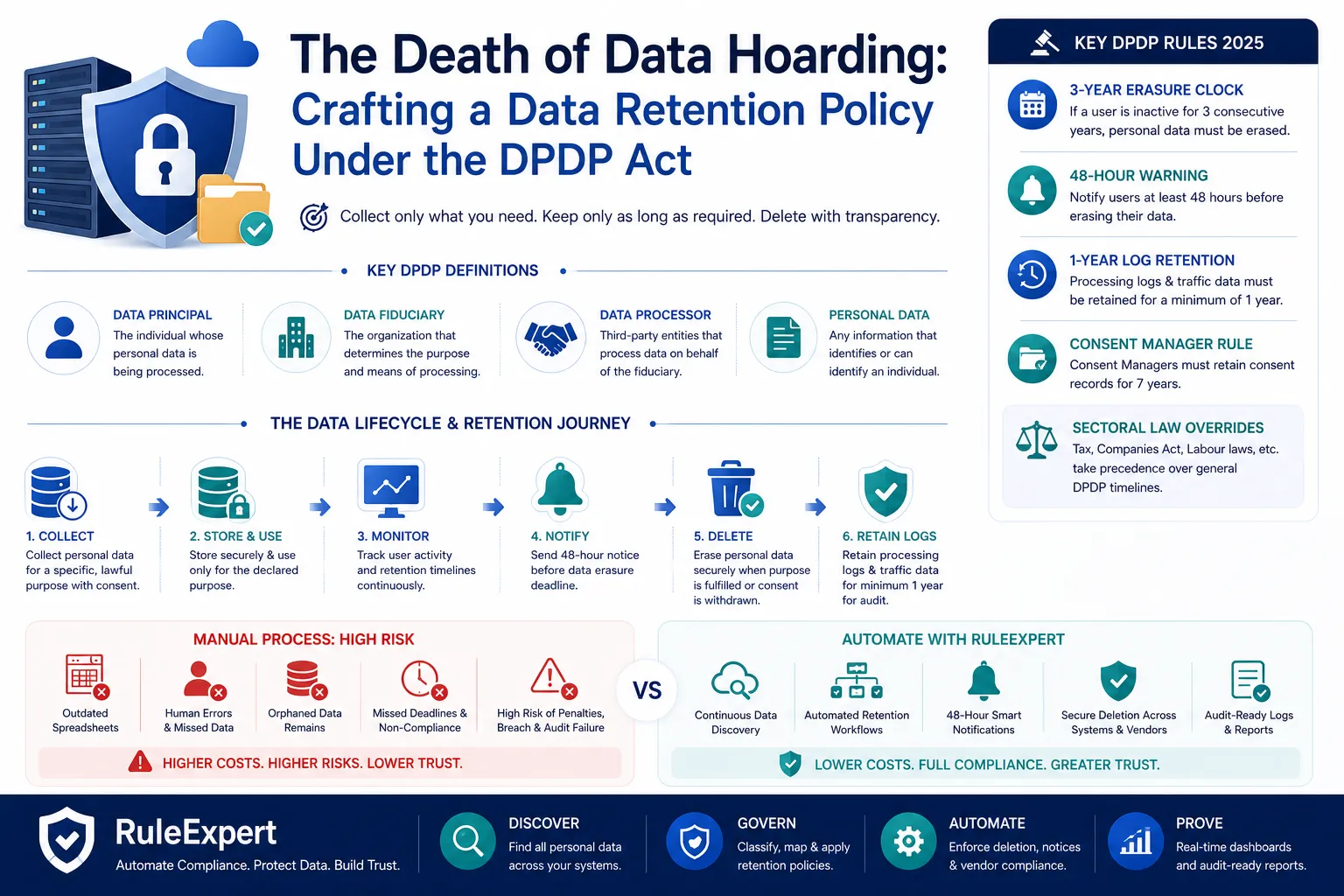
Here are the specific, officially mandated rules you need to build into your backend immediately:
The Three-Year Erasure Clock
If you are classified as a large-scale platform—think an e-commerce site with over 20 million Indian users, a social media giant, or a gaming platform with over 5 million users—the rules are incredibly strict regarding inactive accounts. If a user doesn’t log in, click an email, or interact with your platform for three continuous years, their personal data is legally presumed dead. You must erase it. Your data retention policy must include an automated trigger that tracks the “last approached” date and initiates the digital purge precisely at the 36-month mark.
The 48-Hour Warning Bell
You can’t just quietly delete a user’s history in the middle of the night. The law requires transparency right up to the very end. Before your system automatically erases an account due to inactivity or purpose fulfillment, you are legally obligated to notify the user. They must receive an alert at least 48 hours before the deletion happens, giving them a brief window to log back in and reset the clock. If your data retention policy doesn’t account for this two-day buffer, your deletion process is technically non-compliant.
The Minimum One-Year Log Mandate
Here is where things get slightly complicated. While the law wants you to delete unnecessary personal data, the government also heavily demands accountability. The rules dictate that you must retain processing logs and traffic data for a minimum of one year. Even if a user demands immediate erasure of their profile today, your system must retain the auditable logs of how and when you processed their data for at least 12 months. Your data retention policy needs to carefully separate the user’s actual personal profile (which gets scrubbed) from the backend processing logs (which get locked in a vault for a year).
Consent Managers and the 7-Year Rule
If your business acts as a newly defined “Consent Manager”—a highly regulated third-party platform that handles user consent on behalf of other companies—your obligations look entirely different. The rules require Consent Managers to maintain records of all consent transactions for a massive seven years to ensure a long-term audit trail.
The Sectoral Law Collision
What happens when two laws tell you to do opposite things? This is the biggest headache compliance officers face right now.
The DPDP Act demands data minimization. But what if the Income Tax Act says you must keep financial transaction records for eight years? Or what if the Companies Act requires you to hold onto certain corporate records for a decade?
This is where a simplistic “delete everything after a year” approach completely falls apart. A mature data retention policy embraces legal hierarchy. Sectoral laws—the specific regulations governing finance, healthcare, or labor in India—override the standard DPDP erasure timelines.
Your legal and technical teams need to sit down and map out these intersections. If a customer deletes their account on your app, their marketing profile and app usage history should be wiped immediately according to your data retention policy. However, the invoices attached to their past purchases must be securely partitioned and retained for the eight years mandated by tax authorities.
This requires a sophisticated, multi-tiered data retention policy. You can no longer treat a user’s data as one giant block. It has to be surgically segmented. Financial data goes to the long-term vault; behavioral data hits the digital shredder.
Why Manual Compliance is a Ticking Time Bomb
Let’s be brutally honest. If you are trying to execute a data retention policy using Excel spreadsheets, calendar reminders, and manual IT support tickets, you are going to fail an audit.
The sheer volume of data flowing through a modern business is too vast. A single customer might exist in your CRM, your email marketing platform, your customer support software, and your raw cloud storage buckets. When that customer’s inactivity timer expires, or when they explicitly withdraw their consent, how do you ensure their data is deleted from every single endpoint?
What about your third-party vendors? The DPDP Act holds the Data Fiduciary (you) squarely responsible for the actions of Data Processors (your vendors). If your data retention policy dictates that a dataset must be destroyed on May 1st, but your external analytics agency keeps a copy on their servers until December, you are the one who gets fined.
Manual execution inevitably leads to orphaned data. Somebody forgets to clear an old AWS S3 bucket. A marketing intern downloads a CSV file of customer emails to their local hard drive and leaves it there for three years. The only way to survive the strict 2027 enforcement deadline is to remove human error from the equation entirely.
Hardwiring Compliance with RuleExpert
This is exactly why Indian businesses are abandoning manual tracking and moving to specialized privacy automation platforms. Writing a data retention policy on a piece of paper is easy. Enforcing it across a highly fragmented IT infrastructure is a nightmare.
RuleExpert bridges that exact gap. As a purpose-built automation software, RuleExpert takes your static legal documents and turns them into executable code.
Instead of relying on IT staff to manually hunt down inactive users every month, RuleExpert integrates directly into your databases. It constantly monitors user activity against the specific timelines defined in your data retention policy. When a user hits the inactivity threshold, the software automatically fires off the legally required 48-hour warning notification. If the user doesn’t respond, the system orchestrates the deletion across your primary databases and sends automated erasure commands to your integrated third-party vendors simultaneously.
More importantly, it manages those complex legal overrides. RuleExpert’s built-in logic understands that while a customer’s promotional profile must be deleted today, the associated payment logs need to be archived securely for tax purposes. It handles the segmentation seamlessly behind the scenes.
When the Data Protection Board eventually knocks on your door asking for proof of compliance, you won’t be scrambling to compile messy email chains. RuleExpert provides an immutable, real-time audit trail proving exactly what data was deleted, when it happened, and why—all while automatically maintaining the mandatory one-year processing logs in the background.
The Competitive Edge of Doing It Right
We tend to talk about the DPDP Act purely in terms of fear—massive fines, regulatory audits, and legal nightmares. But there is a massive upside for the companies that figure this out early.
Consumers are hyper-aware of their digital footprint today. They are exhausted by spam calls, endless data leaks, and companies that refuse to let them leave gracefully. When a business publicizes a strict, user-friendly data retention policy, it builds immediate brand equity. Showing your customers that you respect their privacy enough to delete their information when you no longer need it is a surprisingly powerful marketing tool.
Furthermore, from a purely operational standpoint, data hoarding is incredibly expensive. Why pay premium cloud hosting fees to store gigabytes of useless, outdated information from users who haven’t bought anything since 2019? A ruthless data retention policy cleans up your databases. It makes your analytics sharper, your marketing much more targeted, and your server costs significantly lower.
The May 2027 deadline might feel distant right now, but deep architectural IT changes take time. The organizations that scramble at the last minute will make highly visible, expensive mistakes. The ones that start embedding their data retention policy into their infrastructure today will walk into the new regulatory era without breaking a sweat.
With automation tools like RuleExpert ready to handle the heavy lifting, there’s absolutely no excuse to delay. Stop hoarding. Start deleting. Build a data retention policy that protects your users, your bottom line, and your hard-earned reputation.
1. What exactly is a data retention policy under the DPDP Act?
It is a formal, enforced framework dictating how long an organization keeps personal data. Under the DPDP Act, data must be permanently deleted once its original, specified purpose is fulfilled, or when a user formally withdraws their consent, unless another prevailing law requires it to be kept.
2. Do we really have to delete user data after three years?
If you qualify as a large-scale platform (like an e-commerce site with over 20 million users or a gaming site with 5 million), yes. The finalized rules explicitly mandate that if a user hasn’t interacted with your platform for three consecutive years, their personal data must be erased.
3. What is the 48-hour notification rule?
Before you permanently delete a user’s data due to an expiring timeline or purpose fulfillment, you must notify them at least 48 hours in advance. This ensures transparency and gives the user a chance to log in and keep their account active if they choose.
4. If a user asks us to delete their data, do we delete everything immediately?
Not exactly. While their active profile and direct personal identifiers should be erased, the DPDP rules require you to safely retain the actual processing logs and traffic data associated with that user for a minimum of one year strictly for regulatory audit purposes.
5. How does a data retention policy work alongside tax laws?
Sectoral laws always take precedence. If the Income Tax Act requires you to keep an invoice for eight years, you must retain that specific financial record, even if the DPDP Act’s standard timeline suggests earlier deletion. Your policy must intelligently segment data accordingly.
6. Can we just manually handle these data deletions?
Technically yes, but practically it’s highly discouraged and incredibly risky. Manual tracking across different databases, ensuring external vendor compliance, and sending flawless 48-hour notices without human error is nearly impossible at scale. Automation tools are essential for survival.
7. Does the DPDP Act apply to employee data as well?
Yes. Employee data is classified as personal data. Your data retention policy must explicitly cover how long you keep the resumes of rejected candidates, data belonging to former employees, and current staff records, carefully balancing DPDP erasure rules with standard labor laws.
8. What happens if our data retention policy fails and we keep data too long?
Holding onto data past its legal lifespan actively violates the storage limitation principle of the DPDP Act. If this hoarding leads to an unauthorized breach, or if it is simply discovered during a routine regulatory audit, your organization could face severe financial penalties reaching up to ₹250 crore.
“`html “`