


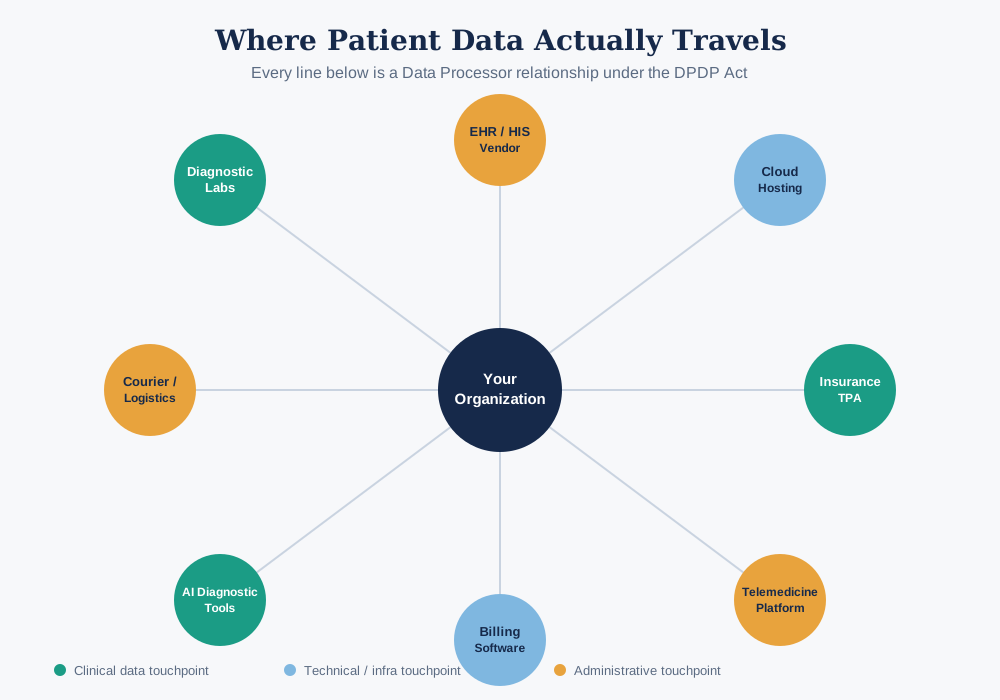
Every hospital, diagnostic chain, insurer, and health-tech platform in India runs on a web of outside vendors. The pathology lab that processes your reports, the cloud host storing your electronic health records, the third-party administrator (TPA) settling insurance claims, the billing software vendor, the courier picking up biological samples, the AI-based diagnostic tool reading your scans — none of them is “you,” yet every one of them is touching personal and often sensitive health data on your behalf.
Under India’s Digital Personal Data Protection Act, 2023 (DPDP Act), and the DPDP Rules, 2025 notified on November 13, 2025, that web of vendors is no longer just an operational convenience. It is a compliance liability that sits squarely on your shoulders — regardless of what your vendor contract says.
That last point is not an exaggeration. The Act states that a Data Fiduciary “shall, irrespective of any agreement to the contrary or failure of a Data Principal to carry out the duties provided under this Act, be responsible for complying with the provisions of this Act… in respect of any processing undertaken by it or on its behalf by a Data Processor.” In plain language: if your lab vendor leaks patient data, the regulator comes to you first, not to the lab.
Your indemnification clause might help you recover costs later, but it does not shield you from the Data Protection Board of India (DPBI), from penalties that can run into hundreds of crores, or from the reputational damage of a headline naming your hospital.
This is precisely why “healthcare vendor governance” has moved from a legal footnote to a board-level agenda item in 2026. The substantive obligations and penalties under the DPDP framework become fully enforceable in May 2027, and the runway between now and then is exactly when compliance-ready organizations separate themselves from the ones scrambling after their first regulatory notice.
This guide walks through what healthcare vendor governance actually means under the DPDP Act, why healthcare organizations carry disproportionate risk, and how to build — and automate — a governance framework that survives an audit, a breach, and a Data Protection Board inquiry.
It is written for the people who will actually own this problem inside a healthcare organization — CEOs and Managing Directors setting overall risk appetite, COOs and CFOs weighing the cost of a governance program against the cost of a penalty, CHROs and Plant HR Heads managing outsourced staffing vendors, Company Secretaries and Chartered Accountants responsible for statutory compliance reporting, and Compliance Managers and Heads of Compliance who will build and run the program day to day. Whether you’re running a single diagnostic center or a multi-state hospital network, the underlying framework below scales — only the number of vendors in your inventory changes.
Part 1: What “Vendor Governance” Means Under the DPDP Act
Data Fiduciaries, Data Processors, and Why the Distinction Matters
The DPDP Act works with two core roles:
- Data Fiduciary — the entity that decides why and how personal data is processed. A hospital, a diagnostic chain, an insurer, or a health-tech app is almost always a Data Fiduciary with respect to patient data.
- Data Processor — any person or entity that processes personal data on behalf of a Data Fiduciary, under its instructions. Your pathology lab’s LIS vendor, your cloud hosting provider, your billing software company, your call-center outsourcing partner, your courier — these are typically Data Processors.
Here is the detail that changes how governance teams have to think: a Data Processor’s obligations flow through from the Data Fiduciary’s own duties — cooperation on data principal rights, breach notification to the Fiduciary, and deletion or return of data when the purpose ends, but India’s model is “lighter on processors but places greater responsibility on fiduciaries to police their processors” compared to frameworks like GDPR, where processors carry direct statutory liability.
That single design choice is the reason vendor governance exists as a discipline at all in India. Since the law does not chase your vendor directly with the same force it chases you, you are the control point. If you don’t govern your vendors, nobody regulatory will — until something breaks, and then the Board comes to you.
The Non-Delegable Duty Problem
Legal commentary on Section 8 of the Act frames this using a doctrine familiar from tort law: certain duties are non-delegable, meaning liability persists regardless of delegation to contractors, and a Data Fiduciary cannot escape responsibility by pointing to a rogue employee of its processor. For a hospital network with dozens of empanelled labs, insurance TPAs, and IT vendors, this means:
- You cannot contract your way out of DPDP liability.
- A breach at any vendor in your chain is treated, for regulatory purposes, as your breach.
- Your only real lever is prevention: choosing vendors carefully, binding them contractually, monitoring them continuously, and documenting all of it so you can prove reasonable diligence if something goes wrong.
That last phrase — “prove reasonable diligence” — is the entire point of a vendor governance program. It’s not a philosophical exercise. It’s the evidence file you hand the Data Protection Board when they ask, “What steps did you take to ensure your processor was compliant?”
Part 2: Why Healthcare Vendors Are a Uniquely High-Risk Category
Healthcare data governance sits at the intersection of two hard problems: healthcare data is exceptionally sensitive, and healthcare delivery is exceptionally vendor-dependent. Neither the pandemic-era hospital IT boom nor the recent wave of health-tech platforms was built with DPDP-style obligations in mind, which means most Indian healthcare organizations are retrofitting governance onto vendor relationships that were never designed for it.
2.1 The Sensitivity Problem
Health data reveals things about a person that few other data categories do — diagnoses, mental health history, reproductive health, HIV status, genetic information, substance use. A leak doesn’t just expose an email address; it can expose an entire medical history that follows someone for life. Regulators worldwide treat health data as a heightened-risk category, and while the DPDP Act does not create a separate “sensitive personal data” tier the way the earlier 2019 bill draft did, the Act’s harm-based penalty structure means that the scale and sensitivity of an exposed dataset directly affects how severely a breach is treated.
2.2 The Vendor-Density Problem
A mid-sized multi-specialty hospital typically has personal data flowing through:
- Diagnostic and pathology labs (in-house and outsourced/referral labs)
- Hospital Information Systems (HIS) and Electronic Health Record (EHR) vendors
- Cloud and data-center hosting providers
- Billing, revenue-cycle, and claims-processing software vendors
- Insurance Third-Party Administrators (TPAs)
- Telemedicine and patient-app platforms
- AI-based diagnostic and imaging-analysis tools
- Courier and logistics partners moving biological samples and physical records
- Call-center and appointment-scheduling outsourcing partners
- Payroll and HR software vendors (processing employee — and by extension, patient-facing staff — personal data)
- Marketing, CRM, and patient-engagement platforms
- Document shredding / physical record destruction vendors
Each of these is a separate Data Processor relationship, each with its own risk profile, contract, and monitoring cadence. Multiply this across a hospital chain with 15–20 locations, or a diagnostics network with hundreds of collection centers, and the vendor inventory alone becomes a governance challenge before you’ve even started assessing risk.
2.3 The Awareness Gap
Unlike banks and large IT/ITES firms — India’s digital economy is heavily outsourcing-driven, and banks outsource KYC verification, insurers rely on TPAs, e-commerce companies use cloud vendors, and corporates engage payroll processors — many healthcare organizations, especially standalone hospitals, diagnostic centers, and clinics, have never run a formal third-party risk program. Vendor onboarding has historically been a procurement and clinical-quality exercise, not a data-protection one.
That gap is exactly where DPDP exposure hides: the lab you’ve used for eight years without a written data-processing clause, the billing vendor whose staff has standing remote access to your patient database, the courier firm that has never signed anything about how they handle physical sample labels bearing patient names and diagnoses.
2.4 A Closer Look at Each Vendor Category and Its Risk Profile
Treating “vendors” as one undifferentiated bucket is one of the fastest ways a governance program loses credibility. Each category below carries a distinct data-protection risk profile, and each needs a slightly different governance emphasis.
Diagnostic and pathology labs. These vendors typically hold the most clinically sensitive data of any category — diagnosis codes, test results, and often genetic or reproductive-health information. Referral labs (where a hospital sends samples to an outside network lab) are especially easy to under-govern because the relationship often predates any formal data-protection review, and sample labels themselves carry patient identifiers that travel physically outside your walls.
Hospital Information Systems (HIS) and EHR vendors. These vendors typically have the broadest access of any category — the full longitudinal patient record. They are also frequently the vendor with the deepest technical access (database administrator-level permissions, remote support tools), which makes access-control discipline as important as contractual discipline.
Cloud and data-center hosting providers. Risk here concentrates on data location, sub-processor chains (a cloud vendor’s own vendors), and encryption practices. Many Indian hospitals migrated to cloud-hosted EHR platforms over the last five years without formally documenting where the underlying data centers sit or whether any processing occurs outside India.
Insurance TPAs and claims-processing vendors. TPAs sit at a sensitive intersection of health and financial data — diagnosis linked directly to claim amount, treatment cost, and payment status. Because TPAs often serve dozens of hospitals simultaneously, their own sub-processor and security posture affects every one of those hospitals at once, making due diligence here a shared, not siloed, responsibility.
Telemedicine and patient-engagement platforms. These vendors often collect data directly from patients (chat transcripts, video consultation recordings, symptom-checker inputs) rather than only receiving data forwarded from clinical staff, which raises additional consent and notice obligations layered on top of standard processor duties.
AI-based diagnostic and imaging-analysis tools. A newer and less-governed category. Many of these vendors process de-identified or aggregated data for model training in addition to per-patient diagnostic output, and the governance question of whether that secondary use is within the scope of original consent needs to be resolved explicitly in contract, not left ambiguous.
Courier and sample-logistics partners. Frequently excluded from “vendor governance” entirely because they are viewed as a logistics function rather than a data-processing one. In reality, a courier handling labeled biological samples or physical insurance documents is processing personal data in a very literal sense, and chain-of-custody failures here are a real breach vector.
Billing, revenue-cycle, and call-center outsourcing vendors. Often staffed by third-party personnel with live access to patient contact details, appointment history, and billing status — sometimes from outside India. These vendors need the same access-logging and staff-level accountability as any internal team member handling the same data.
Part 3: What the DPDP Act and Rules Actually Require of You
Section 8 of the Act and the operational detail added by the DPDP Rules, 2025 translate into a concrete set of vendor-facing obligations. Here is what a healthcare Data Fiduciary must be able to demonstrate for every vendor that touches personal data.
3.1 A Written, DPDP-Compliant Contract for Every Processor
Rule 6 requires written contracts with every data processor. A DPDP-ready vendor contract needs to cover, at minimum: the scope of processing, security obligations, breach notification back to the Fiduciary, cooperation on data principal rights such as access, correction, and erasure, and data retention and deletion when the purpose ends or the relationship terminates. For healthcare specifically, this contract should also nail down:
- Exactly which categories of patient data the vendor can access (e.g., a billing vendor should not need diagnosis codes it doesn’t process claims for).
- Sub-processor restrictions — many labs and IT vendors themselves outsource to smaller partners, and your contract needs visibility into that chain.
- Data localization commitments where cross-border processing is involved (common with cloud-hosted EHR platforms).
- Return or certified destruction of data, including physical samples, printouts, and backup copies, at contract end.
3.2 Reasonable Security Safeguards, Extended to the Vendor
Your organization’s security safeguards are only as strong as your weakest connected vendor. The Act requires reasonable technical and organizational safeguards to prevent breaches; for vendor governance, this means you need evidence — not assumptions — that your lab, your cloud host, and your billing partner meet a comparable security bar. SOC 2 Type II certification is strong evidence of vendor security maturity but is not automatic proof of DPDP compliance on its own — it needs to be combined with DPDP-specific control attestations and your own residual-risk assessment.
3.3 Breach Notification That Flows Through the Chain, Fast
This is where healthcare vendor governance gets time-critical. Rule 7 of the DPDP Rules 2025 operationalises Section 8(6) with the procedural specifics — the clock starts the moment you become aware of a breach, not when you finish investigating, and it runs continuously through weekends, holidays, and the middle of the night. Upon becoming aware of a breach, the Data Fiduciary must notify affected individuals without delay, and must also report to the Board — an initial notification detailing the nature, extent, timing, and location of the breach, followed by a comprehensive follow-up report within 72 hours covering root cause, mitigation, and preventive steps.
The practical problem: if your diagnostic lab vendor discovers a breach on a Friday night and doesn’t tell you until Monday, you have already lost most of your response window before you even know an incident exists. Unlike the GDPR, where notification to individuals can be skipped if the breach is unlikely to pose a high risk, the DPDP Act has no such exception — every breach must be notified to both the Board and every affected individual, regardless of severity. A vendor contract without an explicit, short “notify us within X hours” clause is a governance failure waiting to surface exactly when you can least afford it.
3.4 Data Principal Rights Support
Patients (Data Principals) have rights to access, correct, and request erasure of their personal data. Data Processors are obligated to assist Data Fiduciaries in fulfilling these rights — meaning your lab or billing vendor must be contractually and operationally able to locate, correct, or delete a specific patient’s data on your instruction within a reasonable timeframe. If your vendor’s system can’t isolate one patient’s record for deletion without a manual engineering request, that’s a governance gap that will surface the first time a patient formally exercises their rights.
3.5 Deletion and Retention Discipline
Personal data must be erased as soon as the purpose for which it was collected is no longer being served — because consent was withdrawn, the purpose was fulfilled, or the individual has not engaged with the service within the applicable retention period. For vendors, this means your contracts need explicit retention schedules and deletion triggers, not an open-ended “we’ll keep it as long as needed” clause — a common default in older healthcare IT contracts.
3.6 Elevated Obligations If You’re a Significant Data Fiduciary
Large hospital chains, national diagnostic networks, and health-insurance platforms processing data at scale are likely candidates for designation as a Significant Data Fiduciary (SDF). SDFs carry additional duties, including appointing a Data Protection Officer and performing Data Protection Impact Assessments (DPIAs), and must complete an annual DPIA and an annual data audit by an independent auditor. If your organization is an SDF (or expects to be designated one), your vendor governance program needs to feed directly into that DPIA — every high-risk vendor relationship becomes an input to your annual assessment, not a side conversation.
3.7 The Timeline You’re Working Against
Implementation is phased: the Data Protection Board of India is already functioning, Consent Manager registration opens in November 2026, and the substantive obligations together with penalties of up to ₹250 crore take effect in May 2027. Penalties for inadequate safeguards and for breach-notification failure can apply simultaneously and stack — meaning a single vendor-driven breach could expose your organization to two separate penalty heads at once. Eighteen months sounds like a long runway. For an organization with 40+ active vendor relationships and no existing third-party risk program, it is not.
3.8 Cross-Border Data Flows in Healthcare Vendor Chains
Healthcare vendor chains cross borders more often than most compliance teams realize. A hospital’s EHR platform may be hosted on cloud infrastructure with data centers or disaster-recovery sites outside India. An AI diagnostic-imaging vendor may route scans through a processing pipeline hosted overseas. A telemedicine platform may use an international customer-support tool that stores chat transcripts abroad.
The DPDP Act permits cross-border transfer of personal data except to countries the Central Government specifically restricts, but that permissive default does not remove the governance obligation — it shifts it. For every vendor whose processing touches infrastructure outside India, your vendor governance program needs to separately document: where the data physically resides, whether any restricted-country list applies to that vendor’s jurisdiction, and whether contractual safeguards (equivalent in substance to the security and breach-notification obligations required domestically) are in place regardless of where the servers sit.
A vendor being “compliant” in its home jurisdiction — say, under GDPR as an EU-based cloud provider — does not automatically satisfy DPDP obligations; the two frameworks overlap substantially but are not interchangeable, and your contract needs to say so explicitly rather than assume it.
3.9 Vendor Governance and Organizational Roles
A governance framework only works if responsibility is assigned, not assumed. A practical roles model for a healthcare organization:
- Compliance / Data Protection Officer: owns the overall vendor governance program, sets risk-tiering criteria, and is the point of contact for the Data Protection Board on vendor-related matters.
- Legal: drafts and reviews DPDP-compliant contract clauses, negotiates breach-notification timelines, and reviews sub-processor terms.
- IT Security: conducts technical due diligence, verifies certifications, and monitors vendor access logs and connectivity.
- Procurement: ensures no new vendor relationship — clinical, IT, or logistics — begins without a completed data-protection review, closing the gap where vendors are onboarded purely as a purchasing decision.
- Department heads (lab, billing, radiology, etc.): flag operational changes in vendor scope — for example, when a billing vendor is granted access to a new data field — so risk tiers stay current.
- Executive leadership: reviews vendor governance dashboards periodically and owns ultimate accountability, since DPDP liability sits with the organization regardless of internal delegation.
Without this kind of explicit ownership map, vendor governance tends to default to “whoever signed the last contract remembers to follow up” — which is precisely the failure mode that shows up during a Data Protection Board inquiry.
Part 4: Building a Healthcare Vendor Governance Framework — Step by Step
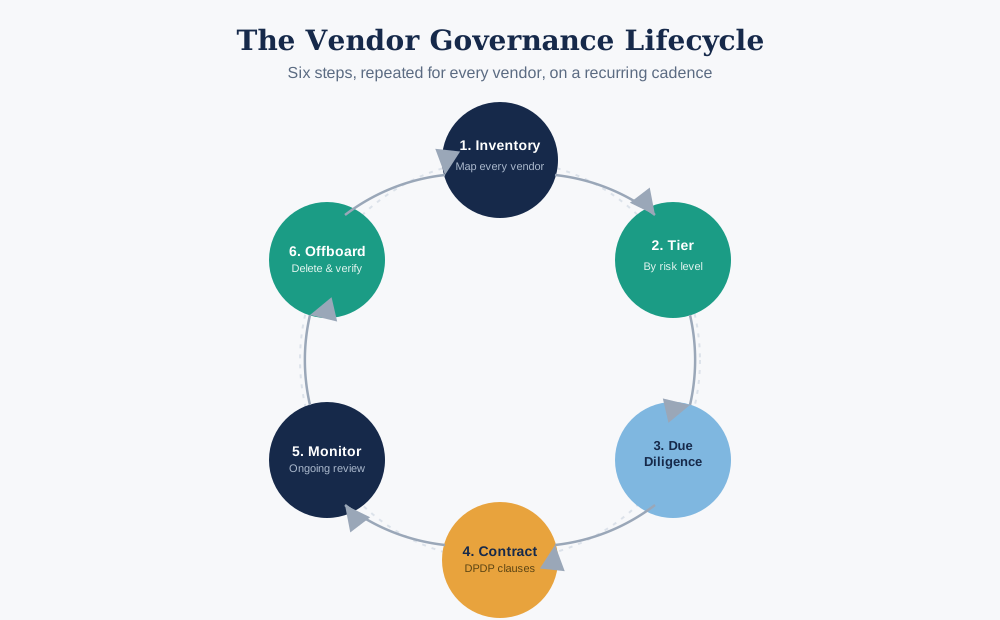
A defensible vendor governance program has six moving parts. Skipping any one of them is the most common reason organizations fail an audit or mishandle a vendor-driven breach.
Step 1: Build a Complete Vendor Inventory
You cannot govern what you haven’t mapped. Start with a single, centralized inventory covering every vendor that touches personal data — not just the “obvious” IT vendors. In healthcare, this list routinely surprises leadership teams once compiled properly: courier partners, print shops handling insurance forms, and even the AMC vendor servicing your diagnostic equipment (who may have remote access for maintenance) all belong on it.
For each vendor, capture:
- What personal data categories they access or process
- Which systems or facilities process that data
- Whether they use sub-processors
- Contract status and renewal date
- Data location (on-premise, cloud, cross-border)
Step 2: Tier Vendors by Risk
Not every vendor deserves the same scrutiny. A stationery supplier is not the same risk category as your EHR cloud host. A practical tiering model for healthcare:
| Tier | Example Vendors | Data Sensitivity | Governance Intensity |
|---|---|---|---|
| Tier 1 — Critical | EHR/HIS platform, cloud host, insurance TPA, diagnostic LIS | Full patient record, diagnosis, billing | Deep due diligence, annual audit, DPIA input, quarterly review |
| Tier 2 — Significant | Referral labs, telemedicine platform, billing software | Partial patient record, contact + diagnosis | Due diligence at onboarding, annual review, contract clause verification |
| Tier 3 — Limited | Courier, print vendor, appointment SMS gateway | Name, contact, appointment metadata | Standard contract clauses, periodic spot-check |
Step 3: Conduct Due Diligence Before Onboarding
Before a new vendor touches any patient data, due diligence should verify: security certifications (ISO 27001, SOC 2), data-handling practices, sub-processor disclosures, incident history, and — critically for smaller Indian healthcare vendors — whether they even have a written data-protection policy at all. Many will not. That’s a finding, not a disqualifier by itself, but it changes what your contract needs to mandate.
A practical scoring approach. Rather than treating due diligence as a pass/fail gate, score each prospective vendor across a small number of weighted criteria so that risk tiering (Step 2) is based on evidence rather than gut feel:
- Data sensitivity of access requested (low/medium/high) — what categories of patient data does the vendor actually need, versus what it’s asking for.
- Security maturity — presence of recognized certifications, encryption practices, and access-control discipline.
- Sub-processor complexity — does the vendor process data itself, or does it hand off to further third parties you’d need to track separately.
- Track record — any history of security incidents, and how transparently the vendor disclosed and remediated them.
- Contractual responsiveness — willingness to accept DPDP-specific clauses (short breach-notification windows, audit rights) rather than pushing back on every non-standard term, which is itself a signal worth weighting.
A vendor scoring poorly on any single high-weight criterion — for instance, a diagnostic partner that resists a written data-processing agreement entirely — should be treated as a stop-onboarding flag regardless of how it scores elsewhere, since a single unresolved gap of that kind undermines the entire governance record for that relationship.
DPDP Vendor Governance Compared to Familiar Global Standards
Many hospital groups and health-tech platforms in India already operate under, or are influenced by, international frameworks such as HIPAA (for US-linked operations) or GDPR (for European patient or partner data). It helps to know where DPDP vendor obligations overlap with these familiar models and where they diverge, so existing compliance infrastructure can be extended rather than rebuilt from zero.
The core idea — that a data controller/fiduciary remains accountable for what its processors do — is shared across all three frameworks, and organizations with an existing HIPAA Business Associate Agreement (BAA) program or a GDPR-style Data Processing Agreement (DPA) template already have much of the contractual scaffolding needed for DPDP.
The differences that matter operationally are: GDPR imposes direct statutory obligations on processors themselves, including in some cases a requirement to appoint their own Data Protection Officer, whereas the DPDP Act places that weight almost entirely on the Fiduciary, with processor obligations flowing through contract rather than direct statute. HIPAA’s Business Associate framework is narrower in scope — it applies specifically to protected health information within defined “covered entity” relationships — while the DPDP Act’s Data Fiduciary/Processor framework applies broadly to any personal data processing relationship, health-specific or not, with no separate heightened category for health data itself.
And critically, the DPDP Act’s breach-notification regime has no risk-based exception: every breach must be notified to both the regulator and every affected individual, a stricter default than GDPR’s materiality threshold for notifying data subjects.
The practical takeaway for a compliance team already running a HIPAA or GDPR vendor program: map your existing BAA or DPA clause library against the DPDP-specific requirements above (particularly the shorter breach-notification window and the non-delegable liability framing), rather than assuming existing paperwork already covers Indian obligations.
Step 4: Lock In DPDP-Compliant Contract Clauses
Bring legal, compliance, and IT security into the same contract-review workflow so that every vendor agreement includes the following, at minimum:
- Scope-limited processing instructions — a precise description of what data the vendor may process, for what purpose, and for how long, rather than an open-ended “as needed for services” clause.
- Breach-notification timelines shorter than the regulatory 72-hour clock — a common and sensible standard is 24 to 48 hours from the vendor becoming aware of an incident, giving your organization real room to investigate and meet its own downstream notification obligations to the Board and affected patients.
- Security-safeguard commitments, ideally referencing a named standard (ISO 27001, SOC 2) plus specific DPDP-relevant controls such as encryption at rest and in transit, access logging, and role-based access restrictions.
- Data principal rights cooperation — a defined turnaround time within which the vendor must locate, correct, or delete a specific patient’s data on instruction.
- Sub-processor restrictions and disclosure — a requirement that the vendor cannot appoint a new sub-processor without notifying you, and that any sub-processor is bound by equivalent obligations.
- Audit rights — your organization’s contractual right to request evidence of compliance, or in higher-risk cases, to conduct or commission an on-site or remote audit.
- Deletion and return obligations at termination, specifying the exact format of proof required (a certificate of destruction, a data-return manifest) rather than a bare promise.
- Cross-border processing disclosure, where applicable, specifying data location and any restricted-jurisdiction considerations as covered in Section 3.8 above.
- Liability and indemnity allocation — while this does not shift regulatory liability away from your organization, it determines who bears the financial cost of remediation, penalties passed through by agreement, and patient-notification expenses.
Treat this as a standard clause library maintained by legal and compliance together, applied consistently across every new and renewed vendor contract, rather than negotiated from scratch each time. Consistency here is what makes an audit trail credible — a Data Protection Board reviewer is far more reassured by twenty contracts following one clause template than by twenty contracts that each look different.
Step 5: Monitor Continuously, Not Just at Signing
A signed contract is a snapshot, not a guarantee. Ongoing governance means scheduled compliance reviews, renewal reminders before certifications lapse, periodic re-assessment of risk tier (a vendor that expands scope, say from billing to full record access, needs to move up a tier), and audit trails showing when each review happened and what was found.
Step 6: Govern the Exit, Not Just the Relationship
Vendor offboarding is where governance most often collapses. When a contract ends, you need documented proof that the vendor deleted or returned all patient data — including backups, and including any data cached by sub-processors. Without this, “data return and destruction” is just a clause nobody ever checked.
Part 5: Common Mistakes Healthcare Organizations Make
Treating vendor governance as a one-time legal exercise. Signing an updated contract once and considering the job done ignores that risk changes over time — new sub-processors, expanded data access, expired certifications.
No visibility into sub-processors. Your lab vendor’s diagnostic software company, who in turn uses a cloud host — each additional hop is a data-processing relationship you may not even know exists until something goes wrong.
Assuming certifications equal compliance. As noted earlier, SOC 2 or ISO 27001 is evidence, not proof — DPDP-specific obligations (breach notification timing, rights cooperation, deletion triggers) are not automatically covered by generic security certifications.
Breach-notification clauses with no real teeth. A clause saying the vendor will “notify promptly” without a defined hour-based window means, in practice, you find out when it’s convenient for them — not when the regulatory clock demands it.
No single source of truth. Vendor contracts in legal’s inbox, security assessments in IT’s spreadsheet, and audit reminders in someone’s calendar — with no centralized system connecting them, gaps are discovered only during a crisis or an actual regulator inquiry.
Ignoring physical-world vendors. Courier services carrying labeled biological samples, print vendors handling insurance claim forms with diagnosis codes, and document-shredding contractors are all Data Processors too, and are frequently left out of “IT vendor” reviews entirely.
Reviewing vendors only at contract renewal. Renewal cycles are often two or three years apart in healthcare IT contracts, which means a vendor’s risk profile can drift substantially — new sub-processors, expanded access, a security incident at the vendor that never reached your desk — long before anyone revisits the relationship. Governance built only around renewal dates misses everything that happens in between.
Confusing “we have a contract” with “we’re governed.” A signed agreement sitting in a legal folder is not the same as an active governance relationship. The organizations that struggle most after an incident are typically the ones that can produce a contract but cannot produce evidence that anyone checked whether the vendor was actually following it.
Part 6: Best Practices Checklist
- Maintain one centralized, continuously updated vendor inventory — not a static spreadsheet reviewed once a year
- Tier every vendor by data sensitivity and processing scope
- Require signed, DPDP-compliant contracts before any data access is granted — no exceptions for “trusted” long-term vendors
- Set contractual breach-notification windows shorter than the regulatory clock
- Verify — don’t assume — vendor security certifications and sub-processor disclosures
- Build vendor risk assessments into your annual DPIA if you are or expect to be a Significant Data Fiduciary
- Schedule recurring compliance reviews with automated reminders before certifications or contracts lapse
- Document every due-diligence check, review, and audit — the paper trail is your defense in a regulatory inquiry
- Verify data deletion or return at every contract termination, including backups and sub-processor copies
- Assign clear internal ownership — someone needs to be accountable for the vendor governance program end to end
Part 6a: Measuring Whether Your Vendor Governance Program Is Actually Working
A checklist tells you what to do; a small set of ongoing metrics tells you whether it’s holding up in practice. Healthcare compliance teams that move past a one-time policy rollout typically track:
- Percentage of active vendors with a current, signed DPDP-compliant contract — the single most important number, and the one most likely to be uncomfortably low the first time it’s actually measured.
- Percentage of Tier 1 vendors with a due-diligence review completed in the last 12 months — a lapsed review on your highest-risk vendors is a materially different problem than a lapsed review on a print vendor.
- Average time from vendor-reported incident to internal escalation — a proxy for whether your breach-notification clauses are working in practice, not just on paper.
- Number of vendor relationships with no documented risk tier at all — ideally zero, and a number worth reporting to leadership specifically because it tends to surface previously invisible relationships (a long-standing referral lab, a courier engaged informally by a department without procurement’s knowledge).
- Certification and audit expiry dates falling due in the next 90 days — tracked proactively rather than discovered after the fact.
None of these metrics require sophisticated tooling to define, but they do require a system that can actually produce them on demand — which is exactly where manual, spreadsheet-based tracking tends to fail even well-intentioned compliance teams.
Part 7: Why Manual Vendor Governance Breaks Down at Scale
For a five-vendor clinic, a shared spreadsheet and a folder of contracts might survive an audit. For a hospital chain with dozens of locations, hundreds of empanelled labs, several insurance TPAs, and a rotating set of technology partners, manual tracking has three predictable failure points:
- Nobody remembers a certification expired until an incident forces a review — by which point the vendor has been operating out-of-compliance for months.
- Documentation is scattered across legal, procurement, IT, and compliance teams, so no single person can produce a complete audit trail on demand.
- Risk tiering never gets revisited, so a vendor that quietly expanded its scope of access two years ago is still being governed at its original, lower-risk tier.
This is exactly the operational gap that purpose-built compliance automation platforms are designed to close.
How RuleExpert Operationalizes Healthcare Vendor Governance
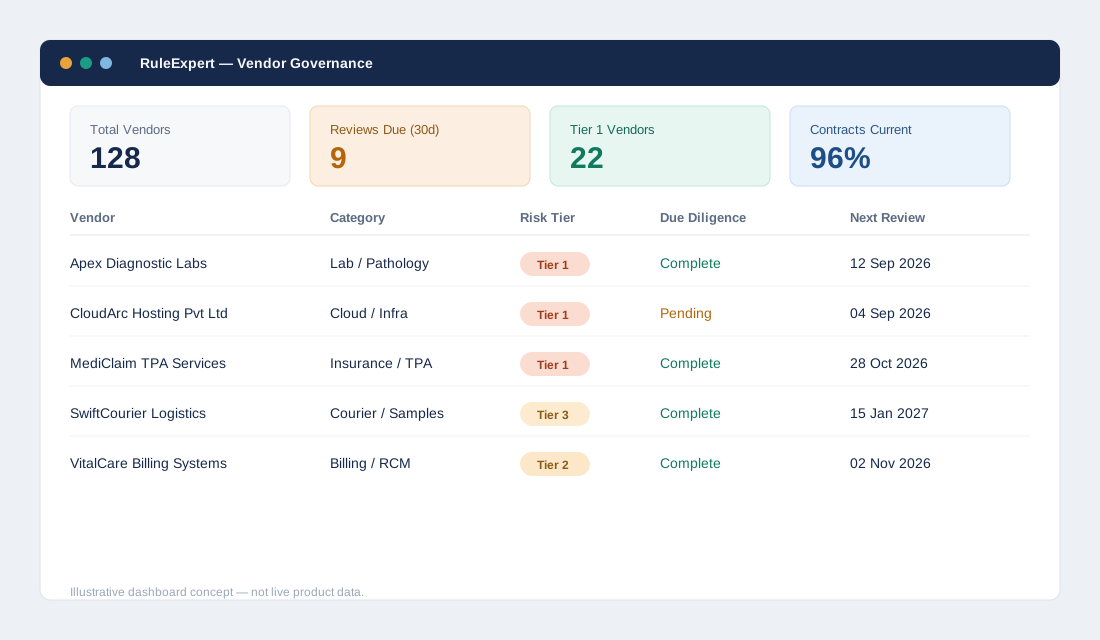
RuleExpert is an AI-powered DPDP compliance platform built to turn the framework above from a policy document into a running, auditable system. Its Vendor Governance module maps directly onto the six-step framework:
- Vendor inventory — a centralized, searchable record of every third party processing personal data on your behalf, replacing scattered spreadsheets across legal, IT, and procurement.
- Vendor risk assessments — structured, repeatable assessments that apply consistent risk criteria across every vendor, so tiering isn’t left to individual judgment calls.
- Due diligence tracking — a documented workflow for every pre-onboarding check, so evidence of diligence exists before you ever need it in an inquiry.
- Compliance reviews and review reminders — scheduled, automated reminders before contracts, certifications, or risk assessments lapse, closing the “nobody remembered” failure mode.
- Vendor documentation — a single repository for contracts, security attestations, and audit records tied to each vendor profile.
- Third-party governance dashboards — executive-level visibility into vendor risk posture across the entire organization, not just the vendor a compliance officer happens to be reviewing that week.
Because Vendor Governance sits on the same platform as RuleExpert’s Breach Management, DSR Automation, and Consent Manager modules, a vendor-driven incident doesn’t require jumping between disconnected tools — a breach reported by a lab vendor can be logged, investigated, and tracked toward the DPDP Rules’ notification timelines within the same audit trail that documents the vendor’s original risk assessment and contract terms.
For a Significant Data Fiduciary, that same vendor risk data feeds directly into DPIA documentation, rather than being reconstructed manually every time an assessment is due.
The result is not just “faster paperwork” — it’s the difference between being able to answer a Data Protection Board inquiry with a complete, time-stamped record, versus reconstructing your vendor governance history under pressure after an incident has already happened.
Quick-Reference: Vendor Onboarding Checklist
Use this as a fast pre-onboarding gate for any new vendor that will touch patient personal data — clinical, IT, logistics, or otherwise.
- Has the vendor’s data access requirement been documented and scoped to the minimum necessary?
- Has the vendor been assigned a risk tier based on data sensitivity and access breadth?
- Has due diligence been completed and scored, including sub-processor disclosure?
- Is there a signed, DPDP-compliant contract in place before any data access is granted?
- Does the contract specify a breach-notification window shorter than the regulatory 72-hour clock?
- Does the contract specify data-principal-rights cooperation timelines?
- Does the contract specify retention limits and a deletion/return process at termination?
- Has the vendor’s security certification (if any) been independently verified rather than taken at face value?
- Has the vendor relationship been logged in the central vendor inventory with a scheduled next-review date?
- Has internal ownership for ongoing monitoring of this specific vendor been assigned to a named individual or team?
If any of the first four items cannot be answered “yes,” data access should not begin — regardless of onboarding timeline pressure from clinical or business teams.
Frequently Asked Questions
1. What is healthcare vendor governance under the DPDP Act? It is the structured process of identifying, assessing, contracting, and continuously monitoring every third party — labs, TPAs, cloud hosts, billing vendors, couriers — that processes patient personal data on behalf of a healthcare Data Fiduciary, so that the organization can demonstrate compliance with the DPDP Act even though the vendor, not the organization itself, is handling the data day to day.
2. Is a diagnostic lab a “Data Processor” under the DPDP Act? Generally yes, when the lab processes patient data strictly on the instructions of the hospital or referring entity for a defined purpose. If the same lab independently decides how patient data is used beyond those instructions, it may itself be treated as a Data Fiduciary for that processing.
3. Can a vendor contract shift DPDP liability away from the hospital? No. The Act makes the Data Fiduciary responsible for DPDP compliance in respect of processing done on its behalf, irrespective of any contractual arrangement to the contrary. Contracts can allocate cost and remedy between the parties, but they cannot shift regulatory liability away from the Fiduciary.
4. How quickly must a vendor notify a hospital of a data breach? The DPDP Rules set the regulatory clock from the moment the Data Fiduciary becomes aware of a breach, not the vendor. This is exactly why vendor contracts need their own, shorter internal notification deadline — so the hospital has time to investigate and meet its own regulatory notification obligations to the Data Protection Board and affected patients.
5. What documents should a hospital request from every vendor before onboarding? At minimum: a signed DPDP-compliant data-processing agreement, evidence of security certification (such as ISO 27001 or SOC 2), a description of any sub-processors used, and a defined data-retention and deletion commitment.
6. Do courier and logistics partners count as vendors under vendor governance? Yes. Any third party handling personal data — including physical samples or documents bearing patient names, contact details, or diagnoses — is within scope of vendor governance, even if the organization thinks of it purely as a “logistics” relationship rather than a “data” one.
7. What is a Significant Data Fiduciary, and does it change vendor obligations? A Significant Data Fiduciary is a Data Fiduciary designated by the government based on the volume and sensitivity of data it processes, and its potential impact on data principals and India’s sovereignty and security. SDFs carry additional obligations, including appointing a Data Protection Officer and conducting annual Data Protection Impact Assessments and independent data audits — both of which typically require a mature vendor risk inventory as an input.
8. How often should vendor risk assessments be repeated? At minimum annually for higher-risk (Tier 1) vendors, and whenever a vendor’s scope of data access materially changes — for example, if a billing vendor is granted access to clinical notes it didn’t previously touch.
9. What happens to patient data when a vendor contract ends? The vendor is expected to delete or return all personal data once the processing purpose is fulfilled, including data held in backups or by sub-processors. This should be a documented, verifiable step in offboarding, not an assumption.
10. Can compliance automation software replace legal review of vendor contracts? No — automation platforms like RuleExpert are built to structure, track, and document the vendor governance process (inventory, risk tiering, due diligence, review scheduling, audit trails), not to replace legal judgment on contract language. The two work together: legal defines the required clauses, and the platform ensures every vendor actually has them, keeps them current, and can prove it.
Conclusion: Governance Is the Only Real Shield You Have
The DPDP Act does not expect healthcare organizations to eliminate vendor risk — that would be impossible in a system this outsourcing-dependent. What it expects, and what the Data Protection Board will look for, is evidence of reasonable, ongoing governance: a vendor inventory that’s actually complete, contracts that actually contain the required clauses, due diligence that actually happened before onboarding, and a monitoring cadence that catches problems before a regulator or a patient does.
With full enforcement and penalties arriving in May 2027, the organizations that will be least exposed are not necessarily the ones with the fewest vendors — they’re the ones that can produce a complete, time-stamped governance record the moment they’re asked for one.
If your organization is still tracking vendor compliance across spreadsheets, email threads, and a shared drive, now is the point to change that — not after your first Data Protection Board inquiry.
Nitin Ray, Compliance Manager at RuleExpert, leads initiatives helping organizations align with India’s evolving data protection regulations, including the Digital Personal Data Protection Act, 2023. His work bridges regulatory requirements and practical implementation — helping startups, SaaS companies, and enterprises operationalize DPDP compliance through structured workflows, consent lifecycle management, Data Subject Request handling, and proactive risk identification, using automation to move organizations from manual compliance processes to scalable, audit-ready systems.
Sources: Ministry of Electronics and Information Technology — Digital Personal Data Protection Act, 2023 (official text); Press Information Bureau, Government of India — DPDP Rules, 2025 notification (November 14, 2025); General Data Protection Regulation (EU) 2016/679 — official consolidated text; Shardul Amarchand Mangaldas & Co. — Enforcement of the DPDP Act and notification of the DPDP Rules.