

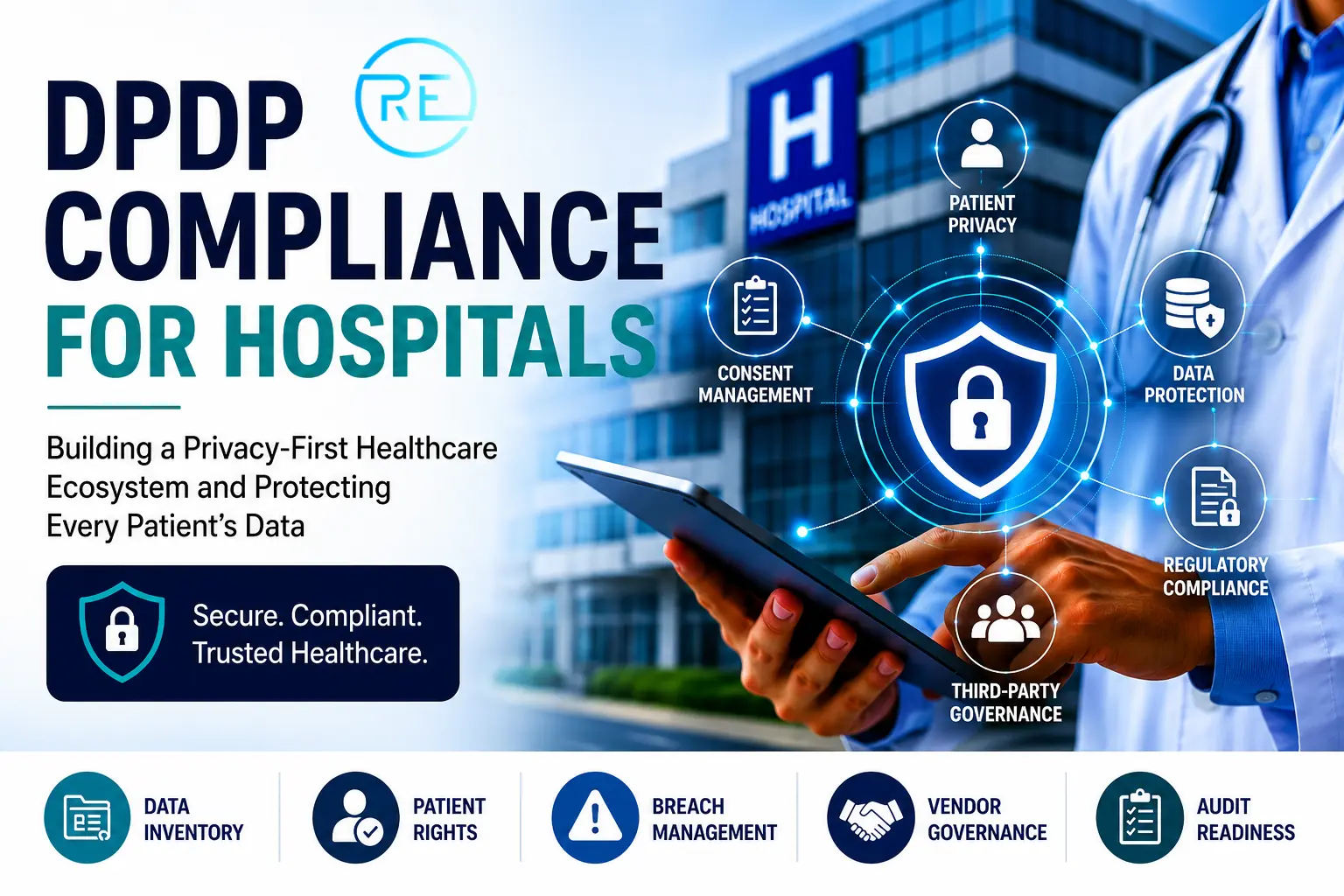
Healthcare is becoming increasingly digital.
From online appointment booking and Electronic Health Records (EHRs) to diagnostic reports, telemedicine, mobile health apps, and insurance processing, hospitals process enormous volumes of personal data every day.
This digital transformation has improved patient care, but it has also increased the responsibility of healthcare organizations to manage personal data responsibly.
The Digital Personal Data Protection (DPDP) Act, 2023 provides India’s legal framework for processing digital personal data. For Healthcare, DPDP compliance is not just about meeting regulatory expectations—it’s about strengthening patient trust, improving operational governance, and building privacy-first healthcare services.
Why DPDP Compliance Matters for Hospitals
Every interaction between a hospital and a patient generates personal information.
This may include:
- Registration details
- Identity documents
- Medical history
- Diagnostic reports
- Laboratory results
- Radiology images
- Prescription records
- Insurance information
- Payment details
- Emergency contacts
This information often moves across multiple systems and departments throughout the patient’s journey.
For example:
- Reception
- OPD
- IPD
- Laboratory
- Radiology
- Pharmacy
- Billing
- Insurance Desk
- Telemedicine Platforms
- Third-party Laboratories
As hospitals continue to digitize operations, maintaining visibility over how patient data is collected, processed, shared, and protected becomes increasingly important.
Understanding DPDP Compliance in a Hospital Environment
DPDP compliance is not a single activity or document.
It involves creating structured governance practices for handling digital personal data throughout its lifecycle.
For hospitals, this includes:
- Understanding what patient data is processed
- Identifying where personal data resides
- Managing patient consent where applicable
- Responding to Data Principal requests
- Governing third-party data processing
- Managing personal data breach incidents
- Maintaining appropriate documentation and accountability
Rather than viewing compliance as a legal exercise, hospitals should treat it as part of good clinical governance and responsible digital healthcare.
Common DPDP Compliance Challenges Hospitals Face
1. Patient Data Is Spread Across Multiple Systems
Most hospitals use several digital platforms simultaneously.
A patient’s information may exist in:
- Hospital Information System (HIS)
- Electronic Health Records (EHR)
- Laboratory software
- Radiology Information System
- Pharmacy software
- Billing software
- Insurance portals
- Email communications
- Shared folders
- Cloud storage
Without a centralized view, locating all personal data associated with a patient can become difficult.
2. Managing Patient Consent
Many healthcare interactions involve obtaining patient consent.
Examples include:
- Admissions
- Surgeries
- Diagnostics
- Teleconsultations
- Clinical research
Hospitals often struggle with:
- Paper-based consent forms
- Multiple consent versions
- Lost documents
- Consent retrieval during audits
- Tracking updates or withdrawals where applicable
It is important to note that not every healthcare processing activity relies solely on consent. Depending on the circumstances, the DPDP Act also recognizes certain lawful grounds for processing. Hospitals should determine the appropriate legal basis for each activity.
3. Responding to Data Principal Requests
The DPDP Act recognizes certain rights for Data Principals regarding their personal data.
Healthcare organizations may receive requests related to:
- Access to personal information
- Correction of inaccurate information
- Erasure where applicable
Responding consistently requires collaboration across multiple departments and systems.
4. Third-Party Data Processing
Hospitals routinely work with external organizations, including:
- Diagnostic laboratories
- Insurance providers
- Cloud service providers
- Health-tech platforms
- IT vendors
- Payment gateways
Appropriate governance over third-party processing helps improve transparency and accountability across the healthcare ecosystem.
5. Managing Personal Data Breaches
Not every personal data breach is caused by hackers.
Common healthcare incidents include:
- Reports sent to the wrong patient
- Unauthorized access to records
- Lost laptops or portable devices
- Incorrect file sharing
- Vendor-related processing errors
A structured breach management process helps hospitals investigate incidents, coordinate teams, maintain documentation, and improve operational readiness.
Best Practices for DPDP Compliance in Hospitals
Conduct a DPDP Readiness Assessment
Before implementing new processes, hospitals should understand their current privacy maturity.
A readiness assessment helps identify gaps in governance, documentation, and operational workflows.
Build a Data Inventory
Hospitals should maintain an up-to-date inventory of:
- Personal data collected
- Processing activities
- Systems storing data
- Departments accessing data
- Third-party processors
Data visibility is the foundation of effective privacy governance.
Strengthen Consent Management
Where consent is the appropriate legal basis, hospitals should maintain:
- Searchable consent records
- Version history
- Timestamped evidence
- Consent updates
- Retrieval capabilities
Standardize Operational Workflows
Hospitals should document processes for:
- Data Principal requests
- Internal approvals
- Incident reporting
- Breach response
- Vendor reviews
Standardization improves consistency and accountability.
Govern Third-Party Relationships
Hospitals should regularly review vendors handling personal data and maintain appropriate contractual and governance controls.
Maintain Documentation
Well-maintained documentation supports:
- Internal governance
- Risk management
- Operational consistency
- Regulatory preparedness
How Compliance Automation Can Help Hospitals
Managing privacy governance through spreadsheets, paper records, and disconnected systems becomes increasingly difficult as hospitals grow.
Compliance automation can help organizations:
- Centralize governance activities
- Track consent records
- Map personal data
- Coordinate Data Principal requests
- Monitor vendor compliance
- Manage incidents
- Maintain governance documentation
Automation reduces manual effort while improving visibility across privacy operations.
How RuleExpert Supports DPDP Compliance for Hospitals
RuleExpert is an AI-powered compliance automation platform designed to help organizations strengthen privacy governance and streamline DPDP compliance operations.
For healthcare organizations, RuleExpert supports key operational areas, including:
- DPDP Readiness Assessments
- Consent Management
- Data Registry
- DSR (Data Principal Request) Automation
- Vendor Governance
- Breach Management
- Compliance Monitoring
- Governance Documentation
By centralizing compliance workflows, hospitals can improve operational visibility, reduce manual processes, and strengthen accountability across departments.
DPDP Compliance Is More Than a Regulatory Requirement
Hospitals have always been trusted with patients’ most personal information.
As healthcare becomes increasingly digital, protecting that information requires structured governance—not just technology.
DPDP compliance provides hospitals with an opportunity to improve privacy practices, strengthen operational processes, and build greater patient confidence.
Organizations that invest in privacy governance today will be better prepared to support responsible, resilient, and patient-centric healthcare tomorrow.
Frequently Asked Questions (FAQ)
What is DPDP compliance for hospitals?
DPDP compliance refers to implementing governance practices that help hospitals process digital personal data responsibly in accordance with the Digital Personal Data Protection Act, 2023.
Why is DPDP important for healthcare organizations?
Healthcare organizations process large volumes of sensitive personal data. Strong privacy governance helps improve patient trust, accountability, and operational efficiency.
Does every healthcare activity require patient consent?
Not necessarily. Depending on the circumstances, processing may rely on consent or other lawful grounds recognized under the DPDP Act. Hospitals should evaluate the appropriate legal basis for each processing activity.
What are the biggest DPDP compliance challenges for hospitals?
Common challenges include managing consent, identifying where patient data resides, responding to Data Principal requests, governing third-party processors, and handling breach incidents effectively.
How can RuleExpert help hospitals?
RuleExpert helps hospitals centralize privacy governance through DPDP readiness assessments, consent management, DSR automation, data registry, vendor governance, breach management, and compliance monitoring.
1 Comment
Comments are closed.