

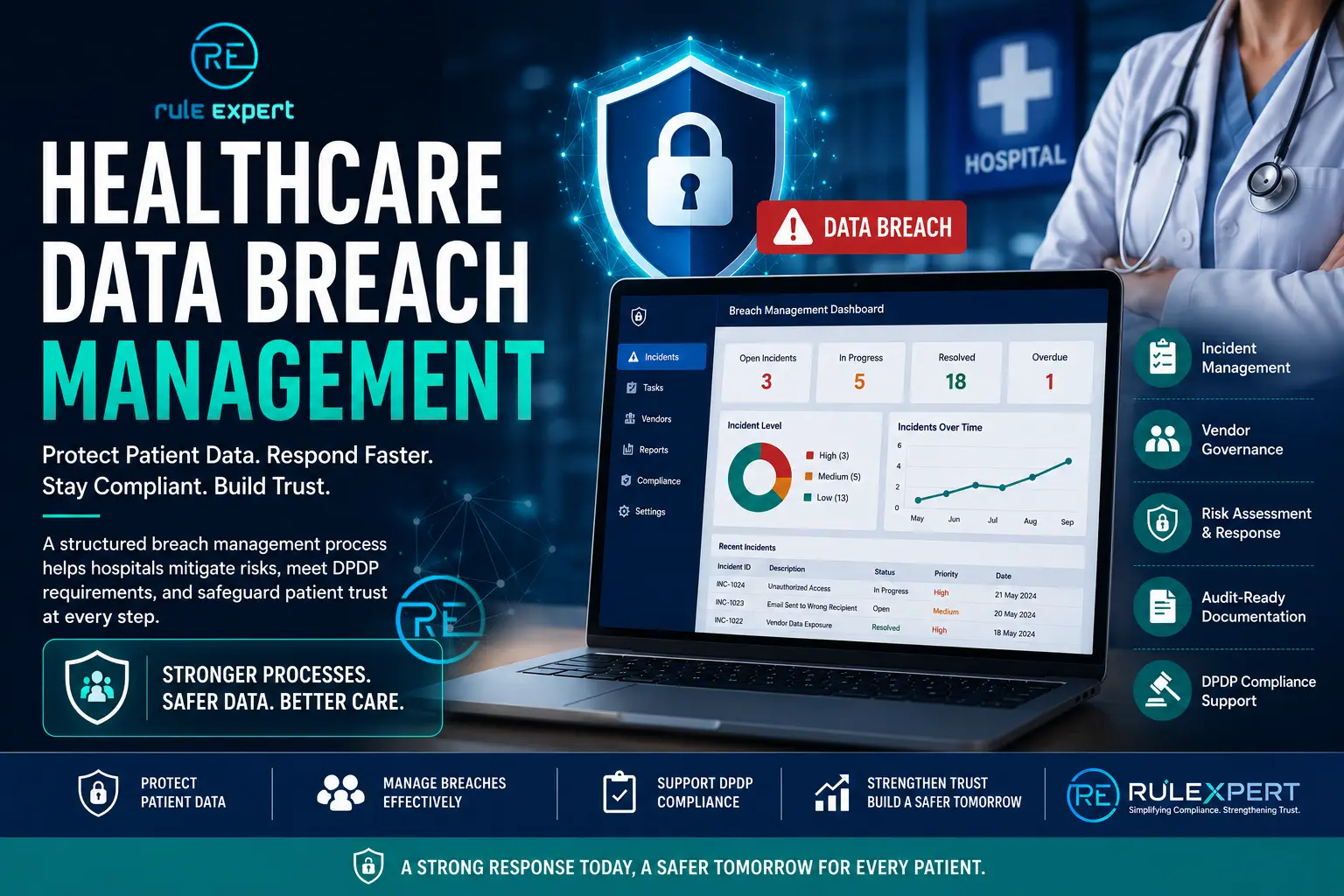
“Healthcare Data Breach Management is essential for hospitals and healthcare organizations that process sensitive patient information in today’s digital environment. This blog explores what constitutes a healthcare data breach under the DPDP Act, common causes of breaches, and the operational, financial, regulatory, and reputational challenges hospitals may face. It also covers best practices for effective healthcare data breach management, including centralized incident reporting, clear ownership, audit-ready documentation, vendor risk management, and structured incident response. Learn how RuleExpert’s Breach Management solution helps healthcare organizations streamline investigations, improve accountability, strengthen DPDP compliance, and protect patient trust through a centralized and governance-driven approach.”
Healthcare organizations are trusted with some of the most sensitive personal information imaginable—from medical histories and diagnostic reports to insurance details, prescriptions, and emergency contacts.
As hospitals embrace Electronic Health Records (EHRs), Hospital Information Systems (HIS), telemedicine platforms, and cloud-based healthcare solutions, patient information flows across multiple departments and digital systems every day.
While digital transformation improves patient care, it also increases the risk of personal data breaches.
The Digital Personal Data Protection (DPDP) Act, 2023 emphasizes responsible processing of digital personal data. DPDP Compliance for Hospitals, this means having appropriate safeguards and being prepared to respond effectively if a personal data breach occurs.
Breach management is no longer just an IT responsibility—it’s an essential part of modern healthcare governance.
What is a Personal Data Breach in Healthcare?
A personal data breach is an incident that results in the accidental or unauthorized access, disclosure, loss, alteration, or destruction of personal data.
In a hospital environment, this could involve:
- Patient reports emailed to the wrong person
- Unauthorized access to Electronic Medical Records (EMR)
- Lost laptops or tablets containing patient information
- Incorrect sharing of diagnostic reports
- Third-party vendors exposing patient data
- Misconfigured cloud storage
- Ransomware attacks affecting hospital systems
- Paper medical records scanned into the wrong patient profile
Not every breach is caused by cybercriminals. Many incidents occur because of operational errors, weak internal controls, or communication gaps.
Why Breach Management Matters for Hospitals
When a breach occurs, every minute matters.
Hospital leadership must quickly understand:
- Which patient records were affected?
- What type of personal data was exposed?
- Which systems were involved?
- Who discovered the incident?
- Has the breach been contained?
- Who is responsible for coordinating the response?
- What evidence has been documented?
- Are regulatory notifications required?
Without a structured breach management process, hospitals may struggle to answer these questions efficiently.
Common Breach Management Challenges in Healthcare
1. Patient Data Exists Across Multiple Systems
Patient information is rarely stored in a single application.
A hospital may use:
- Hospital Information System (HIS)
- Electronic Medical Records (EMR/EHR)
- Laboratory Information System (LIS)
- Radiology Information System (RIS)
- Pharmacy software
- Billing systems
- Insurance portals
- Telemedicine applications
- Cloud storage
- Email platforms
When a breach occurs, identifying every affected system becomes a significant challenge.
2. Delayed Incident Reporting
Many hospitals rely on informal communication such as:
- Phone calls
- Emails
- Messaging apps
Without a centralized reporting mechanism, incidents may not reach the appropriate team quickly enough.
3. Lack of Clear Ownership
A breach often involves multiple departments:
- IT
- Information Security
- Clinical Operations
- Compliance
- Legal
- Hospital Administration
- HR
- External Vendors
Without clearly defined responsibilities, incident response can become fragmented and delayed.
4. Poor Documentation
Hospitals frequently struggle to maintain complete records of:
- Incident timelines
- Investigation findings
- Risk assessments
- Internal approvals
- Corrective actions
- Communication with stakeholders
Good documentation supports accountability and helps organizations learn from incidents.
5. Third-Party Risks
Healthcare organizations regularly share patient information with:
- Diagnostic laboratories
- Insurance providers
- Cloud hosting partners
- HealthTech vendors
- Telemedicine platforms
If a vendor experiences a breach, hospitals need a structured process to coordinate investigations and understand the potential impact on patient data.
DPDP Act and Healthcare Data Breaches
The DPDP Act requires organizations processing digital personal data to implement reasonable security safeguards to prevent personal data breaches.
If a personal data breach occurs, Data Fiduciaries are required to notify the Data Protection Board of India and affected Data Principals in the manner prescribed under the Act and applicable Rules.
For hospitals, this highlights the importance of:
- Strong security controls
- Clear incident response procedures
- Timely assessment of breaches
- Accurate documentation
- Defined governance processes
What Can Happen After a Patient Data Breach?
A breach can affect more than just IT systems.
Operational Disruption
- Clinical workflows may be interrupted.
- Staff may spend significant time investigating the incident.
- Critical systems may become temporarily unavailable.
Loss of Patient Trust
Patients expect hospitals to safeguard their personal information.
A breach can reduce confidence in the organization’s ability to protect sensitive health data.
Financial Costs
Hospitals may incur expenses related to:
- Incident response
- Technical investigations
- Legal advice
- Patient communication
- System recovery
- Additional security improvements
Regulatory Consequences
Where organizations fail to meet their obligations under the DPDP Act, the Data Protection Board of India may impose monetary penalties after considering the facts and circumstances of the case.
For example, failure to implement reasonable security safeguards may attract penalties of up to ₹250 crore, depending on the nature of the violation as provided in the Act.
Best Practices for Healthcare Breach Management
Develop a Breach Response Plan
Create documented procedures for:
- Incident reporting
- Investigation
- Risk assessment
- Escalation
- Communication
- Recovery
Define Roles and Responsibilities
Ensure every department understands its responsibilities before an incident occurs.
Centralize Incident Reporting
Provide a single platform where staff can report incidents consistently.
Maintain Audit-Ready Documentation
Record:
- Incident timelines
- Investigation notes
- Risk assessments
- Corrective actions
- Lessons learned
Review Third-Party Vendors
Regularly assess vendors handling patient information and establish clear communication channels for incident reporting.
Conduct Periodic Training
Educate employees on recognizing and reporting potential privacy incidents to reduce the likelihood of operational errors.
How RuleExpert Helps in healthcare data breach management
Managing breaches through emails, spreadsheets, and disconnected systems often leads to delays and incomplete documentation.
RuleExpert’s Breach Management solution helps hospitals streamline incident response through a centralized, structured workflow.
Healthcare organizations can:
- Report incidents from a single platform
- Assign responsibilities across teams
- Track investigations and corrective actions
- Maintain evidence and documentation
- Monitor response progress
- Support DPDP compliance efforts
- Improve governance and audit readiness
By centralizing breach management, hospitals can respond more efficiently, improve accountability, and strengthen patient data governance.
Conclusion
In healthcare, protecting patient data is just as important as delivering quality care.
While no hospital can eliminate every security risk, every hospital can improve how it prepares for and responds to personal data breaches.
A structured breach management program helps healthcare organizations reduce operational disruption, strengthen governance, support DPDP compliance, and maintain patient trust.
As digital healthcare continues to evolve, hospitals that invest in proactive breach management will be better positioned to protect both their patients and their reputation.
Nitin Ray is a thought leader in DPDP compliance, healthcare data privacy, and governance technology. He regularly writes about data protection, privacy governance, AI compliance, vendor governance, breach management, and regulatory best practices. His mission is to help hospitals, healthcare providers, and enterprises build stronger compliance frameworks, protect sensitive personal data, and adopt technology-driven governance solutions that support long-term digital trust.
Frequently Asked Questions
1. What is a healthcare data breach?
A healthcare data breach is an incident involving the unauthorized access, disclosure, loss, alteration, or destruction of patient personal data or health information.
2. Does the DPDP Act apply to hospitals?
Yes. Hospitals and healthcare organizations that process digital personal data are subject to the DPDP Act and should implement appropriate privacy and security governance measures.
3. What are common causes of patient data breaches?
Common causes include human error, unauthorized access, phishing attacks, lost devices, ransomware, third-party vendor incidents, and misconfigured systems.
4. What should a hospital do after a personal data breach?
Hospitals should activate their breach response process, investigate the incident, assess its impact, document actions taken, implement corrective measures, and comply with applicable notification requirements under the DPDP Act.
5. How does RuleExpert support healthcare breach management?
RuleExpert provides a centralized platform for incident reporting, investigation workflows, responsibility assignment, documentation management, corrective action tracking, and compliance monitoring—helping hospitals strengthen their breach response and privacy governance.