November 13 is the day Consent Manager registration became real. For most of the day it was a date and little else. Then the Data Protection Board’s website, dpbi.gov.in, published what applicants had waited a year for: a Pre-Requisite Documents page listing exactly what to bring.
This post walks through that checklist, shows how to prepare in a sensible order, and names the one problem no document can fix.
Quick answer: Consent Manager registration opened on 13 November 2026 under Rule 4 of the DPDP Rules. The Board’s Pre-Requisite Documents page lists 17 mandatory documents, each as a PDF of up to 8 MB. They include CA certificates for turnover and a net worth of at least ₹2 crore, and articles that bind the company to Part B conflict rules.
What opened on 13 November
Rule 1(3) of the DPDP Rules, 2025 brings Rule 4 into force one year after the Gazette’s publication. Rule 4 and Section 6(9) of the DPDP Act, 2023 are now live, so a company meeting Part A of the First Schedule can apply to the Board.
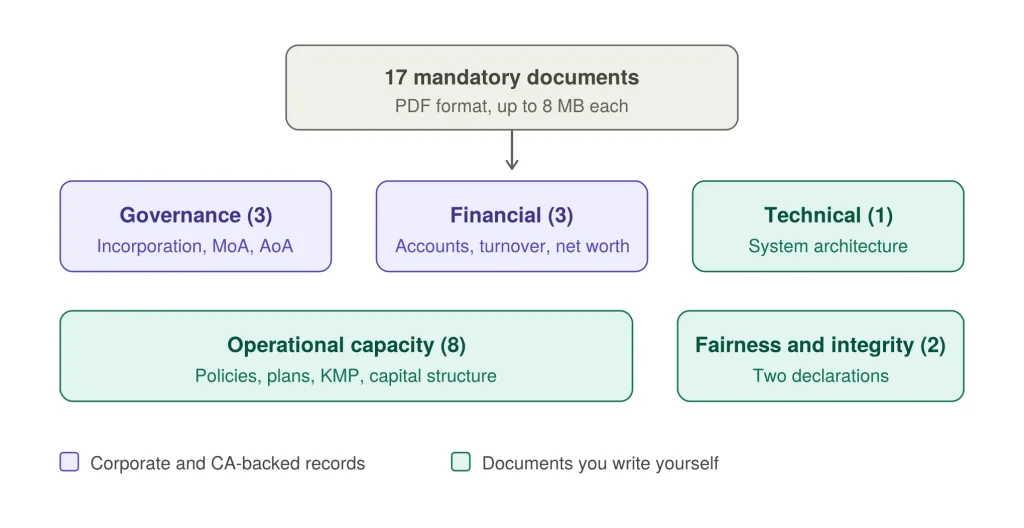
The Board’s readiness page sets the ground rules. All 17 documents carry an asterisk, so all are mandatory. Files must be PDFs, preferably machine readable, up to 8 MB each. By applying, the company confirms that its information is true, accurate and complete, and that it will meet Part A and, once registered, Part B.
The portal also has an option to apply for registration, so the checklist is not just a preview. A status tracker has been reported too, which we have not confirmed. The readiness page states no decision deadline. Rule 4(2) says the Board will publish the particulars of each registered applicant on its website, and we found no registered Consent Manager yet.
The 17 documents
Group
Documents
What the Board specifies
Governance (3)
Certificate of Incorporation; Memorandum of Association; Articles of Association
Both the MoA and the AoA must require adherence to Part B items 9 and 10 (no conflict of interest), and allow amendment only with the Board’s prior approval
Financial (3)
Audited financial statements; annual turnover certificates; net worth certificate
Last three financial years. Turnover and net worth certificates come from a practising CA on letterhead, and net worth must be at least ₹2 crore. See our net worth guide
Technical (1)
System architecture overview
Must conform to Part B and cover platform overview, interoperability, security safeguards, hosting, consent lifecycle, data-blind design, record-keeping and availability
Operational capacity (8)
Statement of operational capacity; KMP and senior management; board governance structure; conflict-of-interest policy; internal audit and compliance monitoring plan; business continuity plan; business and capability plan; capital structure
The statement is signed by an authorised signatory. The audit plan must say how outcomes are reported to the Board. The continuity plan must cover what happens if you stop operating
Fairness and integrity (2)
“Fit and proper” declaration; declaration that operations serve Data Principals
The first covers directors, KMP and senior management, and adds that none has a regulatory debarment
All 17 are mandatory, and each is a PDF of up to 8 MB.
Younger companies get allowances. With fewer than three years, upload every audited statement you have. With none, upload the latest balance sheet signed by a director and certified by a CA. Before the first financial year closes, the turnover certificate becomes a CA-certified provisional profit and loss statement.
The capital structure is the document most founders underestimate. It must show authorised, issued and paid-up capital, every shareholder above 2%, and any body corporate where a promoter, director, KMP or senior manager holds more than 2%.
One gap deserves a question to the Board. Part A item 9 says it must be “independently certified” that the platform is consistent with standards the Board will publish. The 17-document list has no certification report. Do not assume that condition has been waived.
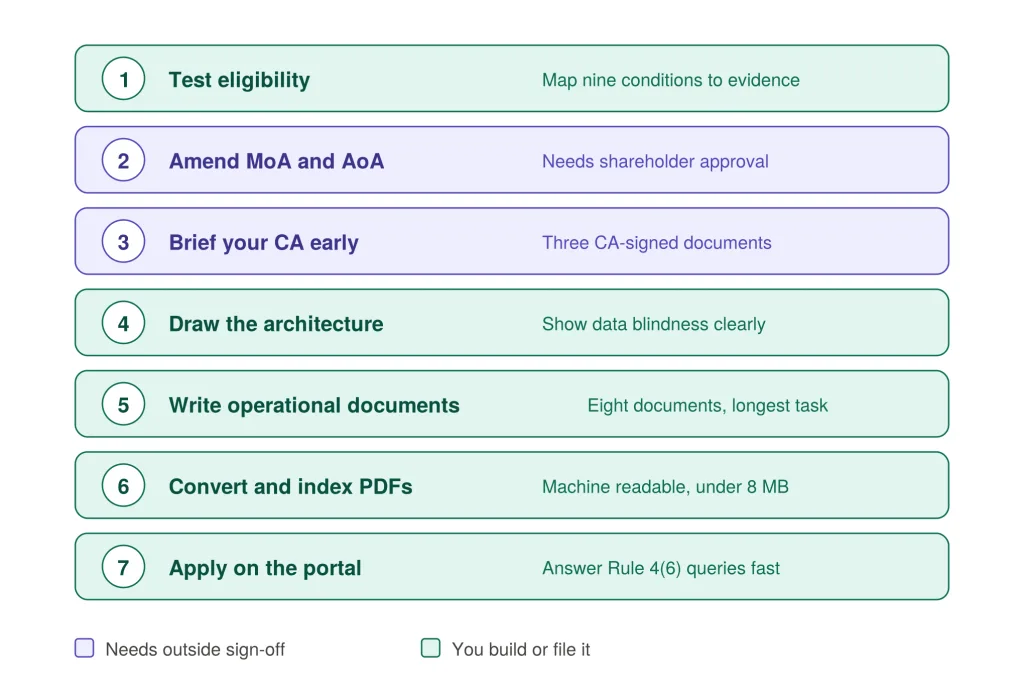
How to prepare, in order
Test eligibility against Part A. Our registration guide maps each of the nine conditions to evidence.
Amend the MoA and AoA first. It needs shareholder approval, and the Board must approve later changes.
Brief your CA early. Three documents need a practising CA’s letterhead and signature.
Draw the architecture. Show data blindness explicitly. One clear diagram helps more than ten paragraphs.
Write the eight operational documents. They take longest. Start with the conflict-of-interest policy and the continuity plan.
Convert everything to PDFs under 8 MB, machine readable, and keep an index.
Use the portal’s apply for registration option, upload the files and answer any Rule 4(6) request for information quickly.
The order matters: the constitutional amendments gate everything else.
The catch: who decides?
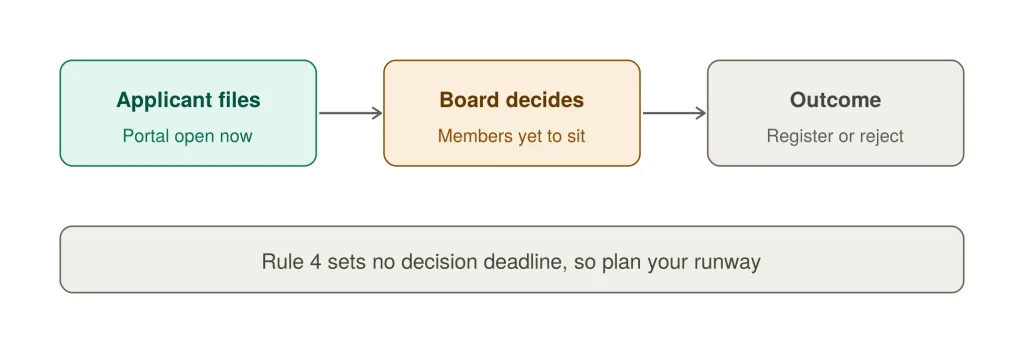
Rule 4 gives the decision to the Board alone. It may inquire, then register the applicant or reject it with reasons. The Board’s four Members have been reported as not yet appointed, and MeitY has only advertised the posts. The government is also reported to have told the Kerala High Court on 7 October that the Board was constituted but not yet functional.
So you can apply today. Whether anyone can approve you today is a different question. Our guide to the Board explains how it works once it sits, and Rule 4 sets no decision deadline. Plan runway accordingly.
Rule 4 and Section 6(9) came into force on 13 November 2026, and the Board has published its 17-document readiness checklist. The portal accepts applications, but whether the Board can decide them is unclear, because its Members are reported as not yet appointed.
Where do I apply for Consent Manager registration?
On the Data Protection Board’s website, dpbi.gov.in. Its readiness page lists the documents. Rule 4(1) says an applicant furnishes the particulars the Board publishes.
What documents are required for Consent Manager registration?
Seventeen mandatory documents: incorporation and constitutional papers, audited accounts, CA turnover and net worth certificates, an architecture overview, eight operational documents and two integrity declarations. Each must be a PDF of up to 8 MB.
What net worth is needed to register as a Consent Manager?
At least ₹2 crore, under Part A of the First Schedule. A note defines it as assets less liabilities in the books, and the Board wants a practising CA’s certificate. Our net worth guide has a worked example.
Is there an application fee or a decision deadline?
The readiness page states neither, and Rule 4 sets no deadline. The ‘fees’ in document 14 sit in the business plan, which describes your own operating model. Check the portal before you budget.
Is independent certification of the platform required?
Yes. Part A item 9 requires independent certification against the Board’s standards, but the readiness checklist has no certification report. Ask the Board how and when it expects to receive it. See our Rule 4 explainer.
Do businesses have to use a Consent Manager?
No. Using one is the individual’s choice under Section 6 of the Act. Businesses keep their own duties, most of which begin on 13 May 2027.
I am a Compliance Manager at RuleExpert, focused on helping organizations navigate the evolving landscape of data protection and privacy regulations in India.
With the introduction of the Digital Personal Data Protection (DPDP) Act, businesses are facing new challenges in managing personal data, ensuring consent, and maintaining compliance across systems. My work revolves around simplifying these complexities and enabling organizations to adopt structured, scalable compliance practices.
I specialize in:
DPDP compliance and privacy frameworks
Data governance and risk management
Consent lifecycle and user rights handling
Compliance automation and operational workflows
At RuleExpert, I work closely with startups, SaaS companies, and enterprises to transform compliance from a manual, documentation-heavy process into an automated, infrastructure-driven system.
I am particularly interested in how AI and automation can reshape privacy operations and help businesses build trust in a data-driven world.
In their words
What compliance teams tell us
“We always thought DPDP compliance was the client’s responsibility
since we were only executing services. The evaluation made it clear that how we handle
client data creates risk on our side too. It changed how we work internally.”
DSFounderDigital services firm
“We had a basic understanding of DPDP requirements, but the scorecard
highlighted gaps we hadn’t identified internally — especially around consent handling
and data visibility. It gave us a much clearer starting point.”
BSFounderB2B SaaS company
“The DPDP score was surprisingly insightful. Within minutes we could see
where we stood and what needed immediate attention. It simplified something that initially
felt quite complex.”
FPProduct HeadFintech platform
“After reviewing our score we opted for a consultation. The discussion was
very practical — we got clear direction on what to fix first and how to approach DPDP
compliance in a structured way.”
LGFounderLogistics company
Real client quotes, attributed by role and sector — we never name a client.
Enquiry
Talk to the team
Your enquiry is with the team
Thank you — we have it. Someone will reply by email, usually within one working day.
Nothing else is needed from you. If it is urgent, email
tushar@ruleexpert.com and it will reach the same
people.
Allowing it lets Google Analytics and Google’s advertising measurement set an
identifier and receive your IP address, the pages you view and how you reached them
— used only to see which pages work and whether a campaign led to an enquiry, never to
build a profile or to decide anything about you. Google processes this outside India, a
cross-border transfer under Section 16. Declining changes nothing about the site, and you
can change your mind any time from the footer.
An analytics identifier is personal data, so the DPDP Act applies to
it — though no Indian cookie statute requires this banner. We ask because we would
rather you chose. What we collect and why
 RuleExpert