Search for a DPDP course and you will find three-day classrooms, three-month programmes, self-paced videos and in-house workshops. All of them call themselves training. They are not interchangeable.
This guide helps you choose. It does not rank providers. Whether any DPDP certificate carries legal weight is a separate question, answered in our guide to DPDP certification in India. Here the question is simpler: what will actually change how your people work?
Quick answer: Choose a DPDP course by matching depth to role, then checking the syllabus against the Act and the Rules, 2025. Leads and DPOs suit multi-day practitioner courses. Operational teams suit short in-house sessions on their own forms and systems. Leadership needs a brief decision-focused session.
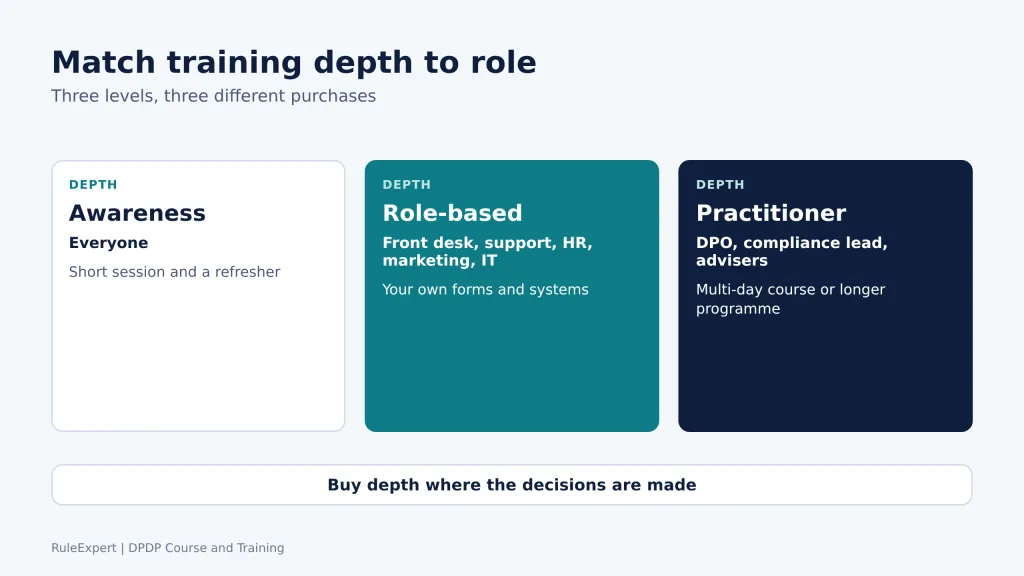
Match depth to role
If you are
Choose
A DPO or compliance lead building the programme
A multi-day practitioner course, or a longer certificate programme
A CA, company secretary or legal adviser
A professional-body course that covers audit and obligations
Front desk, support, HR, marketing or IT
Short in-house sessions using your own forms and systems
Directors and leadership
A brief session on exposure and the decisions only they can make
Everyone else
Short awareness training with a refresher
Buy depth where the decisions are made, and keep the rest short.
The Act does not set a staff-training mandate that we could find. But Rule 6 requires technical and organisational measures that are effectively followed, and people are a common route to a breach. That is the practical case for training. For the role-by-role detail, see our certification guide.
A note on DPOs. Section 10(2)(a) requires a Data Protection Officer, based in India, only for Significant Data Fiduciaries. If that may be you, read our Significant Data Fiduciary guide. If you lack the in-house skills, a DPO as a service option exists, so a course is not the only route. For the wider legal picture, start with our DPDP in India guide and the penalty guide.
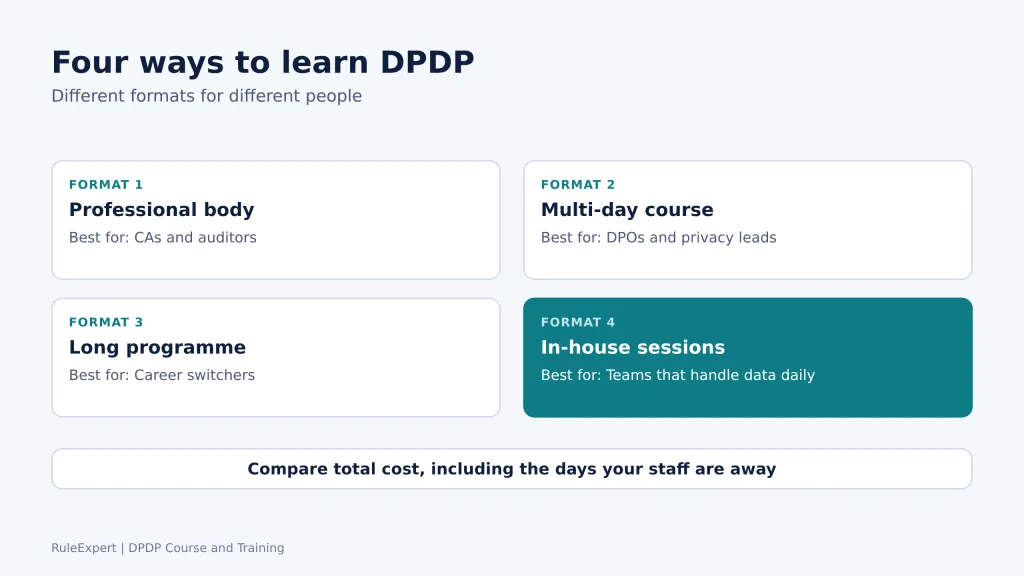
Four ways to learn DPDP
Format
Example we reviewed
Best for
Professional-body certificate course
ICMAI’s DPDP Compliance and Audit course
CAs, cost accountants and auditors
Multi-day practitioner course
BSI’s three-day live online course, DSCI’s three-day DCDPO
DPOs and privacy leads
Long programme
A three-month Zedroit listing with the Electronics and ICT Academy, covering DPDPA and GDPR
We have not evaluated these providers’ quality, and this is not a ranking. Compare total cost too, including the days your staff are away. Most of these courses train one person at a time. Your front desk will not learn your own consent form in a general classroom.
Check the syllabus against the law
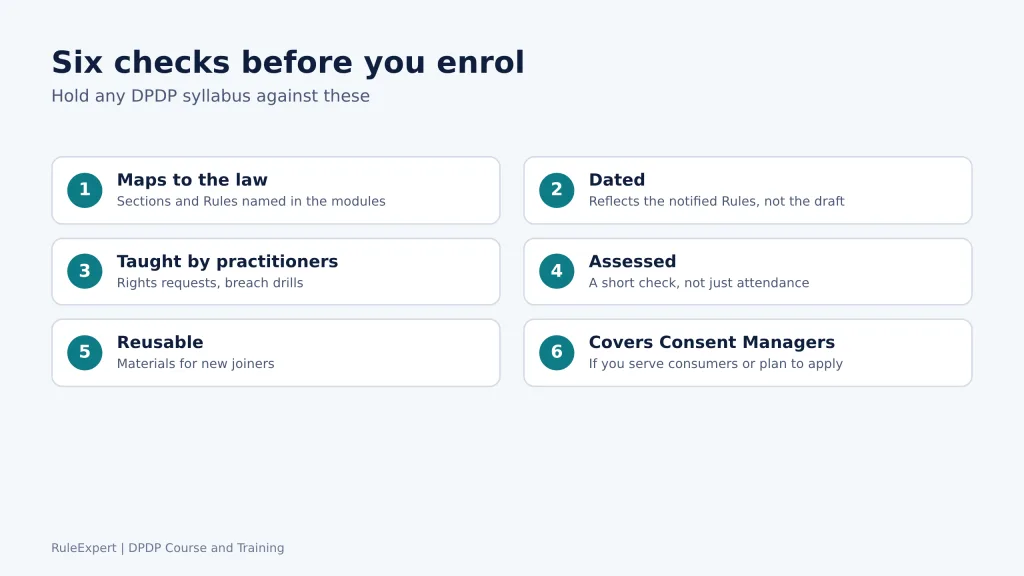
A good syllabus maps to the statute. Ask for the module list and hold it against this.
Topic
Where it sits
Notice and consent, including withdrawal
Sections 5 and 6, Rule 3
Safeguards and breach reporting
Sections 8(5) and 8(6), Rules 6 and 7
Erasure and children’s data
Sections 8(7) and 9
Rights and grievances
Sections 11 to 14, Rule 14
Significant Data Fiduciaries
Section 10, Rule 13
Penalties
Section 33 and the Schedule
Also ask who teaches it. Someone who has run a rights request or a breach drill teaches differently from someone reading slides. A short assessment matters more than a long lecture, and so does getting the materials to reuse.
The date problem
The draft Rules appeared on 3 January 2025. The final Rules were notified on 13 November 2025, and the final version changed when different parts take effect. Anything built before then may teach the draft.
The Zedroit listing above, for instance, shows a July 2024 start, before either version existed. That does not make it poor. It means you should ask how the syllabus was updated. Most Data Fiduciary duties begin on 13 May 2027, so refresh training before then and again when your processes change.
Consent Managers in the syllabus
Most courses teach the Data Fiduciary side. Consent Managers are a different topic: Section 6(7) to (9), Rule 4, and the First Schedule’s conditions for registration. Rule 4 began on 13 November 2026.
Hold any syllabus against these six points before you pay.
RuleExpert’s in-house training
RuleExpert offers role-based DPDP training. We start by finding who touches personal data. Each session uses your own forms and systems, in person or remotely, with a short assessment. You keep the records of who was trained, on what, when and how they scored, plus material for new joiners. Our certificate is private, as our certification guide explains.
No single one. It depends on your role, the depth you need and whether the syllabus reflects the final Rules. Judge by the six checks in this guide, not by a ranking.
Is there a free DPDP course?
Some providers advertise free introductory courses. Judge them on the same checks, especially whether the material reflects the notified Rules.
How long should a DPDP course be?
The listings we reviewed run from three days to three months. Operational staff need short sessions. Leads and DPOs benefit from longer ones.
Is DPDP training mandatory?
We found no staff-training mandate in the Act. Rule 6 does require organisational measures that are effectively followed, which is where training helps.
Does a DPDP certificate course make us compliant?
No. It shows a named person completed a course. Read our certification guide for what carries legal weight.
What is the difference between a DPDP course and DPDP certification?
A course teaches people, and may end in a private certificate. No general certification of a company’s compliance exists under the Act or Rules.
Should we send staff to a course or train in-house?
Both. Send the lead to a practitioner course, and train operational teams in-house on your own forms and systems.
Do we need Consent Manager training?
Only if you plan to apply or serve many consumers. Rule 4 began on 13 November 2026. Check whether the course covers Section 6(7) to (9).
When should we train?
Before 13 May 2027, when most Data Fiduciary duties begin. Refresh when staff, systems or processes change.
Does RuleExpert offer DPDP training?
Yes. It is role-based, uses your own forms and systems, ends with a short assessment, and leaves you with training records. Our certificate is private, not government accreditation.
I am a Compliance Manager at RuleExpert, focused on helping organizations navigate the evolving landscape of data protection and privacy regulations in India.
With the introduction of the Digital Personal Data Protection (DPDP) Act, businesses are facing new challenges in managing personal data, ensuring consent, and maintaining compliance across systems. My work revolves around simplifying these complexities and enabling organizations to adopt structured, scalable compliance practices.
I specialize in:
DPDP compliance and privacy frameworks
Data governance and risk management
Consent lifecycle and user rights handling
Compliance automation and operational workflows
At RuleExpert, I work closely with startups, SaaS companies, and enterprises to transform compliance from a manual, documentation-heavy process into an automated, infrastructure-driven system.
I am particularly interested in how AI and automation can reshape privacy operations and help businesses build trust in a data-driven world.
In their words
What compliance teams tell us
“We always thought DPDP compliance was the client’s responsibility
since we were only executing services. The evaluation made it clear that how we handle
client data creates risk on our side too. It changed how we work internally.”
DSFounderDigital services firm
“We had a basic understanding of DPDP requirements, but the scorecard
highlighted gaps we hadn’t identified internally — especially around consent handling
and data visibility. It gave us a much clearer starting point.”
BSFounderB2B SaaS company
“The DPDP score was surprisingly insightful. Within minutes we could see
where we stood and what needed immediate attention. It simplified something that initially
felt quite complex.”
FPProduct HeadFintech platform
“After reviewing our score we opted for a consultation. The discussion was
very practical — we got clear direction on what to fix first and how to approach DPDP
compliance in a structured way.”
LGFounderLogistics company
Real client quotes, attributed by role and sector — we never name a client.
Enquiry
Talk to the team
Your enquiry is with the team
Thank you — we have it. Someone will reply by email, usually within one working day.
Nothing else is needed from you. If it is urgent, email
tushar@ruleexpert.com and it will reach the same
people.
Allowing it lets Google Analytics and Google’s advertising measurement set an
identifier and receive your IP address, the pages you view and how you reached them
— used only to see which pages work and whether a campaign led to an enquiry, never to
build a profile or to decide anything about you. Google processes this outside India, a
cross-border transfer under Section 16. Declining changes nothing about the site, and you
can change your mind any time from the footer.
An analytics identifier is personal data, so the DPDP Act applies to
it — though no Indian cookie statute requires this banner. We ask because we would
rather you chose. What we collect and why
 RuleExpert