Search for a “DPDP compliance certificate” and the offers arrive quickly: badges, certificates, “DPDP certified” courses. What you will not find is a certificate from the government saying your company complies.
This post separates the certification that really exists in the framework from the private labels. For the wider legal picture, start with our DPDP in India guide. Then decide where your money should go.
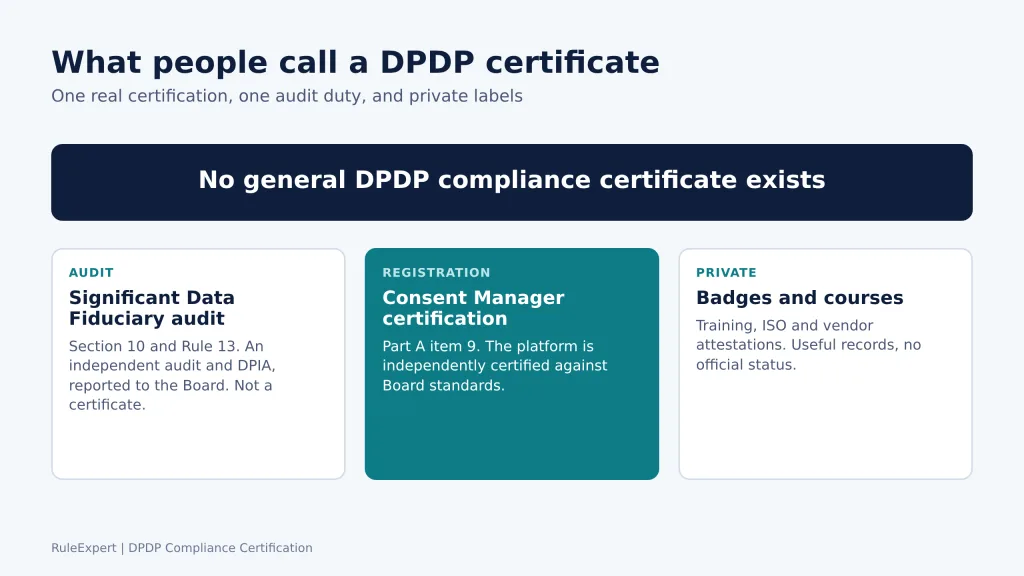
Quick answer: No. The DPDP Act, 2023 and the DPDP Rules, 2025 do not provide a government compliance certificate for Data Fiduciaries, and we found no Board-issued seal or accreditation scheme. The nearest official mechanisms are independent audits for Significant Data Fiduciaries and independent certification of a platform in a Consent Manager’s application. Every other DPDP certificate is private, including RuleExpert’s training certificate, which records trained staff and does not certify a company.
No general DPDP compliance certificate exists. Three look-alikes do.
What the law actually provides
Mechanism
Applies to
Source
A certificate?
Reasonable security safeguards
Every Data Fiduciary
Section 8(5), Rule 6
No. Rule 6 lists minimum measures, including logs kept for a year
Independent data audit and DPIA
Significant Data Fiduciaries
Section 10(2), Rule 13
No. An audit, with a report of significant observations to the Board
Registration with the Board
Consent Managers
Section 6(9), Rule 4
Yes, in part. Part A item 9 asks for independent certification of the platform
Penalties
Every Data Fiduciary
Section 33, Schedule
Ceilings up to ₹250 crore. Mitigation is a factor under Section 33(2)
Section 10 and Rule 13 begin on 13 May 2027, with most other duties. Rule 4 began on 13 November 2026. Our guides to Significant Data Fiduciaries and the penalty process go further.
The one real certification: Consent Managers
Item 9 of Part A of the First Schedule says an applicant must show it is independently certified. First, that its interoperable platform for giving, managing, reviewing and withdrawing consent is consistent with standards the Board may publish. Second, that technical and organisational measures are in place to follow them.
This applies only to applicants. It is a condition of registration, not a badge for ordinary businesses. As far as we have seen, the Board has not published those standards, and the document list on its readiness page carries no certification report. Applicants should ask the Board how and when to submit it.
Training certificates. They show a named person completed a syllabus. Professional bodies offer them too, such as the ICMAI certificate course, whose page makes no claim of Board approval. They certify learners, not companies.
ISO/IEC 27001. An international standard for information security management. It can support your Rule 6 safeguards but does not test notice, consent or rights handling.
Vendor badges. A private attestation. Its worth depends on who issued it and what they tested.
None of these is a defence. The Board sets penalties under Section 33 on the facts of each case.
RuleExpert’s DPDP training and certificate
RuleExpert runs role-based DPDP training and issues a certificate at the end. Let us be precise about that certificate. It is private. Every badge on sale in this market is, ours included, and nothing in the Act makes any of them official.
It can
It cannot
Show a named person was trained on a stated syllabus on a given date
Count as government accreditation or a licence
Serve as a training record, one piece of the mitigation evidence Section 33(2) lets the Board weigh
Act as a Board-recognised qualification
Answer the training question in customer due-diligence forms
Stand as a defence on its own
Show who has not been trained yet
Prove your systems comply
Most breaches start with a person. A rights request does not arrive labelled, and your response clock starts when it lands. A careless “just sign here” at a counter can undo a good notice, since Section 6(1) asks for consent that is free, specific and informed.
Group
Sections
Focus
Front desk
5, 6
How consent is given or spoiled at the counter
Support and call centre
11 to 14
Spotting rights requests inside complaints, and logging them the day they arrive
Why Section 7 gives no basis for marketing, and what makes a purpose new
Engineering and IT
8(5), Rule 6
Safeguards, a year of logs, what counts as a breach
Directors
10, 33
Where exposure sits, and the decisions only leadership can make
The engagement runs in four steps. First, find who touches personal data, usually more people than expected. Second, build a session per group using your own forms and systems. Third, deliver in person or remotely, with a short assessment. Fourth, keep the records of who was trained, on what, when and how they scored, plus material for new joiners. Start with the front desk and support inbox.
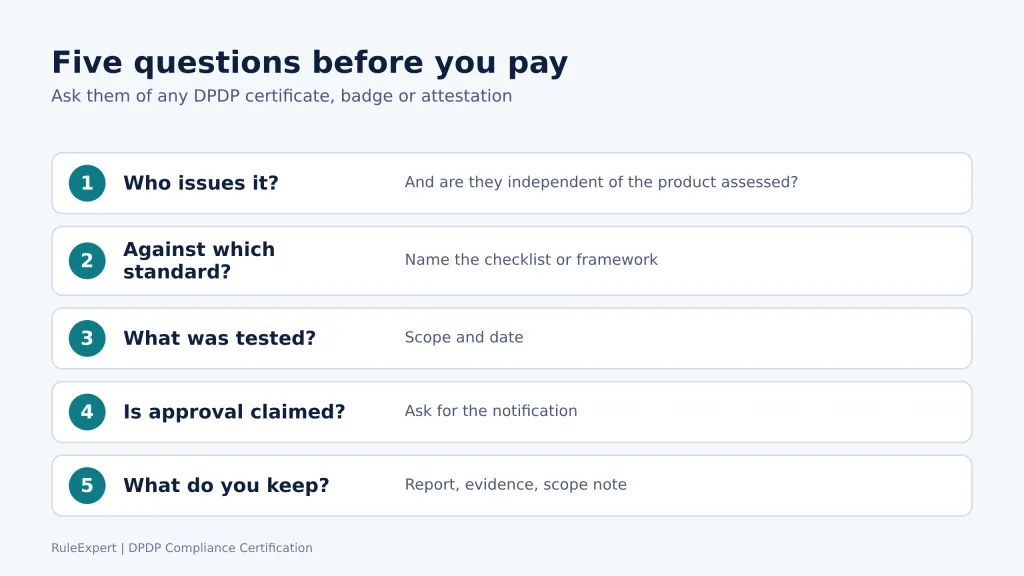
Who issues it, and are they independent of the product they assess?
Against which standard or checklist?
What exactly was tested, and on what date?
Does it claim government or Board approval? If yes, ask for the notification.
What evidence do you keep afterwards?
Any claim of Board approval should come with a notification you can read.
What to keep instead
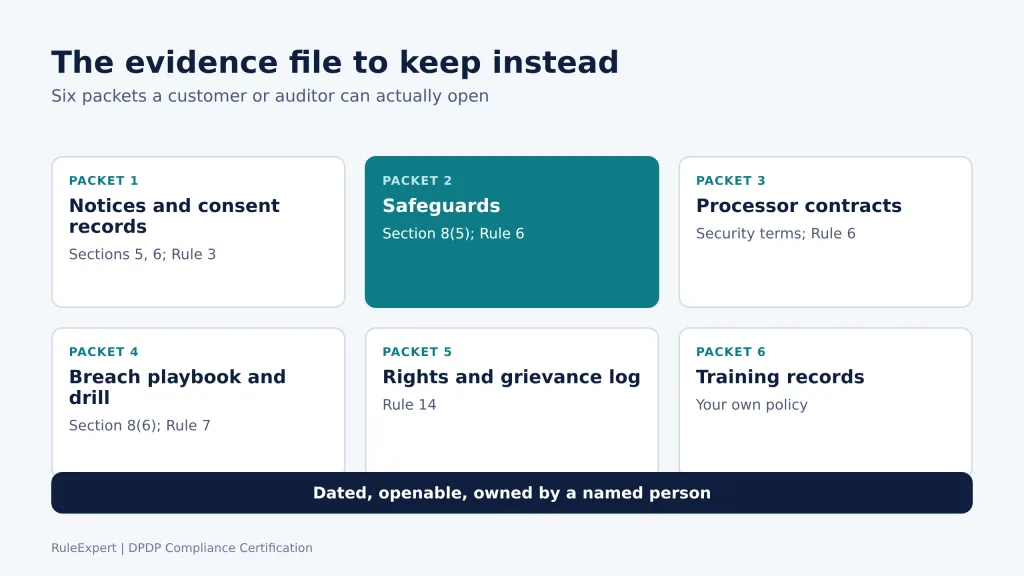
The closest thing to proof is a dated evidence file. It will not shield you, but it shows what you did, and Section 33(2) lists mitigation among the matters the Board weighs.
Evidence
Source
Notices and consent records
Sections 5 and 6, Rule 3
Safeguards: encryption or masking, access control, logs, backups
Section 8(5), Rule 6
Processor contracts with security terms
Rule 6
Breach playbook and drill record
Section 8(6), Rule 7
Rights and grievance log
Rule 14
Training records and scores
Your own policy
Six packets that a customer or auditor can actually open.
Significant Data Fiduciaries should also keep their Rule 13 audit trail and the DPO’s records. Our gap assessment checklist grades each packet.
RuleExpert is not a registered Consent Manager, and nothing here certifies a business as DPDP compliant. Have your plans reviewed by your legal adviser. Read about the Data Protection Board for the regulator’s side.
Frequently asked questions
Is there an official DPDP compliance certificate?
No. The Act and Rules provide no government compliance certificate for Data Fiduciaries, and we found no Board-issued seal. Check dpbi.gov.in for any future scheme.
Which compliance certification is best?
No single one. It depends on what you must prove and to whom. ISO/IEC 27001 suits security management, and role-based credentials suit people. For DPDP, none is required except Consent Manager platform certification.
What are the top 5 cybersecurity certifications?
Lists vary. A TechTarget roundup names CompTIA Security+, ISC2 CISSP, ISC2 CCSP, ISACA CISM and EC-Council CEH. They certify individuals’ skills. None tests DPDP compliance.
How can I get GDPR certified?
There is no general GDPR certificate. Article 42 allows voluntary certification mechanisms, with criteria approved by authorities or the EDPB. Certification does not reduce your GDPR responsibility, and DPDP duties are separate.
What is CDPO certification?
Certified Data Protection Officer is a private credential from several bodies, such as DSCI’s DCDPO. It is not a statutory qualification. Section 10(2)(a) requires a DPO only for Significant Data Fiduciaries.
Are Significant Data Fiduciaries certified?
No. Section 10(2) requires an independent data auditor, and Rule 13 requires an annual DPIA and audit, with significant observations reported to the Board. That is an audit, not a certificate.
Do Consent Managers need certification?
Yes. Part A item 9 of the First Schedule requires independent certification of the platform and supporting measures, against standards the Board may publish.
Does RuleExpert offer a DPDP certificate?
We issue a private training certificate that records who was trained, on what and when. It is not government accreditation and does not certify a company.
What do I show a customer who asks for a certificate?
Share an evidence summary: policies, consent records, safeguards, vendor contracts, drill records and any independent audit or ISO report.
When do the main obligations begin?
Most Data Fiduciary duties begin on 13 May 2027. Rule 4, on Consent Managers, began on 13 November 2026.
I am a Compliance Manager at RuleExpert, focused on helping organizations navigate the evolving landscape of data protection and privacy regulations in India.
With the introduction of the Digital Personal Data Protection (DPDP) Act, businesses are facing new challenges in managing personal data, ensuring consent, and maintaining compliance across systems. My work revolves around simplifying these complexities and enabling organizations to adopt structured, scalable compliance practices.
I specialize in:
DPDP compliance and privacy frameworks
Data governance and risk management
Consent lifecycle and user rights handling
Compliance automation and operational workflows
At RuleExpert, I work closely with startups, SaaS companies, and enterprises to transform compliance from a manual, documentation-heavy process into an automated, infrastructure-driven system.
I am particularly interested in how AI and automation can reshape privacy operations and help businesses build trust in a data-driven world.
In their words
What compliance teams tell us
“We always thought DPDP compliance was the client’s responsibility
since we were only executing services. The evaluation made it clear that how we handle
client data creates risk on our side too. It changed how we work internally.”
DSFounderDigital services firm
“We had a basic understanding of DPDP requirements, but the scorecard
highlighted gaps we hadn’t identified internally — especially around consent handling
and data visibility. It gave us a much clearer starting point.”
BSFounderB2B SaaS company
“The DPDP score was surprisingly insightful. Within minutes we could see
where we stood and what needed immediate attention. It simplified something that initially
felt quite complex.”
FPProduct HeadFintech platform
“After reviewing our score we opted for a consultation. The discussion was
very practical — we got clear direction on what to fix first and how to approach DPDP
compliance in a structured way.”
LGFounderLogistics company
Real client quotes, attributed by role and sector — we never name a client.
Enquiry
Talk to the team
Your enquiry is with the team
Thank you — we have it. Someone will reply by email, usually within one working day.
Nothing else is needed from you. If it is urgent, email
tushar@ruleexpert.com and it will reach the same
people.
Allowing it lets Google Analytics and Google’s advertising measurement set an
identifier and receive your IP address, the pages you view and how you reached them
— used only to see which pages work and whether a campaign led to an enquiry, never to
build a profile or to decide anything about you. Google processes this outside India, a
cross-border transfer under Section 16. Declining changes nothing about the site, and you
can change your mind any time from the footer.
An analytics identifier is personal data, so the DPDP Act applies to
it — though no Indian cookie statute requires this banner. We ask because we would
rather you chose. What we collect and why
 RuleExpert