Count the days from today and May 2027 is a little under six months away. On 13 May 2027 most duties under the DPDP Rules, 2025 begin: notice, consent, security safeguards, breach reporting, erasure, Data Principal rights, children’s data and the penalty provisions.
This is a roadmap for leadership teams that have not started, or started and stalled. For the legal background, read our DPDP in India guide. For evidence-grading, see our gap assessment guide. Here we plan the calendar.
Quick answer: The DPDP compliance deadline for most Data Fiduciaries is 13 May 2027, when Rules 3, 5 to 16, 22 and 23 of the DPDP Rules, 2025 take effect. Rule 4, for Consent Managers, began on 13 November 2026. Work back from May: inventory and owners first, then notices and consent, rights, vendors, breach drills and evidence.
What lands on 13 May 2027
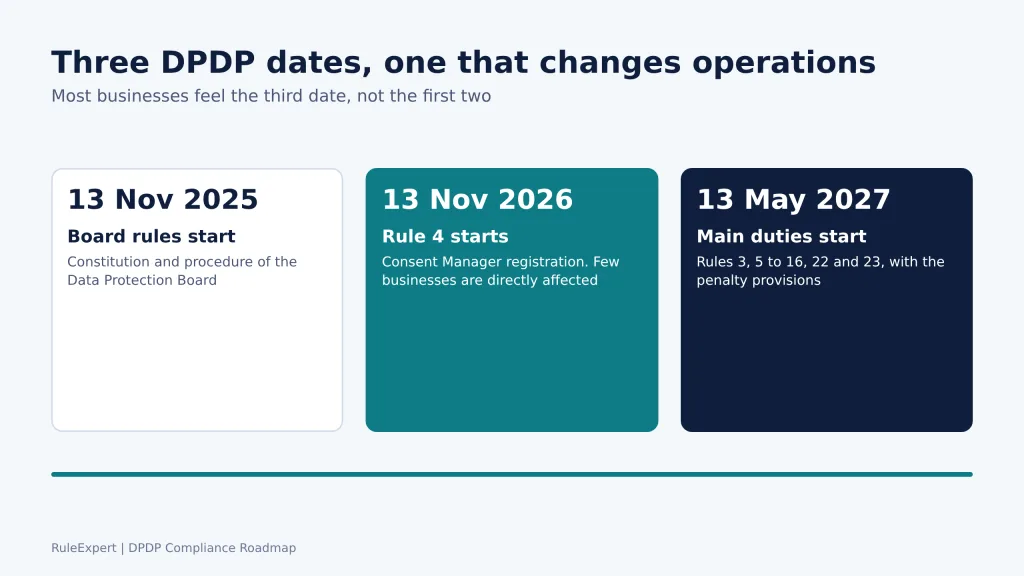
Three dates, but only the last one changes day-to-day operations for most businesses.
Three dates, and only the last changes daily operations for most businesses.
Duty
Where it sits
Itemised notice and valid consent
Sections 5 and 6, Rule 3
Reasonable security safeguards
Section 8(5), Rule 6
Breach intimation to the Board and affected people
Section 8(6), Rule 7
Erasure and retention limits
Section 8(7), Rule 8
Published contact and rights handling
Section 8(9), Rules 9 and 14
Children’s data
Section 9, Rule 10
Significant Data Fiduciary extras
Section 10, Rule 13
Penalties, up to ₹250 crore at the top tier
Section 33 and the Schedule
The penalty structure is explained in our enforcement guide. The Act and the Rules are the authority, so check each reference against them.
A note on ‘DPDP Act 2026’
People search for “DPDP Act 2026” and “DPDP Rules 2026”. Neither is a real title. The Act is the Digital Personal Data Protection Act, 2023, and the Rules were notified in 2025. 2026 matters because that is the year phases begin to bite, and 2027 is when the heavy ones arrive.
Could the date move?
In January 2026 MeitY floated a proposal to shorten the 18-month runway to 12 months. As far as we can find, no amending notification has followed, and changing the date would need an amendment to Rule 1 in the Gazette. The Board also still shows no reported Chairperson or Members, though we have not confirmed that independently.
So plan for 13 May 2027, and front-load the work. A plan that finishes in April survives a date that moves a little. A plan that finishes on 12 May does not.
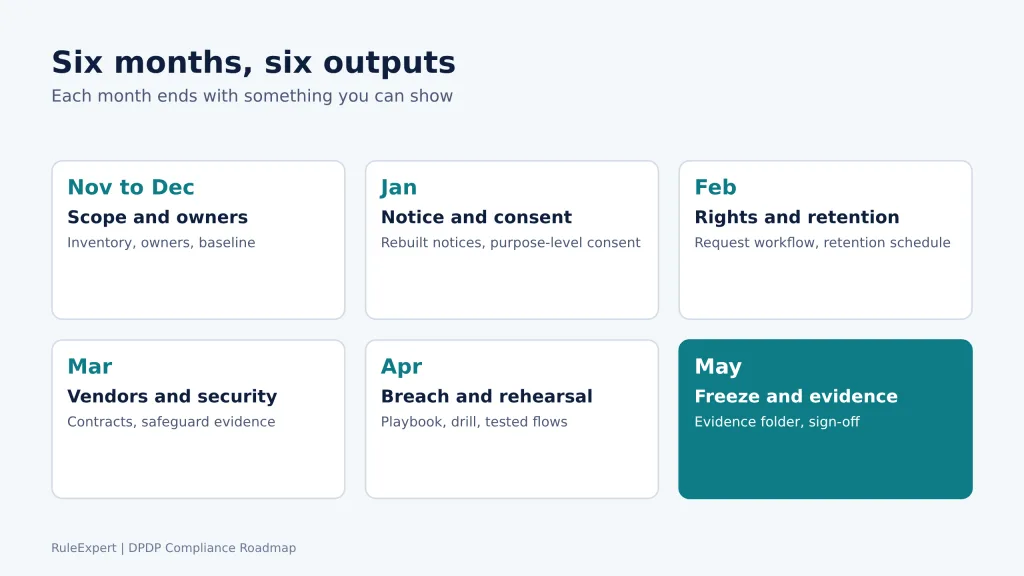
The six-month roadmap
When
Focus
You should end with
Late November to December
Scope and owners
Data inventory, named owners, baseline score
January
Notice and consent
Rebuilt notices, purpose-level consent, a plan for old consents
Breach playbook, a drill, tested withdrawal and rights flows
May, up to the 13th
Freeze and evidence
Evidence folder, board sign-off, monitoring in place
Each month ends with something you can show, not just something you have discussed.
The order matters. Rights handling leans on the inventory, and consent leans on knowing your purposes. Start with a baseline, and our 90-day plan from gap findings shows how to turn results into tasks. Read the gap assessment guide before you commission one.
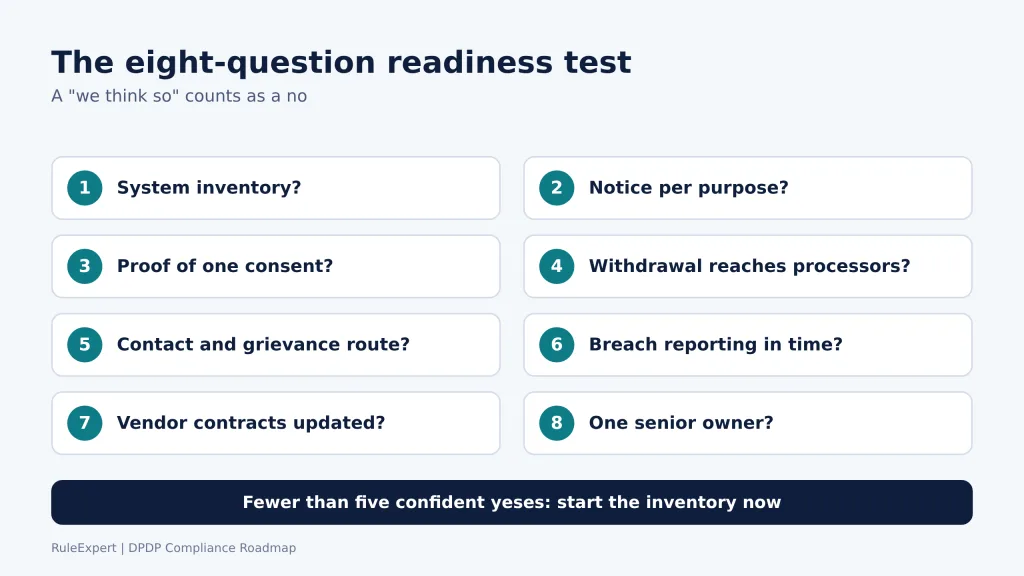
Put these to your leadership team. Be honest. A “we think so” is a no.
Can you list every system that holds personal data?
Does each purpose have a notice that matches it?
Could you prove one customer’s consent today?
Does a withdrawal reach your processors?
Is a contact point and grievance route published?
Could you report a breach to the Board and to affected people in time?
Do vendor contracts carry DPDP duties?
Does one senior person own this and report monthly?
Fewer than five confident yeses means the inventory stage starts immediately.
An illustrative case
This is an illustration, not a client story. A 400-person edtech starts its inventory in December. It finds a retired webinar tool that still holds three years of parents’ phone numbers, with no purpose and no owner.
Under Section 9 that is a children’s-data problem, and under Section 8(7) a retention problem. Fixing it in December costs an afternoon. Finding it in May, during a banner rebuild, costs a week and an awkward board conversation.
Mistakes that cost months
Waiting for the Board. The duties start on a date, not on an appointment.
Buying a tool before the inventory. You cannot configure what you cannot see.
Leaving it to legal alone. Marketing, product and IT own most of the fixes.
Forgetting vendors. Your processors’ lapses are yours to answer for.
No evidence trail. Doing the work and being unable to show it counts for little.
RuleExpert is not a registered Consent Manager, and software does not replace legal advice or management accountability. Book a RuleExpert Demo and we will map this calendar to your own systems. For the regulator’s side, read about the Data Protection Board.
Frequently asked questions
What is the DPDP compliance deadline?
For most Data Fiduciaries it is 13 May 2027, when Rules 3, 5 to 16, 22 and 23 of the DPDP Rules, 2025 take effect. Rule 4 for Consent Managers began on 13 November 2026.
Does the DPDP Act apply to my business?
If you process digital personal data of people in India, generally yes. Exemptions exist, so check the Act. Size alone does not exempt you. Section 17(3) lets the government exempt some classes, including startups, but assume none applies until notified.
Is there a DPDP Act 2026 or DPDP Rules 2026?
No. The Act is from 2023 and the Rules were notified in 2025. People use 2026 and 2027 for the dates when duties begin.
Where should we start?
Start with a data inventory and a named owner, then a baseline score. Everything else depends on knowing what data you hold and why.
Is six months enough?
For many businesses, yes, if work starts now and the inventory is done first. Larger or regulated firms with many systems should expect to be tight.
Could the deadline be brought forward?
MeitY floated a shorter runway in January 2026. We found no notified amendment. Changing it needs a Gazette amendment, so confirm before you plan.
What are the penalties?
Section 33 and the Schedule set ceilings, up to ₹250 crore for failing to take reasonable security safeguards. Amounts depend on the Board’s assessment of each case.
Who should lead the project?
A senior owner, usually the compliance head or DPO, with a sponsor from the board. IT, marketing and product each own their fixes.
Do we need a Consent Manager?
No. A Consent Manager is an intermediary Data Principals may choose to use. You should be ready to receive decisions that come through one.
Can software make us compliant?
It makes the work repeatable and provable. It does not replace legal advice, decisions or accountability, and nothing guarantees compliance.
I am a Compliance Manager at RuleExpert, focused on helping organizations navigate the evolving landscape of data protection and privacy regulations in India.
With the introduction of the Digital Personal Data Protection (DPDP) Act, businesses are facing new challenges in managing personal data, ensuring consent, and maintaining compliance across systems. My work revolves around simplifying these complexities and enabling organizations to adopt structured, scalable compliance practices.
I specialize in:
DPDP compliance and privacy frameworks
Data governance and risk management
Consent lifecycle and user rights handling
Compliance automation and operational workflows
At RuleExpert, I work closely with startups, SaaS companies, and enterprises to transform compliance from a manual, documentation-heavy process into an automated, infrastructure-driven system.
I am particularly interested in how AI and automation can reshape privacy operations and help businesses build trust in a data-driven world.
In their words
What compliance teams tell us
“We always thought DPDP compliance was the client’s responsibility
since we were only executing services. The evaluation made it clear that how we handle
client data creates risk on our side too. It changed how we work internally.”
DSFounderDigital services firm
“We had a basic understanding of DPDP requirements, but the scorecard
highlighted gaps we hadn’t identified internally — especially around consent handling
and data visibility. It gave us a much clearer starting point.”
BSFounderB2B SaaS company
“The DPDP score was surprisingly insightful. Within minutes we could see
where we stood and what needed immediate attention. It simplified something that initially
felt quite complex.”
FPProduct HeadFintech platform
“After reviewing our score we opted for a consultation. The discussion was
very practical — we got clear direction on what to fix first and how to approach DPDP
compliance in a structured way.”
LGFounderLogistics company
Real client quotes, attributed by role and sector — we never name a client.
Enquiry
Talk to the team
Your enquiry is with the team
Thank you — we have it. Someone will reply by email, usually within one working day.
Nothing else is needed from you. If it is urgent, email
tushar@ruleexpert.com and it will reach the same
people.
Allowing it lets Google Analytics and Google’s advertising measurement set an
identifier and receive your IP address, the pages you view and how you reached them
— used only to see which pages work and whether a campaign led to an enquiry, never to
build a profile or to decide anything about you. Google processes this outside India, a
cross-border transfer under Section 16. Declining changes nothing about the site, and you
can change your mind any time from the footer.
An analytics identifier is personal data, so the DPDP Act applies to
it — though no Indian cookie statute requires this banner. We ask because we would
rather you chose. What we collect and why
 RuleExpert