

Think of personal data inside your corporate ecosystem less like oil you own, and more like a rented apartment. You don’t own the space; you just hold a lease under tightly defined conditions shaped by consent lifecycle management. When that lease expires, or when the landlord changes their mind, you pack up and leave.
In India’s rapidly tightening regulatory ecosystem, this dynamic is no longer a theoretical debate. Following the official notification of the Digital Personal Data Protection Rules (DPDP Rules) by the Ministry of Electronics and Information Technology (MeitY), the operational runway for businesses has officially been mapped out.
The transition from high-level policy to enforceable code means that standard compliance mechanisms—like hiding ambiguous legal disclaimers inside an unreadable Terms of Service agreement—will completely fail regulatory scrutiny.
At the absolute center of this structural shift is consent lifecycle management. For platforms handling Indian user data, engineering an end-to-end framework to request, verify, log, and purge user permissions is a clear operational necessity.
Let’s break down exactly how this lifecycle works, the explicit timelines mandated by official gazette notifications, and how automation engines like RuleExpert prevent catastrophic system-level non-compliance.
What Exactly is Consent Lifecycle Management?
Under the unified framework of the DPDP Act and its official Rules, consent is treated as a highly volatile, continuous state—never a static, one-time checkbox event.
Consent Lifecycle Management is the programmatic framework through which a Data Fiduciary (the company determining the purpose and means of data processing) manages an individual’s data permissions.
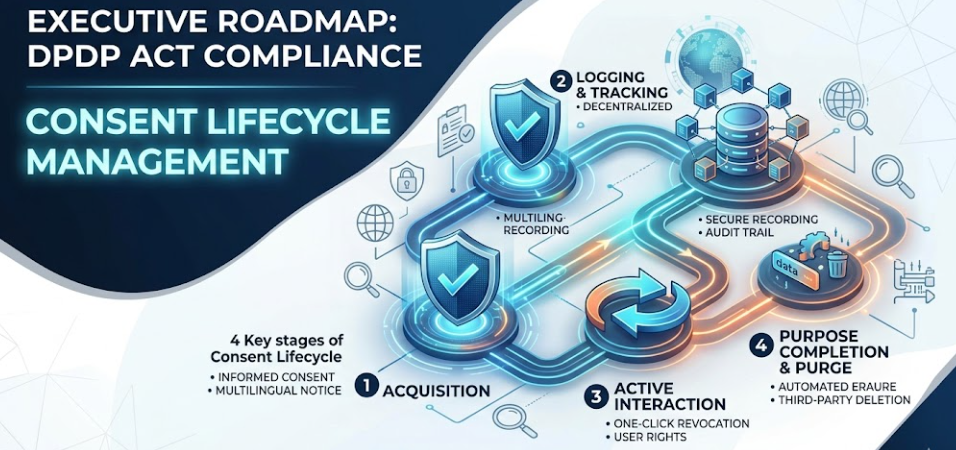
This operational loop monitors every single data touchpoint with a Data Principal (the citizen whose data is being processed) from the millisecond an itemized privacy notice is served, down to the final system-level data erasure.
┌──────────────────────────────────────────────┐
│ 1. ACQUISITION                               │
│ Standalone Notice | 22 Scheduled Languages   │
└──────────────────────┬───────────────────────┘
                       │
                       ▼
┌──────────────────────────────────────────────┐
│ 2. LOGGING & STATE TRACKING                  │
│ Purpose-Linked Tokenization | 1-Year Logs    │
└──────────────────────┬───────────────────────┘
                       │
                       ▼
┌──────────────────────────────────────────────┐
│ 3. ACTIVE INTERACTION & RIGHTS               │
│ One-Click Revocation | 90-Day Grievance Turn │
└──────────────────────┬───────────────────────┘
                       │
                       ▼
┌──────────────────────────────────────────────┐
│ 4. PURPOSE COMPLETION & PURGE                │
│ 48-Hour Platform Warning | Hard Deletion     │
└──────────────────────────────────────────────┘
The scope of this digital mandate leaves no room for bypass protocols.
It strictly applies to:
- All personal data natively captured via digital interfaces (apps, websites, APIs).
- Legacy, offline data assets that are subsequently digitized into corporate databases.
- Data processing operations occurring physically within Indian borders.
- Extraterritorial data processing if your platform profiles users within India or offers them goods and services, regardless of where your servers or headquarters are geographically located.
The Official 3-Stage Enforcement Timeline
A common mistake among enterprise data teams is assuming compliance deadlines are a distant concern. The official MeitY notification outlines a distinct, staggered rollout, making early planning for infrastructure upgrades and consent lifecycle management essential.
Understanding this timeline is vital for mapping your infrastructure investments.
Stage 1: The Activation Phase (Immediate Enforcement)
The regulatory infrastructure is already active. The Data Protection Board of India (DPB) is formally established with its head office located in the National Capital Region (NCR), operating as a digital-first office with complete techno-legal capabilities to review systemic data handling.
Stage 2: The Intermediary Transition (November 14, 2026)
Provisions governing the registration and operational criteria of formal Consent Managers take full effect.
These entities act as data intermediaries, allowing citizens to aggregate, review, and withdraw their permissions across multiple platforms simultaneously.
- Consent Managers must maintain physical offices in India.
- They must fulfill a minimum net worth threshold of ₹2 Crores.
- They must retain structural logs for at least 7 years.
- They cannot directly view or access the personal data passing through their networks.
Stage 3: The Full Compliance Deadline (May 14, 2027)
Every single substantive compliance element becomes legally binding.
This is the ultimate deadline by which all covered businesses must have fully operational systems for:
- Itemized notice delivery.
- Mandatory data breach reporting windows.
- Automated data purging across internal systems and third-party vendors.
Inside the Core Stages of the Consent Lifecycle Management
Successfully managing data under this regime requires translating legal text into system design.
A robust consent lifecycle management infrastructure is broken down into four distinct, logical stages.
1. The Acquisition Phase (Dynamic & Explicit Collection)
The days of pre-ticked checkboxes or implicit “by continuing to browse this site, you agree to our terms” banners are over.
The framework requires that consent be entirely:
- Free
- Specific
- Informed
- Unconditional
- Completely Unambiguous
Mandatory Standalone Notices: You cannot bundle your privacy notice into a generic user agreement. It must be a distinct document that lists the precise items of personal data being collected and the exact, isolated purpose for each item.
The Multilingual Requirement: Your interface must offer notices in clear, plain language, with accessibility options spanning English and any of the 22 scheduled languages of the Indian Constitution.
Specialized Guardrails: For users under the age of 18 or persons with disabilities, platforms must deploy verifiable consent workflows (such as integration with secure identity records or DigiLocker) to validate parental or legal guardian authorization before a single byte of data is processed.
2. The Logging and State Tracking Phase
When a user clicks “Accept”, your database cannot simply flip a basic boolean flag from false to true.
Your system must map the consent event to an itemized audit trail.
[User Session Token]
        │
        ▼
[Associated Notice Version v2.4]
        │
        ▼
[Purpose Restriction: E-Commerce Delivery Only]
If a user grants permission for a delivery driver to see their phone number, your system architecture must programmatically prevent that number from being scraped by an internal marketing or profiling algorithm.
Furthermore, the notified rules establish an explicit data governance baseline:
- Companies must maintain secure records of processing activities (ROPAs).
- Application and access logs must be preserved for a minimum of one year.
3. The Active Interaction and Modification Phase
Data Principals maintain ongoing dominion over their personal information.
A core principle of the ecosystem dictates that withdrawing consent must be just as simple as granting it.
If a user opted into data collection with a single click, your user experience design cannot force them through five pages of settings or support tickets to opt out.
Additionally, your system must seamlessly handle:
- Access requests.
- Data corrections.
- Statutory updates.
- Formal grievances.
If a user registers a formal complaint, the internal grievance infrastructure must track, process, and resolve the issue within a maximum turnaround window of 90 days.
4. The End-of-Life and Data Purge Phase
Data cannot be retained indefinitely under the guise of “potential future utility.” Once the specified operational purpose for which the data was collected has been fulfilled, the lifecycle hits its terminal stage.
For large-scale platforms—such as:
- E-commerce platforms with over 20 million Indian users.
- Online gaming companies with over 5 million users.
- Social media networks exceeding 20 million users.
—stringent data retention rules apply.
These platforms must implement automated systems to delete data once the user account becomes inactive for a rolling three-year window.
Crucially:
- The platform must issue an automated notification to the consumer at least 48 hours prior to the erasure event.
- The Data Fiduciary must also force all downstream third-party Data Processors to securely destroy every existing copy on their respective servers.
Architectural Challenges in Manual Compliance Tracking
Attempting to scale consent lifecycle management processes across legacy microservices or fragmented database layers manually introduces severe operational friction.
Modern digital enterprises face significant implementation bottlenecks:
- Downstream Synchronization Failures: If a user revokes marketing permission on a mobile app frontend, propagating that change instantly to external email tools, analytics vendors, and behavioral profiling engines is extremely complex without automated event pipelines.
- The No-Threshold Breach Trap: Unlike global privacy frameworks like the GDPR, which use a “risk of serious harm” threshold to filter out minor issues, India’s rules mandate that all personal data breaches must be reported.
- The Data Minimization Strain: Engineering teams routinely capture extra telemetry or metadata during sessions “just in case” it becomes useful later. Under the new regime, collecting any data point that lacks an explicit, purpose-linked notice is a direct statutory violation.
How RuleExpert Automates the Consent Journey
To bypass the engineering overhead and human error associated with custom compliance builds, modern enterprises lean heavily on specialized automation software for consent lifecycle management and broader compliance operations.
RuleExpert offers a scalable solution designed to seamlessly orchestrate your end-to-end data governance.
| Functional Area | Manual Approach Risk | The RuleExpert Automation Advantage |
|---|---|---|
| Notice Deployment | Code rewrites for text changes; fragmented translation tracking across 22 regional languages. | Centralized, dynamic consent blocks that update notice text and language options globally via a single API call. |
| Revocation Mapping | Delayed database updates leading to accidental, non-compliant data usage after opt-out. | Real-time event hooks that cascade withdrawal states instantly to internal systems and external data processors. |
| Audit Readiness | Scraping system logs manually across multiple AWS/Azure clouds during a regulatory inquiry. | Continuous generation of immutable, timestamped Records of Processing Activities (ROPAs) that are permanently audit-ready. |
| Vendor Governance | Relying on unverified contractual clauses without knowing if vendors actually deleted user data. | Automated workflows that track data vendor interactions and trigger mandatory deletion verifications upon purpose completion. |
By offloading the structural complexities of consent lifecycle management to RuleExpert, your engineering teams can remain focused on building features, while your legal and data governance departments rest assured that your pipelines are anchored securely to official frameworks.
The True Cost of Infrastructure Failures
Treating data governance as a secondary priority carries massive financial and operational risks.
The statutory penalty architecture under the DPDP framework is designed to punish systemic negligence severely:
- Failure to Implement Reasonable Security Safeguards: Fines reaching up to ₹250 Crores.
- Failure to Notify the Board or Users of a Breach: Fines up to ₹200 Crores.
- Violations Involving Children’s or PwD Data: Penalties up to ₹150 Crores.
- General Fiduciary Non-Compliance: Discretionary fines scaling up to ₹50 Crores.
Building Long-Term Enterprise Value
Ultimately, transitioning your technology stack to an automated consent lifecycle management posture is more than just a defensive maneuver to avoid severe regulatory penalties.
In India’s maturing digital economy, sophisticated data privacy and effective consent lifecycle management have become major drivers of brand value and market differentiation.
Consumers actively align themselves with platforms that demonstrate clear transparency and robust consent lifecycle management practices, while enterprise B2B buyers routinely disqualify vendors that cannot provide verifiable, automated compliance trails.
By implementing a clear, purpose-driven approach to data architecture and consent lifecycle management today, you eliminate long-term legal liabilities and build a resilient foundation of customer trust that scales with your business.
Take the Next Step
The countdown to full, mandatory enforcement is already running.
Protect your market share, streamline your backend data tracking, and ensure your systems are fully compliant by scheduling an architecture review and launching your automated compliance roadmap with RuleExpert today.
Nitin Ray is a Compliance Manager at RuleExpert with expertise in DPDP compliance, data privacy, consent management, and governance. He helps organizations implement practical compliance frameworks and automation strategies to meet the requirements of India’s Digital Personal Data Protection Act, 2023.