

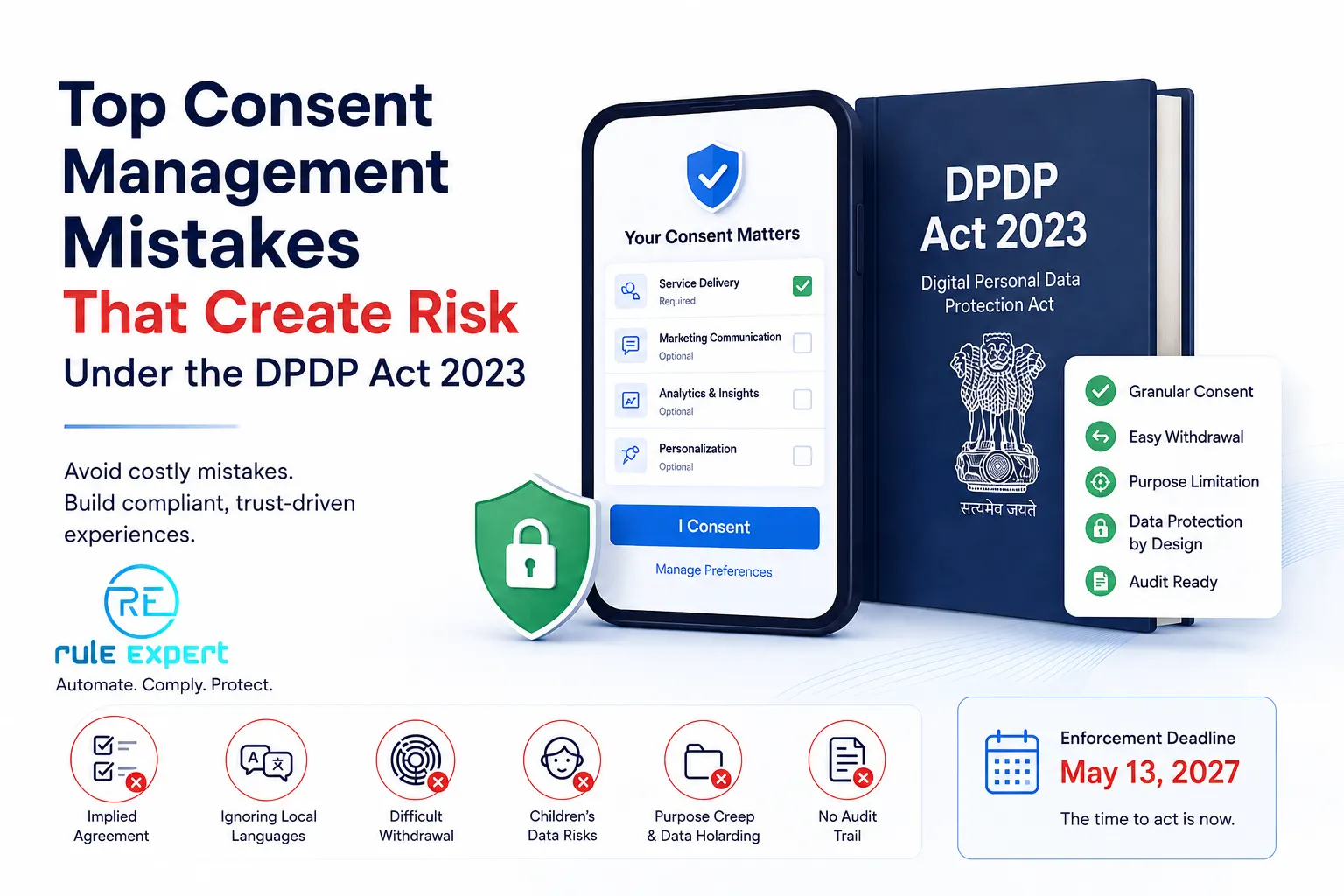
The regulatory grace period is officially evaporating, and organizations making consent management mistakes are rapidly running out of time to course-correct. With the Ministry of Electronics and Information Technology (MeitY) firmly establishing the Digital Personal Data Protection Rules in late 2025, the countdown to the hard enforcement deadline of May 13, 2027, has triggered a massive scramble in boardrooms across India.
Summery
The most common DPDP compliance risks stem from poor consent management, including implied consent, inadequate consent withdrawal mechanisms, children’s data violations, purpose creep, and missing audit trails. Organizations can reduce regulatory exposure by implementing transparent, verifiable, and automated consent management processes.
Yet, despite the very real threat of ₹250 crore penalties, countless organizations are still clinging to obsolete, aggressive data collection tactics. These foundational consent management mistakes aren’t just minor administrative hiccups; they are gaping legal liabilities that completely undermine the core mandate of the Digital Personal Data Protection Act. If your business still assumes a pre-checked terms-of-service box gives you a free pass to harvest and monetize user data, you are already walking straight into a regulatory trap.
The era of passive data hoarding is over. Today, we are tearing down the most dangerous compliance failures businesses make, highlighting how consent management mistakes contribute to growing regulatory risks, exploring the strict realities of the newly finalized rules, and demonstrating how modern automation actually solves the problem.
The Ticking Clock: What the DPDP Rules 2025 Actually Mean
Before dissecting where companies go wrong, you have to understand the playing field. For years, India operated without a unified data privacy framework. That changed with the DPDP Act 2023, but the actual teeth of the law were bared when the government notified the comprehensive rules in November 2025, exposing a wave of consent management mistakes across industries.
The enforcement is happening in phases. While obligations surrounding independent Consent Managers kick in by November 2026, the absolute, non-negotiable deadline for substantive compliance by any Data Fiduciary—that’s you, the entity deciding how and why data is processed—is May 2027.
The law introduces an incredibly strict dynamic between you and the Data Principal (the individual whose data you hold). If you leverage a Data Processor (a third-party vendor or cloud provider) to crunch your numbers, the liability still rests on your shoulders. You cannot outsource accountability. Every time personal data flows through your ecosystem, it must be backed by an airtight, provable legal basis, or risk becoming one of the many consent management mistakes now under regulatory scrutiny.
Common Consent Management Mistakes
When businesses fail to adapt to this reality, they invariably commit the following critical errors.
Mistake 1: The Illusion of “Implied” Agreement
Under legacy privacy frameworks, growth teams loved bundling permissions. The logic was simple: If they want to use our app, they have to agree to let us track their location, read their contacts, and profile their browsing habits.
The DPDP Act 2023 obliterates this dark pattern.
Consent must now be granular, free, specific, informed, and—crucially—unambiguous. Relying on pre-ticked boxes or assuming that a user’s silence equates to permission is dead. Making consent management mistakes like bundling an aggressive marketing opt-in with essential service delivery will trigger immediate regulatory scrutiny.
Think about it logically. If a customer wants to purchase a t-shirt from your e-commerce store, you obviously need their shipping address. You absolutely do not need their real-time GPS location. Forcing them to surrender that location data just to complete the checkout process violates the requirement that consent be unconditional and stands as one of the most common consent management mistakes companies continue to make.
Mistake 2: Ignoring the Linguistic Reality of India
Here is where companies experience immense operational friction. The newly notified rules explicitly require you to offer your privacy and consent notices in English and all 22 languages specified in the Eighth Schedule of the Indian Constitution.
India is not a monolith. A massive chunk of the booming digital economy operates entirely outside the English-speaking demographic. Serving a dense, legalese-heavy privacy policy exclusively in English to a user navigating your app in rural Maharashtra or Tamil Nadu is a textbook violation of the law and one of the most overlooked consent management mistakes companies continue to make.
These types of consent management mistakes signal to the Data Protection Board of India that a company isn’t actually trying to inform the user; they are merely trying to cover their own legal liabilities with an incomprehensible wall of text. An itemized notice must be readable, accessible, and natively localized. If your users cannot understand what they are agreeing to, the consent is legally void.
Mistake 3: The “Hotel California” Withdrawal Trap
We see this everywhere. A business makes opting in as effortless as breathing—a single, shiny green button. But what happens when the user wants to opt out? Suddenly, they have to navigate a labyrinth of nested sub-menus, send a physical email to a neglected support inbox, or call a helpline that inexplicably disconnects. These manipulative tactics are not just frustrating user experiences; they are classic consent management mistakes designed to discourage withdrawal of consent and undermine genuine user choice.
It’s easy to check in, but impossible to leave.
The Digital Personal Data Protection Act explicitly mandates that withdrawing consent must be just as easy as giving it. Friction is no longer just bad UX; it is a punishable offense. Furthermore, once that withdrawal happens, the Data Fiduciary and any associated Data Processor must immediately halt processing and initiate data erasure. Failing to operationalize this process properly is among the most dangerous consent management mistakes organizations face today.
Structuring highly asymmetric consent workflows is one of those consent management mistakes that infuriate consumers and regulators alike. The rules demand a fully functional grievance redressal mechanism that resolves issues within a strict 90-day window. Deliberately stalling a user’s right to exit is a guaranteed way to invite an audit.
Mistake 4: Dropping the Ball on Children’s Data
Children’s data is the undisputed third rail of the Digital Personal Data Protection Act. Mishandle it, and you risk the most severe penalties the law allows—up to ₹200 crores.
The framework lays out incredibly stringent mechanisms for processing the personal data of individuals under 18 years of age. You simply cannot use your standard, generalized workflows for this demographic. The law requires verifiable parental consent before a single byte of a minor’s data is processed.
More alarmingly for ad-tech platforms, the law strictly prohibits behavioral monitoring, tracking, or targeted advertising directed at children. Are your systems actively verifying age? Are you inadvertently feeding data from minors into your programmatic advertising algorithms? Ignoring robust age-gating infrastructure ranks among the most financially catastrophic consent management mistakes a corporate entity can make today. Ignorance of the user’s age is not a valid defense.
Mistake 5: Purpose Creep and Data Hoarding
Historically, data was treated like a zero-cost insurance policy. Companies hoarded it indefinitely, assuming it might become useful a decade down the line.
This directly violates the fundamental principle of purpose limitation. If you ask a Data Principal for their mobile number exclusively to send a one-time password (OTP) for account verification, you cannot legally funnel that same number into an aggressive promotional SMS campaign six months later without asking again.
Purpose creep happens quietly. A new product manager decides to run a highly advanced machine-learning analytics tool on an archival database, completely ignoring the original, narrow context under which that Personal Data was collected years ago. Every single time data crosses the boundary of its originally stated purpose without fresh, explicit approval, it constitutes a breach and reinforces a pattern of systemic consent management mistakes.
Collecting data “just in case” is a toxic habit that organizations must break immediately.
Mistake 6: Operating Without an Immutable Audit Trail
Let’s play out a highly probable scenario. A user files a formal complaint with the Data Protection Board of India, vehemently claiming they never gave your company permission to share their financial footprint with third-party brokers.
The Board knocks on your digital door and demands proof.
If your response involves a frantic, panicked search through scattered SQL databases, fragmented CRM logs, and disjointed marketing spreadsheets, you have already lost the case. Under the DPDP Act 2023, the burden of proof lies solely and entirely on the Data Fiduciary.
You must be able to instantly generate a time-stamped, cryptographic record showing exactly when the user clicked ‘agree.’ You need to prove exactly what itemized notice was displayed to them on their specific device at that exact second, and what specific version of your privacy policy was active at the time. Without this audit trail, even minor consent management mistakes can become impossible to defend legally.
Failing to maintain this level of evidentiary standard is the silent killer among consent management mistakes. If you cannot mathematically prove that you obtained lawful consent, the government will assume you didn’t.
The Crushing Cost of Getting It Wrong
Make no mistake: the financial penalties designed by the DPDP Act are meant to cripple bad actors.
The Data Protection Board of India does not issue polite warnings for systemic failures. The schedule sets terrifying upper limits. You are looking at fines of up to ₹250 crore for failing to implement reasonable security safeguards. If you are caught processing data without valid consent, failing to notify the authorities of a breach within the mandated 72-hour window, or violating the protections around children’s data, the penalties reach up to ₹200 crore—often stemming from avoidable consent management mistakes.
These are not flat fees; they are ceilings. The Board evaluates the gravity, duration, and nature of the breach before dropping the hammer. But honestly? The regulatory fines might be the least of your worries. B2B enterprise contracts now routinely demand comprehensive DPDP compliance before a single vendor agreement is signed. If you cannot prove your data pipelines are clean, you will bleed enterprise clients.
Fixing the Architecture with RuleExpert Automation
How do you actually fix this sprawling mess without hiring an army of compliance officers and stalling your product roadmap? You stop treating privacy as a legal problem and start treating it as an engineering challenge.
Manual compliance is a myth. To survive the post-2025 regulatory landscape, organizations are aggressively pivoting to purpose-built infrastructure. As a premier DPDP Act automation platform, RuleExpert doesn’t just bolt a flimsy cookie banner onto your website; it fundamentally rewrites how data flows and is governed throughout your entire digital ecosystem, eliminating human error and reducing costly consent management mistakes.
Here is how modern automation directly neutralizes regulatory risk:
- Dynamic Multilingual Rendering: Stop worrying about the 22-language mandate. RuleExpert automatically detects user preferences and dynamically generates legally binding, plain-language consent notices natively, ensuring absolute clarity and preventing linguistic compliance failures.
- Granular, Immutable Consent Ledgers: Replace your risky, bundled agreements with specific, itemized opt-ins. Every action is recorded in a centralized, audit-ready ledger. If the Data Protection Board comes knocking, you can export a cryptographic proof of consent in seconds, not weeks.
- Frictionless Lifecycle Management: RuleExpert deploys intuitive, user-facing privacy dashboards. This allows Data Principals to review their data, request corrections, or withdraw their consent with a single click—fully automating the backend erasure process across all your integrated Data Processors and preventing the dreaded 90-day grievance bottleneck.
- Purpose-Bound Data Tagging: By attaching strict contextual tags to data the moment it is collected, the system physically prevents unauthorized internal teams from utilizing data for unapproved marketing campaigns, utterly neutralizing the risk of purpose creep.
- Verifiable Parental Workflows: Deploy structured, age-gated verification funnels that cleanly separate the personal data of minors from adult users, ensuring zero behavioral tracking occurs where it shouldn’t.
The Bottom Line
The DPDP Act 2023 represents a brutal paradigm shift in Indian corporate governance. The days of acting first and apologizing later are over.
Continuing to make legacy consent management mistakes is no longer just an operational quirk; it is a direct, existential threat to your organizational stability, your profit margins, and your hard-earned customer trust. The May 2027 enforcement deadline might seem distant, but retrofitting years of tangled data architecture takes time.
Aligning with the Digital Personal Data Protection Act requires replacing manual, fragmented guesswork with verifiable, automated systems. Stop gambling with your user’s privacy and your company’s future. Modernize your data pipelines, integrate robust automation with tools like RuleExpert, and transform compliance from a legal liability into a distinct competitive advantage.
Nitin Ray is a Compliance Manager at RuleExpert with expertise in DPDP compliance, data privacy, consent management, and governance. He helps organizations implement practical compliance frameworks and automation strategies to meet the requirements of India’s Digital Personal Data Protection Act, 2023.